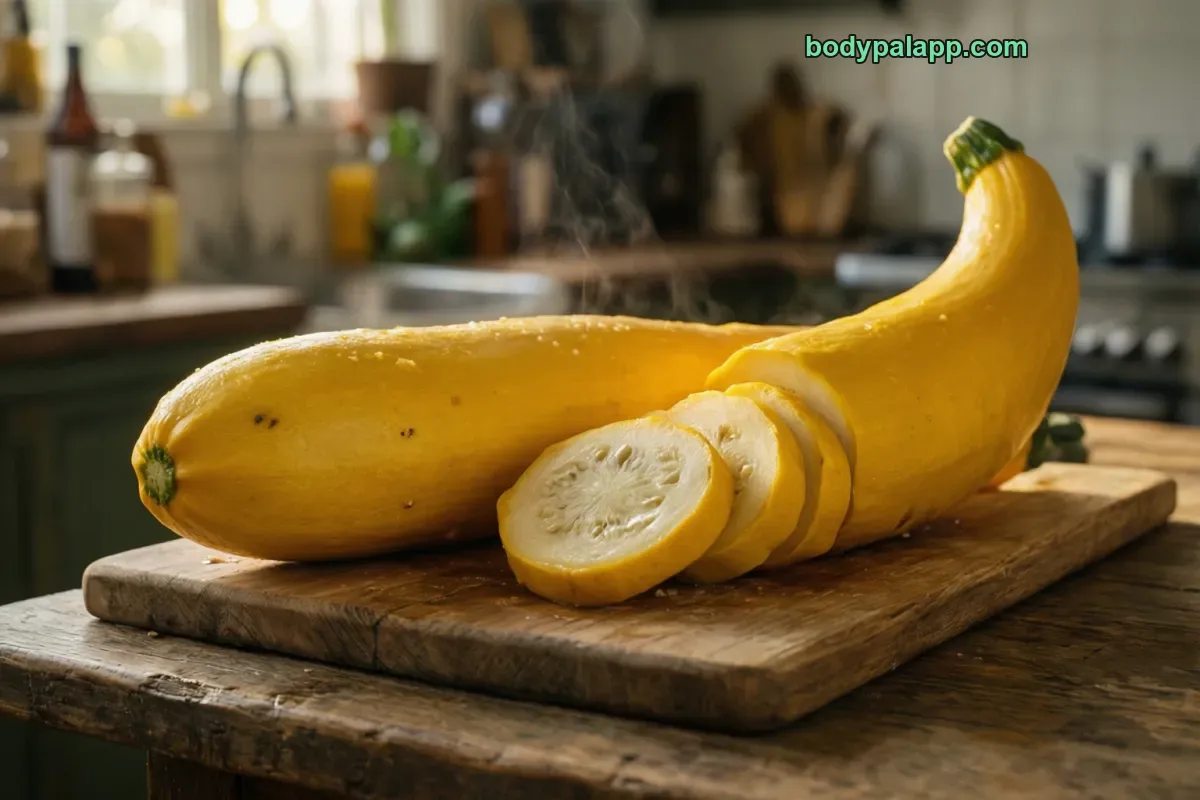
Yellow squash calories come to 42 for one medium squash (200 g) and 21 per 100 g, cooked with no added fat. What stands out is how little the squash itself contributes: cooking it with butter pushes a 185 g serving to 81, and sodium at 142 mg per 100 g is the row that climbs as portions grow.
42kcal
1 medium squash · 200 g, cooked, no added fat
21%protein
2.6 gProtein
8 gCarbs
0.7 gFat
How to burn off 42 kcal
—Walking, brisk
—Jogging
—Cycling, moderate
—Swimming
Skip the math. BodyPal counts these calories from your steps and workouts automatically.
Nutrition facts
Cooked, no added fat · per 200 g
Calories
42 kcal
Protein
2.6 g
Carbohydrate
8.2 g
Fat
0.7 g
Saturated fat
0.2 g
Cholesterol
0 mg
Sodium
284 mg
Potassium
566 mg
Iron
1 mg
Source: USDA FoodData Central
🛡️
Verified nutrition data
Numbers on this page come from USDA FoodData Central, the U.S. Department of Agriculture’s food composition database, and from manufacturer labels where a branded product is named. Last verified September 2026. How we verify our data →
Yellow squash: calories, protein and sodium by serving
Percent of daily value uses the FDA reference of 2,000 kcal a day.
Serving
kcal
Protein
Carbs
Fat
Sodium
% DV kcal
1 medium (200 g)
42
2.6 g
8.2 g
0.7 g
284 mg
2%
1 cup sliced (180 g)
38
2.3 g
7.4 g
0.6 g
256 mg
2%
Cooked with butter (185 g)
81
2.4 g
7.4 g
5.4 g
292 mg
4%
100 g
21
1.3 g
4.1 g
0.4 g
142 mg
1%
3 × 1 medium (200 g)
126
7.8 g
852 mg
5 × 1 medium (200 g)
210
13 g
1,420 mg
One medium squash is a 42-calorie side
A medium yellow squash, about 200 g cooked, lands at 42 calories, which is 2% of the daily calorie value. It brings 2.6 g protein, 8.2 g carbs and 0.7 g fat, plus 2.4 g fiber. Few side dishes give you that much food on the plate for so little.
Slice it and the math barely changes. A cup of sliced squash (180 g) is 38 calories with 7.4 g carbs and 2.2 g fiber, a handy unit to log if you measure after cooking. Weighed by the 100 g, it is 21 calories, so a kitchen scale makes tracking almost effortless.
Scaling up stays gentle. Two medium squash total 84 calories, three reach 126, and even five, a full 1,000 g of vegetable, add up to only 210. Protein grows alongside, from 5.2 g for two to 13 g for five, but squash is never going to be the protein anchor of a meal. Its job is volume, and it does that job cheaply.
Carbs supply two thirds of the calories
Of the energy in yellow squash, 66% comes from carbs, 21% from protein and 13% from fat. Those shares sound balanced until you look at the grams: per 100 g there are 4.1 g carbs, 1.3 g protein and only 0.4 g fat. The percentages are big slices of a very small pie.
The carbs split into 3.2 g sugars and 1.2 g fiber per 100 g. Scale that to a medium squash and you get 6.3 g sugars and 2.4 g fiber, so the carb count stays modest and a real part of it is fiber. If you count carbs closely, squash is one of the easier vegetables to fit in.
Protein looks respectable at 21% of calories, yet a medium squash delivers 2.6 g, about 5% of the daily value. Treat squash as texture and bulk on the plate, and get your protein from whatever you serve beside it. Potassium is a small bonus at 283 mg per 100 g, and cholesterol is 0 mg.
Sodium is the row to watch
For a vegetable this light, the sodium line is surprisingly loud. The USDA cooked entry lists 142 mg per 100 g, so a medium squash carries 284 mg, 12% of the daily value, while its calories sit at only 2%. That gap is the single most useful thing to notice on this page.
A cup of sliced squash has 256 mg (11%), and the buttered version reaches 292 mg (13%). Larger portions add up fast: three medium squash bring 852 mg, and five reach 1,420 mg, more than half the daily sodium value on a plate that barely registers in calories.
The figure reflects how USDA prepared its cooked squash, so your own pan may land lower or higher depending on how you season. If you watch sodium, lean on herbs, lemon, garlic or pepper, and check the running total when squash is a big part of the meal rather than a side.
Butter nearly doubles the side
Plain cooked squash and buttered squash are different foods on paper. The USDA row for squash cooked with butter gives 81 calories for 185 g, against 38 for a 180 g cup with no added fat. Fat jumps from 0.6 g to 5.4 g, and the share of your daily calorie value moves from 2% to 4%.
That is still a small side, but now the butter supplies more of the calories than the squash does. If you want the lowest number, steam, grill or roast with a light hand on the fat and let the mild, slightly sweet flavor carry the dish. A squeeze of lemon does more for it than a second spoon of butter.
Because it is so low in calories, yellow squash works well as a plate stretcher. Pair it with a protein such as chicken, fish, eggs or beans and a grain or potato, and the squash adds volume and fiber without moving the total much. BodyPal can log it from a photo, which helps when the butter or oil is hard to eyeball.
How does yellow squash compare?
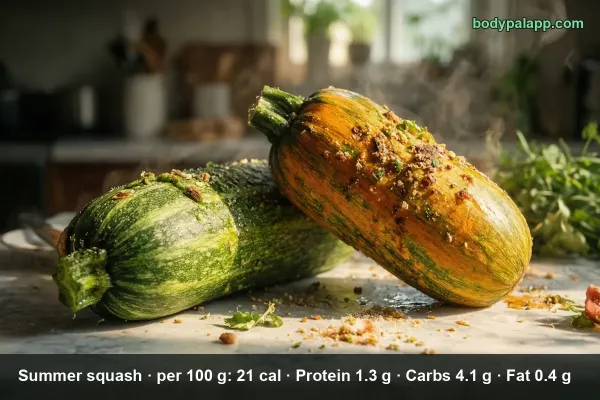
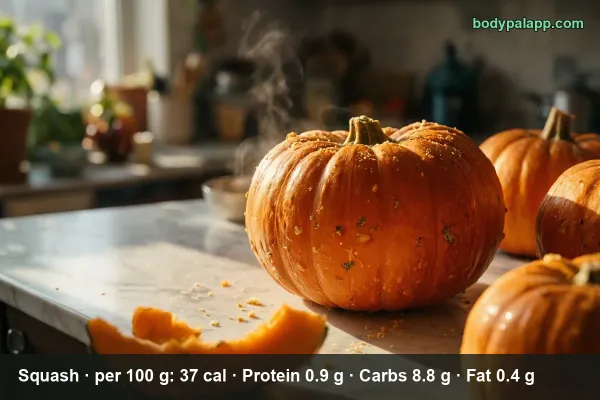
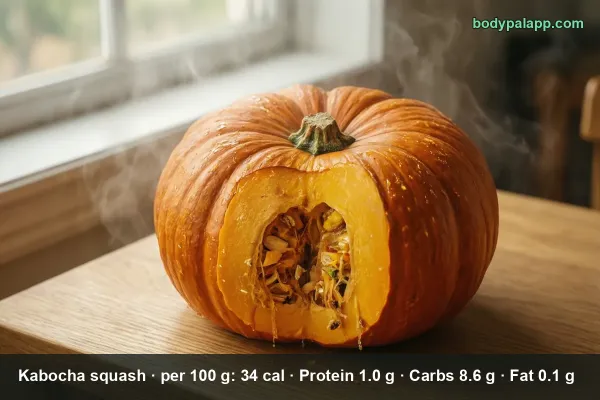
Here is yellow squash next to summer squash, generic squash and kabocha squash, compared per 100 g and per usual serving.
Verdict: For the fewest calories pick yellow or summer squash, which match exactly at 21 per 100 g, while generic squash runs 37 and kabocha 34. If sodium is your concern, kabocha wins easily with 4 mg per 100 g against 142 for the cooked summer types.
Most popular yellow squash brands in the United States
7Save Mart Yellow Squash & Zucchini1 cup · 85 g18 kcal
Fresh and spiralized packs are labeled per raw weight, so they read a little lower than the cooked numbers above. Source: manufacturer labels / USDA FoodData Central.
Yellow squash FAQs
How many calories are in one yellow squash?
A medium yellow squash (200 g) is about 42 calories cooked with no added fat. One cup of sliced squash (180 g) is 38 calories.
Is yellow squash good for weight loss?
Cooked yellow squash is 21 calories per 100 g with 1.2 g of fiber, so a full cup of slices adds only 38 calories. Cooking it with butter raises it to 44 calories per 100 g.
Yellow squash vs kabocha squash: which has fewer calories?
Yellow squash is lower, at 21 calories per 100 g cooked against 34 calories per 100 g for kabocha squash.
How many carbs are in yellow squash?
100 g of cooked yellow squash has 4.1 g of carbs, including 3.2 g sugars and 1.2 g fiber. A medium squash (200 g) has 8.2 g of carbs and 2.6 g of protein.
How many calories are in a cup of yellow squash?
A cup of sliced yellow squash (180 g), cooked without added fat, has 38 calories. It also brings 7.4 g carbs, 2.2 g fiber, 2.3 g protein and 0.6 g fat, so it is one of the lightest cups you can add to a plate.
What are the nutrition facts for yellow squash per 100 g?
Per 100 g, cooked yellow squash has 21 calories, 1.3 g protein, 4.1 g carbs, 0.4 g fat, 1.2 g fiber and 3.2 g sugars. Sodium is 142 mg, potassium is 283 mg, and cholesterol is 0 mg.
How many calories does cooked yellow squash have with butter?
Cooked with butter, a 185 g serving of yellow squash has 81 calories and 5.4 g fat. Cooked with no added fat, it drops to 21 calories per 100 g, so the butter, not the squash, decides the total.
How many calories are in squash in general?
Generic squash averages 37 calories per 100 g, compared with 21 for yellow squash. Kabocha squash sits at 34 per 100 g, so the soft summer types are the lightest pick if calories are your main concern.