
How Many Calories Are in Bok Choy?
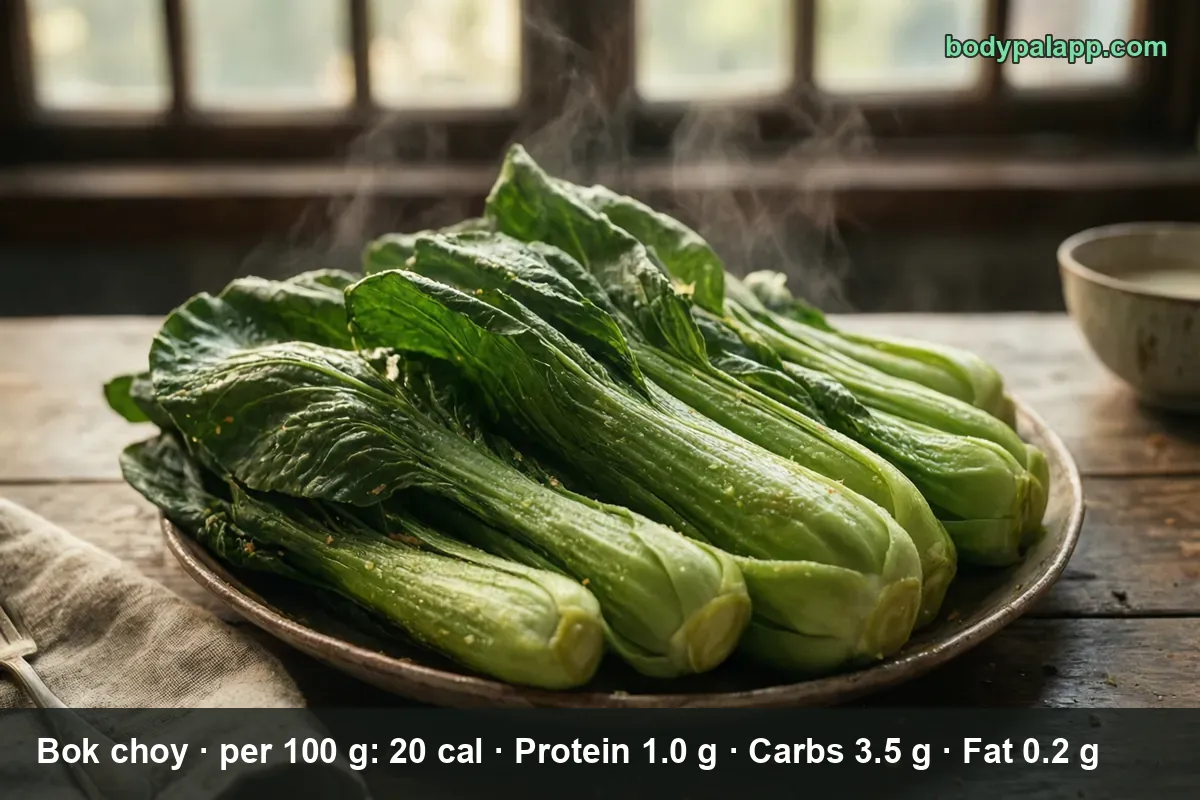
One whole head of bok choy weighs about 113 g and carries 23 calories. Per 100 g the raw vegetable runs 20.259 calories, which makes it one of the lightest things you can put on a plate. A cup of chopped leaves and stalks comes to 14 calories.
On this page
- Bok choy quick facts
- US servings, from one ounce to a whole head
- Raw or cooked, the calories stay put
- Baby, Shanghai, blends and kimchi
- Sodium is the row that moves
- How does bok choy compare?
- Most popular bok choy brands
- Bok choy FAQs
Bok choy quick facts
There is exactly one USDA record for this vegetable: Foundation 2685572, "Cabbage, bok choy, raw". That is convenient, because it is also the form most people buy — loose heads with white stalks and dark green leaves, sold by the pound in the produce aisle or by the bunch at an Asian market. There is no second record to weigh it against and nothing to average.
The head weight below, 113 g, is the 4 oz size sold in sealed containers and the closest thing to a standard unit for a shopper. Calories per serving are our own arithmetic from the USDA 100 g figure, since this record carries no USDA household portions.
| Nutrient | Per 100 g | Per 1 head (113 g) | % Daily Value |
|---|---|---|---|
| Calories | 20.259 | 23 | — |
| Total fat | 0.23 g | 0.3 g | 0% |
| Carbohydrate | 3.51 g | 4.0 g | 1% |
| Dietary fiber | 1.26 g | 1.4 g | 5% |
| Protein | 1.02 g | 1.2 g | 2% |
| Sodium | 14.27 mg | 16 mg | 1% |
| Potassium | 227.8 mg | 257 mg | 5% |
% Daily Value is based on a 2,000-calorie diet.
Verified nutrition data
Numbers on this page come from USDA FoodData Central, the U.S. Department of Agriculture’s food composition database, and from manufacturer labels where a branded product is named. Last verified September 2026. How we verify our data →
Four rows you would expect on a package label are missing here on purpose. Saturated fat, total sugars, added sugars and cholesterol are not reported by USDA for raw bok choy, so listing zeros would be guesswork rather than data. The Daily Values used above come from the FDA label rules.
The interesting line is the last one. A single head delivers 5% of the day's potassium and 5% of the day's fiber for 23 calories — the sort of ratio that only leafy vegetables manage.
US servings, from one ounce to a whole head
| Serving | Weight | Calories |
|---|---|---|
| 1 oz raw | 28 g | 6 kcal |
| 1 cup chopped, raw | 70 g | 14 kcal |
| 1 cup shredded, raw | 85 g | 17 kcal |
| One head, 4 oz container | 113 g | 23 kcal |
| Per 100 g | 100 g | 20 kcal |
Here is the trap. Recipes measure bok choy in cups, stores sell it in heads, and the two are nowhere near the same size. A head is 113 g; a cup of chopped leaves and stalks is 70 g. Two heads come to 226 g, which only just covers the 210 g in three cups of chopped leaves.
Chopped and shredded also differ. Shredded packs tighter, so the same cup measure holds 85 g instead of 70 g and costs 17 calories instead of 14. None of these weights come from USDA — the record has no portion rows at all, so the gram figures are taken from US package labels for the same vegetable and the calories are our own arithmetic from the USDA 100 g number.
Raw or cooked, the calories stay put
USDA publishes no separate record for boiled, steamed or stir-fried bok choy, and that absence is worth explaining rather than papering over. Cooking does not add or destroy calories in a vegetable. What it changes is water and volume: heat collapses the leaves, so a cup of cooked bok choy holds far more plant than a cup of raw and therefore carries more calories per cup, even though 100 g of cooked leaves is close to 100 g of raw ones.
Weigh the head before it hits the pan and you avoid the whole problem. Log 113 g of bok choy at 23 calories and it does not matter whether it ends up steamed, blanched or thrown into soup.
What does change the number is what you cook it in. A tablespoon of oil in the wok adds roughly five times the calories of the vegetable itself, which is the single most common reason a "light" bok choy side stops being light. Garlic, ginger and a splash of broth cost almost nothing; oil and oyster sauce do the work of moving the total.
Baby, Shanghai, blends and kimchi
| Version | Per 100 g | Typical piece | Calories |
|---|---|---|---|
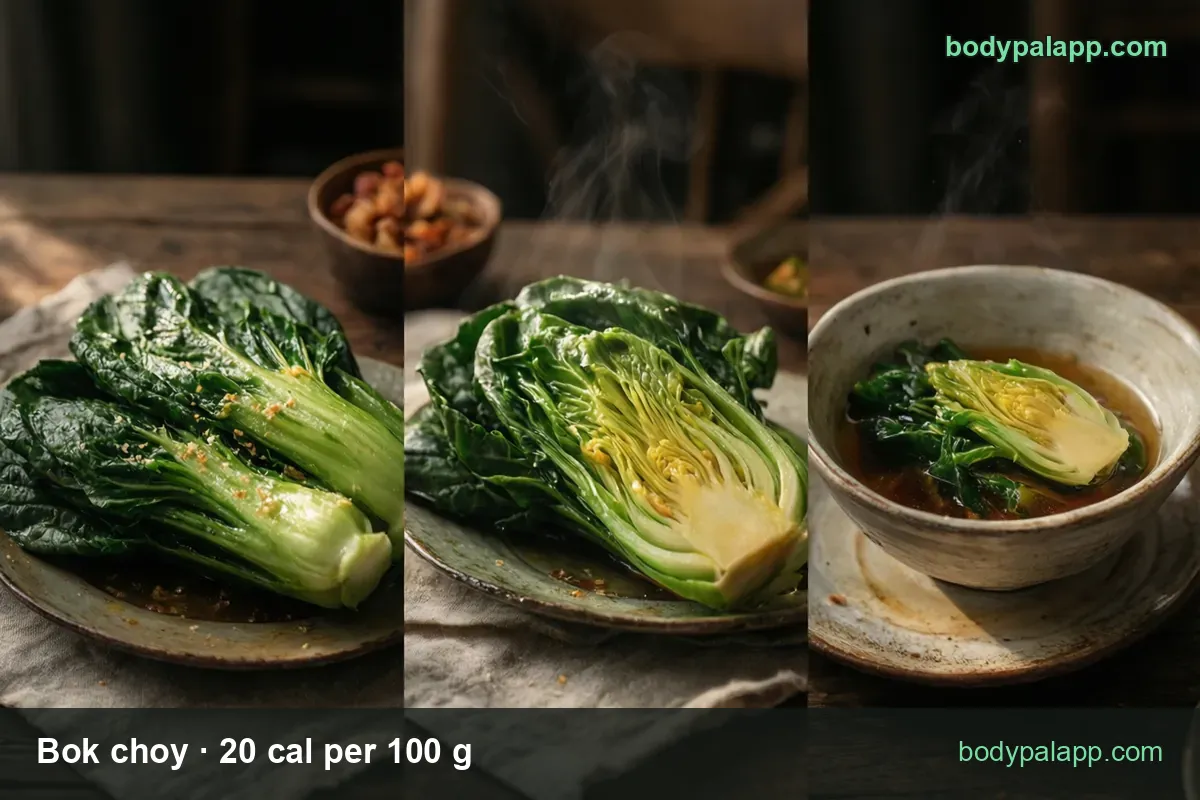
| Bok choy, raw whole head | 20.259 kcal | 1 head (113 g) | 23 kcal |
| Baby bok choy, packaged | 29 kcal | 85 g (2.5 cups) | 25 kcal |
| Shanghai bok choy | 14 kcal | 1 cup (70 g) | 10 kcal |
| Bok choy vegetable blend | 24 kcal | 1 cup (85 g) | 20 kcal |
| Bok choy kimchi | 33 kcal | 1 piece (30 g) | 10 kcal |
Baby bok choy is the same plant harvested young, and the packaged version from Organicgirl reads 29 calories per 100 g — a touch higher than the loose heads, close enough that it makes no practical difference in a day of eating. AeroFarms sells its 4 oz baby heads at 13 calories per 100 g. Two brands, one vegetable, and a 16-calorie spread per 100 g that comes from the labels, not from the plant.
Shanghai bok choy, the green-stemmed type, is labeled by Coast Asia at 14 calories per 100 g, the lightest row in the table above. A cup of it is 10 calories. If you are building a big vegetable bowl, that is about as cheap as a vegetable gets.
Kimchi is the outlier and it is not the calories that make it one. Mama O's bok choy kimchi is 33 calories per 100 g, so a piece is 10 calories. The fermentation and salt are what change the picture, and that belongs in its own section.
Sodium is the row that moves
Fresh bok choy carries 14.27 mg of sodium per 100 g. A whole head is 16 mg — 1% of the 2,300 mg Daily Value, which is to say nothing at all. Bok choy kimchi runs 467 mg per 100 g, or 20% of a day's sodium in that 100 g. That is a 33-fold jump at almost identical calories.
This is the clearest example of a rule that applies to most vegetables: the plant is not what makes a dish salty, the preparation is. Soy sauce, oyster sauce, miso and fermentation all sit in the same category. If you're watching sodium, the fresh heads are effectively a free ingredient and the seasoning is where your budget goes.
On the other side of the ledger, the Dietary Guidelines for Americans put adult vegetable targets at roughly two to three cups a day, and MyPlate counts one cup of raw leafy greens as half a cup toward that. Bok choy is a cheap way to hit it: three cups of chopped leaves is 42 calories.
How does bok choy compare?
| Vegetable | Per 100 g | US serving | Calories |
|---|---|---|---|
| Bok choy, raw | 20.3 kcal | 1 head (113 g) | 23 kcal |
| Broccoli, raw | 32 kcal | 1 cup chopped (91 g) | 29 kcal |
| Kale, raw | 35 kcal | 1 cup chopped (21 g) | 7 kcal |
| Celery, raw | 16.7 kcal | 1 cup chopped (101 g) | 17 kcal |
Our take: among these four, only celery is lighter per 100 g than bok choy, and celery gives you almost no protein in exchange. For volume on the plate at the lowest cost, bok choy and celery are interchangeable; for something that actually holds up in a hot pan and brings 1.02 g of protein per 100 g, bok choy wins. Kale looks lightest per serving only because a cup of loose kale weighs 21 g — a fifth of a cup of celery. Compare by weight, not by cup, or the ranking flips on you.
Most popular bok choy brands in the United States
Ranked by how widely each product appears among foods sold in the United States, from the BodyPal food database of over 3.3 million products. Calories are the figures printed on each Nutrition Facts label, checked against USDA FoodData Central.
| Product | Calories (per 100 g) |
|---|---|
| Organicgirl Baby Bok Choy | 29 cal |
| AeroFarms Baby Bok Choy | 13 cal |
| Mama O's Kimchi Baby Bok Choy | 33 cal |
| Hannaford Bok Choy Blend | 24 cal |
| Coast Asia Shanghai Bok Choy | 14 cal |
Brand popularity: BodyPal food database. Nutrition: manufacturer labels / USDA FoodData Central.
Bok choy FAQs
How many calories are in one head of bok choy?
One head of about 113 g is 23 calories, based on the USDA figure of 20.259 calories per 100 g for raw bok choy. That is less than a cup of chopped raw broccoli, which comes to 29 calories. Head sizes vary, so weigh yours if you want precision.
How many calories in 1 cup of bok choy?
A cup of chopped raw bok choy weighs 70 g and is 14 calories. Shredded packs tighter at 85 g per cup, which brings it to 17 calories. Both are our arithmetic from the USDA 100 g figure, since that record carries no official household portions.
How much protein is in bok choy?
Bok choy has 1.02 g of protein per 100 g, so one head of 113 g gives 1.2 g — about 2% of the 50 g Daily Value. It is a respectable amount for a leafy vegetable at 23 calories, but it is not a protein source. Treat it as volume, not as the protein on the plate.
How many carbs are in bok choy?
One head of 113 g has 4.0 g of carbohydrate, of which 1.4 g is fiber, so roughly 2.6 g is everything else. Per 100 g that is 3.51 g of carbohydrate and 1.26 g of fiber. USDA does not report sugars for raw bok choy, so no sugar figure is listed on this page.
Is baby bok choy lower in calories than regular bok choy?
No, packaged baby bok choy reads 29 calories per 100 g against 20.259 for loose raw heads, so it is slightly higher by weight, not lower. An 85 g package portion is 25 calories. The difference between the two is far smaller than the difference between a cup and a whole head.
Does cooking bok choy change the calories?
Not in itself: a head is 23 calories either way. USDA has no separate record for cooked bok choy, and heat neither adds nor removes calories. It removes water, so a cup of cooked leaves holds more plant and more calories than a raw cup. Weigh it raw and the oil in the pan is the only variable.
Is bok choy high in sodium?
No, raw bok choy has 14.27 mg of sodium per 100 g, so a head is 16 mg, about 1% of the 2,300 mg Daily Value. Bok choy kimchi is a different story at 467 mg per 100 g, or 20% of a day's sodium, with barely more calories than the fresh vegetable.
Is bok choy good for weight loss?
At 23 calories a head, bok choy is one of the cheapest ways to make a plate look full. A cup of chopped leaves costs 14 calories and brings 5% of the day's fiber per head. The calories that matter in a bok choy dish come from the oil and the sauce, not the vegetable.
Similar foods
- Shishito Peppers — 18 cal for 12 peppers
- Sauerkraut — 27 cal per cup, drained
- Summer Squash — 38 cal per cup
- Yellow Squash — 42 cal per squash
- Asparagus — 20 cal per half cup
- Beefsteak Tomato — 33 cal per large whole tomato
Count it without the math
Point the camera at the plate and BodyPal counts the bok choy for you, stalks, leaves and all.


One food is easy to picture; a whole day is harder. See how many calories you need a day and what a deficit actually looks like.