
How many calories are in a beefsteak tomato?
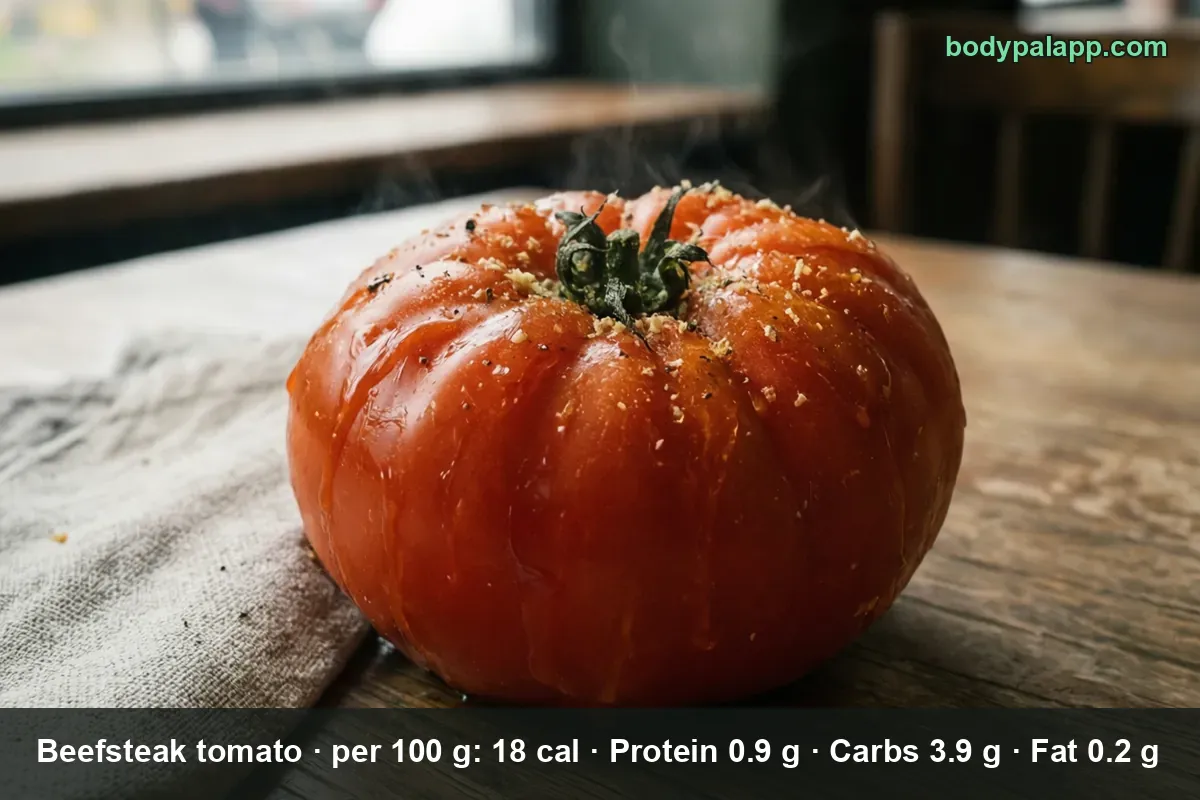
One large whole tomato weighs 182 g and carries 33 calories. Per 100 g a raw red ripe tomato runs 18 calories, about as low as solid food goes. A thick slice for a sandwich is 5. A cup of it chopped is 32. The water is doing most of the work here.
On this page
- Beefsteak tomato quick facts
- US servings from one slice to a whole tomato
- Every way a beefsteak tomato gets eaten
- Cooked canned and green tomatoes
- Fiber and potassium outweigh the calorie count
- How does a beefsteak tomato compare?
- FAQ
Beefsteak tomato quick facts
USDA has no record with the word beefsteak in it. Beefsteak is a size and shape rather than a lab category, so the row that fits is SR Legacy 170457, "Tomatoes, red, ripe, raw, year round average". That record carries the household measure this page is built on: one large whole tomato, 3 inches across, 182 g. That is the fruit somebody is holding when they ask the question.
The alternative rows are either survey averages across every tomato in the country or single cultivars such as roma and grape. They describe different fruit, not a different source, so they get their own table below rather than being blended into one number.
| Nutrient | Per 100 g | Per 1 large whole tomato (182 g) | % Daily Value |
|---|---|---|---|
| Calories | 18 | 33 | — |
| Total fat | 0.2 g | 0.4 g | 0% |
| Saturated fat | 0.03 g | 0.1 g | 0% |
| Carbohydrate | 3.89 g | 7.1 g | 3% |
| Dietary fiber | 1.2 g | 2.2 g | 8% |
| Total sugars | 2.63 g | 4.8 g | — |
| Protein | 0.88 g | 1.6 g | 3% |
| Sodium | 5 mg | 9 mg | 0% |
| Cholesterol | 0 mg | 0 mg | 0% |
| Potassium | 237 mg | 431 mg | 9% |
% Daily Value is based on a 2,000-calorie diet.
Verified nutrition data
Numbers on this page come from USDA FoodData Central, the U.S. Department of Agriculture’s food composition database, and from manufacturer labels where a branded product is named. Last verified September 2026. How we verify our data →
There is no added sugars row here, because the SR Legacy edition does not carry that field at all, and a raw tomato off the vine has none by definition. The 4.8 g of sugar in a large tomato is the fruit's own. The 9 mg of sodium is less than a two-hundredth of a teaspoon of table salt, which is another way of saying none.
These are the other USDA tomato records, for anyone whose fruit does not match the description.
| USDA record | fdc_id | Per 100 g |
|---|---|---|
| Tomatoes red ripe raw (used on this page) | 170457 | 18 kcal |
| Tomatoes raw survey average | 2709719 | 20 kcal |
| Tomato roma | 1750354 | 22 kcal |
| Tomatoes grape raw | 321360 | 27 kcal |
| Tomatoes green raw | 170456 | 23 kcal |
| Tomatoes yellow raw | 170096 | 15 kcal |
| Tomatoes red ripe cooked | 170050 | 18 kcal |
| Tomatoes red ripe cooked with salt | 170137 | 18 kcal |
Eight records and the spread runs from 15 to 27 calories per 100 g. Yellow is the lightest of the eight, grape the heaviest, and the difference is water: the small dense varieties carry less of it, the big slicing tomatoes carry more. A beefsteak sits near the watery end, which is why it is one of the cheapest tomatoes on the plate per bite.
US servings from one slice to a whole tomato
| Serving | Weight | Calories |
|---|---|---|
| 1 thick slice (1/2 in) | 27 g | 5 kcal |
| 1 oz | 28 g | 5 kcal |
| 1 medium whole (2-3/5 in) | 123 g | 22 kcal |
| 1 cup chopped or sliced | 180 g | 32 kcal |
| 1 large whole (3 in) | 182 g | 33 kcal |
| Per 100 g | 100 g | 18 kcal |
The slice, the medium, the large and the chopped cup are all USDA household measures attached to record 170457. The ounce is our own arithmetic from the USDA 100 g figure, not a USDA serving, and the same goes for anything you weigh yourself.
Here is the cup trap, and it catches people who log by volume. The same USDA record gives 180 g for a cup of chopped or sliced tomato and 149 g for a cup of cherry tomatoes. One cup, 31 g apart, because whole small fruit leaves air between the pieces. Chopped is 32 calories, cherry is 27, our own arithmetic in both cases from the 18-per-100-g figure. Five calories is not worth an argument, but the same gap on a denser food would be.
The other thing worth knowing: a supermarket beefsteak often beats the USDA large. Fruit over 250 g is common, and at 250 g you are looking at 45 calories rather than 33, our own arithmetic from the 18-per-100-g figure. Weigh one once, remember the number, stop weighing.
Every way a beefsteak tomato gets eaten
| Version | Per 100 g | Typical serving | Calories |
|---|---|---|---|
| Whole raw beefsteak | 18 kcal | 1 large whole (182 g) | 33 kcal |
| Whole raw medium | 18 kcal | 1 medium whole (123 g) | 22 kcal |
| Sliced for a sandwich | 18 kcal | 1 thick slice (27 g) | 5 kcal |
| Chopped into a salad | 18 kcal | 1 cup chopped (180 g) | 32 kcal |
Cutting a tomato does not change its energy, only the size of the piece you log. Four thick slices on a burger add 20 calories, which is less than a single teaspoon of the mayo underneath them. In a build like a Chipotle bowl the fresh tomato salsa is the least expensive thing in the container by a wide margin.
The salad version is where people overshoot in the other direction. A cup of chopped tomato is 32 calories, so a bowl built on two cups of it starts at 64 and stays under 100 until dressing arrives. On a plate where you want volume rather than density, this is the vegetable that buys the most room.
Cooked canned and green tomatoes
| Version | Per 100 g | Typical serving | Calories |
|---|---|---|---|
| Cooked with salt | 18 kcal | 1 cup (240 g) | 43 kcal |
| Canned whole no salt added | 16 kcal | 1 cup (240 g) | 38 kcal |
| Green unripe raw | 23 kcal | 1 large (182 g) | 42 kcal |
Cooking is the surprise. Raw red ripe tomato is 18 calories per 100 g and cooked red ripe tomato with salt is also 18. Water leaves, energy does not, and the two effects land close enough that USDA prints the same figure. What does move is sodium: 5 mg per 100 g raw against 247 mg per 100 g cooked with salt. A 240 g cup of the salted version carries 593 mg of sodium, 26% of the Daily Value, from a food that started with almost none.
Green tomatoes run 23 calories per 100 g, so a large one is 42 rather than 33. Unripe fruit carries more carbohydrate overall, and the carbohydrate row shows it at 5.1 g per 100 g against 3.89 g for ripe. Fried green tomatoes are of course a different question entirely, because the batter and the oil are the meal.
Canned whole tomatoes packed in juice with no salt added come in lowest of the three at 16 calories per 100 g, or 38 for a 240 g cup. That is the row to reach for in winter, when the fresh beefsteak in the store is a pale imitation of the August one anyway.
Fiber and potassium outweigh the calorie count
A large tomato is 33 calories, which is 1.65% of a 2,000-calorie day. Its fiber is 2.2 g, or 8% of the 28 g Daily Value the FDA sets for the Nutrition Facts label. Its potassium is 431 mg, 9% of the 4,700 mg Daily Value. Both percentages are roughly five times the calorie share, which is the entire argument for eating vegetables by volume.
Potassium is the row most people never look at, and a single beefsteak covers close to a tenth of the day's mark. MyPlate counts a large raw tomato as one cup of the vegetable group, so one fruit on a sandwich is a real dent in the daily target rather than a garnish.
If you are watching sodium, the raw tomato is one of the few whole foods that costs you nothing at all: 9 mg for a large one. The moment it goes in a pan with salt, or into a jar of sauce, that stops being true. Season at the table and you keep the number.
How does a beefsteak tomato compare?
| Tomato | Per 100 g | US serving | Calories |
|---|---|---|---|
| Beefsteak red ripe raw | 18 kcal | 1 large whole (182 g) | 33 kcal |
| Green raw | 23 kcal | 1 large (182 g) | 42 kcal |
| Cooked with salt | 18 kcal | 1 cup (240 g) | 43 kcal |
| Canned in juice no salt added | 16 kcal | 1 cup (240 g) | 38 kcal |
Our take: for weight management the raw beefsteak wins, and not by a small margin, because the serving that satisfies is a whole 182 g fruit for 33 calories. Of the four rows above, only the canned tomato is lower per 100 g, at 16, and it comes in a cup rather than a slice. If you are cooking, the salted row is fine on calories and expensive on sodium, so the swap worth making is the no-salt-added can plus your own seasoning. Green tomatoes are the one to skip if you are counting, since they cost 27% more per gram and taste like they are not finished.
Beefsteak tomato FAQs
How many calories are in one beefsteak tomato?
One large whole tomato, 3 inches across and 182 g on the USDA scale, is 33 calories. Per 100 g the figure is 18. A medium tomato of 123 g comes to 22. Beefsteak fruit often runs heavier than the USDA large, so weigh anything that fills your palm.
How many calories in a slice of beefsteak tomato?
A thick half-inch slice weighs 27 g and carries 5 calories. Four slices on a burger add 20. The slice is almost entirely water, so the tomato is rarely the thing that moves a sandwich total. The bun, the cheese and the mayo do that.
How many carbs are in a beefsteak tomato?
A large 182 g tomato holds 7.1 g of carbohydrate, 3% of the Daily Value. Of that, 2.2 g is fiber and 4.8 g is total sugars, all of it the fruit's own. Subtract the fiber and about 4.9 g remains, which is our own arithmetic from the USDA figures.
Is a beefsteak tomato good for weight loss?
At 18 calories per 100 g, very few foods cost less per bite. A whole large tomato is 33 calories with 2.2 g of fiber, so it fills space on the plate cheaply. It is not a weight-loss plan on its own, but it is one of the least expensive ways to make a meal bigger.
How much fiber is in a beefsteak tomato?
A large 182 g tomato gives 2.2 g of fiber, 8% of the 28 g Daily Value used on the Nutrition Facts label. Per 100 g that is 1.2 g. Grape tomatoes are denser at 2.1 g per 100 g, so the small varieties carry close to double the fiber gram for gram.
Beefsteak vs roma tomato: which has fewer calories?
The beefsteak, at 18 calories per 100 g against 22 for the USDA roma record. Roma holds less water and more flesh, which is why it is the sauce tomato. USDA publishes no beefsteak-specific record, so the red ripe raw row covers the big slicing fruit here.
How much does a beefsteak tomato weigh?
USDA lists a large whole tomato, 3 inches in diameter, at 182 g and a medium at 123 g. Beefsteak fruit is often bigger than both. A 250 g specimen works out to 45 calories, our own arithmetic from the 18-per-100-g figure. Weigh one once and you will know your usual size.
Do cooked tomatoes have more calories than raw?
No, raw and cooked red ripe tomatoes both sit at 18 calories per 100 g in USDA data. What changes is salt. Cooked with salt, sodium goes from 5 mg per 100 g to 247 mg, and a 240 g cup then carries 593 mg, which is 26% of the Daily Value.
Similar foods
- Big Tomato — 31 cal per large tomato
- Campari Tomato — 18 cal per 100 g
- Campari Tomatoes — 16 cal per small whole
- Roma Tomato — 10 cal per tomato
- Tomato Slices — 4 cal per slice
- Tomato — 11 cal per plum (Roma) tomato
Count it without the math
Point the camera at the plate and BodyPal counts the tomato for you, slice by slice.


How long does it take to burn off 33 kcal of beefsteak tomato?
One large whole tomato (182 g) is 33 kcal. Enter your weight and the amount you ate to see how long it takes you to burn that off:
lb
| Activity | Time to burn 33 kcal |
|---|---|
| Walking, brisk | 7 min |
| Cycling, moderate | 4 min |
| Swimming, moderate | 5 min |
| Jogging | 4 min |
| Weight training, moderate | 7 min |
Times are for a 155 lb adult at a steady pace; change the weight to see yours. The amount is set to the portion in the text (182 g); change it to what you actually ate. BodyPal works this out from your steps automatically.
This table assumes you know your daily total. If you do not, the daily calorie calculator works it out from five numbers.