
How many calories are in Campari tomatoes?
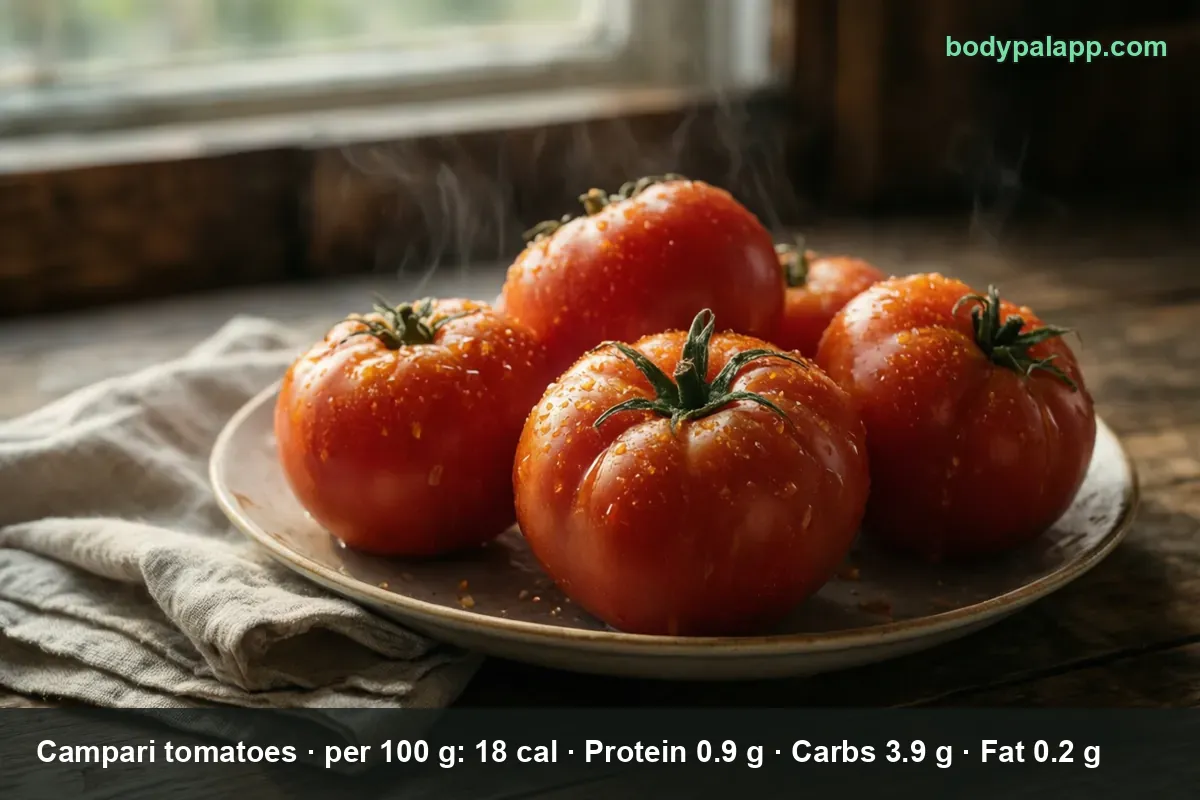
One Campari tomato, the small vine-ripened kind sold in a clamshell, weighs about 91 g and carries 16 calories. Red ripe tomatoes run 18 calories per 100 g. A whole cup of slices, 180 g of them, still lands at 32. The calories in Campari tomatoes stay tiny at every serving size.
On this page
- Campari tomato quick facts
- US servings, from one ounce to a sliced cup
- Campari vs grape, roma and green tomatoes
- Potassium is the row that surprises people
- How do Campari tomatoes compare?
- FAQ
Campari tomato quick facts
Campari is a variety name, not a USDA food. The database has no row called "Campari," so the honest match is the one that describes exactly what you are holding: a red, ripe, raw eating tomato. That is SR Legacy 170457, "Tomatoes, red, ripe, raw, year round average", and the "year round average" part matters here, because it blends greenhouse winter fruit with summer field fruit — which is precisely how Campari tomatoes reach a US store, on the vine, twelve months a year.
The Foundation rows for grape and roma tomatoes are tempting, but they describe different varieties with different water content, so they belong further down the page rather than at the top of this table.
| Nutrient | Per 100 g | Per 1 small whole (91 g) | % Daily Value |
|---|---|---|---|
| Calories | 18 | 16 | — |
| Total fat | 0.2 g | 0.2 g | 0% |
| Saturated fat | 0.03 g | 0.0 g | 0% |
| Carbohydrate | 3.89 g | 3.5 g | 1% |
| Dietary fiber | 1.2 g | 1.1 g | 4% |
| Total sugars | 2.63 g | 2.4 g | — |
| Protein | 0.88 g | 0.8 g | 2% |
| Sodium | 5 mg | 5 mg | 0% |
| Potassium | 237 mg | 216 mg | 5% |
% Daily Value is based on a 2,000-calorie diet.
Verified nutrition data
Numbers on this page come from USDA FoodData Central, the U.S. Department of Agriculture’s food composition database, and from manufacturer labels where a branded product is named. Last verified September 2026. How we verify our data →
There is no added sugars row above, and that is not an omission: the SR Legacy edition does not carry added sugars at all, and a raw tomato has none by definition — every gram of its 2.63 g is the fruit's own sugar. Cholesterol is 0 mg, as it is in any plant food, so it does not earn a line either.
The single most useful thing in that table is how flat it is. Nothing reaches 5% of a Daily Value except potassium. A Campari tomato is, nutritionally, water with color in it.
US servings, from one ounce to a sliced cup
| Serving | Weight | Calories |
|---|---|---|
| 1 oz | 28 g | 5 kcal |
| 1 small whole (2-2/5" dia) | 91 g | 16 kcal |
| 1 medium whole (2-3/5" dia) | 123 g | 22 kcal |
| 1 cup cherry tomatoes | 149 g | 27 kcal |
| 1 cup, chopped or sliced | 180 g | 32 kcal |
| Per 100 g | 100 g | 18 kcal |
The small and medium whole tomatoes, the cherry cup and the sliced cup are all USDA household measures attached to record 170457. The 1 oz line is our own arithmetic from the USDA 100 g figure, not a USDA serving — it is there because deli scales and meal-prep recipes still speak in ounces.
A Campari sits between the two whole-tomato rows. Most of the fruit in a clamshell falls near the 91 g small size, though a large one will push toward the 123 g medium and 22 calories. Log two of them and you are at 32 calories, the same as a full sliced cup. That is the trap worth knowing: chopping a tomato does not make it a bigger serving, it just makes it look like one in the bowl.
Here is the comparison people rarely run. A whole cup of cherry tomatoes, 149 g of them, is 27 calories — less than two Campari tomatoes. The cup measure sounds like a lot more food than "one tomato." By weight and by calories, it is not.
Campari vs grape, roma and green tomatoes
| Version | Per 100 g | Typical piece | Calories |
|---|---|---|---|
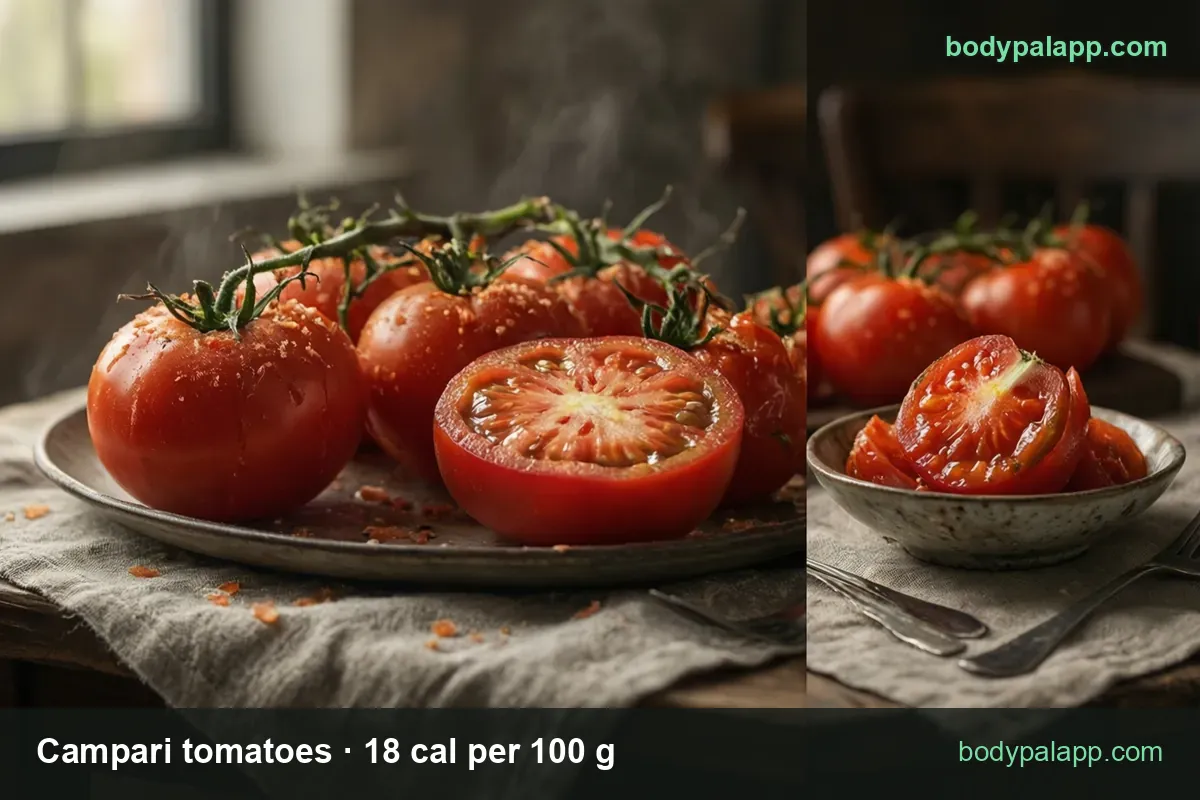
| Campari tomato, raw | 18 kcal | 1 small whole (91 g) | 16 kcal |
| Grape tomatoes, raw | 27 kcal | 1 oz (28 g) | 8 kcal |
| Roma (plum) tomato, raw | 22 kcal | 1 oz (28 g) | 6 kcal |
| Green tomatoes, raw | 23 kcal | 1 medium (123 g) | 28 kcal |
| Cooked tomatoes, with salt | 18 kcal | 1/2 cup (120 g) | 22 kcal |
| Canned tomatoes in juice | 16 kcal | 1 cup (240 g) | 38 kcal |
Grape tomatoes are the densest thing on this list at 27 calories per 100 g — half again as much as a Campari. Smaller fruit means proportionally more skin and wall and less watery gel, and the fiber follows: 2.1 g per 100 g against 1.2 g. If you snack from the container without counting, grape tomatoes cost more than you would guess from the Campari number.
Roma tomatoes land at 22 calories per 100 g. That figure is Atwater-calculated rather than directly measured, so treat it as close rather than exact. Romas are bred for sauce — less juice, firmer flesh — which is why they read slightly heavier per gram than an eating tomato.
Green tomatoes are 23 calories per 100 g, and the reason is timing, not variety. Unripe fruit still holds starch that has not yet turned to sugar, so a medium green tomato is 28 calories against 22 for a ripe one the same size. That is before anyone breads and fries it.
Cooked and canned rows change the calorie math barely at all. Cooking drives off water, so half a cup of cooked tomatoes is 22 calories, and canned tomatoes packed in their own juice come in at 16 per 100 g — the lightest row here, because the packing juice is thinner than the fruit. What moves instead is sodium, and it moves a long way.
Potassium is the row that surprises people
Everyone expects tomatoes to be a vitamin C story. In the Daily Value table, potassium is the number that actually shows up: 237 mg per 100 g, so a cup of slices delivers 427 mg, or 9% of the 4,700 mg Daily Value the FDA sets for the Nutrition Facts label. The same cup gives 2.2 g of fiber, 8% of the DV. Potassium quietly beats fiber here, and it does it for 32 calories.
Sodium is the other row worth watching, and it is the clearest illustration of what processing costs. Raw Campari tomatoes are 5 mg of sodium per 100 g. Canned tomatoes packed in juice run about 115 mg — roughly 23 times as much. Tomatoes cooked with salt reach 247 mg, about 49 times the raw figure, at identical calories. Half a cup of those salted cooked tomatoes carries 296 mg of sodium, 13% of a day's DV, for 22 calories.
If you are watching sodium, that is the whole decision in one line: the calories are the same either way, so buy the fresh fruit and salt it yourself, where you can see how much goes on. And if you are trying to fill a plate without filling a calorie budget, tomatoes are the cheapest way to do it — MyPlate counts a cup of raw chopped tomato as a full cup of vegetables, and that cup costs 32 calories.
How do Campari tomatoes compare?
| Tomato | Per 100 g | US serving | Calories |
|---|---|---|---|
| Campari, red ripe, raw | 18 kcal | one small tomato, 91 g | 16 kcal |
| Green tomatoes, raw | 23 kcal | 1 medium, 123 g | 28 kcal |
| Cooked, with salt | 18 kcal | 1/2 cup, 120 g | 22 kcal |
| Canned in tomato juice | 16 kcal | 1 cup, 240 g | 38 kcal |
Our take: for weight loss, raw Campari tomatoes are as close to free as food gets — four of them are 64 calories, less than one medium banana, and they add bulk and acid to a plate that would otherwise need dressing. For actual fullness, they are the wrong tool on their own; 0.8 g of protein and 1.1 g of fiber per tomato will not hold anyone for an afternoon, so pair them with something that has protein. Of the four rows above, only canned in juice is lighter per 100 g, at 16, and it arrives with roughly 115 mg of sodium per 100 g instead of 5. Fresh wins on every axis except convenience.
Campari tomato FAQs
How many calories are in one Campari tomato?
16 calories for a small whole tomato of 91 g, based on the USDA row for red ripe raw tomatoes at 18 calories per 100 g. A larger one closer to the 123 g medium size comes to 22 calories. Four of them together are 64 calories.
How much does a Campari tomato weigh?
Roughly 91 g, matching the USDA small whole tomato of about 2-2/5 inches across, which is the size most clamshell Camparis hit. Bigger fruit reaches the 123 g medium measure. Weighing beats guessing: the difference between those two sizes is only 6 calories, but it doubles for a salad.
Are Campari tomatoes the same as cocktail tomatoes?
For counting purposes, yes — both terms describe the same small vine-ripened eating tomato, and both fall under the USDA red ripe raw row at 18 calories per 100 g. Campari is a specific branded variety; cocktail tomato is the general size class between cherry and slicing tomatoes.
Campari vs Roma tomatoes: which has fewer calories?
Campari, at 18 calories per 100 g against 22 for roma. The gap is water. Romas are bred for sauce with firmer, less juicy flesh, so they weigh more per unit of volume. Per ounce it is 5 calories versus 6 — a difference too small to change any meal.
How many carbs are in Campari tomatoes?
3.5 g of carbohydrate in one 91 g tomato, or 3.89 g per 100 g, which is 1% of the Daily Value. A full cup of slices, 180 g, holds 7.0 g. Subtract the 1.1 g of fiber in a single tomato and the net figure is about 2.4 g.
How much sugar is in a Campari tomato?
2.4 g of total sugars per 91 g tomato, or 2.63 g per 100 g. All of it is the fruit's own sugar — a raw tomato has no added sugars, which is why the label's added sugars limit is not the relevant comparison here. A sliced cup contains about 4.7 g.
Are Campari tomatoes keto friendly?
With 3.5 g of carbohydrate and 1.1 g of fiber per tomato, one Campari costs roughly 2.4 g net carbs, so two or three fit inside most low-carb daily targets. A whole sliced cup at 7.0 g of carbohydrate is where it starts to matter on a strict allowance.
How many Campari tomatoes are in one cup?
Two, near enough: a USDA cup of chopped or sliced tomato weighs 180 g and carries 32 calories, while a small whole tomato is 91 g — that is our own arithmetic from the weights, not a USDA count. Whole cherry-size fruit packs looser: a cup of those is 149 g and 27 calories.
Similar foods
- Beefsteak Tomato — 33 cal per large whole tomato
- Big Tomato — 31 cal per large tomato
- Campari Tomato — 18 cal per 100 g
- Roma Tomato — 10 cal per tomato
- Tomato Slices — 4 cal per slice
- Tomato — 11 cal per plum (Roma) tomato
Count it without the math
Point the camera at the plate and BodyPal counts the tomatoes, slices and all.


Want the bigger picture? Calculate your daily calorie needs — your maintenance figure, a target for losing or gaining, and the date you get there.