
How many calories are in a tomato?
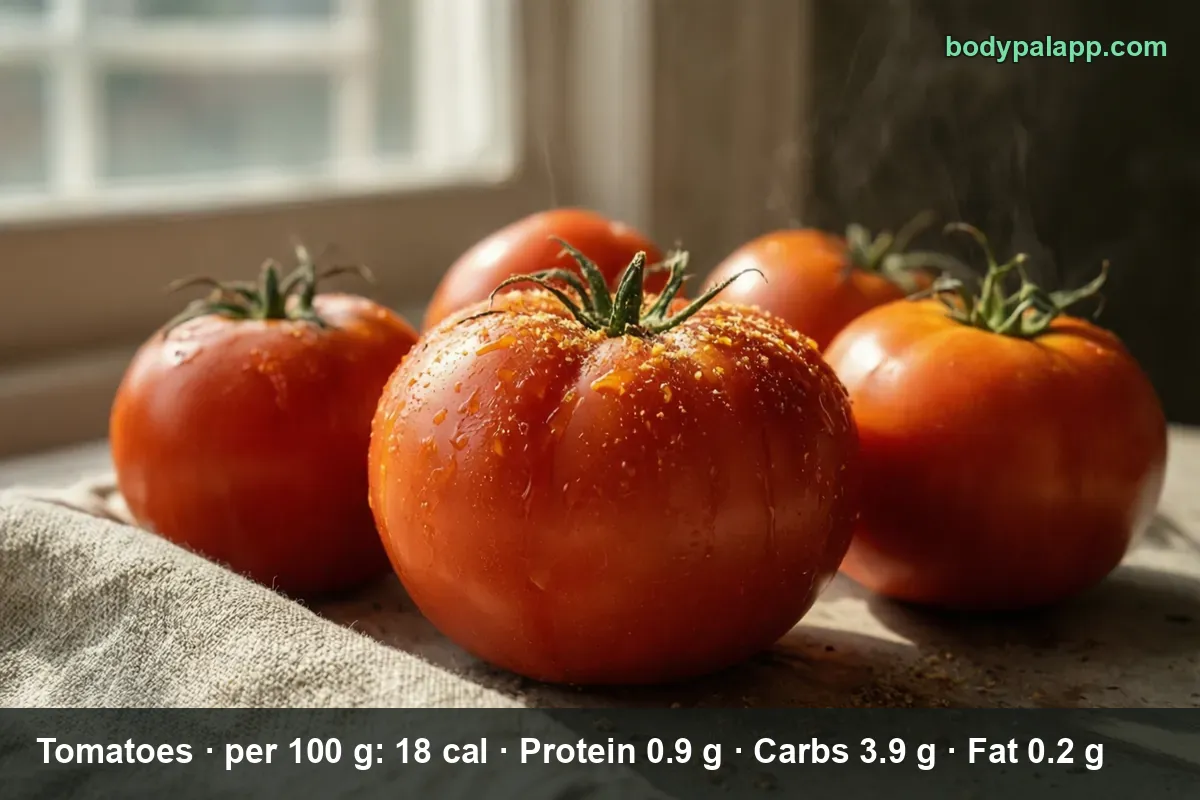
One medium tomato weighs 123 g and carries 22 calories. Raw red tomatoes run 18 calories per 100 g, so a whole cup of them, chopped, is 32. Almost all of that weight is water, which is why the number stays flat no matter how many you pile on the plate.
On this page
- Tomato quick facts
- US servings, from one Roma to a full cup
- Cherry, green, canned and sun-dried tomatoes
- Potassium and fiber are the rows that pay you back
- How do tomatoes compare?
- Most popular tomatoes brands
- FAQ
Tomato quick facts
The record behind every number here is SR Legacy 170457, "Tomatoes, red, ripe, raw, year round average". It is the right one because the person searching is holding an actual raw tomato, not a can and not a plate of pasta sauce. The year-round average also carries the deepest set of household measures in the database, which is how a plum tomato and a cup of cherry tomatoes get real weights instead of guesses.
There is a second USDA edition of the same food, FNDDS 2709719, that lists 20 calories per 100 g instead of 18. Same tomato, different survey release and slightly different rounding. Two calories on a medium tomato is noise, and mixing editions is how food pages end up contradicting themselves, so this page stays on one record start to finish.
| Nutrient | Per 100 g | Per 1 medium tomato (123 g) | % Daily Value |
|---|---|---|---|
| Calories | 18 | 22 | — |
| Total fat | 0.2 g | 0.2 g | 0% |
| Saturated fat | 0.03 g | 0.0 g | 0% |
| Carbohydrate | 3.89 g | 4.8 g | 2% |
| Dietary fiber | 1.2 g | 1.5 g | 5% |
| Total sugars | 2.63 g | 3.2 g | — |
| Protein | 0.88 g | 1.1 g | 2% |
| Sodium | 5 mg | 6 mg | 0% |
% Daily Value is based on a 2,000-calorie diet.
Verified nutrition data
Numbers on this page come from USDA FoodData Central, the U.S. Department of Agriculture’s food composition database, and from manufacturer labels where a branded product is named. Last verified September 2026. How we verify our data →
Two label rows are missing on purpose. Added sugars and trans fat are not published in this SR Legacy record, and a raw tomato has neither — nothing is added to a fruit picked off a vine. Cholesterol is 0 mg, as it is in every plant food. Potassium is the row worth writing down: 237 mg per 100 g, or 292 mg in a medium tomato, which is 6% of the 4,700 mg daily value.
US servings, from one Roma to a full cup
| Serving | Weight | Calories |
|---|---|---|
| 1 oz | 28 g | 5 kcal |
| 1 plum (Roma) tomato | 62 g | 11 kcal |
| 1 medium tomato, 2 3/5 in across | 123 g | 22 kcal |
| 1 cup cherry tomatoes | 149 g | 27 kcal |
| 1 cup chopped or sliced | 180 g | 32 kcal |
| Per 100 g | 100 g | 18 kcal |
Four of those weights come straight from USDA household measures: the medium tomato, the plum tomato, the cup of cherry tomatoes and the cup chopped. The 1 oz line is our own arithmetic from the USDA 100 g figure, not a USDA serving, and it exists mainly to show how small the unit has to get before the number drops below five.
The cup trap runs the other way here compared with most foods. A cup of chopped tomatoes weighs 180 g, more than a whole medium tomato, yet it still only costs 32 calories. That whole cup also brings 2.2 g of fiber and 427 mg of potassium by our own scaling of the 100 g figures — 9% of the potassium daily value for something people treat as garnish.
Cherry, green, canned and sun-dried tomatoes
| Version | Per 100 g | Typical serving | Calories |
|---|---|---|---|
| Cherry tomatoes | 18 kcal | 1 cup (149 g) | 27 kcal |
| Green tomatoes, raw | 23 kcal | 1 medium (123 g) | 28 kcal |
| Cooked, no salt added | 18 kcal | 1/2 cup (120 g) | 22 kcal |
| Canned diced | 18 kcal | 1/2 cup (121 g) | 22 kcal |
| Crushed canned | 32 kcal | 1/2 cup (121 g) | 39 kcal |
| Sun-dried | 258 kcal | 1 cup (54 g) | 139 kcal |
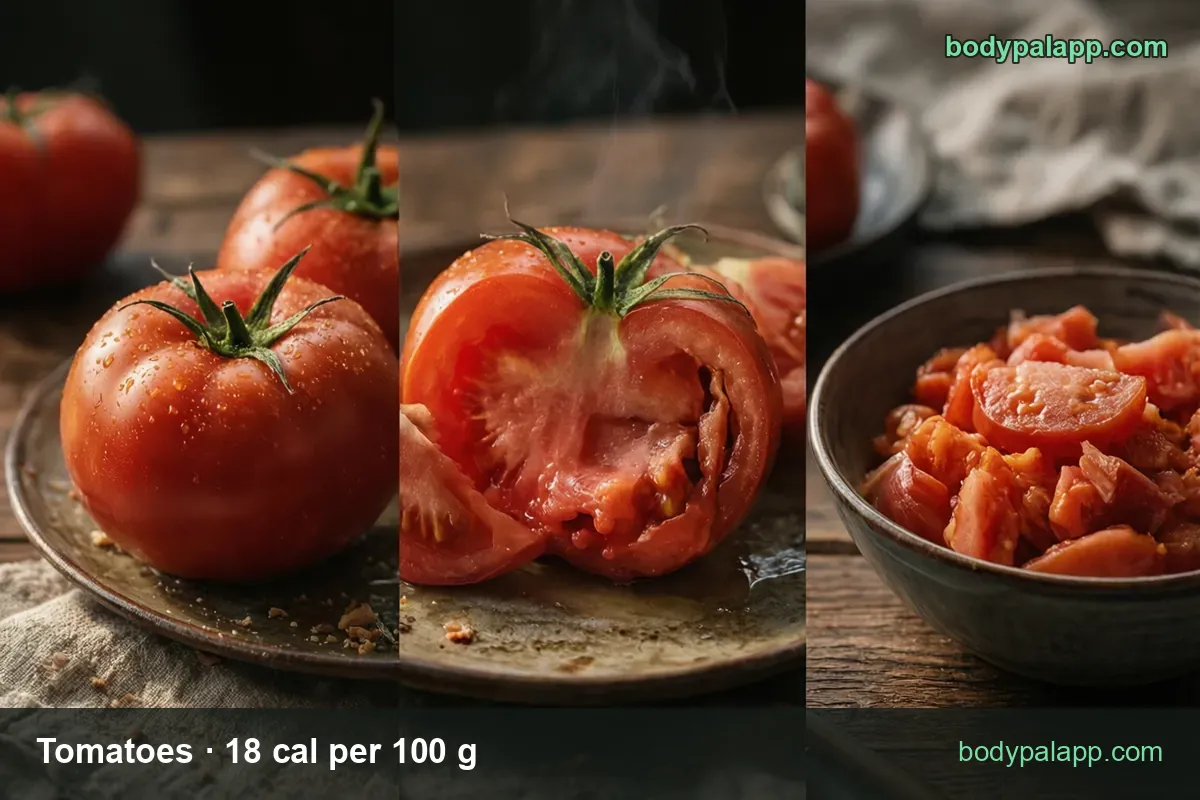
Cherry tomatoes are not a separate USDA food. They sit on the same raw red record at 18 calories per 100 g, so a cup is 27 calories and the only variable is how tightly the fruit packs. Green tomatoes are the one fresh version that costs more: 23 calories per 100 g, five more than red, because an unripe tomato holds 5.1 g of carbohydrate against 3.89 g. A medium green tomato is 28 calories.
Cooking changes almost nothing. Boiled tomatoes with no salt hold 18 calories per 100 g, the same as raw, because the water stays in the pan and in the fruit. The half-cup weights in the table for the cooked and canned rows are our own arithmetic from the 100 g figures rather than published USDA servings.
Crushed canned tomatoes are the quiet jump: 32 calories per 100 g, almost twice the diced pack, since crushing concentrates pulp that would otherwise be packing juice. Sun-dried tomatoes are in a different league entirely at 258 calories per 100 g. Drying takes the water out and leaves 37.59 g of sugar and 14.11 g of protein per 100 g behind. A cup of dried halves is only 54 g but 139 calories, roughly what six medium fresh tomatoes would cost you, with about 6.6 g of fiber by our own scaling.
Store-brand cans track the USDA rows closely. Across six plain US canned and strained tomato products, the range runs from 16 to 37 calories per 100 g — Dei Fratelli Petite Diced at 16, or 20 calories in a half-cup, up to Hunt's Crushed at 37. Hunt's Diced Tomatoes sit at 25 per 100 g, which is 30 calories in a half-cup serving.
Potassium and fiber are the rows that pay you back
Nobody eats tomatoes for the calories, so the interesting question is what you get for the 22. A medium tomato delivers 292 mg of potassium, 6% of the FDA daily value of 4,700 mg. Potassium is one of the nutrients the NIH Office of Dietary Supplements flags as under-consumed by most American adults, and vegetables are where the label expects you to find it.
Sodium is where the fresh-versus-canned decision actually lands, and it has nothing to do with calories. A raw tomato has 5 mg of sodium per 100 g. Canned tomatoes packed in tomato juice with salt carry 115 mg per 100 g — same 16 calories as the no-salt-added pack, twenty-three times the sodium of a raw tomato. Cook with a full cup, 240 g by our own arithmetic, and you have added 276 mg before anything else goes in the pot, or 12% of the 2,300 mg daily value. That is about a tenth of a teaspoon of table salt. The no-salt-added version brings it down to 10 mg per 100 g.
Fiber is the third row. A medium tomato has 1.5 g, 5% of the 28 g daily value, and a cup chopped has 2.2 g. That will not carry a day on its own, but MyPlate counts a cup of raw chopped tomatoes as a full cup toward the vegetable group, and few foods hit a cup-equivalent for 32 calories.
How do tomatoes compare?
| Tomato | Per 100 g | US serving | Calories |
|---|---|---|---|
| Red tomatoes, raw | 18 kcal | one medium, 123 g | 22 kcal |
| Green tomatoes, raw | 23 kcal | one medium, 123 g | 28 kcal |
| Canned, packed in tomato juice, no salt added | 16 kcal | 1/2 cup, 120 g | 19 kcal |
| Sun-dried | 258 kcal | 1 cup, 54 g | 139 kcal |
Our take: for anything raw — salads, sandwiches, a bowl of cherry tomatoes in front of the TV — the calorie count is close enough to zero that it is not worth logging precisely, and the fresh red tomato is the pick. For cooking, the no-salt-added can at 16 calories per 100 g is the better buy than the salted pack, because you get the identical calorie and carbohydrate line while keeping 105 mg of sodium per 100 g off the plate. Sun-dried tomatoes are the only row on this page that needs a measuring cup: at 258 calories per 100 g they behave like a condiment, not a vegetable, and a generous handful in a pasta dish can outweigh the pasta sauce it is sitting in.
Most popular tomatoes brands in the United States
Ranked by how widely each product appears among foods sold in the United States, from the BodyPal food database of over 3.3 million products. Calories are the figures printed on each Nutrition Facts label, checked against USDA FoodData Central.
| Product | Calories (per 100 g) |
|---|---|
| Pomi Strained Tomatoes | 33 cal |
| Pomi Strained Tomatoes (carton) | 26 cal |
| Hunt's Crushed Tomatoes | 37 cal |
| Hunt's Fire Roasted Crushed Tomatoes | 37 cal |
| Hunt's Diced Tomatoes | 25 cal |
| Dei Fratelli Petite Diced Tomatoes | 16 cal |
Brand popularity: BodyPal food database. Nutrition: manufacturer labels / USDA FoodData Central.
Tomato FAQs
How many calories are in one medium tomato?
22 calories for a medium tomato of 123 g, at 18 calories per 100 g. That comes with 4.8 g of carbohydrate, 1.5 g of fiber and 292 mg of potassium. Two of them add 44 calories, so a sliced tomato is one of the cheapest ways to add bulk to a sandwich.
How many calories are in a cup of cherry tomatoes?
A cup of cherry tomatoes weighs 149 g and holds 27 calories. USDA prices cherry tomatoes on the same raw red tomato record as a beefsteak, 18 calories per 100 g, so the only thing that changes is how tightly the fruit packs into the cup. That is less than 2 percent of a 2,000-calorie day.
How many calories are in a Roma tomato?
11 calories. A plum or Roma tomato is a USDA household measure at 62 g, half the weight of a medium round tomato, so it lands at half the calories too. Three of them, by our own arithmetic, come to 33 calories and about 2.2 g of fiber, which is 8 percent of the daily value.
How many carbs are in a tomato?
4.8 g of carbohydrate in a medium 123 g tomato, of which 1.5 g is fiber and 3.2 g is naturally occurring sugar. That is 2 percent of the 275 g daily value. A full cup of chopped tomatoes carries 7.0 g of carbohydrate, so tomatoes stay easy to fit into a low-carb day.
Do canned tomatoes have more calories than fresh?
No — tomatoes canned in tomato juice run 16 calories per 100 g against 18 for raw, and a half-cup serving of 120 g is 19 calories. Canning adds water and juice rather than fat or sugar, so the calorie line barely moves. Sodium is the row that changes between the two, not calories.
How much sodium is in canned tomatoes?
115 mg per 100 g in salted canned tomatoes, against 5 mg per 100 g in a raw tomato. A full cup, 240 g by our own arithmetic, is 276 mg, or 12 percent of the 2,300 mg daily value. The no-salt-added pack drops back to 10 mg per 100 g.
Why are sun-dried tomatoes so high in calories?
258 calories per 100 g, fourteen times a raw tomato, because drying removes the water and leaves the sugar behind at 37.59 g per 100 g. One cup of dried halves weighs only 54 g and still costs 139 calories, roughly what six medium fresh tomatoes would cost you. Weigh them rather than eyeballing.
Are tomatoes good for weight loss?
At 18 calories per 100 g, tomatoes are one of the cheapest ways to make a plate look full. A cup of chopped tomatoes is 32 calories with 2.2 g of fiber and counts as a full cup toward the vegetable group. If you are watching calories, raw or no-salt-added canned tomatoes beat sun-dried.
Similar foods
- Beefsteak Tomato — 33 cal per large whole tomato
- Big Tomato — 31 cal per large tomato
- Campari Tomato — 18 cal per 100 g
- Campari Tomatoes — 16 cal per small whole
- Roma Tomato — 10 cal per tomato
- Tomato Slices — 4 cal per slice
Count it without the math
Point the camera at the plate and BodyPal counts the tomatoes for you, cherry or chopped.


One food is easy to picture; a whole day is harder. See how many calories you need a day and what a deficit actually looks like.