
How many calories are in mushrooms?
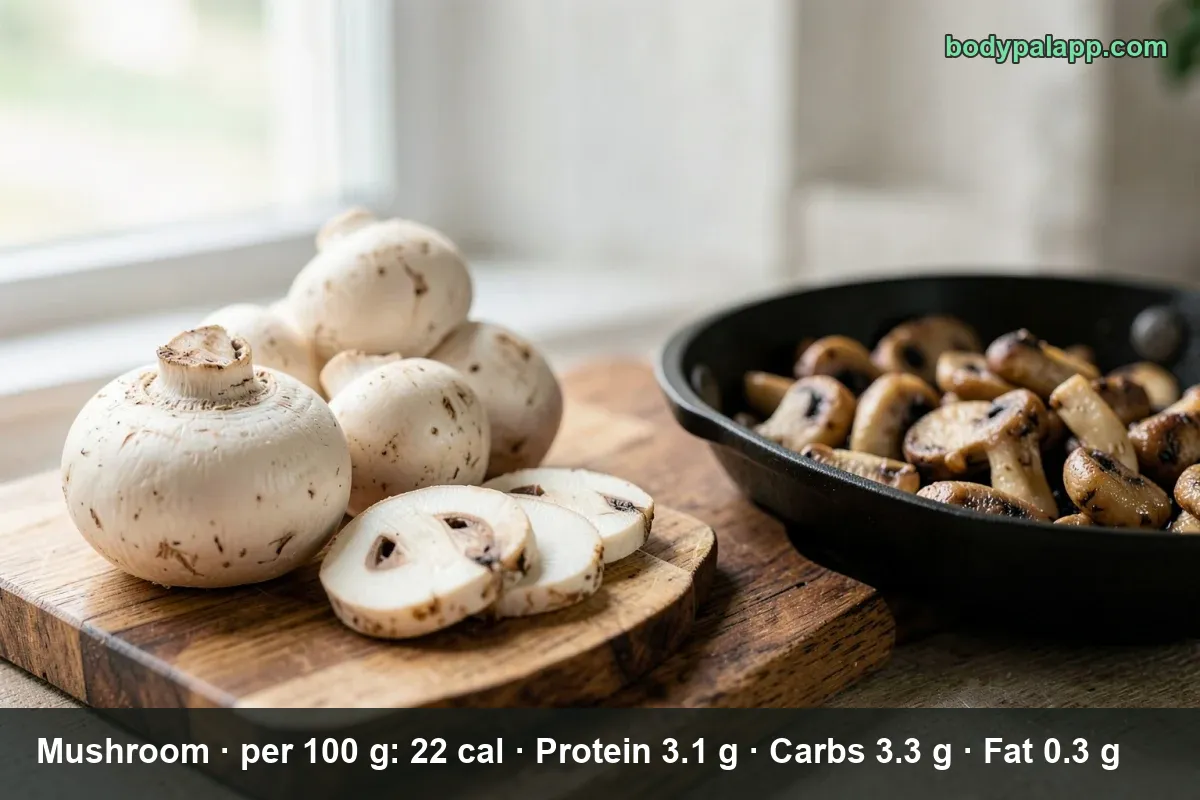
A cup of sliced raw white mushrooms weighs 70 g and carries just 15 calories. Per 100 g the count is 22 calories, which makes the button mushroom one of the lightest things you can pile on a plate. Almost all of that weight is water, and the calories follow it around.
On this page
- Mushroom quick facts
- US servings, from one button to a full cup
- Crimini, portabella, shiitake and oyster
- What cooking does to the calorie count
- Sodium is the row to watch
- How do mushrooms compare with other vegetables
- Most popular mushroom brands
- FAQ
Mushroom quick facts
The record behind this page is SR Legacy 169251, "Mushrooms, white, raw". That is the plain white button mushroom sold in a blue carton or loose by the pound, and it is what most people mean when they type the question. It is also the only mushroom record that carries both a full nutrient profile and real US household measures, which is why the cup and the single cap below have weights attached to them.
USDA also publishes a newer Foundation entry for white button mushrooms. Its calorie figure comes out higher on a fresh sample, and it ships without household portions, so mixing the two would only blur the number you are trying to log. One food, one record.
| Nutrient | Per 100 g | Per 1 cup sliced (70 g) | % Daily Value |
|---|---|---|---|
| Calories | 22 | 15 | — |
| Total fat | 0.34 g | 0.2 g | 0% |
| Saturated fat | 0.05 g | 0.0 g | 0% |
| Carbohydrate | 3.26 g | 2.3 g | 1% |
| Dietary fiber | 1 g | 0.7 g | 2% |
| Total sugars | 1.98 g | 1.4 g | — |
| Protein | 3.09 g | 2.2 g | 4% |
| Sodium | 5 mg | 4 mg | 0% |
% Daily Value is based on a 2,000-calorie diet.
Verified nutrition data
Numbers on this page come from USDA FoodData Central, the U.S. Department of Agriculture’s food composition database, and from manufacturer labels where a branded product is named. Last verified September 2026. How we verify our data →
Two label rows are missing on purpose. USDA does not publish added sugars or trans fat for fresh mushrooms in this record, so there is nothing honest to put in those cells. There is no vitamin D figure on this entry either, which is why you will not see one quoted here even though UV-treated mushrooms are sold on that promise. Cholesterol is 0 mg, and potassium is worth a mention: 318 mg per 100 g, 223 mg in a cup of slices, about 5% of the Daily Value.
US servings, from one button to a full cup
| Serving | Weight | Calories |
|---|---|---|
| 1 medium mushroom | 18 g | 4 kcal |
| 1 large mushroom | 23 g | 5 kcal |
| 1 oz | 28 g | 6 kcal |
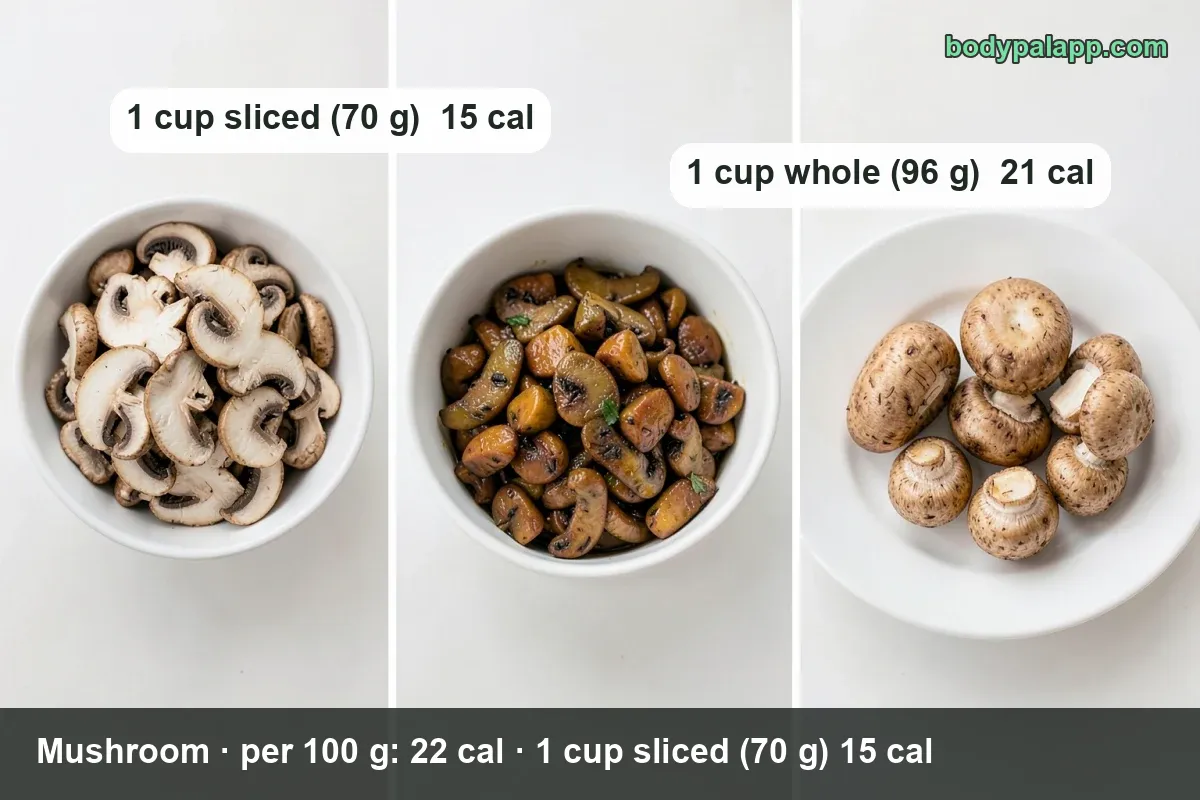
| 1 cup, sliced or pieces | 70 g | 15 kcal |
| 1 cup, whole | 96 g | 21 kcal |
| Per 100 g | 100 g | 22 kcal |
The cup rows and the single-cap rows are USDA household measures. The ounce row is our own arithmetic from the USDA 100 g figure, not a USDA serving.
Here is the trap nobody warns you about: a cup is not a cup. Sliced mushrooms do not pack tighter than whole caps, oddly enough, and the USDA weights bear it out. A cup of slices is 70 g; a cup of whole buttons is 96 g, because the caps sit with less air between them once you drop them in. That is 37% more weight for the same spoken measure, 15 calories against 21. At this calorie level the gap is small, but the same mistake on a denser food is how a log drifts.
The other useful anchor is the cap itself. A medium button is 4 calories and a large one is 5, so a handful tossed raw into a salad is under 20 and rounds to nothing in a day's total.
Crimini, portabella, shiitake and oyster
| Variety | Per 100 g | Serving | Calories |
|---|---|---|---|
| White button, raw | 22 kcal | 1 cup sliced (70 g) | 15 kcal |
| Crimini, baby bella, raw | 22 kcal | 1 oz (28 g) | 6 kcal |
| Portabella, raw | 22 kcal | 1 oz (28 g) | 6 kcal |
| Shiitake, raw | 34 kcal | 1 oz (28 g) | 10 kcal |
| Oyster, raw | 33 kcal | 1 cup sliced (86 g) | 28 kcal |
White, crimini and portabella are the same species at three ages, and USDA prices all three at 22 calories per 100 g. Paying more for baby bellas buys flavor and a firmer bite, not a different number. A portabella cap logs heavier only because it weighs more, not because the flesh is richer.
Shiitake and oyster are the two outliers in the table, at 34 and 33 calories per 100 g. Both hold less water and more carbohydrate than a button does, shiitake at 6.79 g per 100 g against 3.26 g. They also bring more fiber, 2.5 g and 2.3 g per 100 g, so on a grain bowl they earn their extra dozen calories. The ounce rows here are our own arithmetic from the USDA 100 g figures.
What cooking does to the calorie count
| Preparation | Per 100 g | Serving | Calories |
|---|---|---|---|
| Raw, white | 22 kcal | 1 cup sliced (70 g) | 15 kcal |
| Boiled, drained, no salt | 28 kcal | 100 g | 28 kcal |
| Canned, drained solids | 25 kcal | 1 cup (156 g) | 39 kcal |
| Cooked with oil | 70 kcal | 1 oz (28 g) | 20 kcal |
This is the single most useful table on the page. Raw and cooked are not the same food on a scale, and mushrooms shrink harder than almost anything else in the pan. Boiled and drained, they read 28 calories per 100 g rather than 22, and nothing was added: water left, so what remains is more concentrated per gram. Weigh mushrooms after cooking and you are weighing a denser food.
Sauteed is where the arithmetic really moves. USDA's record for fresh mushrooms cooked with oil lands at 70 calories per 100 g, a little over three times the raw figure, and fat climbs from 0.34 g to 4.05 g per 100 g. Mushrooms are sponges; whatever butter or oil hits the pan ends up inside them. An ounce of sauteed mushrooms is 20 calories, so the half-cup heaped next to a steak is closer to a condiment than a vegetable in accounting terms. If you want the volume without the oil, dry-sear them in a hot pan until they release their own water, then season at the end.
Canned mushrooms, drained, sit at 25 calories per 100 g, which puts a full 156 g cup at 39 calories. Store labels agree: jarred and canned sliced mushrooms in the USDA branded data run from 13 to 24 calories per 100 g, and a Pennsylvania Dutchman half-cup serving of 115 g is listed at 20 calories.
Sodium is the row to watch
Fresh mushrooms are practically sodium free, at 5 mg per 100 g and 4 mg in a cup of slices. The can changes that completely. Drained canned mushrooms carry 425 mg of sodium per 100 g, so one 156 g cup delivers 663 mg, which is 29% of the 2,300 mg Daily Value in a food that gives you 39 calories. That is roughly a quarter teaspoon of table salt hiding inside a vegetable most people log as free.
Sauteed mushrooms sit in between, at 148 mg per 100 g in the USDA record, most of it from the seasoning rather than the mushroom. None of this makes canned mushrooms a bad choice on a busy weeknight. It just means the calorie column is the wrong one to be watching here. If you are keeping sodium down, buy fresh, or drain and rinse the can before it goes in the pan.
The protein row deserves a nod too. At 3.09 g per 100 g, mushrooms carry more protein than most vegetables of the same weight, and MyPlate still counts them squarely in the vegetable group. A cup of slices is 2.2 g, or 4% of the Daily Value. Useful, not a protein source.
How do mushrooms compare with other vegetables
| Vegetable | Per 100 g | US serving | Calories |
|---|---|---|---|
| Mushrooms, white | 22 kcal | 1 oz (28 g) | 6 kcal |
| Cauliflower, raw | 25 kcal | 1 oz (28 g) | 7 kcal |
| Cabbage, raw | 25 kcal | 1 oz (28 g) | 7 kcal |
| Eggplant, raw | 25 kcal | 1 oz (28 g) | 7 kcal |
Our take: mushrooms are the lightest of these four per 100 g, and the margin over cauliflower, cabbage and eggplant is 3 calories in 100 g, which is noise. Pick between them on texture and on what you are cooking, not on the calorie column. Where mushrooms genuinely win is protein, 3.09 g per 100 g against 1.92 g for cauliflower and 0.98 g for eggplant, and where they genuinely lose is the frying pan, since eggplant and mushrooms are the two on this list that drink oil fastest. For volume on a weight-loss plate, raw or dry-seared mushrooms are the better pick; for satiety in a real meal, cook them with something and count the fat you used.
Most popular mushroom brands in the United States
Ranked by how widely each product appears among foods sold in the United States, from the BodyPal food database of over 3.3 million products. Calories are the figures printed on each Nutrition Facts label, checked against USDA FoodData Central.
| Product | Calories (per 100 g) |
|---|---|
| Giorgio Sliced Mushrooms | 14 cal |
| Pennsylvania Dutchman Sliced Mushrooms | 17 cal |
| Giorgio Sliced Mushrooms 3 oz | 24 cal |
| Giorgio Whole Sliced Mushrooms | 13 cal |
| Brandywine Sliced Button Mushrooms | 17 cal |
| Giorgio Organic Sliced Mushrooms | 13 cal |
Brand popularity: BodyPal food database. Nutrition: manufacturer labels / USDA FoodData Central.
Mushroom FAQs
How many calories are in one mushroom?
One medium white mushroom weighs 18 g and carries 4 calories; a large one at 23 g is 5. That is the whole cap, stem included, straight off the USDA record for raw white mushrooms at 22 calories per 100 g. Three large caps still land under 20 calories.
How many calories in 1 cup of sliced mushrooms?
A cup of sliced raw white mushrooms weighs 70 g and holds 15 calories. Watch the word cup, though: a cup of whole caps weighs 96 g and comes to 21. Same measure, same mushroom, 37 percent more weight on the scale.
How many calories in sauteed mushrooms?
Sauteed mushrooms run 70 calories per 100 g, a little over three times the 22 of the raw cap, and an ounce of them is 20. The mushroom did not change; the pan did. Fat climbs from 0.34 g to 4.05 g per 100 g, which is where the extra calories sit.
Do mushrooms have carbs?
Raw white mushrooms carry 3.26 g of carbohydrate per 100 g, and 1 g of that is fiber. A cup of slices is 2.3 g, about 1 percent of the 275 g Daily Value. Sugars sit at 1.98 g per 100 g and come from the mushroom itself.
How much protein is in mushrooms?
Raw white mushrooms give 3.09 g of protein per 100 g, so a cup of slices is 2.2 g, or 4 percent of the 50 g Daily Value. That is high for a vegetable this light on calories, but it is not a protein source; treat it as a bonus on top of the meat, beans or eggs.
Are canned mushrooms high in sodium?
Drained canned mushrooms hold 425 mg of sodium per 100 g against 5 mg raw, and a 156 g cup is 663 mg, 29 percent of the 2,300 mg Daily Value. Calories barely move, at 25 per 100 g. Rinsing the drained solids washes some of that salt off.
Are portabella mushrooms higher in calories than white mushrooms?
Both run 22 calories per 100 g, so no. An ounce of either is 6. Portabella is simply a crimini left to grow up, and crimini is 22 too. The cap is bigger and meatier, so a portabella serving usually weighs more, but per gram nothing changes.
Are mushrooms good for weight loss?
At 22 calories per 100 g, mushrooms are one of the cheapest ways to add volume to a plate; a whole cup of slices is 15. Swapping half the ground beef in a burger mix for chopped mushrooms is the standard trick. The catch is the pan: cooked in oil they hit 70 per 100 g.
Similar foods
- Asparagus — 20 cal per half cup
- Portobello Mushroom — 18 cal per whole cap
- Cabbage Boiled — 17 cal per half cup
- Cooked Cabbage — 17 cal per half cup
- Head Of Cabbage — 290 cal per head
- Steamed Cabbage — 17 cal per half cup
Count it without the math
Point the camera at the plate and BodyPal counts the mushrooms for you, pan oil and all.


Want the bigger picture? Calculate your daily calorie needs — your maintenance figure, a target for losing or gaining, and the date you get there.