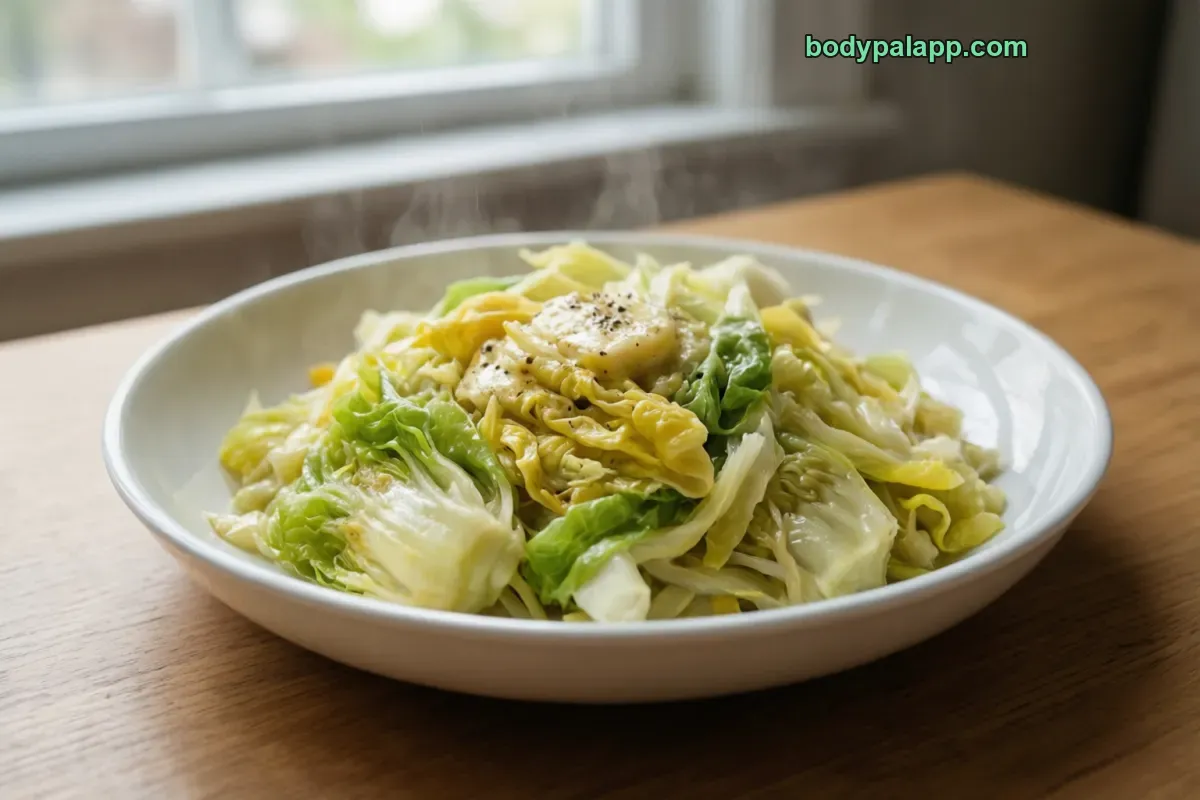
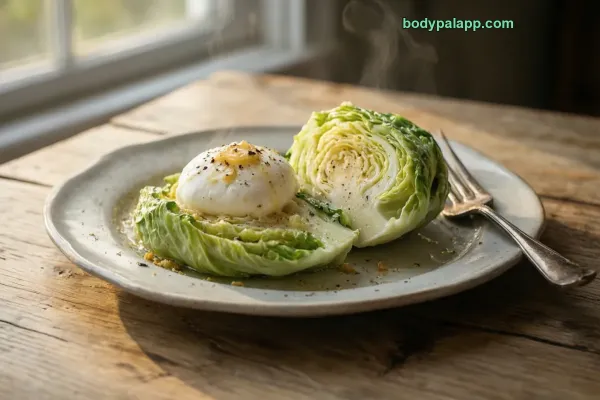
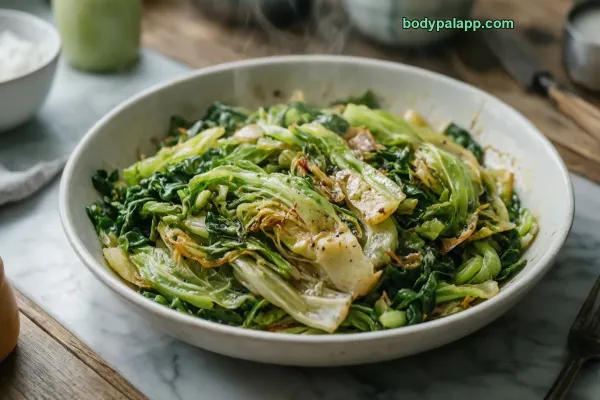
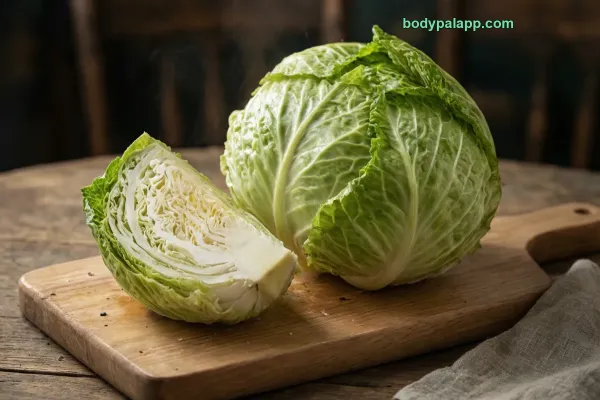
Steamed cabbage calories come to 17 for a half cup (75 g) and 23 per 100 g, cooked without salt. Portion size barely matters here. Even a heaping plate hardly moves your daily total. Carbs supply 80 percent of those few calories, and a good share of those carbs is fiber, not sugar.
17kcal
1 half cup · 75 g, cooked, unsalted
18%protein
1 gProtein
4 gCarbs
0 gFat
How to burn off 17 kcal
—Walking, brisk
—Jogging
—Cycling, moderate
—Swimming
Skip the math. BodyPal counts these calories from your steps and workouts automatically.
Nutrition facts
Cooked, unsalted · per 75 g
Calories
17 kcal
Protein
1 g
Carbohydrate
4.1 g
Fat
0 g
Saturated fat
0 g
Cholesterol
0 mg
Sodium
6 mg
Potassium
147 mg
Iron
0.1 mg
Source: USDA FoodData Central
🛡️
Verified nutrition data
Numbers on this page come from USDA FoodData Central, the U.S. Department of Agriculture’s food composition database, and from manufacturer labels where a branded product is named. Last verified September 2026. How we verify our data →
Steamed cabbage: calories, protein and sodium by serving
Percent of daily value uses the FDA reference of 2,000 kcal a day.
Serving
kcal
Protein
Carbs
Fat
Sodium
% DV kcal
Half cup (75 g)
17
1 g
4.1 g
0 g
6 mg
1%
100 g
23
1.3 g
5.5 g
0.1 g
8 mg
1%
Red variety (75 g)
22
1.1 g
5.2 g
0.1 g
21 mg
1%
Napa variety (109 g)
13
1.2 g
2.4 g
0.2 g
12 mg
1%
3 × Half cup (75 g)
52
2.9 g
18 mg
5 × Half cup (75 g)
86
4.8 g
30 mg
A heaping plate still lands under 100 calories
A half cup (75 g) is the standard side portion, and it carries 17 calories. Double it to 150 g and you reach 35 calories. Three half cups, or 225 g, come to 52 calories. Most foods jump fast as the scoop grows. Cabbage barely moves.
Go big with five half cups, 375 g, and the total is still only 86 calories. That much cabbage covers a dinner plate. The fat you cook it in will usually count for more than the vegetable does, so watch that part of the recipe.
Protein climbs slowly as the pile grows: 1 g in a half cup, 1.9 g in two, 4.8 g in five. Sodium rises just as gently, from 6 mg per half cup to 30 mg in the largest portion, because the USDA figure assumes no salt in the pot. Whatever you add while cooking sets the real sodium number.
Carbs supply 80 percent of the calories
Per 100 g, steamed cabbage has 5.5 g of carbohydrate, 1.3 g of protein and 0.1 g of fat. Split by calories, that comes to 80 percent carbs, 18 percent protein and 2 percent fat. Fat hardly shows up at all, with 0 g of saturated fat and 0 mg of cholesterol.
The carbs are not mostly sugar. Of the 5.5 g, 2.8 g are sugars and 1.9 g are fiber, so a large part of the carbohydrate is bulk. In a half cup that works out to 1.4 g of fiber and 2.1 g of sugars, against a fiber daily value of 28 g.
Protein looks decent as a percentage, but the grams are small. A half cup gives 1 g, about 2 percent of the daily value. Cabbage adds volume, not protein. Put it next to something that brings the protein and let the cabbage fill the rest of the plate.
Red and napa cabbage shift the numbers slightly
The USDA keeps separate rows for other varieties, and they differ a little. A 75 g portion of cooked red cabbage has 22 calories, against 17 for the same weight of steamed green cabbage. Red also brings 2 g of fiber and 2.5 g of sugars. Its sodium is higher, at 21 mg.
Napa cabbage is the lightest of the three. A 109 g serving has 13 calories, 2.4 g of carbs and 1.2 g of protein. You get a bigger portion for fewer calories than a half cup of green, which makes napa the pick if you want maximum volume.
Steaming and boiling look identical in the data. Both use the same cooked, drained, unsalted USDA row at 23 calories per 100 g, so choose the method by texture. Steamed leaves keep more bite. Boiled ones turn softer and sweeter, and neither choice changes the calorie count.
Steamed cabbage frees up room on the plate
A half cup is only 1 percent of the daily value for calories, so steamed cabbage works best as the bulk of a meal rather than a garnish. Serve it next to chicken, fish, eggs or beans, and let the cabbage take the space a second helping of starch might fill.
Watch the extras. Butter, bacon drippings or a creamy sauce can easily outweigh the cabbage itself, so log those separately if you count calories. Vinegar, mustard, black pepper or caraway add flavor and change the numbers very little.
Each 100 g also brings 196 mg of potassium, against a daily value of 4700 mg, while sodium stays at 8 mg until you salt it. If you track meals in BodyPal, you can log a plate of cabbage from a photo and adjust the portion afterward.
How does steamed cabbage compare?
Here is steamed cabbage next to boiled, cooked and green cabbage, compared per 100 g and per usual serving.
Verdict: Steamed, boiled and cooked cabbage are the same food in the data, at 17 calories per half cup and 23 per 100 g, so pick whichever method you enjoy. Green cabbage runs about 1.3 times higher by weight at 31 per 100 g, but its 1 cup (90 g) serving is still just 28 calories, so texture should decide, not calories.
Steamed cabbage FAQs
How many calories are in steamed cabbage?
A half cup of shredded steamed cabbage is about 17 calories, and 100 g comes to 23 calories.
Is steamed cabbage good for weight loss?
A half-cup serving holds 17 calories and 1.4 g of fiber, and 100 g carries 0.06 g of fat, so it adds volume to a plate for very few calories.
Steamed cabbage vs green cabbage: which is lower in calories?
Steamed cabbage is 23 calories per 100 g, while green cabbage is listed at 31 calories per 100 g.
How many carbs are in steamed cabbage?
Per 100 g there are 5.5 g of carbs, including 2.8 g sugars and 1.9 g fiber. A half cup (75 g) has 4.1 g of carbs.
How many calories are in a large plate of steamed cabbage?
Five half cups, or 375 g, come to 86 calories. That full plate also carries 4.8 g of protein and 30 mg of sodium when the cabbage is cooked without salt.
Is steamed cabbage high in sodium?
No. A half cup has 6 mg of sodium, 0 percent of the 2300 mg daily value, because the USDA figure is unsalted. Salt, broth or soy sauce added during cooking will raise it.
How much fiber is in steamed cabbage?
A half cup (75 g) has 1.4 g of fiber, and 100 g has 1.9 g, against a daily value of 28 g. Cooked red cabbage is slightly higher at 2 g per 75 g.
Does steamed cabbage have any fat or cholesterol?
Almost none. Per 100 g it has 0.1 g of fat, 0 g of saturated fat and 0 mg of cholesterol, so fat supplies only 2 percent of its calories.
Is cooked red cabbage higher in calories than green?
Slightly. Cooked red cabbage has 22 calories per 75 g, while steamed green cabbage has 17 for the same weight. Red also carries more sodium, 21 mg versus 6 mg.