
How many calories are in an artichoke?
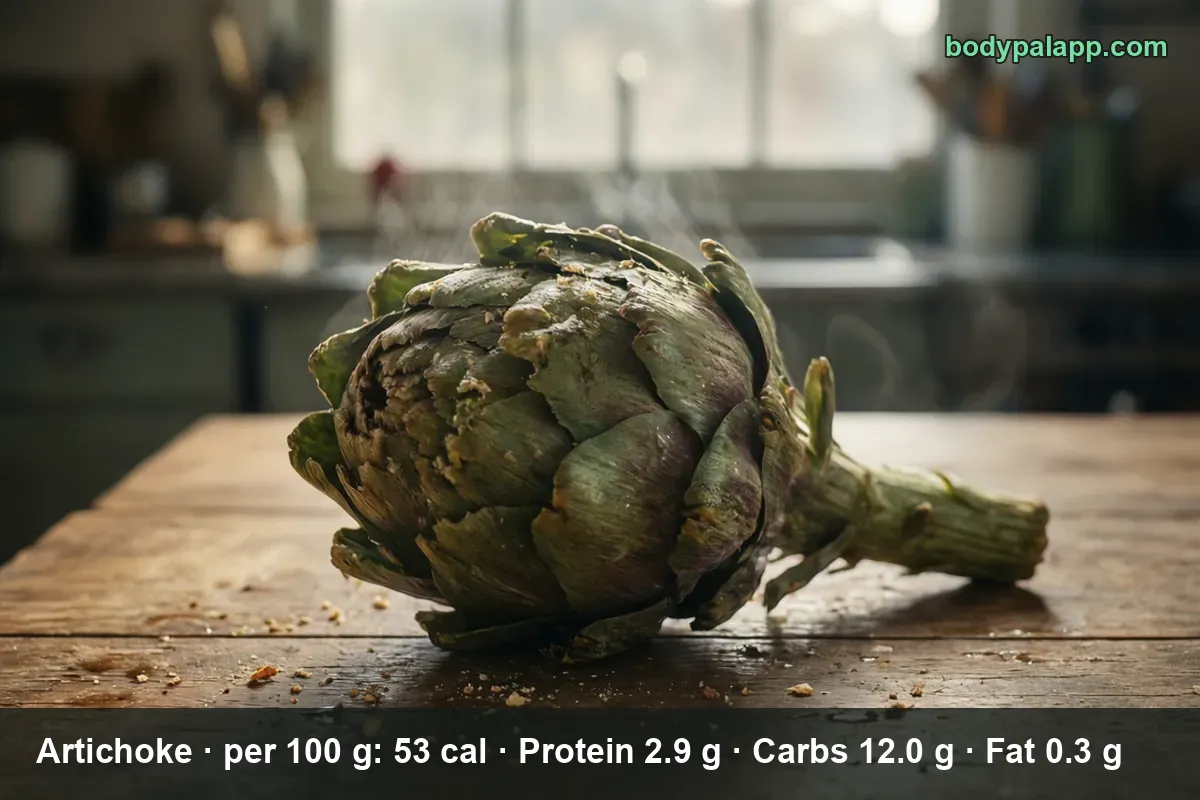
One whole cooked artichoke, about 125 g of edible flesh once you've worked through the leaves, carries 66 calories. Per 100 g the same artichoke runs 53 calories, which puts it in the lightest tier of vegetables that still feel like a meal. The fiber is what makes it unusual.
On this page
- Artichoke quick facts
- US servings from one heart to a full cup
- Every form artichoke comes in
- Fiber is the row that earns its keep
- How does artichoke compare?
- Most popular artichoke brands
- Artichoke FAQs
Artichoke quick facts
The row on this page is FNDDS 2709766, "Artichoke" — the artichoke as people actually eat it, boiled and drained, with household measures attached to it. Its numbers match SR Legacy 168386, the entry for globe artichokes cooked, boiled and drained without salt, so the two agree to the decimal.
That matters more here than with most vegetables, because an artichoke is a food you cook before you weigh it. The raw record exists and is listed further down, but almost nobody logs a raw one.
| Nutrient | Per 100 g | Per 1 whole artichoke (125 g) | % Daily Value |
|---|---|---|---|
| Calories | 53 | 66 | — |
| Total fat | 0.34 g | 0.4 g | 1% |
| Saturated fat | 0.08 g | 0.1 g | 0% |
| Carbohydrate | 11.95 g | 14.9 g | 5% |
| Dietary fiber | 5.7 g | 7.1 g | 25% |
| Total sugars | 0.99 g | 1.2 g | — |
| Protein | 2.89 g | 3.6 g | 7% |
| Sodium | 60 mg | 75 mg | 3% |
% Daily Value is based on a 2,000-calorie diet.
Verified nutrition data
Numbers on this page come from USDA FoodData Central, the U.S. Department of Agriculture’s food composition database, and from manufacturer labels where a branded product is named. Last verified September 2026. How we verify our data →
There is no added-sugars row and no trans-fat row on this page: this FNDDS edition does not publish either for a plain boiled vegetable, and neither belongs in a food that is nothing but the plant and water. Cholesterol is 0 mg, as it is in every vegetable. Potassium comes to 286 mg per 100 g, or 358 mg in a whole artichoke — 8% of the 4,700 mg Daily Value, quietly respectable for something this light. The 1.2 g of total sugars is the plant's own; total sugars carry no Daily Value on the US label, so that cell stays empty.
US servings from one heart to a full cup
| Serving | Weight | Calories |
|---|---|---|
| 1 heart | 30 g | 16 kcal |
| 1 oz | 28 g | 15 kcal |
| Quantity not specified | 75 g | 40 kcal |
| One whole artichoke | 125 g | 66 kcal |
| 1 cup | 150 g | 80 kcal |
| Per 100 g | 100 g | 53 kcal |
The whole artichoke, the cup and the single heart are USDA household measures attached to the record, along with the odd-sounding "quantity not specified" at 75 g, which is what the database uses when a survey respondent said "an artichoke" and nothing more. The 1 oz line is our own arithmetic from the USDA 100 g figure, not a USDA serving — useful only if you are weighing hearts on a kitchen scale.
Two of those measures trip people up. A whole artichoke bought at the store weighs far more than 125 g, often twice that, because most of what you carry home is inedible leaf and choke. The 125 g is the part that ends up in you. And the cup at 150 g is a cup of cooked pieces, not a cup of whole artichokes — nobody fits one of those in a measuring cup.
Every form artichoke comes in
| Version | Per 100 g | Typical portion | Calories |
|---|---|---|---|
| Raw, globe | 47 kcal | 1 medium, 128 g | 60 kcal |
| Boiled, no salt | 53 kcal | 1 whole, 125 g | 66 kcal |
| Boiled with salt | 51 kcal | 1 medium, 120 g | 61 kcal |
| Boiled hearts | 51 kcal | 1/2 cup, 84 g | 43 kcal |
| Frozen, cooked, no salt | 45 kcal | 1 cup, 168 g | 76 kcal |
| Frozen, unprepared | 38 kcal | 9 oz package, 255 g | 97 kcal |
| Spinach and artichoke dip | 329 kcal | 100 g | 329 kcal |
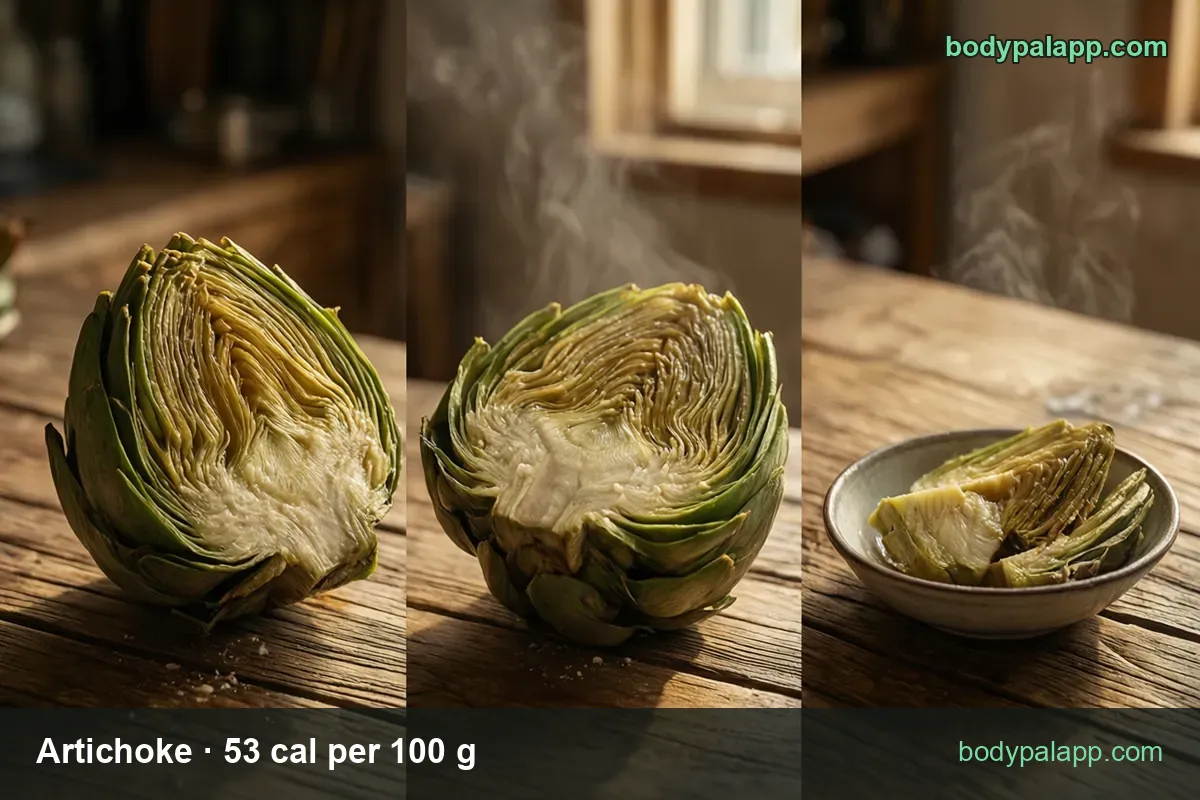
Raw looks lighter per 100 g at 47 calories, and it is, but only because raw flesh holds more water. Weigh the food instead of the gram column and the gap closes to nothing: one medium raw artichoke of 128 g is 60 calories, one medium boiled of 120 g is 61. Boiling concentrates, it does not add.
Frozen hearts sit lower again — 45 calories per 100 g cooked from frozen, 76 for a full cup — because they are packed with more water still. A whole 9 oz package, unprepared, is 97 calories, which makes frozen artichoke one of the cheapest bulk additions to a pasta dish you can find.
The dip is a different food wearing the same name. At 329 calories per 100 g it is more than six times the vegetable, and the cream and cheese it is built on are doing all of that. Stuffed artichokes land in between at 160 calories per 100 g — three times the plain version, with 404 mg of sodium per 100 g against 60 — because breadcrumbs and oil go in before the artichoke goes in the oven.
Jarred and canned hearts are worth knowing by the label. Hearts canned in water run 27 to 30 calories per 100 g on US brands, so a half-cup drained serving of 130 g is 35 to 39 calories; quartered and jumbo canned styles are heavier at 58 to 62 calories per 100 g, up to 139 calories for a whole drained can of 240 g. Marinated hearts in oil are 67 to 83 calories per 100 g, though the serving is tiny — two to three pieces of 30 g, 20 to 25 calories.
Fiber is the row that earns its keep
Look down the % Daily Value column and one number stands out. Of the eight rows in the table, fiber is the only one above 10%: 7.1 g in a whole artichoke, 25% of the FDA's 28 g Daily Value. Fat is 1%, sodium 3%, carbohydrate 5%, protein 7%.
Push that to a full cup of cooked pieces, 150 g, and you get 8.6 g of fiber — 31% of the day, our own arithmetic from the USDA 100 g figure — for 80 calories. Almost a third of your fiber for less than a hundred calories is a ratio very few foods manage, and it is the reason artichokes show up on so many high-fiber lists in MyPlate's vegetable guidance.
The trap is not the artichoke. It is the water and the jar. USDA lists artichokes boiled with salt at 296 mg of sodium per 100 g against 60 mg without, so salting the pot takes a 120 g medium from roughly 72 mg to 355 mg — 15% of the 2,300 mg Daily Value, from one vegetable. Add oil-packed hearts at 67 to 83 calories per 100 g and butter for dipping, and the 66-calorie vegetable is no longer the light part of the plate. If you are watching sodium, boil it plain and finish it with lemon.
How does artichoke compare?
| Vegetable | Per 100 g | Protein | Carbohydrate | Fat |
|---|---|---|---|---|
| Artichoke, boiled | 53 kcal | 2.89 g | 11.95 g | 0.34 g |
| Beets, cooked | 53 kcal | 0.89 g | 7 g | 2.69 g |
| Snow peas, cooked from frozen | 52 kcal | 3.49 g | 8.99 g | 0.38 g |
| Kohlrabi, cooked | 51 kcal | 1.72 g | 6.26 g | 2.75 g |
Household gram weights are not published for these three records, so the comparison runs on 100 g across the board.
Our take: these four vegetables are effectively the same calorie, 51 to 53 per 100 g, and choosing between them on energy is pointless. What separates them is what fills the gram. Artichoke carries the most carbohydrate of the four at 11.95 g and the least fat at 0.34 g, and most of that carbohydrate is fiber rather than starch — which is why it satisfies longer than beets or kohlrabi at an identical calorie count. Snow peas beat it on protein, 3.49 g against 2.89 g. For volume and staying power per calorie, the artichoke wins the group.
Most popular artichoke brands in the United States
Ranked by how widely each product appears among foods sold in the United States, from the BodyPal food database of over 3.3 million products. Calories are the figures printed on each Nutrition Facts label, checked against USDA FoodData Central.
| Product | Calories (per 100 g) |
|---|---|
| Roland Artichoke Hearts | 27 cal |
| Progresso Artichoke Hearts | 30 cal |
| Roland Jumbo Whole Artichoke Hearts | 58 cal |
| Roland Quartered Artichoke Hearts | 62 cal |
| Roland Marinated Artichoke Hearts | 67 cal |
| Mezzetta Marinated Artichoke Hearts | 83 cal |
Brand popularity: BodyPal food database. Nutrition: manufacturer labels / USDA FoodData Central.
Artichoke FAQs
How many calories are in one whole artichoke?
66 calories for a whole cooked globe artichoke of 125 g, at 53 calories per 100 g. That is the USDA figure for artichoke boiled without salt, drained. A medium one boiled in salted water is close behind at 61 calories, since salt adds sodium and not energy.
How many calories are in artichoke hearts?
One boiled heart of 30 g is 16 calories, and half a cup of boiled hearts, 84 g, is 43. Canned hearts packed in water are lighter still, 27 to 30 calories per 100 g on US labels, because the can holds more brine and less dense flesh.
Are artichokes good for weight loss?
A whole one is 66 calories with 7.1 g of fiber, 25% of the 28 g Daily Value. Few foods give a quarter of your fiber for that little energy. If you are watching calories, keep it boiled and lemon-dressed; the dip version runs 329 calories per 100 g.
How much fiber is in an artichoke?
7.1 g in a whole 125 g artichoke, which is 25% of the 28 g Daily Value, and 5.7 g per 100 g. A full cup of cooked pieces, 150 g, works out to 8.6 g, or 31% of the day, our own arithmetic from the USDA 100 g figure.
Do marinated artichoke hearts have more calories?
Yes, two to three times as many per 100 g. Marinated hearts in oil run 67 to 83 calories per 100 g on US labels, against 27 to 30 for hearts canned in water. Servings are small, so two marinated pieces come to 20 calories and three to 25.
Are canned artichoke hearts high in sodium?
USDA lists artichokes boiled with salt at 296 mg of sodium per 100 g against 60 mg without, so salt is the variable and not the calories. A 120 g medium goes from about 72 mg to 355 mg, 15% of the 2,300 mg Daily Value. Canned brands vary; read the can.
How many carbs are in an artichoke?
14.9 g of total carbohydrate in a whole 125 g artichoke, 5% of the Daily Value, and 11.95 g per 100 g. Fiber accounts for 7.1 g of that, so the net figure is about 7.8 g, our own subtraction rather than a USDA number. Total sugars are only 1.2 g.
Raw or cooked artichoke, which has more calories?
Cooked is denser per 100 g, 53 against 47 raw, but on the plate they land in the same place: one medium raw artichoke of 128 g is 60 calories and one medium boiled of 120 g is 61. Boiling drives off water and shrinks the weight; it does not add energy.
Similar foods
- Acorn Squash — 115 cal per cup
- Greek Salad — 50 cal per cup
- Fruit Salad — 89 cal per cup
- Butternut Squash — 63 cal per cup cubed
- Carrot — 53 cal per cup chopped
- Cooked Onions — 92 cal per cup
Count it without the math
Point the camera at the plate and BodyPal counts the artichoke for you, hearts and all.


How long does it take to burn off artichoke?
One whole artichoke (125 g) is 66 kcal. Enter your weight and the amount you ate to see how long it takes you to burn that off:
lb
| Activity | Time to burn 66 kcal |
|---|---|
| Walking, brisk | 13 min |
| Cycling, moderate | 8 min |
| Swimming, moderate | 9 min |
| Jogging | 8 min |
| Weight training, moderate | 15 min |
Times are for a 155 lb adult at a steady pace; change the weight to see yours. The amount is set to the portion in the text (125 g); change it to what you actually ate. BodyPal works this out from your steps automatically.
One food is easy to picture; a whole day is harder. See how many calories you need a day and what a deficit actually looks like.