
How many calories are in a Yukon Gold potato?
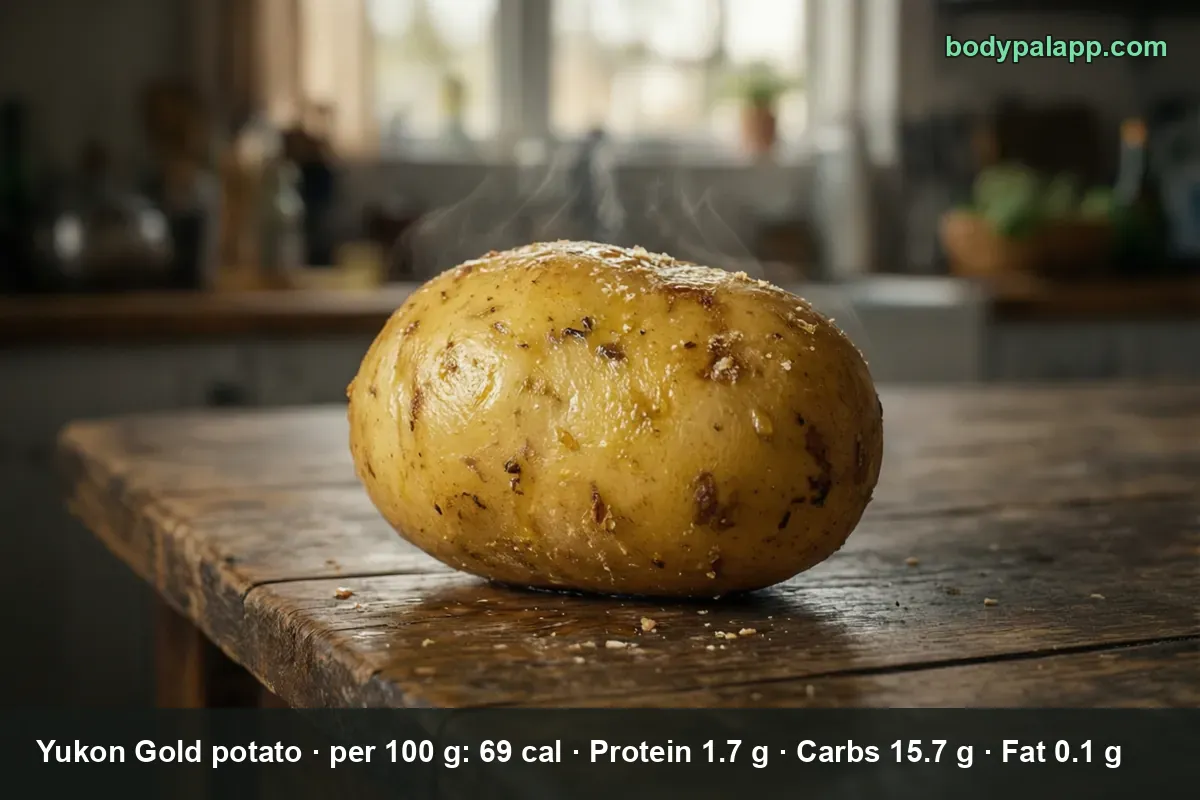
One medium Yukon Gold potato weighs 213 g and carries 147 calories. Per 100 g, raw flesh and skin come to 69 calories. That is a starchy vegetable priced like a light snack: a small potato lands at 63, a large one at 255, and the fat never climbs above 0.2 g.
On this page
- Yukon Gold potato quick facts
- US servings, from one ounce to a large potato
- Baked, diced and red: the versions people actually log
- Potassium and fiber are the rows worth reading
- How does a Yukon Gold potato compare?
- Most popular yukon gold potato brands
- FAQ
Yukon Gold potato quick facts
USDA does not publish a row for the Yukon Gold variety by name. The yellow-fleshed potato you pick up at the store sits inside the SR Legacy record 170028, "Potatoes, white, flesh and skin, raw", which measures the whole potato with the peel on. That is the food a shopper is actually holding, so it anchors this page. The baked record is a preparation, not a different source, and it gets its own section further down.
| Nutrient | Per 100 g | Per one medium potato (213 g) | % Daily Value |
|---|---|---|---|
| Calories | 69 | 147 | — |
| Total fat | 0.1 g | 0.2 g | 0% |
| Saturated fat | 0.03 g | 0.1 g | 0% |
| Carbohydrate | 15.71 g | 33.5 g | 12% |
| Dietary fiber | 2.4 g | 5.1 g | 18% |
| Total sugars | 1.15 g | 2.4 g | — |
| Protein | 1.68 g | 3.6 g | 7% |
| Sodium | 16 mg | 34 mg | 1% |
| Cholesterol | 0 mg | 0 mg | 0% |
| Potassium | 407 mg | 867 mg | 18% |
% Daily Value is based on a 2,000-calorie diet.
Verified nutrition data
Numbers on this page come from USDA FoodData Central, the U.S. Department of Agriculture’s food composition database, and from manufacturer labels where a branded product is named. Last verified September 2026. How we verify our data →
Two rows you would see on a package are missing here on purpose. The SR Legacy edition does not carry added sugars or trans fat for this record, and a raw potato has neither a sweetener nor a hydrogenated fat to declare. The 1.15 g of total sugars per 100 g is the potato's own, which is why that cell shows a dash: total sugars have no Daily Value on the FDA label reference.
US servings, from one ounce to a large potato
The word "potato" is doing a lot of work in most food diaries. USDA sizes the raw potato three ways, and the gap between the ends is bigger than most people expect.
| Serving | Weight | Calories |
|---|---|---|
| 1 oz | 28 g | 20 kcal |
| One small potato, 1-3/4 to 2-1/4 inches | 92 g | 63 kcal |
| One medium potato, 2-1/4 to 3-1/4 inches | 213 g | 147 kcal |
| One large potato, 3 to 4-1/4 inches | 369 g | 255 kcal |
| Half a cup, diced raw | 75 g | 52 kcal |
| Per 100 g | 100 g | 69 kcal |
The small, medium, large and half-cup lines are USDA household measures for record 170028. The 1 oz line is our own arithmetic from the USDA 100 g figure, not a USDA serving, and it is there because deli counters and grocery scales still speak in ounces.
Look at the spread: a small potato at 63 and a large one at 255 differ by a factor of four, and both get logged with the same three words. A grocery-store Yukon Gold usually lands near the medium line, because the variety is sold in bags of round, hand-sized tubers rather than the long baking potatoes sold loose. If you are logging from a bag, weigh one potato once and reuse the number all week.
Baked, diced and red: the versions people actually log
| Version | Per 100 g | Typical piece | Calories |
|---|---|---|---|
| Baked, medium potato | 92 kcal | one medium baked potato, 173 g | 159 kcal |
| Baked, large potato | 92 kcal | one large baked potato, 299 g | 275 kcal |
| Baked, small potato | 92 kcal | one small baked potato, 138 g | 127 kcal |
| Raw, diced | 69 kcal | half a cup, 75 g | 52 kcal |
| Raw, large potato | 69 kcal | one large potato, 369 g | 255 kcal |
| Red potato, raw | 70 kcal | 1 oz, 28 g | 20 kcal |
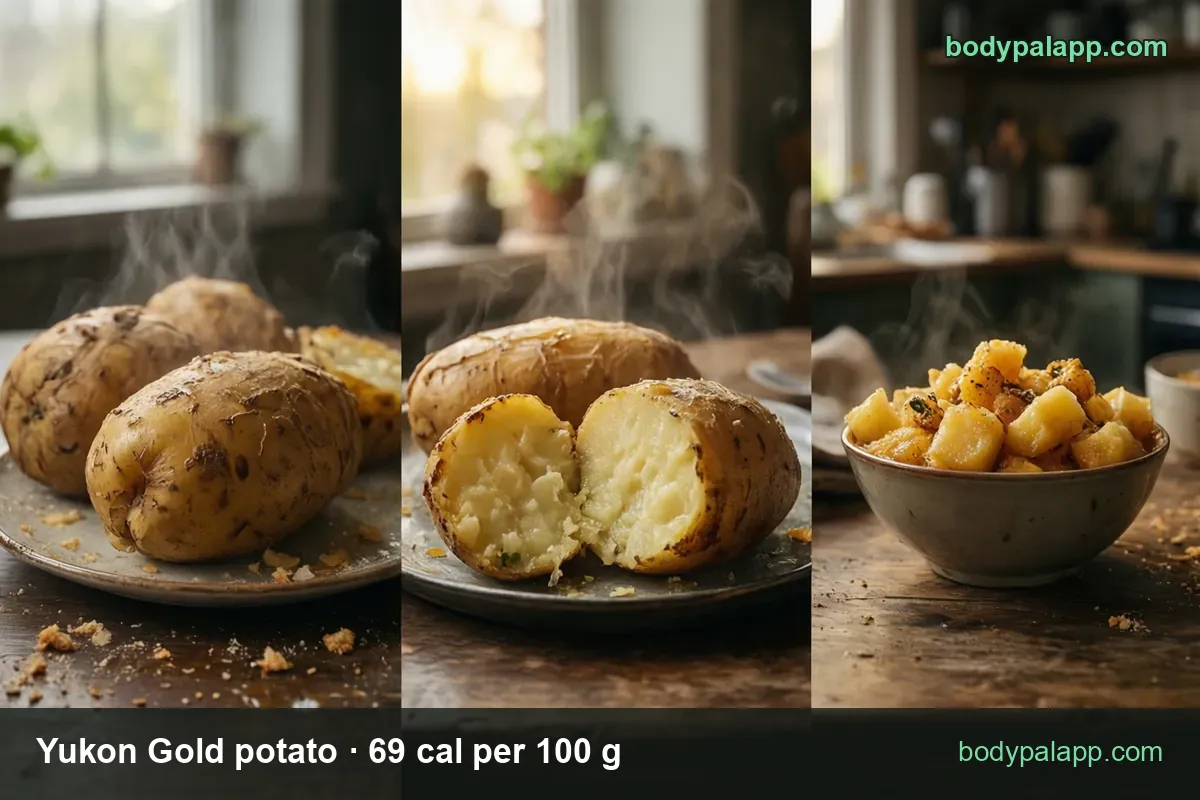
Baking is where the arithmetic trips people up. On paper the number jumps from 69 to 92 calories per 100 g, a 33% rise, and it looks like the oven added something. It did not. The oven removed water, so the same potato weighs less and every remaining gram is denser. USDA's baked record 170434 puts a medium baked potato at 173 g, against 213 g raw.
Run it through: 147 calories raw, 159 baked. Twelve calories, all of it rounding and sizing rather than energy conjured by heat. The honest way to log a baked Yukon Gold is to weigh it raw and use 69 per 100 g, or weigh it after the oven and use 92. Do one or the other, never both.
Diced is the other trap. Half a cup of raw dice is 75 g and 52 calories, which is less than a small potato. Cups measure air as much as food, so a loosely filled cup of chunky dice and a tightly packed cup of fine dice are not the same log entry.
Red potatoes sit close enough to be interchangeable in a diary: record 170029 gives 70 calories per 100 g against 69 for white and yellow flesh. One calorie per 100 g is noise, not a decision.
Potassium and fiber are the rows worth reading
Two numbers on this page are doing more than the calorie count. A medium potato carries 867 mg of potassium, which is 18% of the 4,700 mg Daily Value, and 5.1 g of fiber, also 18% of the 28 g Daily Value. Very few 147-calorie foods hit 18% of anything twice.
The sodium row runs the other way. The potato itself brings 34 mg per medium tuber, 1% of the day. That is less than a fiftieth of a teaspoon of table salt. Everything salty about a potato dinner arrives at the stove or the table, which is a useful thing to know if you are watching sodium: the vegetable is not the problem, the seasoning and the toppings are.
Fat stays at 0.2 g per medium potato, 0% DV, and saturated fat at 0.1 g. Butter, oil and sour cream can multiply a potato's calories several times over while the potato's own contribution never moves. MyPlate counts potatoes in the vegetable group as a starchy vegetable, which is the right mental filing: treat it as the carbohydrate on the plate, not as a free side.
How does a Yukon Gold potato compare?
| Food | Per 100 g | US serving | Calories |
|---|---|---|---|
| Yukon Gold potato, raw | 69 kcal | one medium potato, 213 g | 147 kcal |
| White potato, baked | 92 kcal | one medium potato, 173 g | 159 kcal |
| Red potato, raw | 70 kcal | 1 oz, 28 g | 20 kcal |
| Mountain yam, raw | 67 kcal | 1 oz, 28 g | 19 kcal |
The two 1 oz lines are our own arithmetic from the USDA 100 g figures, scaled so the starchy roots can be read side by side. Of the four rows, only the mountain yam is lighter per 100 g, and it beats the potato by two calories.
Our take: at this density, the variety of potato is not a decision worth agonizing over. For weight loss, the raw medium at 147 calories with 5.1 g of fiber is a genuinely efficient carbohydrate, and the lever that matters is what goes on top, not whether the flesh is gold, white or red. For staying full on the fewest calories, keep the skin on and bake rather than fry, because the peel is where a good share of that fiber lives. The only version that changes the math is the one that arrives swimming in fat.
Most popular yukon gold potato brands in the United States
Ranked by how widely each product appears among foods sold in the United States, from the BodyPal food database of over 3.3 million products. Calories are the figures printed on each Nutrition Facts label, checked against USDA FoodData Central.
| Product | Calories (per 100 g) |
|---|---|
| Open Acres Yukon Gold Potatoes | 74 cal |
| Harvest Club Yukon Gold Potatoes | 74 cal |
| Brookshire's Yukon Gold Potatoes | 74 cal |
Brand popularity: BodyPal food database. Nutrition: manufacturer labels / USDA FoodData Central.
Yukon Gold potato FAQs
How many calories are in a medium Yukon Gold potato?
147 calories for a medium potato of 213 g, raw with the skin on, at 69 calories per 100 g. A small potato of 92 g is 63 calories and a large one of 369 g is 255. Those are USDA household sizes, so weigh yours once to see where it lands.
How many carbs are in a Yukon Gold potato?
33.5 g of carbohydrate in a medium 213 g potato, which is 12% of the Daily Value, from 15.71 g per 100 g. Of that total, 5.1 g is fiber and only 2.4 g is naturally occurring sugar. A small potato brings roughly 14 g of carbohydrate.
Does baking a Yukon Gold potato add calories?
No: baking moves the figure from 69 to 92 calories per 100 g only because water evaporates and the potato weighs less. A medium raw potato is 147 calories at 213 g; a medium baked potato is 159 calories at 173 g. Toppings add calories, the oven does not.
Are Yukon Gold potatoes lower in calories than russet potatoes?
No meaningful difference: USDA publishes no separate russet or Yukon Gold record, so both fall under the same white-potato entry at 69 calories per 100 g with skin. The red-potato record is 70. Variety changes texture and flavor far more than it changes calories.
How much potassium is in a Yukon Gold potato?
867 mg in a medium 213 g potato, or 18% of the 4,700 mg Daily Value, from 407 mg per 100 g. A small 92 g potato still delivers around 375 mg. Potassium sits mostly under the skin, so peeling a potato costs you some of it.
How many calories are in a cup of diced Yukon Gold potatoes?
52 calories for the USDA half-cup of raw dice at 75 g, so a full cup runs about 104 calories at 150 g. That full-cup figure is our own arithmetic from the USDA half-cup, not a USDA serving. Packing the cup tightly can push it noticeably higher.
Do Yukon Gold potatoes have fiber in the skin?
5.1 g of fiber in a medium 213 g potato, 18% of the Daily Value, measured with flesh and skin together. USDA publishes no peeled row for this record, so there is no exact peeled figure to quote here. Leaving the skin on is the simplest way to keep that fiber.
Are Yukon Gold potatoes good for weight loss?
At 69 calories per 100 g and 147 for a medium potato, they are one of the cheaper starches on the plate, with 5.1 g of fiber and 0.2 g of fat. The calories climb with butter, oil and frying, not with the potato. Weigh it and keep the toppings light.
Similar foods
- Peppermint — 2 cal for 2 tbsp chopped
- Corn — 111 cal per cup
- Corn Canned — 111 cal per cup
- Garden Salad — 180 cal per salad
- White Sweet Potato — 115 cal per medium sweet potato
- Caesar Salad — 61 cal per cup
Count it without the math
Point the camera at the plate and BodyPal counts the potato for you, skin, toppings and all.


How long does it take to burn off 147 kcal of Yukon Gold potato?
One medium potato (213 g) is 147 kcal. Enter your weight and the amount you ate to see how long it takes you to burn that off:
lb
| Activity | Time to burn 147 kcal |
|---|---|
| Walking, brisk | 29 min |
| Cycling, moderate | 18 min |
| Swimming, moderate | 21 min |
| Jogging | 17 min |
| Weight training, moderate | 33 min |
Times are for a 155 lb adult at a steady pace; change the weight to see yours. The amount is set to the portion in the text (213 g); change it to what you actually ate. BodyPal works this out from your steps automatically.
Want the bigger picture? Calculate your daily calorie needs — your maintenance figure, a target for losing or gaining, and the date you get there.