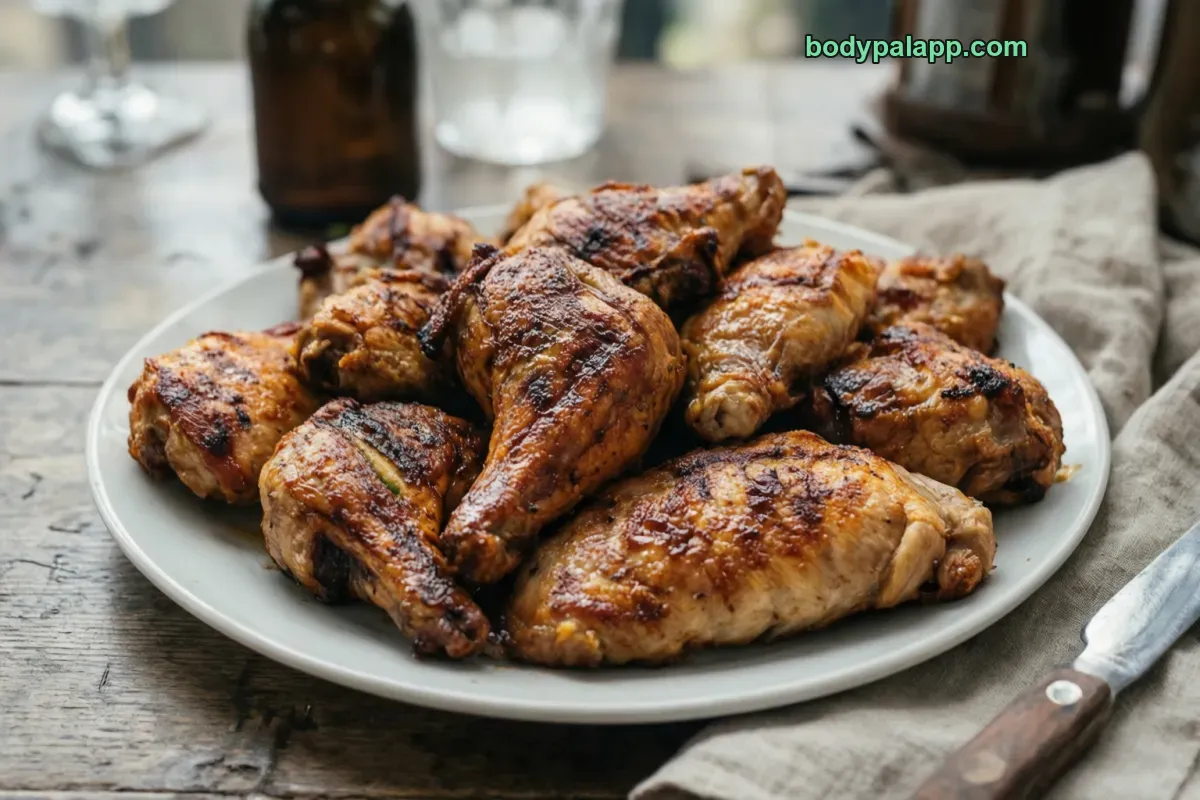
Grilled chicken calories come to 152 for a 3 oz portion (85 g) and 179 per 100 g, cooked without sauce. Protein supplies 62% of those calories, so one 3 oz serving gives you 22.7 g of protein, 45% of the daily value, for only 8% of a day's calories. Watch the sodium, which is higher than most people expect.
152kcal
1 3 oz portion · 85 g, grilled, no sauce
62%protein
23 gProtein
0 gCarbs
6.1 gFat
How to burn off 152 kcal
—Walking, brisk
—Jogging
—Cycling, moderate
—Swimming
Skip the math. BodyPal counts these calories from your steps and workouts automatically.
Nutrition facts
Grilled, no sauce · per 85 g
Calories
152 kcal
Protein
23 g
Carbohydrate
0 g
Fat
6.1 g
Saturated fat
1.4 g
Cholesterol
95 mg
Sodium
328 mg
Potassium
258 mg
Iron
0.7 mg
Source: USDA FoodData Central
🛡️
Verified nutrition data
Numbers on this page come from USDA FoodData Central, the U.S. Department of Agriculture’s food composition database, and from manufacturer labels where a branded product is named. Last verified October 2026. How we verify our data →
Grilled chicken: calories, protein and sodium by serving
Percent of daily value uses the FDA reference of 2,000 kcal a day.
Serving
kcal
Protein
Carbs
Fat
Sodium
% DV kcal
3 oz portion (85 g)
152
22.7 g
0 g
6.1 g
328 mg
8%
1 cup diced (135 g)
242
36.1 g
0 g
9.7 g
521 mg
12%
Breast with skin (130 g)
268
33.4 g
0 g
13.8 g
428 mg
13%
100 g
179
26.7 g
0 g
7.2 g
386 mg
9%
3 × 3 oz portion (85 g)
456
68.2 g
984 mg
5 × 3 oz portion (85 g)
761
113.6 g
1,641 mg
A 3 oz serving is 152 calories, but most plates hold more
The standard reference serving is a 3 oz portion (85 g), which comes to 152 calories and 22.7 g of protein. Few dinner plates stop there. Restaurant entrees and meal-prep boxes often carry two or three of those portions. Two portions (170 g) add up to 304 calories and 45.5 g of protein. Three portions (255 g) reach 456 calories and 68.2 g.
Diced chicken is where estimates drift the most. A level 1 cup diced weighs 135 g and lands at 242 calories, 12% of daily calories, with 36.1 g of protein. That is the amount many people pile onto a salad or into a wrap without counting it as a full serving. At the far end, a big batch of 5 portions (425 g) totals 761 calories and 113.6 g of protein.
The fix is simple. Weigh your usual portion once, then reuse that number. If weighing feels like too much, BodyPal can log grilled chicken from a photo of your plate, and the totals above give you a sense of whether the estimate looks right.
Protein carries 62% of the calories, fat the rest
Per 100 g, grilled chicken has 26.7 g of protein, 7.2 g of fat and 0 g of carbohydrate. There is no sugar and no fiber. That puts the calorie split at 62% protein and 38% fat, with carbs at 0%. Saturated fat is modest at 1.6 g per 100 g.
The USDA row behind these numbers covers chicken of unspecified part, grilled without sauce, with or without skin. In other words, it is a blend of white and dark meat, the kind of mix you get from a platter or a container of diced chicken. Skin changes the picture. A grilled breast with skin (130 g) has 268 calories and 13.8 g of fat, alongside 33.4 g of protein. If you want the leaner end of the range, peel the skin before eating.
Because there are no carbs at all, every calorie here comes from protein or fat. That makes grilled chicken easy to fit around whatever else is on the plate, and it explains why it shows up in so many high-protein meal plans.
Sodium is the row to watch
Grilled chicken carries 386 mg of sodium per 100 g, which is 17% of the daily value. A 3 oz portion has 328 mg, or 14%. A cup of diced chicken climbs to 521 mg, 23% of the daily value, before any dressing, cheese or bread joins it.
Larger portions stack up fast. Three 3 oz portions come to 984 mg of sodium, and 5 portions reach 1,641 mg. For a food with no added sauce, that is a lot, and it is mostly hidden from the eater.
The contrast with other chicken is sharp. Quarter chicken and ground chicken each list 75 mg of sodium per 100 g, while rotisserie chicken sits at 343 mg. If you watch sodium, packaged strips such as Tyson Grilled Chicken Breast Strips or Nature Raised Farms Gluten Free Grilled Chicken Breast Strips are worth a look at the label, and plain chicken you season yourself gives you the most control.
It needs a carb and a vegetable to make a meal
With 0 g of fiber and 0 g of carbohydrate, grilled chicken covers protein and little else. On its own, a 3 oz portion is only 8% of daily calories, so there is plenty of room on the plate. Grains, beans, potatoes or bread bring the carbs and fiber that the chicken lacks.
Vegetables do the same job with fewer calories. A salad, roasted vegetables or a grain bowl turns a 152-calorie protein into a full meal. The calorie total of the finished dish depends far more on the dressing, oil and cheese than on the chicken itself.
Grilled chicken also provides 304 mg of potassium and 112 mg of cholesterol per 100 g. If you are building a high-protein day, two 3 oz portions spread across lunch and dinner bring 45.5 g of protein for 304 calories, which leaves most of the day's budget for everything else.
How does grilled chicken compare?
Here is how grilled chicken stacks up against quarter chicken, rotisserie chicken and ground chicken, per 100 g and per usual serving.
Verdict: For the leanest bite with the least sodium, quarter chicken edges ahead at 167 calories and 75 mg sodium per 100 g, against 179 calories and 386 mg for grilled chicken. For protein per calorie, grilled chicken wins with 26.7 g per 100 g, more than any of the other three, while staying below rotisserie chicken at 196 and ground chicken at 189.
Most popular grilled chicken brands in the United States
Ranked by popularity in the BodyPal database
# Productkcal / 100 g
1Tyson Grilled Chicken Nuggets3 oz · 84 g155 kcal
2Tyson Grilled Chicken Breast Nuggets3 oz · 84 g131 kcal
3Tyson Grilled Chicken Breast Tenderloins3 oz · 84 g107 kcal
4Tyson Grilled Chicken Breast Strips3 oz · 84 g131 kcal
5Nature Raised Farms Gluten Free Grilled Chicken Breast Strips3 oz · 84 g107 kcal
Packaged grilled strips and nuggets are mostly skinless breast meat, so their labels read lower than the mixed-cut number above. Source: manufacturer labels / USDA FoodData Central.
Grilled chicken FAQs
How many calories are in grilled chicken?
About 152 calories in a 3 oz portion (85 g), or 179 per 100 g. A medium grilled breast with skin (130 g) is about 268 calories.
Is grilled chicken good for weight loss?
Grilled chicken without sauce has 179 calories per 100 g with 26.7 g of protein, 7.2 g of fat and 0 g of carbs.
Grilled chicken vs rotisserie chicken: which has fewer calories?
Grilled chicken has 179 calories per 100 g and rotisserie chicken 196, so grilled is 17 calories lower per 100 g.
How much protein is in grilled chicken?
A 3 oz portion (85 g) has about 22.7 g of protein, and a cup of diced grilled chicken (135 g) about 36.1 g.
How many calories are in a quarter grilled chicken?
A quarter chicken has 286 calories for 1 quarter (171 g), or 167 per 100 g. It brings 25 g of protein and 6.6 g of fat per 100 g, slightly leaner than mixed grilled chicken at 179 per 100 g.
How many calories are in a grilled chicken breast with skin?
A grilled breast with skin (130 g) has 268 calories, 13% of the daily value. It also delivers 33.4 g of protein, 13.8 g of fat and 428 mg of sodium. Removing the skin brings the fat down.
How many calories does the grilled chicken in a wrap add?
The chicken alone adds about 152 calories for a 3 oz portion (85 g), or 242 for 1 cup diced (135 g). The tortilla, cheese and dressing come on top, so a full restaurant wrap runs well higher.
How much sodium is in grilled chicken?
A 3 oz portion of grilled chicken has 328 mg of sodium, 14% of the daily value. Per 100 g it is 386 mg, or 17%, and 1 cup diced reaches 521 mg.
Does grilled chicken have fewer calories than ground chicken?
Yes, grilled chicken has 179 calories per 100 g versus 189 for ground chicken. It also has more protein, 26.7 g against 23.3 g, and less fat, 7.2 g against 10.9 g.