
How many calories are in a gummy bear?
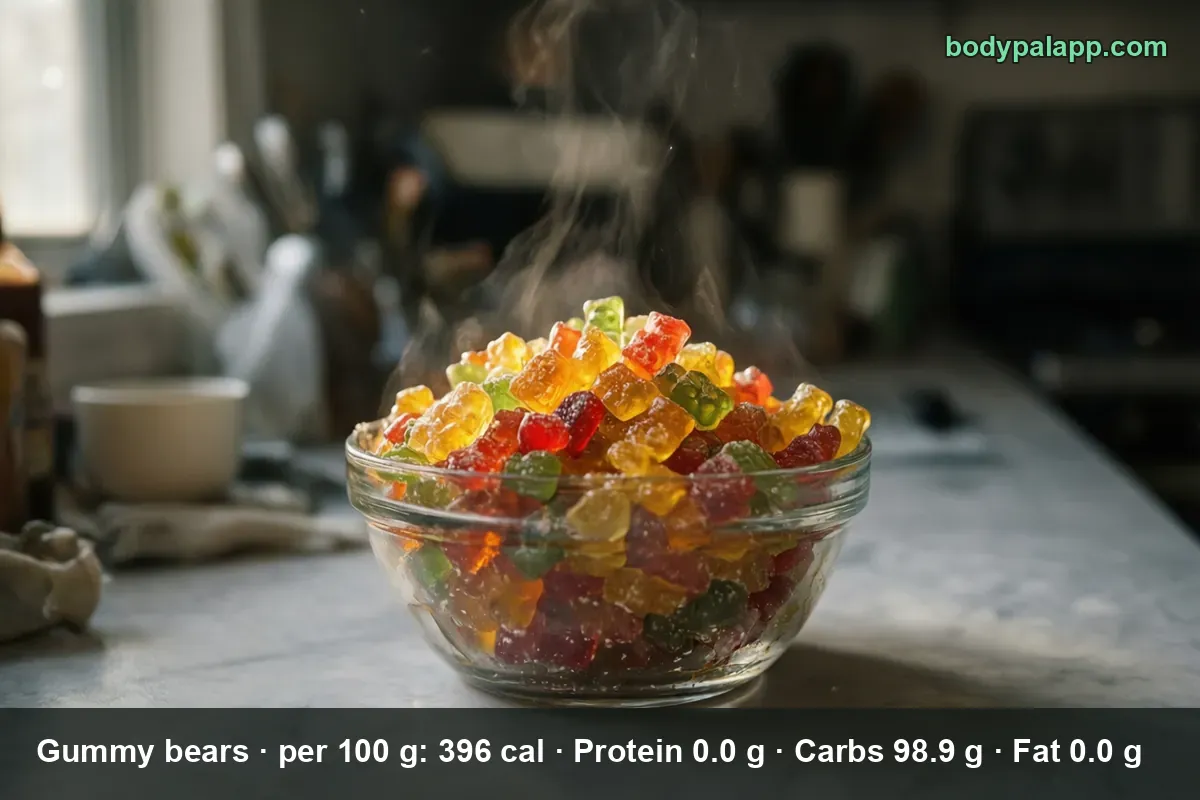
Ten gummy bears weigh 22 grams and carry 87 calories. Per 100 grams the candy runs 396 calories, so a cup poured into a bowl comes to 721 — eight times the handful most people picture. There is no fat and no protein here at all; carbohydrate supplies every calorie in the bag.
On this page
- Gummy bear quick facts
- US servings from one bear to a full cup
- Worms gumdrops and sugar-free bears
- Carbs do all the work here
- How do gummy bears compare?
- Most popular gummy bears brands
- FAQ
Gummy bear quick facts
The record behind every figure on this page is SR Legacy 167989, "Candies, gumdrops, starch jelly pieces". It is the only entry in the database that carries its own household measure of 10 gummy bears, 22 g — which is exactly the thing a person is holding when they go looking for a number. The FNDDS entry "Candy, gummy" (2710359) reports identical values per 100 grams, inherited from this same analysis, but only offers package-sized portions, so it adds nothing.
One naming quirk is worth clearing up. The description says gumdrops, not gummy bears, because USDA analyzed one starch jelly formula and applied it across the shapes cut from it. Bears, worms and gumdrops come out of the same kettle of sugar, glucose syrup and starch; only the mold changes.
| Nutrient | Per 100 g | Per 10 gummy bears (22 g) | % Daily Value |
|---|---|---|---|
| Calories | 396 | 87 | — |
| Total fat | 0 g | 0.0 g | 0% |
| Saturated fat | 0 g | 0.0 g | 0% |
| Carbohydrate | 98.9 g | 21.8 g | 8% |
| Dietary fiber | 0.1 g | 0.0 g | 0% |
| Total sugars | 58.97 g | 13.0 g | — |
| Protein | 0 g | 0.0 g | 0% |
| Sodium | 44 mg | 10 mg | 0% |
% Daily Value is based on a 2,000-calorie diet.
Verified nutrition data
Numbers on this page come from USDA FoodData Central, the U.S. Department of Agriculture’s food composition database, and from manufacturer labels where a branded product is named. Last verified September 2026. How we verify our data →
Two rows you might expect are missing. There is no added sugars line and no trans fat line, because SR Legacy is an analytical database built from lab assays rather than from packaging, and neither field exists in it — the added sugars figure only appears on a brand's own label. Cholesterol is 0 mg and potassium is 5 mg per 100 grams, which works out to 1 mg in a ten-bear serving, so neither earns a row.
US servings from one bear to a full cup
| Serving | Weight | Calories |
|---|---|---|
| 1 gummy bear | 2.2 g | 9 kcal |
| 10 gummy bears | 22 g | 87 kcal |
| 1 oz | 28 g | 112 kcal |
| 20 gummy bears | 44 g | 174 kcal |
| 1 cup | 182 g | 721 kcal |
| Per 100 g | 100 g | 396 kcal |
Two of these come straight from USDA: the ten-bear measure at 22 grams and the one-cup measure at 182 grams. The single bear, the ounce and the twenty-bear count are our own arithmetic from the USDA 100 g figure, not USDA servings — a bear averages 2.2 grams, so it lands at roughly 9 calories.
That spread is the whole problem with candy. A ten-bear serving is a genuinely small snack at 87 calories, less than a medium apple. A cup of the same candy is 721 calories, more than most fast-food burgers, and a cup is not an absurd amount to work through in front of a screen. Nothing about the food changed between those two lines. Only the container did.
If you like round numbers, a level ounce is 112 calories — close enough to a snack-size candy bar that the comparison is useful when you are deciding what to spend the calories on.
Worms gumdrops and sugar-free bears
| Version | Per 100 g | Typical serving | Calories |
|---|---|---|---|
| Gummy bears | 396 kcal | 10 bears, 22 g | 87 kcal |
| Gumdrops | 396 kcal | 10 gumdrops, 36 g | 143 kcal |
| Gummy fish | 396 kcal | 10 fish, 50 g | 198 kcal |
| Gummy dinosaurs | 396 kcal | 10 dinosaurs, 63 g | 249 kcal |
| Gummy worms | 396 kcal | 10 worms, 74 g | 293 kcal |
| Snack-size gummy pouch | 396 kcal | 1 pouch, 60 g | 238 kcal |
| Sugar-free gummy bears | 354 kcal | 1 cup, 182 g | 644 kcal |
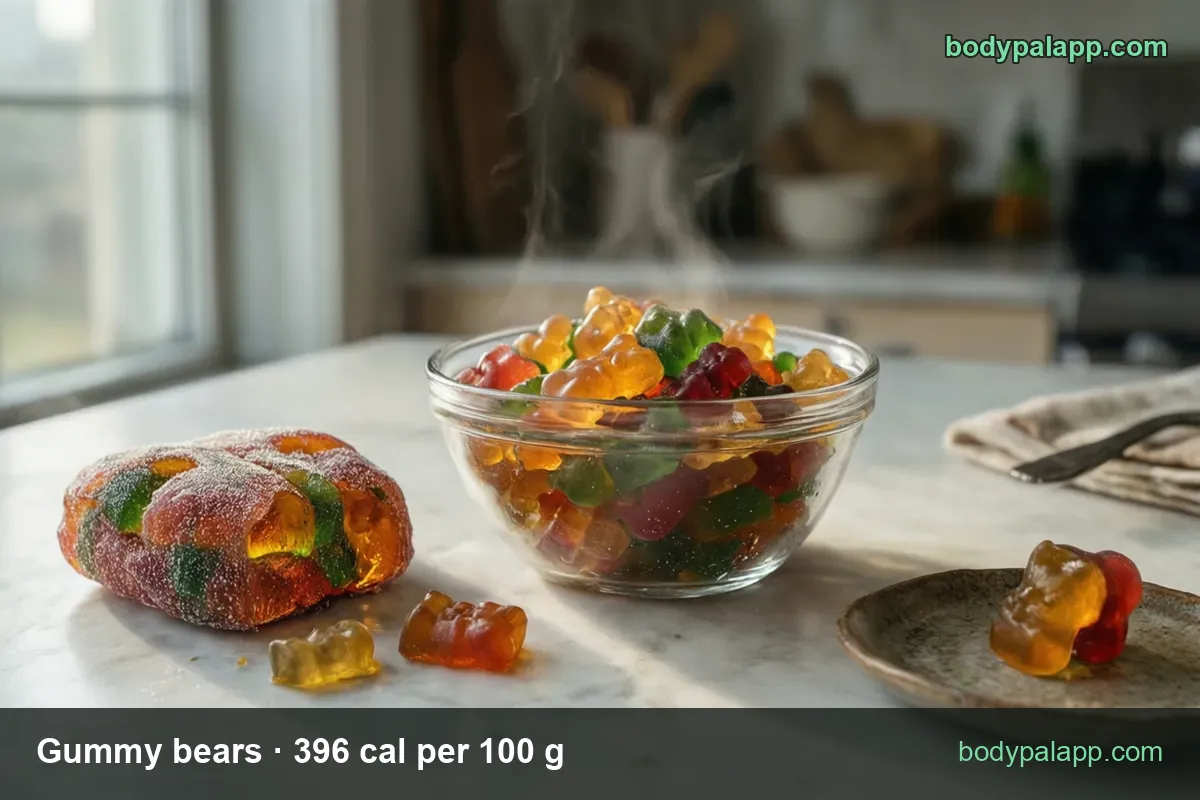
Read down that table and the useful lesson is that counting pieces tells you almost nothing. Ten of each shape ranges from 87 calories to 293, a gap of more than three times, and the candy is identical in every one of those rows. A worm is simply a bear stretched to three and a third times the weight. Log grams, or log the shape by name, but never log "ten pieces" and assume you know what you ate.
The sugar-free line deserves its own warning. SR Legacy 169061 covers gum drops sweetened with sorbitol instead of syrup, and it comes in at 354 calories per 100 grams against 396 for the regular kind. That is a saving of under 11%. Sorbitol is a sugar alcohol, not a zero-calorie sweetener, so "sugar free" on the front of the bag is a claim about sugar, not about energy.
Brand labels sit lower than the USDA figure across the board. Haribo's US listing prints 140 calories for a 39 g serving of 17 pieces, Black Forest Organic 100 calories for 30 g, Great Value 120 calories for 39 g. Converted to a common basis those run from 308 to 367 calories per 100 grams, all under USDA's 396, because manufacturers calculate from recipes with permitted label rounding while USDA assays a finished sample. When you have the bag in front of you, use its label; when you have a bowl at a party, use 396.
Carbs do all the work here
Multiply the 98.9 grams of carbohydrate in 100 grams by 4 calories per gram and you get 396 — the entire calorie count. That is unusual even among candies. There is no fat to soften the number and no protein to slow it down, which is why gummies leave people hungry twenty minutes later while a handful of nuts with the same calories does not.
The split inside that carbohydrate is the part almost nobody quotes. Of the 98.9 grams, only 58.97 grams are sugars. The remaining 40 grams or so are starch and glucose syrup solids that the lab does not score as sugar but that your body treats the same way. In a ten-bear serving that is 13.0 grams of sugars sitting inside 21.8 grams of total carbohydrate, or 8% of the Daily Value for carbohydrate.
Total sugars carry no Daily Value on the US label, and the added sugars line — the one the Dietary Guidelines tie to a limit of under 10% of daily calories — cannot be calculated from this record at all, since USDA's analysis does not separate added from naturally occurring sugars. Brand labels do print it, and for candy built entirely from syrup the two numbers are close to each other.
Sodium is a non-issue: 44 mg per 100 grams, 10 mg in ten bears, 0% of the Daily Value. If you are watching sodium, gummy candy is not where the problem lives. Fiber is effectively zero too, at 0.1 g per 100 grams.
How do gummy bears compare?
| Candy | Per 100 g | US serving | Calories |
|---|---|---|---|
| Gummy bears | 396 kcal | 1 oz, 28 g | 112 kcal |
| Hard candy | 394 kcal | 1 oz, 28 g | 112 kcal |
| Taffy | 397 kcal | 1 oz, 28 g | 113 kcal |
| Nougat with almonds | 398 kcal | 1 oz, 28 g | 113 kcal |
Our take: switching between these four candies is a waste of effort. They sit within 4 calories of each other per 100 grams, and an ounce of any of them is 112 or 113 calories. What actually moves the total is how long the candy stays in your hand. Hard candy has to be sucked and buys you several minutes per piece; gummy bears are chewed in two seconds, which is why a bag disappears in a way a roll of hard candy does not. If you want the treat and the smaller number, portion ten bears onto a dish and put the bag away — 87 calories is a snack, 721 is a meal.
Most popular gummy bears brands in the United States
Ranked by how widely each product appears among foods sold in the United States, from the BodyPal food database of over 3.3 million products. Calories are the figures printed on each Nutrition Facts label, checked against USDA FoodData Central.
| Product | Calories (per 100 g) |
|---|---|
| Black Forest Organic Gummy Bears | 333 cal |
| Haribo Gummy Candy | 359 cal |
| Amport Foods Gummy Bears | 325 cal |
| 365 Everyday Value Gummy Bears | 367 cal |
| Great Value Gummy Bears | 308 cal |
| First Street Mini Gummy Bears | 333 cal |
Brand popularity: BodyPal food database. Nutrition: manufacturer labels / USDA FoodData Central.
Gummy bear FAQs
How many calories are in 10 gummy bears?
Ten gummy bears weigh about 22 grams and carry 87 calories, based on the USDA record for starch jelly candy at 396 calories per 100 grams. Nothing in that number is fat or protein. Every calorie comes from the carbohydrate in the syrup and starch base.
How many calories are in one gummy bear?
One standard gummy bear runs about 9 calories. That is our own arithmetic from the USDA 100 g figure: the household measure is ten bears at 22 grams, so a single bear is roughly 2.2 grams. Bears vary by brand, and mini bears land nearer 4 calories each.
How many calories are in a cup of gummy bears?
A cup of gummy candy weighs 182 grams and holds 721 calories, more than eight times the 87 calories in ten bears. That is the trap with a bowl left on the coffee table: the food has not changed, only the size of the handful you keep taking from it.
How many carbs are in gummy bears?
Ten gummy bears hold 21.8 grams of carbohydrate, 8% of the Daily Value, and 100 grams holds 98.9 grams. Only 58.97 grams of that 100 is sugar; the rest is starch and glucose syrup solids. With zero fat and zero protein, carbohydrate supplies every calorie.
How much sugar is in gummy bears?
Ten gummy bears carry 13.0 grams of total sugars, and 100 grams carries 58.97 grams. Total sugars have no Daily Value on the US label. USDA's analytical record does not split added from naturally occurring sugars, so no added-sugars percentage can be calculated from it; brand labels print that line.
Are sugar-free gummy bears lower in calories?
Barely. Sugar-free gum drops sweetened with sorbitol run 354 calories per 100 grams against 396 for the regular kind, which is under 11% less. A cup comes to 644 calories instead of 721. Sorbitol is a sugar alcohol and still carries calories, so the swap saves less than the packaging suggests.
Do gummy bears have protein?
No. Gummy bears carry 0 grams of protein per 100 grams and 0 grams in a ten-bear serving, along with 0 grams of fat and effectively no fiber. The USDA record used here is a starch jelly candy with no gelatin in it, and even gelatin bears are counted as a negligible protein source.
How many calories are in Haribo gummy bears?
Haribo's US listing shows 140 calories for a 39 gram serving of 17 pieces, which works out to 359 calories per 100 grams. That sits below USDA's 396. Brand labels across the shelf run 308 to 367 per 100 grams, since recipes and permitted label rounding differ from a lab analysis.
Similar foods
- Coffee Cake — 257 cal per piece
- Laffy Taffy — 60 cal per piece
- Candy Cane — 47 cal per candy cane
- Chocolate Cheesecake — 690 cal per slice
- Dum Dum Pop — 20 cal per pop
- Jolly Rancher — 71 cal for 3 pieces
Count it without the math
Point the camera at the bowl and BodyPal counts the gummy bears for you, shape and all.


How long does it take to burn off gummy bears?
A serving of 10 gummy bears (22 g) is 87 kcal. Enter your weight and the amount you ate to see how long it takes you to burn that off:
lb
| Activity | Time to burn 87 kcal |
|---|---|
| Walking, brisk | 17 min |
| Cycling, moderate | 11 min |
| Swimming, moderate | 12 min |
| Jogging | 10 min |
| Weight training, moderate | 19 min |
Times are for a 155 lb adult at a steady pace; change the weight to see yours. The amount is set to the portion in the text (22 g); change it to what you actually ate. BodyPal works this out from your steps automatically.
This table assumes you know your daily total. If you do not, the daily calorie calculator works it out from five numbers.