Hershey bar calories come to 235 for one 1.55 oz (44 g) bar and 535 per 100 g. Fat supplies 50% of those calories and carbs 44%, while protein brings only 6%. That makes it a dense, sweet treat that is easy to finish and hard to feel full on, so the portion decides almost everything.
235kcal
1 standard bar · 44 g, plain milk chocolate
6%protein
3.4 gProtein
26 gCarbs
13.1 gFat
How to burn off 235 kcal
—Walking, brisk
—Jogging
—Cycling, moderate
—Swimming
Skip the math. BodyPal counts these calories from your steps and workouts automatically.
Nutrition facts
Plain milk chocolate · per 44 g
Calories
235 kcal
Protein
3.4 g
Carbohydrate
26 g
Fat
13.1 g
Saturated fat
8.1 g
Cholesterol
10 mg
Sodium
35 mg
Potassium
164 mg
Iron
1 mg
Source: USDA FoodData Central
🛡️
Verified nutrition data
Numbers on this page come from USDA FoodData Central, the U.S. Department of Agriculture’s food composition database, and from manufacturer labels where a branded product is named. Last verified September 2026. How we verify our data →
Hershey bar: calories, protein and sodium by serving
Percent of daily value uses the FDA reference of 2,000 kcal a day.
Serving
kcal
Protein
Carbs
Fat
Sodium
% DV kcal
1 bar, 1.55 oz (44 g)
235
3.4 g
26.1 g
13.1 g
35 mg
12%
Miniature bar (7 g)
37
0.5 g
4.2 g
2.1 g
6 mg
2%
100 g
535
7.7 g
59.4 g
29.7 g
79 mg
27%
3 × 1 bar, 1.55 oz (44 g)
706
10.1 g
104 mg
5 × 1 bar, 1.55 oz (44 g)
1,177
16.8 g
174 mg
A miniature is 37 calories, a full bar is 235
The standard bar weighs 44 g and lands at 235 calories, which is 12% of the daily value for energy. The Miniature bar is 7 g and 37 calories, just 2% of the daily value. That gap is the most useful number on this page: a single Miniature satisfies the chocolate craving for a fraction of the cost.
Bars add up fast because nothing in them slows you down. Two full bars weigh 88 g and reach 471 calories. Three bars, 132 g, come to 706 calories, and five bars, 220 g, hit 1,177. Protein barely moves along the way, from 6.7 g for two bars to 16.8 g for five.
If you snack from a bag of Miniatures, count wrappers rather than guessing. Each one is small, but a handful of them reaches full-bar territory before you notice. Weighing a portion once is a quick way to calibrate your eye.
Fat is half the calories, sugar is most of the carbs
Per 100 g, milk chocolate carries 29.7 g fat, 59.4 g carbs and 7.7 g protein. Fat is the more concentrated fuel, so even though there are more grams of carbs, fat ends up supplying 50% of the calories. Carbs deliver 44% and protein the remaining 6%.
Look closer at the carbs and nearly all of them are sugar: 51.5 g of the 59.4 g per 100 g. In a full bar that means 22.7 g sugars out of 26.1 g carbs. Fiber is a minor player at 1.5 g per bar. This is the profile of a confection, not a snack built for staying power.
Protein per bar is 3.4 g, or 7% of the daily value. It is not nothing, but it is too little to do the job a protein snack does. If you want chocolate to hold you longer, pairing it with a protein food does more than switching chocolate brands.
Saturated fat is the row to watch
Of the 29.7 g fat in 100 g of milk chocolate, 18.5 g is saturated. The daily value for saturated fat is 20 g, so a 100 g portion comes close to the whole reference amount on its own. That is the line on the label that matters most here, more than sodium or cholesterol.
The other rows are calmer. Sodium is just 35 mg per bar, 2% of the daily value of 2300 mg, and 79 mg per 100 g. Cholesterol is 23 mg per 100 g against a daily value of 300 mg. Potassium shows up at 372 mg per 100 g, a modest contribution toward 4700 mg.
If you track saturated fat, a Miniature or a single bar is easier to fit than a 100 g slab or a few bars in a row. The calories and the saturated fat rise together, so keeping one in check keeps the other in check too.
Planned chocolate beats grazing
A full bar takes 12% of the daily value for calories while adding little protein or fiber. The simplest way to fit it in is to plan for it: decide on a Miniature or a single bar, eat it slowly, and put the rest away. Unplanned grazing is where totals like 706 or 1,177 calories happen.
Pairing helps. Chocolate eaten after a meal with protein and vegetables tends to feel like dessert rather than the start of a snacking session. Pairing a Miniature with fruit gives you volume and sweetness for the 37 calories of the chocolate plus whatever the fruit adds.
Logging helps too, because chocolate is easy to forget by evening. BodyPal can log a Hershey bar from a photo, which makes it simpler to keep the small pieces on the record alongside your meals.
How does hershey bar compare?
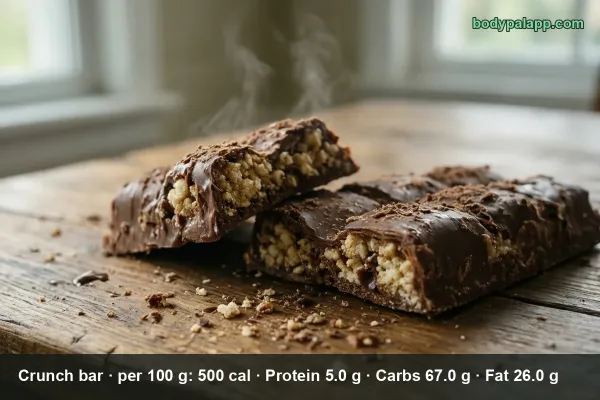
Here is how the Hershey bar stacks up against a generic chocolate bar, a Hershey Kiss and a Crunch bar, per 100 g and per usual serving.
Verdict: For the fewest calories per gram, the Crunch bar edges ahead at 500 per 100 g, though it carries 150 mg sodium and only 5 g protein. For slightly more protein, the generic chocolate bar offers 8.5 g per 100 g versus 7.7 g here, with calories nearly identical at 531 against 535.
Hershey bar FAQs
How many calories are in one Hershey bar?
A standard 1.55 oz (44 g) Hershey milk chocolate bar has about 235 calories. A miniature bar (7 g) has about 37.
Is a Hershey bar good for weight loss?
Milk chocolate is calorie dense at 535 calories per 100 g, so one 44 g bar adds 235 calories and 13.1 g of fat.
Hershey bar vs chocolate bar: which has more calories?
They are almost the same: milk chocolate is 535 calories per 100 g and a generic chocolate bar is 531 per 100 g.
How much sugar is in a Hershey bar?
A 44 g bar has about 22.7 g of sugar out of 26.1 g of carbs, plus 3.4 g of protein. Per 100 g that is 51.5 g of sugar.
How many calories are in a miniature Hershey bar?
A Miniature Hershey bar has 37 calories in 7 g, about 2% of the daily value. It carries 0.5 g protein, 2.1 g fat and 3.6 g sugars, so it is the easiest way to keep the portion small.
How much fat is in a Hershey bar?
A full 44 g Hershey bar has 13.1 g fat. Per 100 g that rises to 29.7 g, of which 18.5 g is saturated, and fat supplies 50% of the bar's calories.
How much protein does a Hershey bar have?
One Hershey bar has 3.4 g protein, which is 7% of the daily value. Protein makes up only 6% of its calories, so it will not keep you full the way a protein snack does.
How many calories are in two Hershey bars?
Two Hershey bars, 88 g in total, come to 471 calories. Three bars reach 706 calories, and five bars add up to 1,177, so the total climbs quickly with each extra bar.
Is a Hershey bar high in sodium?
No. A Hershey bar has 35 mg sodium, only 2% of the daily value, and 79 mg per 100 g. Saturated fat and sugar are the rows that matter more for this food.