
How many calories are in home fries?
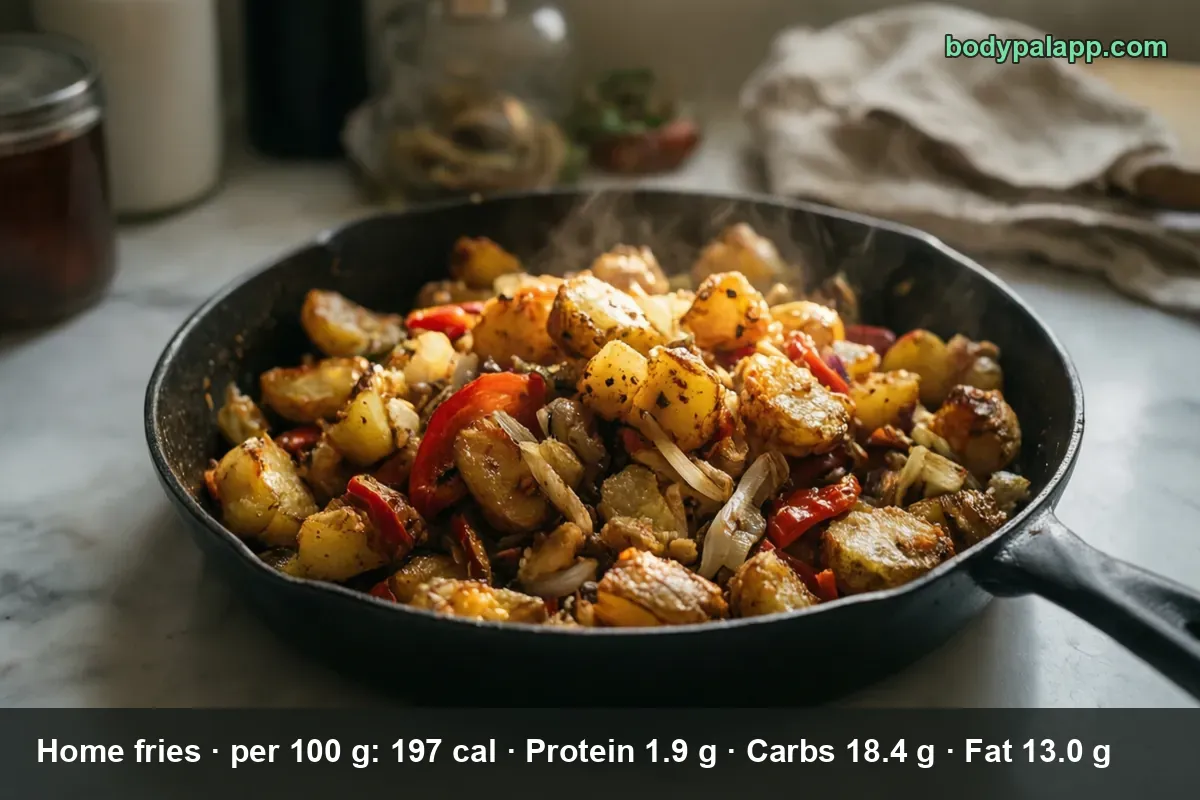
A 1-cup serving of home fries weighs 200 g and carries 394 calories. Per 100 g the number is 197 calories, which puts a skillet of diced potatoes almost exactly level with french fries. Most of that total comes from the oil in the pan, not from the potato underneath it.
On this page
- Home fries quick facts
- US servings from one ounce to a full cup
- Diner home fries versus homemade and ready-to-heat
- Sodium is the row to watch
- How do home fries compare?
- Most popular home fries brands
- FAQ
Home fries quick facts
Home fries have five separate USDA records, one for each way the potatoes reach the skillet. The number below is the generic one: FNDDS 2709472, "Potato, home fries, NFS", which does not specify whether the potatoes were diced at home, poured from a tub or cooked on a diner flat-top. It sits in the middle of the range those five records cover, 173 to 213 calories per 100 g, so it is the honest default when you are logging a plate someone else cooked.
If you know exactly how yours were made, the variant sections further down have their own record and their own numbers.
| Nutrient | Per 100 g | Per 1 cup (200 g) | % Daily Value |
|---|---|---|---|
| Calories | 197 | 394 | — |
| Total fat | 13.03 g | 26.1 g | 33% |
| Saturated fat | 1.75 g | 3.5 g | 18% |
| Carbohydrate | 18.4 g | 36.8 g | 13% |
| Dietary fiber | 1.6 g | 3.2 g | 11% |
| Total sugars | 1.24 g | 2.5 g | — |
| Protein | 1.92 g | 3.8 g | 8% |
| Sodium | 340 mg | 680 mg | 30% |
% Daily Value is based on a 2,000-calorie diet.
Verified nutrition data
Numbers on this page come from USDA FoodData Central, the U.S. Department of Agriculture’s food composition database, and from manufacturer labels where a branded product is named. Last verified September 2026. How we verify our data →
Two label rows are missing on purpose. FNDDS does not publish added sugars or trans fat for prepared dishes, so there is nothing to report for either. Cholesterol is 0 mg, since the fat here is cooking oil rather than butter or bacon drippings, and potassium is 399 mg per 100 g, which works out to 798 mg a cup, or 17% of the Daily Value. That is the one row where home fries quietly do well.
The fat line is the surprise for most people. A cup of these potatoes delivers 33% of a day's fat from what looks like a vegetable side, and the FDA Daily Value reference is what turns that 26.1 g into a third of a day.
US servings from one ounce to a full cup
| Serving | Weight | Calories |
|---|---|---|
| 1 oz | 28 g | 55 kcal |
| 1/2 cup | 100 g | 197 kcal |
| 1 potato, any size | 100 g | 197 kcal |
| 4 oz | 113 g | 223 kcal |
| 1 cup | 200 g | 394 kcal |
| Per 100 g | 100 g | 197 kcal |
Two of these come straight from USDA household measures: the 1-cup pour at 200 g and "1 potato, any size" at 100 g. The half cup, the 4 oz portion and the single ounce are our own arithmetic from the USDA 100 g figure, not USDA servings.
The cup is where the counting goes wrong. USDA weighs a cup of home fries at 200 g, twice what a single potato's worth comes to, so a breakfast plate that gets two loose cups scooped onto it is 788 calories of potato before the eggs arrive. If you are eyeballing a diner plate, count scoops, not potatoes.
Diner home fries versus homemade and ready-to-heat
| Version | Per 100 g | Typical serving | Calories |
|---|---|---|---|
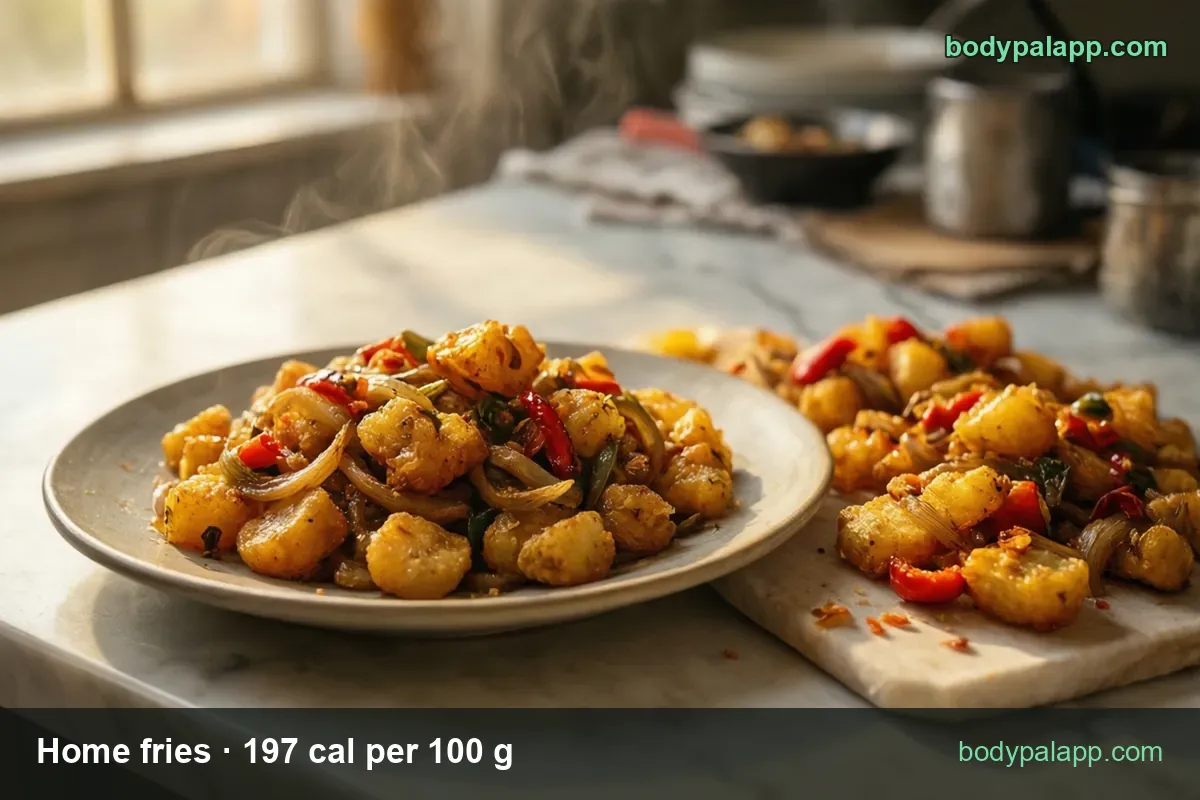
| Home fries from fresh potatoes | 185 kcal | 1 cup (200 g) | 370 kcal |
| Home fries with onions and peppers | 173 kcal | 1 cup (200 g) | 346 kcal |
| Ready-to-heat home fries | 197 kcal | 1 cup (200 g) | 394 kcal |
| Diner or restaurant home fries | 213 kcal | 1 cup (200 g) | 426 kcal |
From fresh potatoes is the lightest of the plain versions at 185 calories per 100 g, 370 a cup. Starting with raw potatoes instead of a par-cooked product means less oil clinging to the surface before the skillet even heats.
With onions and peppers is the lightest cooked version here, 173 calories per 100 g and 346 a cup, because the vegetables take up room that potato would otherwise fill. The trade is salt, which goes up rather than down, at 382 mg per 100 g.
Ready-to-heat home fries carry the same values as the generic record, 197 per 100 g and 394 a cup. If you tipped a refrigerated tub into a pan, the generic number is already your number.
Diner style is the heaviest at 213 calories per 100 g, 426 a cup. The gap over the homemade version is 28 calories per 100 g, which is not dramatic, but the saturated fat gap is: 4.96 g per 100 g against 1.55 g, more than three times as much, from a flat-top that has been oiled all morning.
Refrigerated diced potatoes sold as home fries are a different food again. The Bob Evans refrigerated packs list 82 calories per 100 g, 70 for the 1/2 cup (85 g) label serving, but those are raw potatoes with no fat added yet, so the number tells you nothing about what lands on the plate.
Sodium is the row to watch
The potato is not salty. Raw refrigerated diced potatoes come in at 65 mg of sodium per 100 g; cooked home fries come in at 340 mg. Everything in between happened in the skillet.
A 1-cup serving is 680 mg, 30% of the 2,300 mg Daily Value, which is about a third of a teaspoon of table salt sitting inside a potato side. Restaurant home fries are higher still at 396 mg per 100 g, and the onions-and-peppers version, which looks like the health-conscious pick, is 382 mg per 100 g. Only the from-fresh record comes in meaningfully lower, at 279 mg.
If you are watching sodium, the cooking method matters more than the vegetables mixed in. Home fries made in your own pan with a light hand on the salt shaker are the only version that stays under a quarter of the day's limit per cup. And if you want the potato to count toward the vegetable group, MyPlate counts starchy vegetables there whether or not they saw oil, which is worth remembering when the rest of the plate is eggs and bacon.
How do home fries compare?
| Potato side | Per 100 g | US serving | Calories |
|---|---|---|---|
| Home fries | 197 kcal | 4 oz (113 g) | 223 kcal |
| French fries, from fresh, fried | 198 kcal | 4 oz (113 g) | 224 kcal |
| Hash browns, from fresh | 190 kcal | 4 oz (113 g) | 215 kcal |
| Potato tots, frozen, baked | 187 kcal | 4 oz (113 g) | 211 kcal |
Serving weights here are matched at 4 oz so the shapes can be compared directly; all four are our own arithmetic from the USDA 100 g figures.
Our take: these four are the same food wearing different haircuts. The whole spread is 11 calories per 100 g, from tots at 187 to french fries at 198, with home fries at 197 sitting a single calorie under the fries. Choosing hash browns over home fries to save calories is not a decision worth making. What is worth deciding is the size of the scoop and whose skillet it came out of: one extra cup of diner home fries costs 426 calories, which is more than every difference in this table combined.
Most popular home fries brands in the United States
Ranked by how widely each product appears among foods sold in the United States, from the BodyPal food database of over 3.3 million products. Calories are the figures printed on each Nutrition Facts label, checked against USDA FoodData Central.
| Product | Calories (per 100 g) |
|---|---|
| Bob Evans Home Style Diced Home Fries | 82 cal |
| Bob Evans Restaurant Style Diced Home Fries with Paprika & Onion | 82 cal |
Brand popularity: BodyPal food database. Nutrition: manufacturer labels / USDA FoodData Central.
Home fries FAQs
How many calories are in a cup of home fries?
A 1-cup serving weighs 200 g and holds 394 calories, based on the USDA generic record at 197 calories per 100 g. That cup also carries 26.1 g of fat and 680 mg of sodium. Two cups on a breakfast plate, which is a common diner pour, come to 788 calories.
How many calories are in home fries from a diner?
Restaurant home fries run 213 calories per 100 g, so a 1-cup serving of 200 g is 426 calories. The bigger jump is saturated fat: 4.96 g per 100 g against 1.75 g in the generic record, which makes that single cup 9.9 g, or half a day's limit.
Are home fries healthier than hash browns?
Barely. Hash browns from fresh potatoes are 190 calories per 100 g and home fries 197, a gap of 7 calories that one extra spoon of oil erases. Sodium is the real separator, and that comes down to the cook rather than to the shape of the potato.
How many calories are in homemade home fries?
Home fries made from fresh potatoes are 185 calories per 100 g, or 370 calories for a 1-cup serving of 200 g. They also carry 279 mg of sodium per 100 g against 340 mg in the generic record, so the home skillet saves both calories and salt.
Do home fries have more calories than french fries?
No, they are level. French fries from fresh potatoes are 198 calories per 100 g and home fries 197, a difference of one calorie. Portion size decides the plate: USDA counts a cup of home fries as 200 g and 394 calories, while a 4 oz side of fries is 224.
How much sodium is in home fries?
Home fries carry 340 mg of sodium per 100 g, so a 1-cup serving is 680 mg, or 30% of the 2,300 mg Daily Value and about a third of a teaspoon of table salt. Restaurant versions are higher again, at 396 mg per 100 g.
How many carbs are in home fries?
A 1-cup serving of 200 g has 36.8 g of carbohydrate, 13% of the Daily Value, with 3.2 g of fiber and 2.5 g of total sugars inside that figure. Per 100 g it is 18.4 g, lower than people expect, because the cooking oil displaces some of the potato.
How many calories are in 4 oz of home fries?
A 4 oz portion is 113 g and 223 calories, our own arithmetic from the USDA 100 g figure of 197 calories rather than a listed USDA serving. That is roughly half a diner scoop, and it brings 384 mg of sodium along with it.
Similar foods
- Waffle cone — 556 cal per Waffle cone with 2 scoops
- Nachos — 663 cal per order
- Cannoli — 227 cal per cannoli
- Fries — 452 cal per medium fast food order
- Popsicle — 40 cal per single stick
- Onion Rings — 282 cal for 8 rings
Count it without the math
Point the camera at the plate and BodyPal counts the home fries for you, scoop by scoop.


How long does it take to burn off home fries?
A 1-cup (200 g) serving is 394 kcal. Enter your weight and the amount you ate to see how long it takes you to burn that off:
lb
| Activity | Time to burn 394 kcal |
|---|---|
| Walking, brisk | 1 hr 19 min |
| Cycling, moderate | 49 min |
| Swimming, moderate | 56 min |
| Jogging | 46 min |
| Weight training, moderate | 1 hr 28 min |
Times are for a 155 lb adult at a steady pace; change the weight to see yours. The amount is set to the portion in the text (200 g); change it to what you actually ate. BodyPal works this out from your steps automatically.
One food is easy to picture; a whole day is harder. See how many calories you need a day and what a deficit actually looks like.