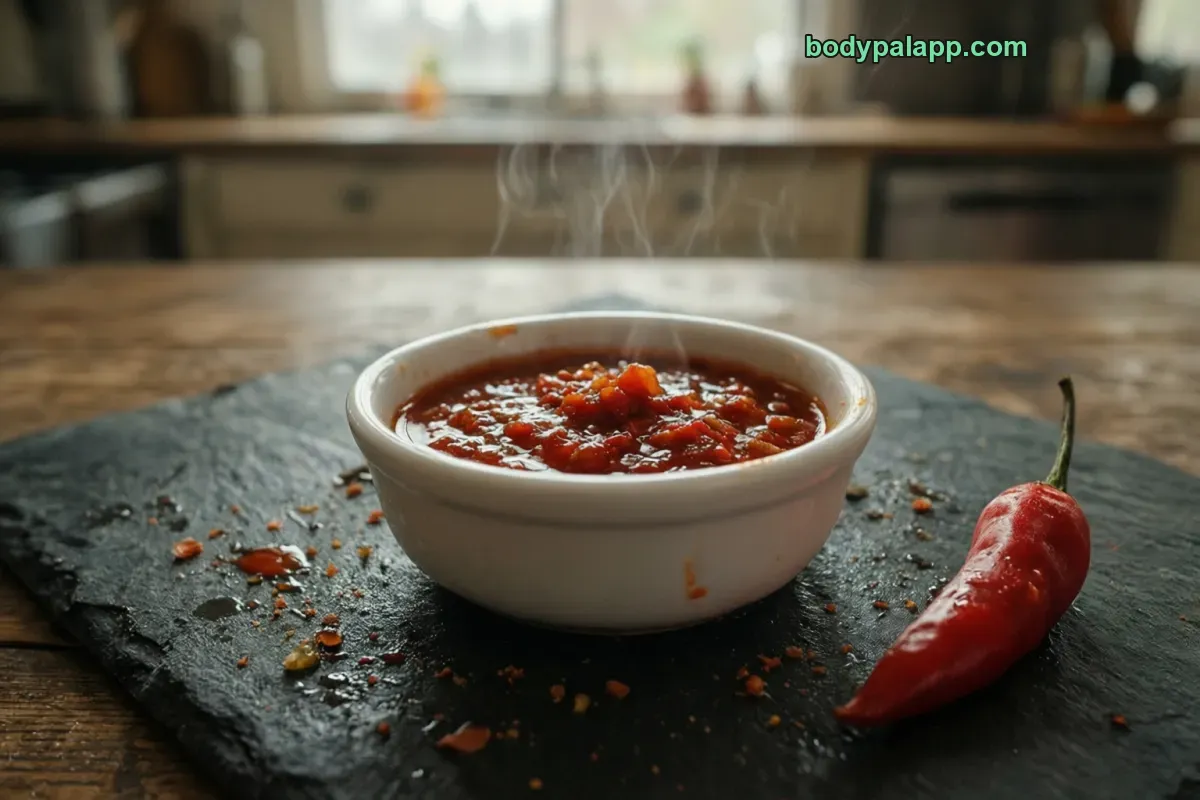
Hot sauce calories come to 1 for a teaspoon (4.7 g) and 11 per 100 g, so the energy barely registers on a food log. Sodium is what you should notice. That same teaspoon carries 124 mg, 5% of the daily value, and 100 g holds 2,643 mg, or 115% of it.
1kcal
1 teaspoon · 4 g, ready-to-serve
16%protein
0 gProtein
0 gCarbs
0 gFat
How to burn off 1 kcal
—Walking, brisk
—Jogging
—Cycling, moderate
—Swimming
Skip the math. BodyPal counts these calories from your steps and workouts automatically.
Nutrition facts
Ready-to-serve · per 4 g
Calories
1 kcal
Protein
0 g
Carbohydrate
0.1 g
Fat
0 g
Saturated fat
0 g
Cholesterol
0 mg
Sodium
124 mg
Potassium
7 mg
Iron
0 mg
Source: USDA FoodData Central
🛡️
Verified nutrition data
Numbers on this page come from USDA FoodData Central, the U.S. Department of Agriculture’s food composition database, and from manufacturer labels where a branded product is named. Last verified October 2026. How we verify our data →
Hot sauce: calories, protein and sodium by serving
Percent of daily value uses the FDA reference of 2,000 kcal a day.
Serving
kcal
Protein
Carbs
Fat
Sodium
% DV kcal
1 tsp (4.7 g)
1
0 g
0.1 g
0 g
124 mg
0%
1 tbsp (16 g)
2
0.2 g
0.1 g
0.1 g
101 mg
0%
100 g
11
0.5 g
1.8 g
0.4 g
2,643 mg
1%
3 × 1 tsp (4.7 g)
2
0.1 g
373 mg
5 × 1 tsp (4.7 g)
3
0.1 g
621 mg
Five teaspoons still add up to just 3 calories
A single teaspoon of hot sauce weighs 4.7 g and counts as 1 calorie. Double it to 9 g and the total stays at 1. Three teaspoons, about 14 g, reach 2 calories, and a generous five-teaspoon pour of 24 g lands at 3. A tablespoon (16 g) also comes in at 2 calories.
For calories, the portion barely matters. You could shake hot sauce over every meal and the energy would round to almost nothing. That makes it one of the rare condiments you can log once and not worry about measuring precisely for calorie purposes.
Sodium is where the portion does matter. The same steps that move calories from 1 to 3 move sodium from 124 mg to 248 mg, then 373 mg, then 621 mg. So the measuring spoon is still worth using, just for salt instead of calories.
Carbs supply more than half of almost nothing
Of the few calories in hot sauce, 57% come from carbohydrates, 27% from fat and 16% from protein. Those percentages sound meaningful until you look at the grams behind them: per 100 g there are 1.8 g of carbs, 0.4 g of fat and 0.5 g of protein.
Most of the carbs are sugars, 1.3 g per 100 g, with 0.3 g of fiber. At teaspoon scale that becomes 0.1 g of carbs and 0.1 g of sugars, with fat, protein and fiber rounding to 0. Saturated fat sits at 0.1 g per 100 g and cholesterol at 0.
The takeaway is simple. Hot sauce does not contribute protein, does not fill you up and does not meaningfully dent a carb budget. It adds flavor and heat, and its macro profile is close to neutral. Sweet styles such as honey and habanero blends can differ, so check the label if sugar is your concern.
Sodium is the row to watch, not calories
Per 100 g, hot sauce delivers 2,643 mg of sodium, which is 115% of the daily value. Nobody eats 100 g in one sitting, but the figure shows how concentrated it is: salt is the main thing in the bottle after peppers and vinegar, and calories are an afterthought.
At realistic portions, a teaspoon carries 124 mg, or 5% of the daily value. Five teaspoons push that to 621 mg. If you douse eggs at breakfast, tacos at lunch and a bowl of rice at dinner, those teaspoons stack quickly across the day.
If you watch sodium, treat hot sauce like table salt rather than like a free food. Measure it for a few days to see your real habit, then decide whether to cut back or save it for the dishes where it matters most. Potassium is 144 mg per 100 g, a small amount next to the sodium.
Heat without calories makes it an easy swap
Because a teaspoon is 1 calorie, hot sauce works well as a replacement for richer toppings on eggs, grilled chicken, beans, roasted vegetables or popcorn. Strong heat also tends to slow people down, so a few dashes can go further than a ladle of a creamy sauce.
Styles vary widely on the shelf, from vinegar-forward bottles like Texas Brand Hot Sauce and Tapatio Salsa Picante Hot Sauce to sweeter or fermented ones like Good & Gather Honey & Habanero Pepper Hot Sauce and Ajumma Republic Korean Kimchi Hot Sauce. Sweetened versions are the ones most likely to carry more sugar than the plain figures here.
If you track your intake, log hot sauce anyway, mainly for the sodium total. BodyPal can log it from a photo of your plate, which helps on days you add it to several meals.
How does hot sauce compare?
Here is how hot sauce stacks up against buffalo, enchilada and soy sauce, per 100 g and per usual serving.
Verdict: For the fewest calories, hot sauce and buffalo sauce tie at 11 per 100 g, while soy sauce has 53 and a 1/4 cup of enchilada sauce adds 17. If sodium is your priority, enchilada sauce at 547 mg per 100 g is the gentler pick, and soy sauce at 5,493 mg is the one to use most sparingly.
Most popular hot sauce brands in the United States
Ranked by popularity in the BodyPal database
# Productkcal / 100 g
1Tapatio Salsa Picante Hot Sauce1 tsp · 5 g0 kcal
2Ajumma Republic Korean Kimchi Hot Sauce1 tbsp · 20 g150 kcal
Labels round anything under 5 calories per serving down to 0, while sauces sweetened with honey, fruit or kimchi read higher than the plain pepper sauce above. Source: manufacturer labels / USDA FoodData Central.
Hot sauce FAQs
How many calories are in hot sauce?
A teaspoon (4.7 g) has about 1 calorie, and a tablespoon of hot pepper sauce (16 g) has 2.
Is hot sauce good for weight loss?
At 11 calories per 100 g it adds almost no energy to a meal. A teaspoon does carry 124 mg of sodium.
Hot sauce vs buffalo sauce: which has fewer calories?
They are level: hot sauce has 11 calories per 100 g and buffalo sauce also has 11.
How much sodium is in hot sauce?
A teaspoon (4.7 g) has 124 mg of sodium, and 100 g has 2643 mg.
How many calories are in a tablespoon of hot sauce?
A tablespoon of hot sauce (16 g) has 2 calories. It also carries 0.1 g of carbs and 0.1 g of fat, so for calorie counting a tablespoon is close to nothing.
Does hot sauce have sugar?
Plain hot sauce has 0.1 g of sugars per teaspoon and 1.3 g per 100 g. Sweetened styles, such as honey or fruit blends, can contain more, so check the label on those bottles.
Is hot sauce saltier than soy sauce?
No. Hot sauce has 2,643 mg of sodium per 100 g, while soy sauce has 5,493 mg. Hot sauce is still salty, at 124 mg in a single teaspoon.
Is hot sauce keto or low-carb friendly?
Plain hot sauce has 0.1 g of carbs per teaspoon and 1.8 g per 100 g, so it fits most low-carb plans easily. Sweetened versions are the exception worth checking.