
How many calories are in an IPA?
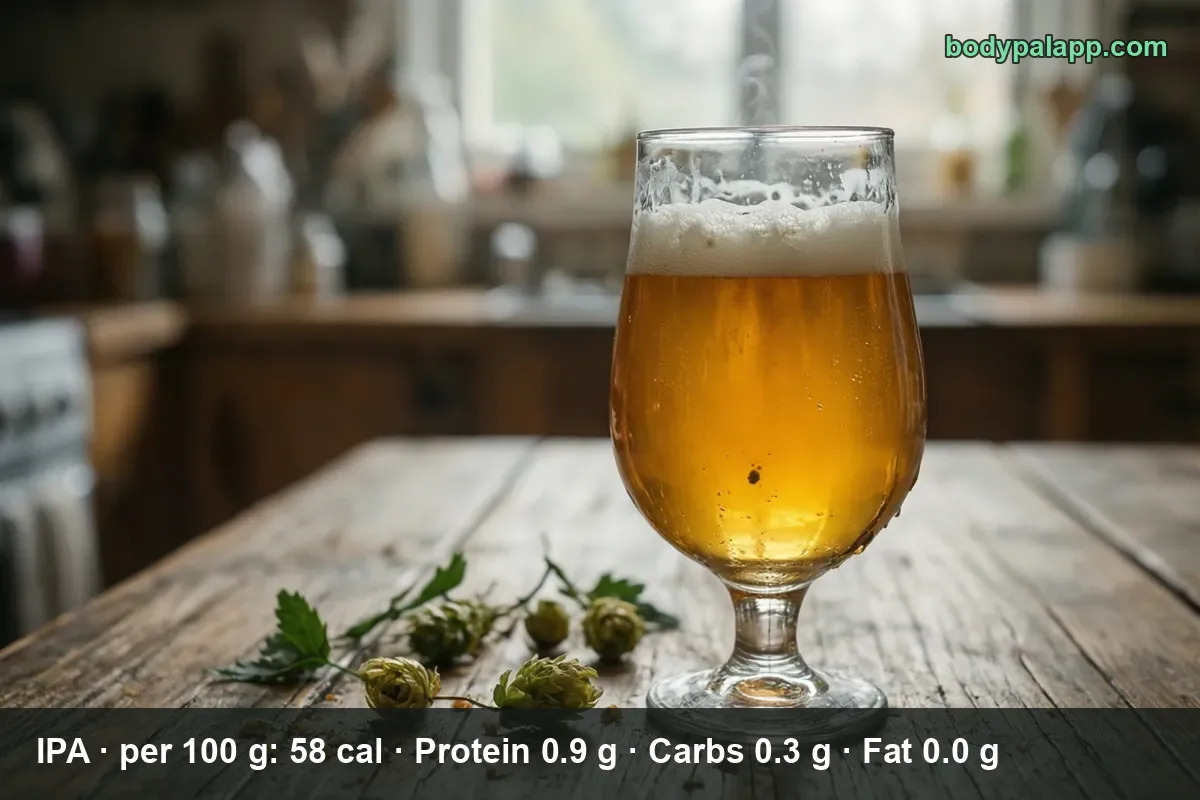
A 12 fl oz can or bottle of IPA holds 209 calories. Per 100 g the beer runs 58 calories, which is why the size of the glass decides almost everything here. Order the same beer as a 16 fl oz pint and you are drinking 278. Nothing changed but the pour.
On this page
- IPA quick facts
- US servings, from one ounce to a pint
- Session IPA, hazy and double IPA
- The calories come from alcohol, not carbs
- How does an IPA compare?
- FAQ
IPA quick facts
USDA has no row called "IPA." It has a row called Beer, higher alcohol (FNDDS 2710618), and that is the category an India pale ale sits in: beer brewed above 5% ABV. The older SR Legacy edition of the same food, record 171906, carries identical per-100-g numbers, but the FNDDS edition is the one with US household measures attached, so the 12 fl oz can and the 16 fl oz pint come straight from the database rather than from our own scaling.
| Nutrient | Per 100 g | Per 1 can or bottle, 12 fl oz (360 g) | % Daily Value |
|---|---|---|---|
| Calories | 58 | 209 | — |
| Total fat | 0 g | 0 g | 0% |
| Saturated fat | 0 g | 0 g | 0% |
| Carbohydrate | 0.27 g | 1.0 g | 0% |
| Dietary fiber | 0 g | 0 g | 0% |
| Total sugars | 0 g | 0 g | — |
| Protein | 0.9 g | 3.2 g | 6% |
| Sodium | 4 mg | 14 mg | 1% |
% Daily Value is based on a 2,000-calorie diet.
Verified nutrition data
Numbers on this page come from USDA FoodData Central, the U.S. Department of Agriculture’s food composition database, and from manufacturer labels where a branded product is named. Last verified September 2026. How we verify our data →
Two rows you would expect on a US label are missing on purpose. Added sugars and trans fat are not published for this FNDDS record, so we left them out rather than guess — and in beer's case the added-sugar line would read zero anyway, since the calories come from alcohol, not from sugar left in the glass. Cholesterol is 0 mg. Potassium is the one mineral with any presence: 223 mg per can, 5% of the Daily Value, from the malt.
If you want to see where these Daily Value percentages come from, the FDA's Daily Value reference is the source: 275 g of carbohydrate, 50 g of protein, 2,300 mg of sodium a day.
US servings, from one ounce to a pint
| Serving | Weight | Calories |
|---|---|---|
| 1 fl oz | 30 g | 17 kcal |
| 1 oz | 28.4 g | 16 kcal |
| Half pour, 8 fl oz | 240 g | 139 kcal |
| 1 can or bottle, 12 fl oz | 360 g | 209 kcal |
| 1 pint glass, 16 fl oz | 480 g | 278 kcal |
| Per 100 g | 100 g | 58 kcal |
The 12 fl oz can and the 16 fl oz pint are USDA household measures for this record. The 8 fl oz half pour and the 1 oz row are our own arithmetic from the USDA 100 g figure, not USDA servings — useful if you split a bomber or log a taster flight.
That pint row is the sentence worth remembering. A pint glass holds a third more beer than a can, and it costs 69 calories more for the identical liquid. Two pints at a brewery is 556 calories; two cans on the couch is 418. Same beer, same night, 138 calories apart, decided entirely by glassware.
Weights here are grams, not fluid ounces, and beer is close enough to water that 12 fl oz lands at 360 g. That is why the arithmetic in the table looks so tidy compared with, say, a bowl of cereal.
Session IPA, hazy and double IPA
| Version | Per 100 g | Typical pour | Calories |
|---|---|---|---|
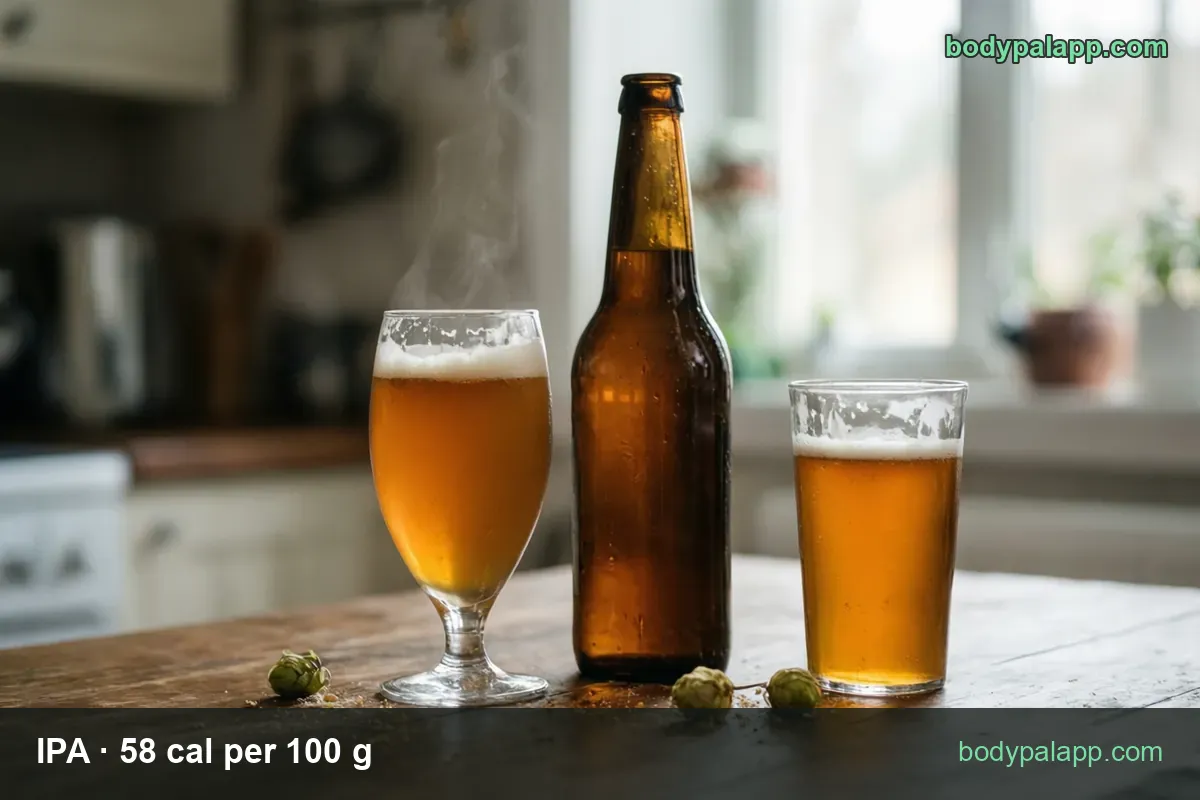
| IPA (beer, higher alcohol) | 58 kcal | 12 fl oz (360 g) | 209 kcal |
| Session / light IPA | 46 kcal | 12 fl oz (356 g) | 164 kcal |
| Regular beer, lager | 43 kcal | 12 fl oz (360 g) | 155 kcal |
| Light beer | 29 kcal | 12 fl oz (360 g) | 104 kcal |
| Hard cider | 56 kcal | 12 fl oz (360 g) | 202 kcal |
| Hard seltzer | 24 kcal | 12 fl oz (360 g) | 86 kcal |
Session IPA is the only variant with its own USDA record, beer, light, higher alcohol (174145), at 46 calories per 100 g. Ordering the session version instead of the full-strength one saves 45 calories a can — real, but smaller than most people expect, because a session IPA is still a beer with alcohol in it.
Hazy IPA has no separate row, and it does not need one. Haze is a hop bill and a suspended-protein trick, not a strength class, so a hazy logs at the same 209 per 12 fl oz unless the label says it is a double.
Double and imperial IPA are the honest gap. USDA does not publish a record for them, so we are not putting a number on one. What we can say is that beer calories track alcohol almost step for step, so a double brewed well above the 5% line sits above the 58 calories per 100 g in the higher-alcohol row — treat it as a floor, not an estimate.
One more thing you will notice if you go looking: USDA Branded has no IPA labels at all. US alcoholic drinks are regulated and labeled by the TTB rather than the FDA, so the brand you drink is simply not in the food database. Every generic number on this page is the best available stand-in.
The calories come from alcohol, not carbs
Here is the number that surprises people who cut beer for carb reasons: a 12 fl oz IPA contains 1.0 g of carbohydrate, which rounds to 0% of the Daily Value, and 0 g of sugar. Add the 3.2 g of protein and you have accounted for about 17 of the 209 calories. The remaining 90%-plus is ethanol, which carries 7 calories per gram and no nutrition attached to it.
That reframes the usual swap. Choosing a "low-carb" beer barely moves the total, because the carbs were never the problem; choosing a weaker beer does, which is exactly why light beer lands at 104 and hard seltzer at 86. Strength and volume are the two dials that matter.
It also explains the sodium and potassium picture. At 14 mg of sodium a can, IPA is invisible against the 2,300 mg daily reference — beer is not a salt problem. The Dietary Guidelines for Americans frame alcohol on its own terms instead: adults of legal drinking age can choose not to drink, and those who do are advised to keep it to two drinks or fewer a day for men and one or fewer for women. Worth knowing that the CDC counts one standard drink as 12 fl oz of regular 5% beer — so a strong IPA served in a pint glass is more than one standard drink before it is more than 278 calories.
How does an IPA compare?
| Drink | Per 100 g | US serving | Calories |
|---|---|---|---|
| IPA (beer, higher alcohol) | 58 kcal | 12 fl oz (360 g) | 209 kcal |
| Hard cider | 56 kcal | 12 fl oz (360 g) | 202 kcal |
| Beer, regular lager | 43 kcal | 12 fl oz (360 g) | 155 kcal |
| Beer, light | 29 kcal | 12 fl oz (360 g) | 104 kcal |
Our take: IPA is the heaviest thing on this list, and the gaps are bigger than the label suggests — 54 calories more than a standard lager per can, and almost exactly double a light beer. Cider looks like the sweeter, lighter option and comes within 7 calories of the IPA, only with 5.92 g of carbohydrate per 100 g doing the work instead of alcohol. If you drink two beers a few nights a week and want to claw back calories without giving anything up, the swap that pays is not the style, it is the size: drink your IPA from a 12 fl oz can rather than a 16 fl oz pint and you keep the beer you like while dropping 69 calories a pour.
IPA FAQs
How many calories are in a 12 oz IPA?
209 calories in a 12 fl oz can or bottle (360 g), from the USDA row for beer above 5% ABV at 58 calories per 100 g. That is the standard can you buy in a four-pack. Poured into a 16 fl oz pint glass, the same beer comes to 278.
How many calories in a pint of IPA?
278 calories for a 16 fl oz pint glass (480 g). The beer has not changed, the glass has. A pint holds a third more liquid than a 12 fl oz can, so it carries 69 more calories than the 209 in the can, with no difference in the brew itself.
Does IPA have more calories than regular beer?
Yes, 209 versus 155 for the same 12 fl oz pour, a difference of 54 calories. USDA lists standard beer at 43 calories per 100 g and higher-alcohol beer, the IPA category, at 58. Light beer is lower still at 29 per 100 g, which works out to 104 per can.
How many carbs are in an IPA?
About 1 gram in a 12 fl oz can, from 0.27 g per 100 g, which rounds to 0% of the Daily Value. By the numbers, IPA is not a carb-heavy drink at all. Hard cider is the one to watch on that row, at 5.92 g of carbohydrate per 100 g.
Is there sugar in IPA beer?
Zero grams: USDA lists 0 g of total sugars per 100 g for higher-alcohol beer, because the yeast eats the malt sugars during fermentation and turns them into alcohol. The sweetness some hazy IPAs seem to have comes from hops, haze proteins and body, not from sugar in the glass.
How many calories in a hazy IPA?
Log it as 209 for a 12 fl oz can. Hazy is a look and a hop bill rather than a strength class, and USDA publishes no separate hazy record, so the higher-alcohol beer figure of 58 calories per 100 g is the right one to use unless the can says double.
How many calories in a double IPA?
More than 209 per 12 fl oz, but USDA does not publish a record for double or imperial IPA, so we will not invent a number. Beer calories track alcohol closely, so a double brewed well above 5% ABV sits above the 58 calories per 100 g in the standard IPA row.
Is IPA bad for weight loss?
Two IPAs is 418 calories, about the size of a meal, with 0 g of fiber and 3.2 g of protein per can to show for it. If you are counting, the glass is the cheapest fix: an 8 fl oz half pour is 139, and a light beer is 104 per 12 fl oz can.
Similar foods
- Vodka Soda — 133 cal per drink
- Vodka Water — 133 cal per drink
- Whiskey And Soda — 133 cal per drink
- Angry Orchard — 269 cal per pint (16 fl oz)
- Cider — 202 cal per can or bottle (12 fl oz)
- Mojito — 137 cal per drink
Count it without the math
Point the camera at the glass and BodyPal counts the beer for you, pint or can.


How long does it take to burn off IPA?
A 12 fl oz can or bottle (360 g) is 209 kcal. Enter your weight and the amount you ate to see how long it takes you to burn that off:
lb
| Activity | Time to burn 209 kcal |
|---|---|
| Walking, brisk | 42 min |
| Cycling, moderate | 26 min |
| Swimming, moderate | 30 min |
| Jogging | 25 min |
| Weight training, moderate | 46 min |
Times are for a 155 lb adult at a steady pace; change the weight to see yours. The amount is set to the portion in the text (360 g); change it to what you actually ate. BodyPal works this out from your steps automatically.
This table assumes you know your daily total. If you do not, the daily calorie calculator works it out from five numbers.