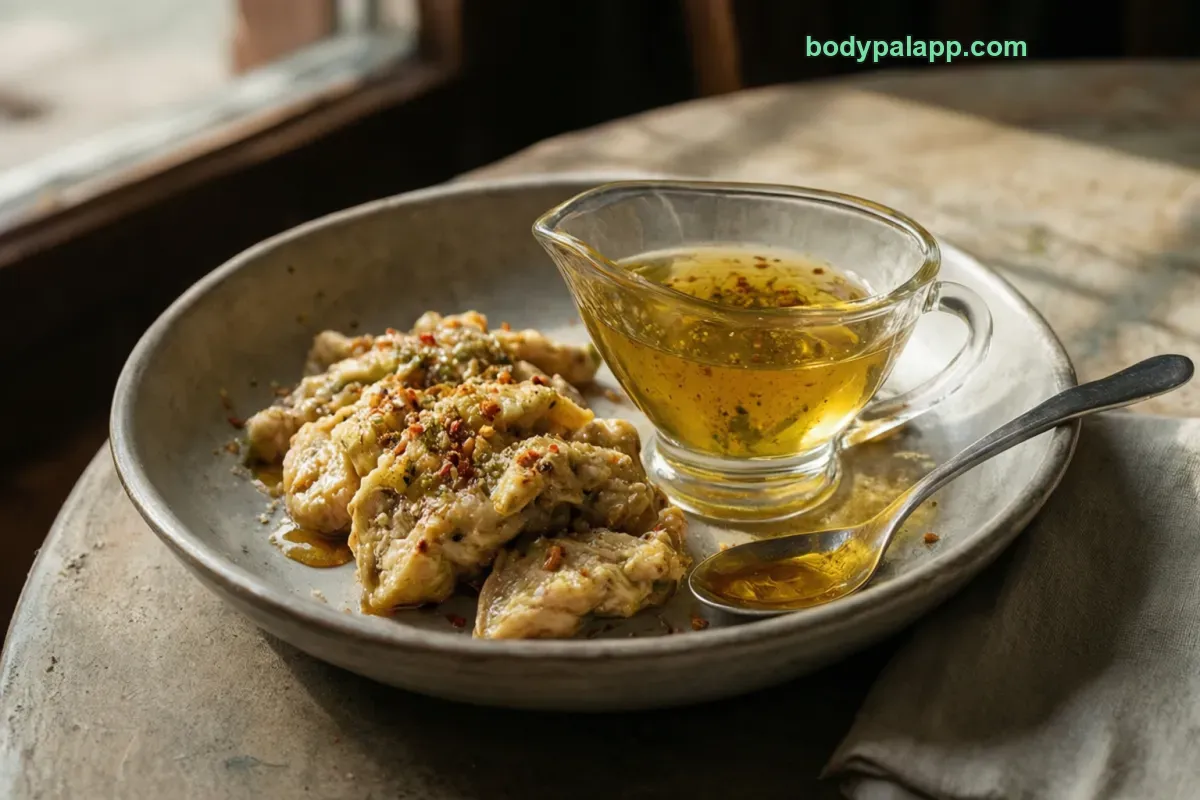
Italian dressing calories come to 35 per tablespoon (14.7 g) and 240 per 100 g of regular bottled dressing. Fat supplies 79% of those calories. Sodium is the cost people miss: one tablespoon carries 146 mg, 6% of the daily value, and most salads get far more than one tablespoon.
35kcal
1 tablespoon · 14 g, commercial, regular
1%protein
0.1 gProtein
2 gCarbs
3.1 gFat
How to burn off 35 kcal
—Walking, brisk
—Jogging
—Cycling, moderate
—Swimming
Skip the math. BodyPal counts these calories from your steps and workouts automatically.
Nutrition facts
Commercial, regular · per 14 g
Calories
35 kcal
Protein
0.1 g
Carbohydrate
1.8 g
Fat
3.1 g
Saturated fat
0.4 g
Cholesterol
0 mg
Sodium
146 mg
Potassium
12 mg
Iron
0 mg
Source: USDA FoodData Central
🛡️
Verified nutrition data
Numbers on this page come from USDA FoodData Central, the U.S. Department of Agriculture’s food composition database, and from manufacturer labels where a branded product is named. Last verified October 2026. How we verify our data →
Italian dressing: calories, protein and sodium by serving
Percent of daily value uses the FDA reference of 2,000 kcal a day.
Serving
kcal
Protein
Carbs
Fat
Sodium
% DV kcal
1 tbsp (14.7 g)
35
0.1 g
1.8 g
3.1 g
146 mg
2%
Light, 1 tbsp (15 g)
15
0.1 g
1.5 g
1 g
134 mg
1%
1 packet (44 g)
106
0.2 g
5.3 g
9.3 g
437 mg
5%
100 g
240
0.4 g
12.1 g
21.1 g
993 mg
12%
3 × 1 tbsp (14.7 g)
106
0.2 g
438 mg
5 × 1 tbsp (14.7 g)
176
0.3 g
730 mg
The pour, not the dressing, sets the total
One measured tablespoon of regular Italian dressing is 35 calories. That is small enough to ignore, and that is the trap. Few people measure. A free pour over a big bowl of greens easily reaches several tablespoons, and the total climbs in a straight line with every splash.
Two tablespoons come to 71 calories and 292 mg of sodium. Three tablespoons weigh 44 g and land at 106 calories, which is exactly what one 44 g packet holds. Five tablespoons, a realistic restaurant-style soaking, reach 176 calories and 730 mg of sodium. At that point the dressing can rival the rest of a vegetable salad.
The practical move is simple: pour into a spoon first, then onto the salad. If you eat salads daily, the gap between one tablespoon and five is the difference between a rounding error and a real line in your food log. BodyPal can log a dressed salad from a photo, but a measured pour is still the most reliable number you can give it.
Fat is four in five calories
Italian dressing is an oil-based dressing, and the calorie split shows it. Fat supplies 79% of the calories, carbohydrate 20% and protein just 1%. Per 100 g that is 21.1 g of fat, 12.1 g of carbs and 0.4 g of protein.
The carbs are nearly all sugar: 10.8 g of the 12.1 g per 100 g. Per tablespoon that is 1.6 g of sugar, a minor amount at a normal pour. Fiber is 0 and cholesterol is 0, so the dressing adds flavor and fat but nothing that fills you up on its own.
Saturated fat is modest at 2.9 g per 100 g, so most of the fat is the unsaturated kind typical of vegetable oils. That makes Italian a better pick than creamy dressings if fat quality matters to you. It does not make it light. Treat it as an added fat, the same way you would count a drizzle of oil.
Sodium is the row to watch
Per 100 g, regular Italian dressing carries 993 mg of sodium, 43% of the daily value. You will not eat 100 g in one sitting, but the per-serving numbers add up quickly. One tablespoon has 146 mg (6% DV). A packet has 437 mg, or 19% of the daily value, in one salad.
That ratio is the striking part. A packet is only 5% of daily calories but 19% of daily sodium. The dressing delivers salt far faster than it delivers energy, and the greens underneath add almost none to offset it, while toppings like cheese, olives or croutons add more.
If you watch sodium, portion control matters more here than switching to light. The light version still has 134 mg per tablespoon, also 6% DV, nearly the same as regular. Using less dressing is the only lever that cuts both calories and salt at once.
Light Italian saves calories, not sodium
Light Italian dressing comes in at 15 calories per 15 g tablespoon, against 35 for regular. The savings come almost entirely from fat: 1 g per tablespoon in the light version versus 3.1 g in regular. Carbs barely move, at 1.5 g against 1.8 g, and sugar is 1.4 g versus 1.6 g.
For someone who likes a generous pour, that difference compounds. Light dressing lets you use more for the same calories, which can make a big salad more satisfying to eat. Brands such as Wish-Bone Light Italian Dressing sit in this category, alongside regular, house, creamy and robusto styles that vary in richness.
The tradeoff is that light dressing keeps nearly all the sodium, so a heavy pour of light dressing can still be a salty salad. Pick light if calories are the goal, then measure anyway. Pick regular if you prefer the flavor and are willing to stick to a tablespoon or two.
How does italian dressing compare?
Here is how Italian dressing compares with other common dressings per 100 g and per usual serving.
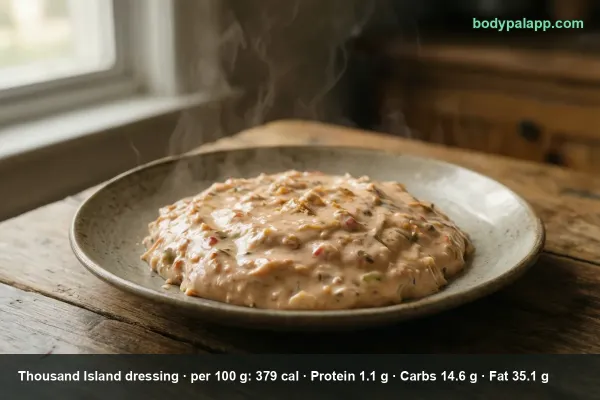
Verdict: If calories are the priority, balsamic dressing wins at 158 per 100 g and 47 per 2 Tbsp serving, with 533 mg of sodium per 100 g against 993 for Italian. Italian still beats thousand island dressing (379 per 100 g, about 1.6 times as much) and generic salad dressing (355 per 100 g), so it is a sensible middle choice when you measure the pour.
Most popular italian dressing brands in the United States
Ranked by popularity in the BodyPal database
# Productkcal / 100 g
1Wish-Bone Italian Dressing2 Tbsp · 30 ml267 kcal
2Wish-Bone House Italian Dressing2 Tbsp · 30 ml367 kcal
3Wish-Bone Light Italian Dressing2 Tbsp · 30 ml133 kcal
4Wish-Bone Creamy Italian Dressing2 Tbsp · 30 ml400 kcal
5Wish-Bone Robusto Italian Dressing2 Tbsp · 30 ml267 kcal
How many calories are in one tablespoon of Italian dressing?
About 35 calories in 1 tablespoon (14.7 g) of regular Italian dressing, and 15 in a tablespoon of light.
Is Italian dressing good for weight loss?
Regular Italian dressing has 240 calories per 100 g, mostly from 21.1 g of fat. Light versions have 102 calories per 100 g and fat-free ones 47.
Italian dressing vs salad dressing: which has fewer calories?
Italian dressing has 240 calories per 100 g, while generic salad dressing is listed at 355 per 100 g.
How much fat and sodium is in Italian dressing?
One tablespoon has 3.1 g of fat and 146 mg of sodium. Per 100 g that is 21.1 g of fat and 993 mg of sodium.
How many calories does Italian dressing add to a salad?
Regular Italian dressing adds 35 calories per tablespoon and 71 for two tablespoons, on top of the salad itself. Three tablespoons add 106 calories and 438 mg of sodium, so the pour size matters more than the greens.
How many calories are in a small salad with Italian dressing?
A small salad with one tablespoon of regular Italian dressing gets 35 calories from the dressing. Switch to light Italian and the dressing drops to 15 calories per tablespoon, with 134 mg of sodium.
How many calories are in a packet of Italian dressing?
A 44 g packet of Italian dressing has 106 calories, 9.3 g of fat and 437 mg of sodium. That sodium is 19% of the daily value, while the calories are only 5%.
How many calories are in light Italian dressing?
Light Italian dressing has 15 calories per 15 g tablespoon, compared with 35 for regular. It has 1 g of fat per tablespoon but keeps 134 mg of sodium, nearly as much as regular.
How much sugar is in Italian dressing?
Regular Italian dressing has 1.6 g of sugar per tablespoon and 10.8 g per 100 g. A full 44 g packet adds 4.7 g of sugar to a salad.