
How many calories are in a kiwi without the skin?
One medium kiwi with the skin off weighs 69 g and carries 42 calories. Per 100 g the peeled flesh runs 61 calories. Peeling changes nothing in that number, because USDA already weighs the fruit without its fuzzy jacket — the skin is counted as refuse and left out.
On this page
- Kiwi without skin quick facts
- US servings, from one ounce to a cup of slices
- Green kiwi, golden kiwi and the records that disagree
- Fiber and potassium do the heavy lifting
- How does kiwi compare?
- Most popular kiwi without skin brands
- FAQ
Kiwi without skin quick facts
The row behind every number here is SR Legacy 168153, "Kiwifruit, green, raw". It is the right record for a peeled kiwi for a reason people rarely notice: USDA analyzes fruit by edible portion. The brown skin is classified as refuse and never enters the lab sample, so "kiwi" and "kiwi without skin" are the same 61 calories per 100 g. This record is also the only kiwi entry with a complete profile — sugars, saturated fat, cholesterol and potassium all filled in — and with household measures an American kitchen actually uses.
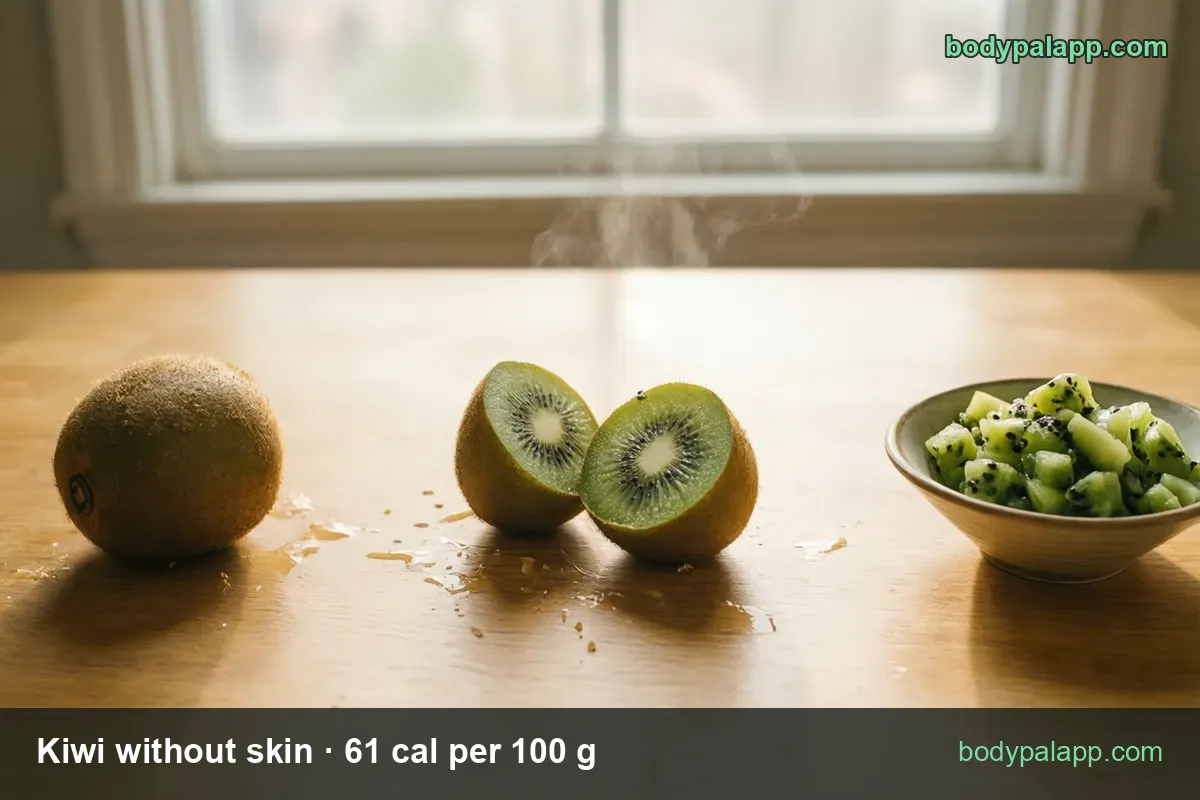
The medium fruit USDA describes is about 2 inches across and 69 g of flesh. That is the kiwi you slice in half and scoop with a teaspoon.
| Nutrient | Per 100 g | Per 1 medium kiwi, peeled (69 g) | % Daily Value |
|---|---|---|---|
| Calories | 61 | 42 | — |
| Total fat | 0.52 g | 0.4 g | 0% |
| Saturated fat | 0.03 g | 0.0 g | 0% |
| Carbohydrate | 14.66 g | 10.1 g | 4% |
| Dietary fiber | 3 g | 2.1 g | 7% |
| Total sugars | 8.99 g | 6.2 g | — |
| Protein | 1.14 g | 0.8 g | 2% |
| Sodium | 3 mg | 2 mg | 0% |
| Potassium | 312 mg | 215 mg | 5% |
% Daily Value is based on a 2,000-calorie diet.
Verified nutrition data
Numbers on this page come from USDA FoodData Central, the U.S. Department of Agriculture’s food composition database, and from manufacturer labels where a branded product is named. Last verified September 2026. How we verify our data →
There is no added sugars row because USDA does not publish added sugars for this record, and a whole raw fruit has none by definition — the 8.99 g is all sugar the plant made. Cholesterol is 0 mg, as it is in every fruit. Sodium is so low it barely registers: 2 mg in a whole kiwi is less than a thousandth of a teaspoon of table salt.
US servings, from one ounce to a cup of slices
| Serving | Weight | Calories |
|---|---|---|
| 1 oz | 28 g | 17 kcal |
| 1 medium kiwi, peeled (2" dia) | 69 g | 42 kcal |
| 1/2 cup, sliced | 90 g | 55 kcal |
| Per 100 g | 100 g | 61 kcal |
| 1 NLEA serving, 2 kiwi | 148 g | 90 kcal |
| 1 cup, sliced | 180 g | 110 kcal |
Two of those are USDA household measures: the medium fruit at 69 g and the cup of slices at 180 g. The 148 g NLEA serving is the two-fruit portion the label on a clamshell of kiwi uses. The 1 oz and half-cup lines are our own arithmetic from the USDA 100 g figure, not USDA servings — handy if you are weighing on a kitchen scale rather than counting fruit.
Here is the trap worth memorizing. A cup of slices is 110 calories and a medium kiwi is 42. That is a 68-calorie gap between two things you would both log as "kiwi," and it comes entirely from the fact that a cup holds roughly two and a half fruits' worth of flesh. If you slice kiwi into yogurt straight from the cutting board, you are almost certainly logging the cup, not the fruit.
Green kiwi, golden kiwi and the records that disagree
| Version | Per 100 g | Typical piece | Calories |
|---|---|---|---|
| Green kiwi, peeled (SR Legacy 168153) | 61 kcal | 1 medium, 69 g | 42 kcal |
| Kiwifruit, green, raw (Foundation 327046) | 58 kcal | 1 medium, 69 g | 40 kcal |
| Kiwi fruit, raw (FNDDS 2709239) | 64 kcal | 1 fruit, 75 g | 48 kcal |
| Kiwifruit, green, peeled, raw (Foundation 2710831) | 65 kcal | 1 medium, 69 g | 45 kcal |
| Golden SunGold kiwi (SR Legacy 168211) | 63 kcal | 1 fruit, 81 g | 51 kcal |
| Sliced kiwi, per cup (168153) | 61 kcal | 1 cup sliced, 180 g | 110 kcal |
| Kiwi strawberry juice drink (174111) | 47 kcal | 16 fl oz, 473 g | 222 kcal |
Four of those rows are the same green fruit, and they spread from 58 to 65 calories per 100 g. The spread is not disagreement about kiwi; it is disagreement about method. The 65-calorie Foundation record is calculated with Atwater factors from its measured protein, fat and carbohydrate, while the 61-calorie SR Legacy record comes with a measured sugar and saturated fat profile attached. Neither is wrong. If you want one number to live by, take 61 and stop thinking about it — the difference across the four records is about 5 calories on a medium fruit, less than the difference between a small kiwi and a big one.
Golden kiwi is the variant that genuinely behaves differently. SunGold runs 63 calories per 100 g, close enough to green, but its sugar is 12.3 g against green kiwi's 8.99 g, and its fiber is 1.4 g against 3 g. That is under half the fiber for noticeably more sugar. Golden kiwi tastes sweeter because it is sweeter, and the smooth skin means people eat bigger pieces of it.
Fresh kiwi in a store is the plain fruit, so brand labels track USDA closely: Mighties Kiwi lists 90 calories for its 148 g two-fruit serving, exactly the USDA figure, while Zespri SunGold lists 110 for a slightly larger 162 g pair. Essential Everyday Kiwi Slices is the lightest label of the four at 56 per 100 g, or 80 calories for its 142 g cup. The one row on the table that should make you flinch is the juice drink: a 16 fl oz bottle of kiwi strawberry is 222 calories, more than five whole kiwi, with none of the fiber.
Fiber and potassium do the heavy lifting
A medium kiwi is 42 calories and 2.1 g of fiber. Against the FDA Daily Value of 28 g, that is 7% of a day's fiber for 2% of a 2,000-calorie day — the fiber is arriving faster than the calories, which is the whole argument for whole fruit over juice. The FDA Daily Value reference is the same one printed on every Nutrition Facts panel, so the math is comparable to anything in your pantry.
Potassium is the quieter win: 215 mg in one kiwi, 5% of the 4,700 mg DV, at 2 mg of sodium. Few foods have a ratio that lopsided.
Carbohydrate is where low-carb eaters get surprised. A medium kiwi carries 10.1 g of carbohydrate, of which 6.2 g is sugar and 2.1 g is fiber. That is a modest fruit by carb count, but a cup of slices takes it to about 26 g. If you are counting carbs, count fruit by the piece, not by the bowl.
A cup of sliced kiwi also counts as a full cup toward the fruit group on MyPlate, which is a useful way to think about it: 110 calories buys a whole cup of your day's fruit.
How does kiwi compare?
| Fruit | Per 100 g | US serving | Calories |
|---|---|---|---|
| Kiwi, peeled | 61 kcal | 2 kiwi, 148 g | 90 kcal |
| Mango, raw | 60 kcal | equal mass, 148 g | 89 kcal |
| Pear, red anjou, raw | 62 kcal | equal mass, 148 g | 92 kcal |
| Tangerines, canned in light syrup | 61 kcal | equal mass, 148 g | 90 kcal |
The 148 g servings for mango, pear and tangerine are our own arithmetic, matched to the weight of USDA's two-kiwi serving so the comparison is fair. At that equal mass everything lands between 89 and 92 calories. Only mango is lighter than kiwi per 100 g, and it is lighter by a single calorie.
Our take: stop picking fruit by calories. Four different fruits, one of them canned in syrup, all sit within three calories of each other at the same weight — the decision is not a calorie decision. Pick kiwi when you want fiber and potassium cheap, and pick green over golden when you want the fiber specifically, since SunGold gives you under half of it. For the neighbors, USDA's rows here list protein, carbohydrate and fat but not fiber, so we are not going to claim kiwi beats them on that count. What we will claim is that the canned tangerine's sugar arrives in syrup and the kiwi's does not.
Most popular kiwi without skin brands in the United States
Ranked by how widely each product appears among foods sold in the United States, from the BodyPal food database of over 3.3 million products. Calories are the figures printed on each Nutrition Facts label, checked against USDA FoodData Central.
| Product | Calories (per 100 g) |
|---|---|
| Mighties Kiwi | 61 cal |
| Zespri SunGold Kiwifruit | 68 cal |
| Disney Kiwifruit | 61 cal |
| Essential Everyday Kiwi Slices | 56 cal |
Brand popularity: BodyPal food database. Nutrition: manufacturer labels / USDA FoodData Central.
Kiwi without skin FAQs
How many calories are in a kiwi without the skin?
42 calories in one medium peeled kiwi of 69 g, at 61 calories per 100 g. USDA measures fruit by edible portion, so the skin was never part of the sample. A larger fruit closer to 75 g comes to about 48 calories.
Does peeling a kiwi change the calories?
No — the number is 61 calories per 100 g either way. USDA classifies kiwi skin as refuse and excludes it from analysis, so the published figure already describes the flesh alone. Eating the skin adds a little fiber but does not change the calorie figure you should log.
How many calories in 2 kiwis?
90 calories for two medium kiwi, the 148 g serving USDA uses on Nutrition Facts panels. That pair brings 4.4 g of fiber, about 13.3 g of sugar and 4 mg of sodium. Fresh brands like Mighties list exactly 90 for the same two-fruit serving.
How many calories in a cup of sliced kiwi?
110 calories in one cup of slices, which USDA weighs at 180 g. That is 68 calories more than a single medium kiwi, because the cup holds roughly two and a half fruits' worth of flesh. Half a cup, 90 g, works out to 55 calories.
How many carbs are in a kiwi?
10.1 g of carbohydrate in a medium 69 g kiwi, 4% of the Daily Value. Of that, 6.2 g is sugar and 2.1 g is fiber. Per 100 g the flesh carries 14.66 g of carbohydrate. A full cup of slices pushes the total to roughly 26 g.
How much fiber is in one kiwi?
2.1 g of fiber in one medium peeled kiwi, which is 7% of the 28 g FDA Daily Value for only 42 calories. Per 100 g the flesh gives 3 g. That ratio — 7% of the fiber for 2% of the calories — is why whole kiwi beats kiwi juice.
Green kiwi vs golden kiwi calories?
Green is 61 calories per 100 g and golden SunGold is 63, so calories are nearly identical. The real gap is inside: SunGold carries 12.3 g of sugar and 1.4 g of fiber per 100 g, against 8.99 g of sugar and 3 g of fiber for green kiwi.
Is kiwi good for weight loss?
At 42 calories per fruit with 2.1 g of fiber, kiwi is one of the cheaper ways to end a meal with something sweet. If you are watching calories, eat it whole rather than drinking it: a 16 fl oz kiwi strawberry juice drink is 222 calories, more than five kiwi.
Similar foods
- Kiwi — 42 cal per medium kiwi
- Mango — 99 cal per cup pieces
- Bartlett Pear — 112 cal per medium pear
- Bing Cherries — 97 cal per cup without pits
- Fruit cup — 89 cal per cup
- Gala Apple — 98 cal per medium apple
Count it without the math
Point the camera at the bowl and BodyPal counts the kiwi for you, slices and all.


How long does it take to burn off kiwi without skin?
One medium kiwi, peeled (69 g) is 42 kcal. Enter your weight and the amount you ate to see how long it takes you to burn that off:
lb
| Activity | Time to burn 42 kcal |
|---|---|
| Walking, brisk | 8 min |
| Cycling, moderate | 5 min |
| Swimming, moderate | 6 min |
| Jogging | 5 min |
| Weight training, moderate | 9 min |
Times are for a 155 lb adult at a steady pace; change the weight to see yours. The amount is set to the portion in the text (69 g); change it to what you actually ate. BodyPal works this out from your steps automatically.
One food is easy to picture; a whole day is harder. See how many calories you need a day and what a deficit actually looks like.