
How many calories are in a Manhattan?
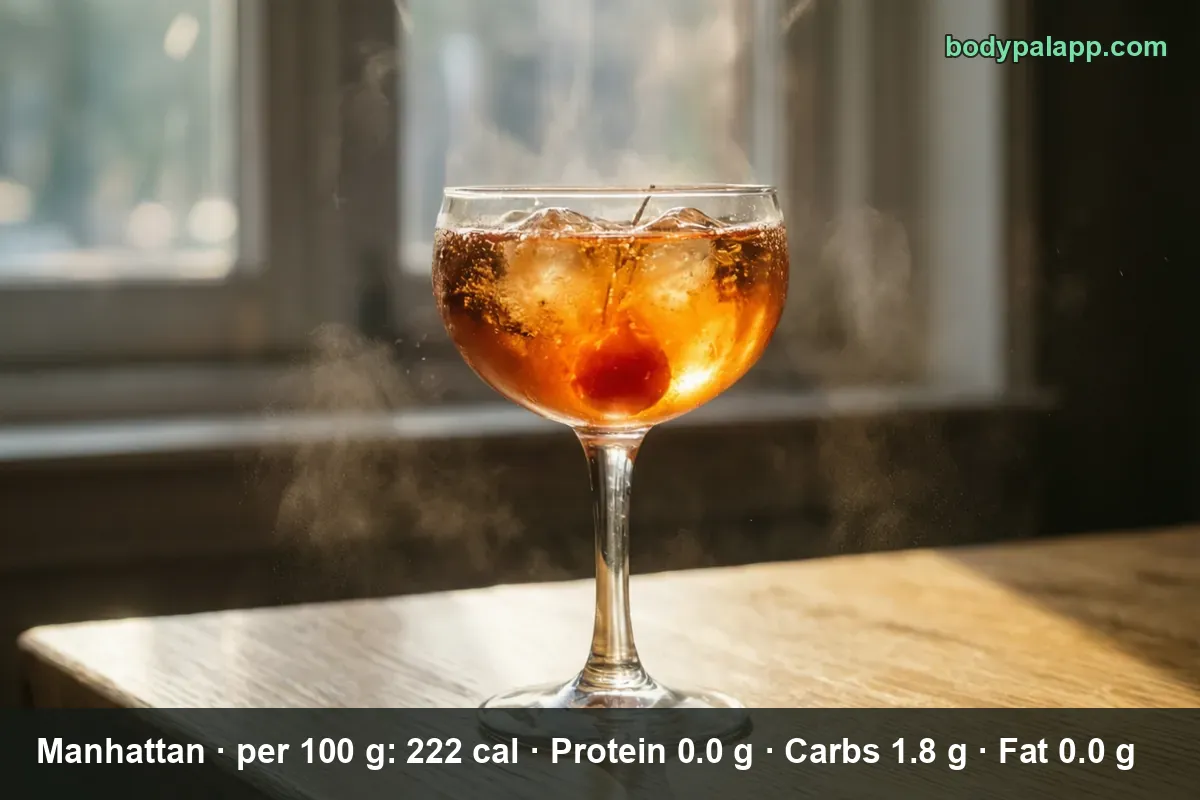
One Manhattan, the 120 g drink USDA measures, carries 266 calories. Per 100 g the cocktail runs 222 calories, which is spirit territory rather than dessert territory. Almost none of it is sugar: the whole glass holds 2.2 g of carbohydrate. The calories ride in on the whiskey and the sweet vermouth.
On this page
- Manhattan quick facts
- US pours, from one ounce to a full drink
- Manhattan clam chowder is a different food entirely
- Why the nutrition panel looks empty
- How does a Manhattan compare?
- Manhattan FAQs
Manhattan quick facts
The number people want is for the glass in their hand, so this page is built on the one USDA record for the drink itself: FNDDS 2710637, "Manhattan", in the Liquor and cocktails category of the 2021-2023 survey release. It is also the only record with a "1 drink" household measure attached, which USDA weighs at 120 g. Four other USDA rows carry the word Manhattan, and every one of them is clam chowder. Those get their own section further down rather than being averaged into the cocktail, because they are a different food that happens to share a name.
Bar pours vary, and so does the whiskey-to-vermouth ratio behind the stick. Treat 266 calories as the number for a standard drink, not as a promise about the one a generous bartender just slid across the bar.
| Nutrient | Per 100 g | Per 1 drink (120 g) | % Daily Value |
|---|---|---|---|
| Calories | 222 | 266 | — |
| Total fat | 0 g | 0 g | 0% |
| Saturated fat | 0 g | 0 g | 0% |
| Carbohydrate | 1.82 g | 2.2 g | 1% |
| Dietary fiber | 0 g | 0 g | 0% |
| Total sugars | 1.03 g | 1.2 g | — |
| Protein | 0.03 g | 0.0 g | 0% |
| Sodium | 2 mg | 2 mg | 0% |
| Cholesterol | 0 mg | 0 mg | 0% |
| Potassium | 14 mg | 17 mg | 0% |
% Daily Value is based on a 2,000-calorie diet.
Verified nutrition data
Numbers on this page come from USDA FoodData Central, the U.S. Department of Agriculture’s food composition database, and from manufacturer labels where a branded product is named. Last verified September 2026. How we verify our data →
There is no added sugars row here on purpose. The FNDDS release does not publish added sugars or trans fat for cocktails, so those lines are left out rather than guessed; the small amount of sweetness on the label comes from the vermouth, and total sugars have no Daily Value to compare against. Cholesterol is zero and potassium is 17 mg per drink, which rounds to 0% of the Daily Value set by the FDA.
US pours, from one ounce to a full drink
A Manhattan is served up in a coupe more often than over ice, which makes the pour hard to eyeball. USDA gives two anchors: the full drink at 120 g and a fluid ounce at 30 g. Everything between them is scaling.
| Serving | Weight | Calories |
|---|---|---|
| 1 oz | 28.4 g | 63 kcal |
| 1 fl oz | 30 g | 67 kcal |
| 2 fl oz | 60 g | 133 kcal |
| 3 fl oz pour | 90 g | 200 kcal |
| One drink, coupe or rocks glass | 120 g | 266 kcal |
| Per 100 g | 100 g | 222 kcal |
Only the 120 g drink and the 1 fl oz line are USDA household measures. The 2 fl oz, 3 fl oz and 1 oz rows are our own arithmetic from the USDA 100 g figure, not USDA servings. Note also that a fluid ounce and an ounce are not the same thing here: a fluid ounce of the cocktail weighs about 30 g, a weight ounce is 28.4 g, and the four-calorie gap between those two rows is entirely a measuring artifact.
The practical version: a short 2 fl oz nightcap is 133 calories, a bar-standard 3 fl oz pour is 200, and the full drink is 266. Two of them clear 500 calories before dinner arrives, which is the part most people miss when they log a cocktail as "one drink" and move on.
Manhattan clam chowder is a different food entirely
Search for calories in a Manhattan and you may want the tomato-based chowder instead of the whiskey. The two share nothing but a name. The cocktail is 222 calories per 100 g; the chowder as served is 35, more than six times lighter by weight. A cup of soup is 86 calories against 266 for the drink.
| Version | Per 100 g | Typical serving | Calories | Sodium |
|---|---|---|---|---|
| As served, restaurant or homemade | 35 kcal | 1 cup (245 g) | 86 kcal | 610 mg |
| Canned, condensed, before diluting | 61 kcal | 0.5 cup (126 g) | 77 kcal | 880 mg |
| Canned, chunky, ready-to-serve | 56 kcal | 1 cup (240 g) | 134 kcal | 1001 mg |
| Canned, prepared with equal water | 30 kcal | 1 cup (249 g) | 75 kcal | 563 mg |
The condensed row is the trap. At 61 calories per 100 g it looks like the heaviest chowder on the list, but that is soup still sitting in the can at full strength; add an equal volume of water and the same product lands at 30 calories per 100 g. Chunky ready-to-serve is not diluted at all, which is why one cup of it is 134 calories, the highest number in the table.
Sodium is the row that actually moves, and every sodium-per-serving figure above is our own arithmetic from the USDA 100 g values. A cup of chowder as served carries about 610 mg, roughly a quarter teaspoon of table salt and 27% of the Daily Value. The chunky canned cup reaches 1,001 mg, or 44%. Half a cup of condensed is 880 mg, 38%, before you add anything to the pot. The cocktail, by contrast, has 2 mg. Calories and sodium point in opposite directions across these two foods with one name.
Why the nutrition panel looks empty
Line up the Manhattan's macros and almost every row reads zero: no fat, no fiber, no protein worth counting, 2.2 g of carbohydrate. Then the calorie line says 266. That gap is the whole story of a spirit-forward cocktail. Alcohol itself carries calories that never show up in the fat, carb or protein columns of a Nutrition Facts panel, so the arithmetic that works for a cookie simply does not close here.
That is why sugar-free framing misses the point with this drink. At 1.2 g of total sugars per glass, a Manhattan is already one of the least sweet cocktails you can order, and cutting the vermouth further would barely move the calorie count. What moves it is the pour.
For context on how a drink is defined and where daily limits sit, the CDC's standard drink page is the reference point, and the Dietary Guidelines for Americans put moderate drinking at 2 drinks or less in a day for men and 1 drink or less for women. If you are watching a calorie budget on a night out, the useful move is ordering one smaller pour rather than switching to a "lighter" cocktail, because the spirit base is where the calories live.
How does a Manhattan compare?
Held to a common fluid ounce, the Manhattan sits almost exactly where its base spirit does.
| Drink | Per 100 g | US pour | Calories |
|---|---|---|---|
| Manhattan | 222 kcal | 1 fl oz (30 g) | 67 kcal |
| Rob Roy | 212 kcal | 1 fl oz (28 g) | 59 kcal |
| Whiskey | 231 kcal | 1 fl oz (28 g) | 65 kcal |
| Gin | 231 kcal | 1 fl oz (28 g) | 65 kcal |
Rob Roy is the only drink on this list lighter than a Manhattan per 100 g, and the margin is 10 calories. The Manhattan's fluid ounce shows the highest number in the table at 67 calories, but that is a weight quirk rather than a richer drink: USDA weighs a fluid ounce of the cocktail at 30 g and a fluid ounce of the spirits at 28 g. The Rob Roy and neighbor pours are our own arithmetic from their USDA 100 g figures.
Our take: stop thinking of a Manhattan as a mixed drink that dilutes the whiskey. At 222 calories per 100 g against 231 for straight whiskey, the vermouth and bitters barely thin it, and the reward is 2.2 g of carbohydrate instead of the sugar load a soda mixer would add. If you want a cocktail that behaves like a spirit on your log, this is one of them. If you want fewer calories, order a shorter pour, because there is no version of this drink where the recipe saves you.
Manhattan FAQs
How many calories are in a Manhattan cocktail?
266 calories for one drink, the 120 g serving USDA lists for this record. Per 100 g the cocktail is 222 calories. A shorter 3 oz pour comes to 200. Nothing in the glass is fat or fiber, and only 2.2 g is carbohydrate.
How many carbs are in a Manhattan?
2.2 g of carbohydrate in one 120 g drink, or 1.82 g per 100 g. That is 1% of the Daily Value, and 1.2 g of it is sugar from the sweet vermouth. Fiber is zero, so total and net carbs are the same number here.
How much sugar is in a Manhattan?
1.2 g of total sugars in a 120 g drink, scaled from 1.03 g per 100 g. That is less than half a teaspoon. USDA does not publish an added sugars figure for this record, so the page shows total sugars only, and the sweetness comes from the vermouth.
Is a Manhattan keto friendly?
2.2 g of carbohydrate per drink is low enough to fit most low-carb budgets, and 1% of the Daily Value for carbohydrate is the whole story on paper. The calories are the catch: 266 per drink, almost all of them from alcohol rather than from carbs or fat.
Does a Manhattan have more calories than straight whiskey?
Per 100 g whiskey is 231 calories and a Manhattan 222, so the mixed drink is slightly lighter by weight. By the glass it is not close: one Manhattan is 266 calories against 65 for a 1 fl oz pour of whiskey. Size decides, not the recipe.
How many calories in a 3 oz Manhattan?
200 calories for a 3 fl oz pour, which weighs about 90 g. That is our own arithmetic from the USDA 100 g figure of 222 calories, not a USDA serving. A 2 fl oz pour lands at 133, and the full 120 g drink at 266.
How many calories are in Manhattan clam chowder?
86 calories in a 1 cup (245 g) bowl of Manhattan clam chowder as served, or 35 per 100 g. The chunky ready-to-serve canned version is heavier at 134 per cup. Sodium is the row that moves: about 610 mg in that first cup.
Does the cherry add calories to a Manhattan?
The 266 calories cover the drink as USDA reports it at 120 g, and USDA does not publish a separate record for the maraschino cherry, so there is no figure to add here. What is certain is where the calories sit: 2.2 g of carbohydrate in the glass, the rest alcohol.
Similar foods
- Bourbon — 97 cal for 1.5 fl oz jigger
- Cranberry Vodka — 97 cal per jigger
- Shot Of Crown Royal — 97 cal per shot
- Gin — 97 cal per shot
- Shot Of Gin — 97 cal per shot
- Jack Daniel's — 97 cal per shot
Count it without the math
Point the camera at the glass and BodyPal counts the pour for you, vermouth and all.


How long does it take to burn off a Manhattan?
One drink (120 g) is 266 kcal. Enter your weight and the amount you ate to see how long it takes you to burn that off:
lb
| Activity | Time to burn 266 kcal |
|---|---|
| Walking, brisk | 53 min |
| Cycling, moderate | 33 min |
| Swimming, moderate | 38 min |
| Jogging | 31 min |
| Weight training, moderate | 59 min |
Times are for a 155 lb adult at a steady pace; change the weight to see yours. The amount is set to the portion in the text (120 g); change it to what you actually ate. BodyPal works this out from your steps automatically.
Burning it off is one side of it. The other is knowing your number: work out how many calories you need a day, with macros and a goal date.