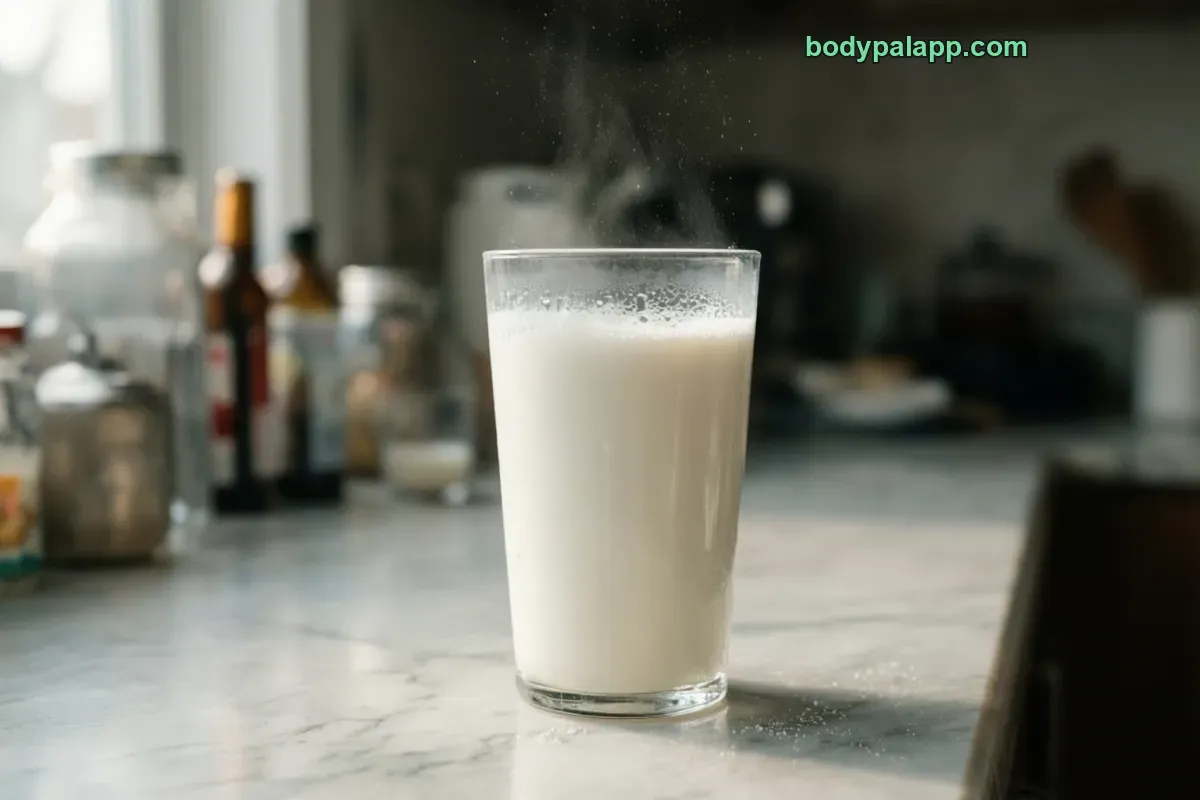
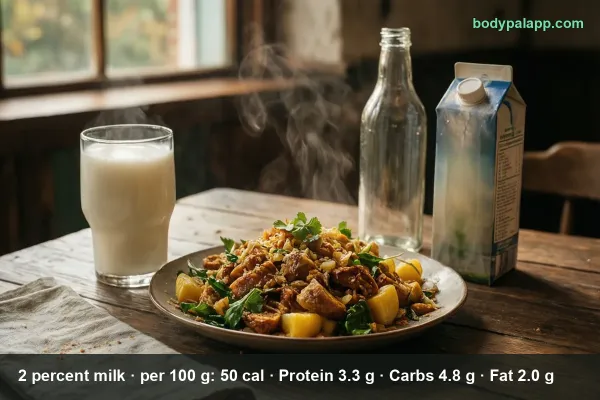
Semi-skimmed milk calories come to 122 for 1 cup (244 g) and 50 per 100 g. In the US this is 2% reduced-fat milk. What stands out is the balance: carbs bring 38% of the calories, fat 35% and protein 26%. Fat is only 2 g per 100 g, but it still carries a third of the energy.
122kcal
1 cup · 244 g, 2% reduced fat, fluid
26%protein
8.1 gProtein
12 gCarbs
4.8 gFat
How to burn off 122 kcal
—Walking, brisk
—Jogging
—Cycling, moderate
—Swimming
Skip the math. BodyPal counts these calories from your steps and workouts automatically.
Nutrition facts
2% reduced fat, fluid · per 244 g
Calories
122 kcal
Protein
8.1 g
Carbohydrate
11.7 g
Fat
4.8 g
Saturated fat
3.1 g
Cholesterol
20 mg
Sodium
115 mg
Potassium
342 mg
Iron
0 mg
Source: USDA FoodData Central
🛡️
Verified nutrition data
Numbers on this page come from USDA FoodData Central, the U.S. Department of Agriculture’s food composition database, and from manufacturer labels where a branded product is named. Last verified September 2026. How we verify our data →
Semi-skimmed milk: calories, protein and sodium by serving
Percent of daily value uses the FDA reference of 2,000 kcal a day.
Serving
kcal
Protein
Carbs
Fat
Sodium
% DV kcal
1 cup (244 g)
122
8.1 g
11.7 g
4.8 g
115 mg
6%
100 g
50
3.3 g
4.8 g
2 g
47 mg
3%
1 quart (976 g)
488
32.2 g
46.8 g
19.3 g
459 mg
24%
3 × 1 cup (244 g)
366
24.2 g
344 mg
5 × 1 cup (244 g)
610
40.3 g
573 mg
A cup is 122 calories, a quart is 488
One cup (244 g) of semi-skimmed milk gives 122 calories, which is 6% of the daily value. That is a modest number for a glass that also delivers 8.1 g of protein. The trouble with milk is rarely one cup. It is the pour you don't measure.
Two cups come to 244 calories and three cups to 366. If you go through a quart (976 g) in a day across coffee, cereal and a smoothie, that adds up to 488 calories, or 24% of the daily value. Five cups reach 610 calories in 1,220 g of milk. None of these pours feels like a meal, which is exactly why they slip past a food log.
Protein grows at the same pace. Three cups supply 24.2 g and a full quart gives 32.2 g, which covers 64% of the daily value for protein. So if you drink milk in volume, you are buying a lot of protein along with the calories. If you only splash it into coffee, the numbers stay small, but it is still worth measuring the splash once so you know what a usual pour really is.
Carbs, fat and protein split the calories almost evenly
Few foods spread their calories this evenly. In semi-skimmed milk, carbs supply 38% of the energy, fat 35% and protein 26%. Per 100 g that works out to 4.8 g of carbs, 2 g of fat and 3.3 g of protein, with 0 g of fiber.
The carbs are milk sugar, not added sugar. The label lists 5.1 g of sugars per 100 g and 12.3 g in a cup. There is no fiber to slow it down, so a glass on its own is a light snack rather than a filling one. Pairing it with something that has fiber changes that.
Fat is the swing factor. Of the 2 g of fat per 100 g, 1.3 g is saturated. That small amount is why semi-skimmed sits at 50 calories per 100 g while skim milk sits at 34 and whole milk at 61. Trimming fat is the only thing that moves milk's calorie count much, because the protein and carbs stay nearly identical across the three.
Sodium, cholesterol and potassium stay in the background
Milk is not a salty food. One cup carries 115 mg of sodium, only 5% of the daily value. Even a quart reaches 459 mg, which is 20% of the daily value. If you track sodium closely, milk is rarely the row that pushes you over; cheese, bread and sauces usually are.
Cholesterol is low at 8 mg per 100 g, set against a daily value of 300 mg. Saturated fat is the more relevant row if you watch it: 1.3 g per 100 g, compared with a daily value of 20 g. A cup or two keeps that modest, while a quart a day starts to count.
Potassium is the quiet positive here. Semi-skimmed milk carries 140 mg per 100 g, against a daily value of 4700 mg. One glass will not fill that gap, but it adds up for regular milk drinkers. The milk in the USDA data is fortified with vitamin A and vitamin D, which is standard for US reduced-fat milk.
Semi-skimmed milk works best as part of a meal
Semi-skimmed milk is the practical middle ground. It costs fewer calories than whole milk but keeps more body than skim. That makes it easy to use every day in coffee, oatmeal, cereal or a smoothie. Brands such as Upstate Farms 2 Percent Reduced Fat Milk fall into this same category.
Because it has no fiber and only moderate protein per cup, milk alone does not keep most people full for long. Pair it with oats, fruit or whole-grain cereal and the same 122 calories feel more like breakfast. In a protein-focused day, two cups add 16.1 g of protein for 244 calories, which is a fair trade.
The habit that matters most is counting the milk you add to other things. A latte, a bowl of cereal and an evening glass can add up to a quart without anyone noticing. BodyPal can log milk from a photo of your glass or bowl, which helps you catch the pours that never make it into a written log.
How does semi-skimmed milk compare?
Here is semi-skimmed milk next to skim, 2 percent and whole milk, compared per 100 g and per usual serving.
Verdict: If you want the fewest calories, pick skim milk at 83 per cup and 34 per 100 g; semi-skimmed at 122 per cup is the better choice if skim tastes too thin to you. Whole milk at 149 per glass and 61 per 100 g only earns its place if you prefer the richer taste, since the protein stays at 3.3 g per 100 g in all three.
Most popular semi-skimmed milk brands in the United States
How many calories are in a cup of semi-skimmed milk?
About 122 calories in 1 cup (244 g). Per 100 g it has 50 calories.
Is semi-skimmed milk good for weight loss?
A cup has 122 calories with 8.1 g protein and 4.8 g fat. That is fewer calories than whole milk at 61 per 100 g.
Semi-skimmed milk vs skim milk: which has fewer calories?
Skim milk has 34 calories per 100 g, while semi-skimmed milk has 50.
How much sugar is in semi-skimmed milk?
About 12.3 g of sugar per cup (244 g), or 5.06 g per 100 g, all from the milk's natural lactose.
How many calories are in a quart of semi-skimmed milk?
A quart (976 g) of semi-skimmed milk has 488 calories, which is 24% of the daily value. It also carries 32.2 g of protein and 459 mg of sodium.
How much protein is in a cup of semi-skimmed milk?
One cup (244 g) has 8.1 g of protein, which is 16% of the daily value. Protein supplies 26% of the milk's calories, with 3.3 g in every 100 g.
Is semi-skimmed milk the same as 2% milk?
Yes. In the US, semi-skimmed milk is 2% reduced-fat milk. Both have 50 calories, 3.3 g of protein and 2 g of fat per 100 g, so the numbers on the two pages match.
How much sodium is in semi-skimmed milk?
One cup has 115 mg of sodium, only 5% of the daily value. Per 100 g it is 47 mg, so milk is a minor sodium source unless you drink it by the quart.
How many calories are in two cups of semi-skimmed milk?
Two cups (488 g) of semi-skimmed milk contain 244 calories. That pour also gives you 16.1 g of protein and 229 mg of sodium.
Does semi-skimmed milk have fewer calories than whole milk?
Yes. Semi-skimmed milk has 50 calories per 100 g against 61 for whole milk. A cup of semi-skimmed is 122 calories, while a glass of whole milk is 149.