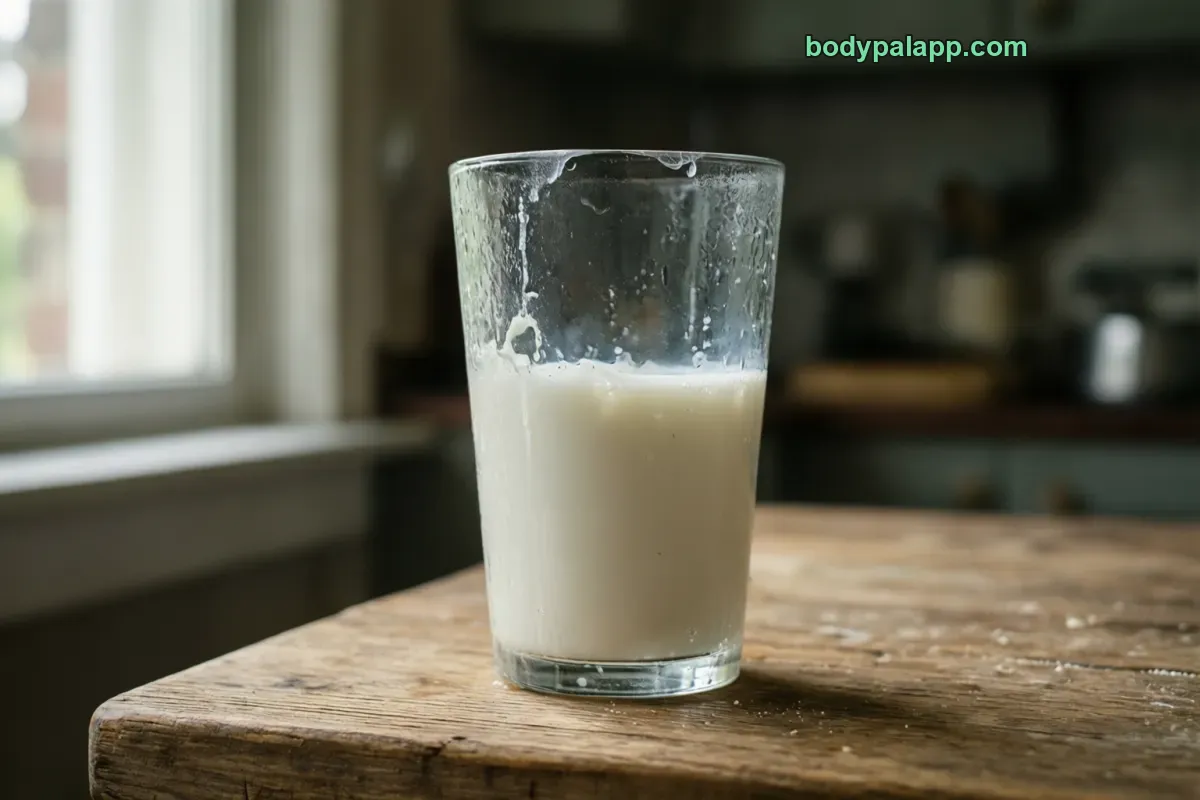
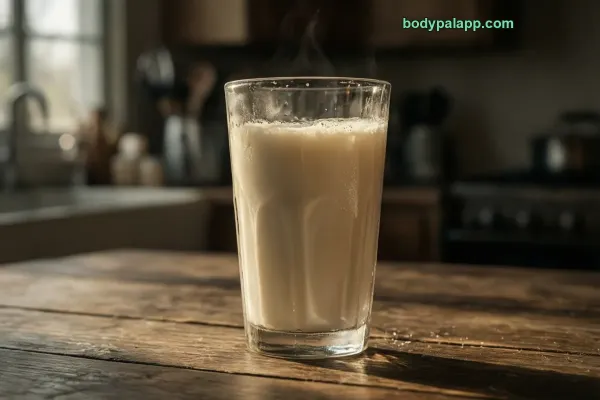
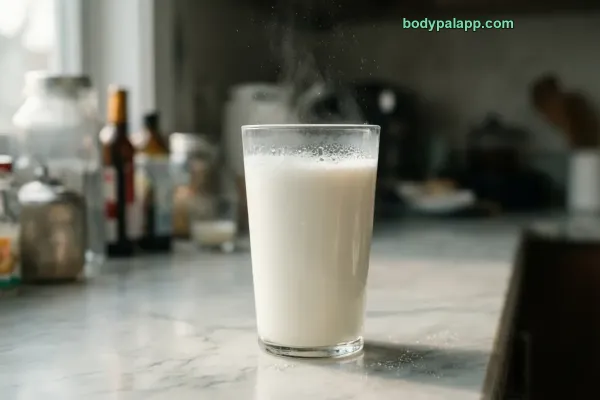
One glass of milk calories come to 149 for a 244 g glass of whole milk, or 61 per 100 g. Fat supplies 48% of those calories, so the type of milk you pour matters as much as the size of the glass. That same glass also brings 8 g of protein and 11.7 g of sugar.
149kcal
1 glass · 244 g, whole milk
22%protein
8 gProtein
11 gCarbs
7.8 gFat
How to burn off 149 kcal
—Walking, brisk
—Jogging
—Cycling, moderate
—Swimming
Skip the math. BodyPal counts these calories from your steps and workouts automatically.
Nutrition facts
Whole milk · per 244 g
Calories
149 kcal
Protein
8 g
Carbohydrate
11.3 g
Fat
7.8 g
Saturated fat
4.5 g
Cholesterol
29 mg
Sodium
93 mg
Potassium
366 mg
Iron
0 mg
Source: USDA FoodData Central
🛡️
Verified nutrition data
Numbers on this page come from USDA FoodData Central, the U.S. Department of Agriculture’s food composition database, and from manufacturer labels where a branded product is named. Last verified September 2026. How we verify our data →
Milk: calories, protein and sodium by serving
Percent of daily value uses the FDA reference of 2,000 kcal a day.
Serving
kcal
Protein
Carbs
Fat
Sodium
% DV kcal
1 glass (244 g)
149
8 g
11.3 g
7.8 g
93 mg
7%
100 g
61
3.3 g
4.6 g
3.2 g
38 mg
3%
3 × 1 glass (244 g)
447
23.9 g
278 mg
5 × 1 glass (244 g)
744
39.9 g
464 mg
Two glasses add up to 298 calories
A standard 244 g glass of whole milk gives 149 calories, which is 7% of the daily value for calories and 16% of the daily value for protein. On its own, that is a modest line in a food log. The catch is that milk rarely arrives as a single measured pour. It goes into coffee, over cereal and into a glass with dinner, and nobody counts the refills.
Two glasses (488 g) come to 298 calories and 16 g of protein. Three glasses (732 g) reach 447 calories and 23.9 g of protein. Five glasses, 1,220 g in total, land at 744 calories with 39.9 g of protein. Sodium climbs along the way, from 93 mg in one glass to 464 mg in five, which is still small next to salty foods.
If you track what you eat, measure your usual glass once. Plenty of tumblers hold more than 244 g, and a bigger pour moves every number in proportion. BodyPal can log the glass from a photo if you would rather not weigh it.
Fat supplies nearly half the calories
By weight, whole milk looks balanced: 100 g holds 3.3 g of protein, 4.6 g of carbs and 3.2 g of fat. By calories, the picture tilts. Fat is the densest of the three, so it delivers 48% of the energy, carbs 31% and protein 22%.
Most of that fat is saturated. Of the 3.2 g of fat in 100 g, 1.9 g is saturated, and the same 100 g carries 12 mg of cholesterol. A full glass holds 7.8 g of fat. If you watch saturated fat, this is the row on the label that separates whole milk from lighter versions, since the protein barely changes between them.
That makes whole milk a richer drink than its watery look suggests. It is not a heavy food, but it is not a free one either. Think of each glass as a small snack rather than a beverage that does not count.
The sugar is natural, but it still counts
A glass of whole milk carries 11.7 g of sugar, or 4.8 g per 100 g. That sugar is the milk's own, not something added at the plant, and it makes up essentially all of the 11.3 g of carbohydrate in the glass. There is 0 g of fiber, so nothing slows how quickly those carbs arrive.
For most people this is a non-issue at one glass. It becomes worth noticing when milk turns into the base of a large latte or a tall bowl of sweetened cereal, where its sugar stacks on top of whatever else is in the cup or bowl.
The upside sits on the same label. Each 100 g also provides 150 mg of potassium, and the protein in a glass covers 16% of the daily value. Few drinks give you that much protein for 149 calories.
Milk works best as part of a meal
Because a glass brings 8 g of protein along with its fat, whole milk pairs well with foods that are mostly carbohydrate. Poured over oatmeal or plain cereal, it turns a starchy bowl into something more filling. Next to a piece of fruit, it makes a simple snack with some staying power.
If calories are tight, use whole milk where its richness shows, such as in coffee or a sauce, and keep the volume small. If you drink milk mainly for protein, a lighter milk gives you the same protein per 100 g for fewer calories.
Brands such as Publix Whole Grade A Milk, Horizon Organic Whole Milk and Simple Truth Organic Whole Milk are all whole milk, so the numbers on this page are a fair guide for any of them. Organic labeling does not change the basic calorie math of a glass.
How does milk compare?
This table compares whole milk with a slightly larger glass of milk, semi-skimmed milk and orange juice, per 100 g and per usual serving.
Verdict: For fewer calories, pick semi-skimmed milk at 122 per cup, which keeps the same 3.3 g of protein per 100 g as whole milk. Orange juice is lower still at 117 per glass, but with only 0.8 g of protein per 100 g it does far less to keep you full.
Most popular milk brands in the United States
Ranked by popularity in the BodyPal database
# Productkcal / 100 g
1Publix Whole Grade A Milk1 cup · 240 ml62 kcal
2Horizon Organic Whole Milk1 cup · 240 ml67 kcal
3Simple Truth Organic Whole Milk8 fl oz · 240 ml62 kcal
A 244 g glass (1 cup) of whole milk has about 149 calories.
How much protein is in a glass of milk?
A 244 g glass of whole milk has 8.0 g of protein, 7.8 g of fat and 11.7 g of sugar.
Is milk good for weight loss?
A glass of whole milk adds 149 calories with 8.0 g of protein. Per 100 g it has 61 calories.
Milk vs chocolate milk: which has more calories?
Chocolate milk has slightly more: 65 calories per 100 g against 61 for whole milk.
How many calories are in two glasses of whole milk?
Two glasses of whole milk (488 g) contain 298 calories. They also provide 16 g of protein and 185 mg of sodium, so a second glass doubles everything, including the fat.
How much sugar is in a glass of milk?
A 244 g glass of whole milk has 11.7 g of sugar, or 4.8 g per 100 g. It is the milk's natural sugar, and the glass contains 0 g of fiber.
How much fat is in a glass of whole milk?
A glass of whole milk holds 7.8 g of fat. Per 100 g there are 3.2 g of fat, 1.9 g of it saturated, and fat supplies 48% of the calories.
How much sodium is in a glass of milk?
One 244 g glass of whole milk has 93 mg of sodium, which is 4% of the daily value. Per 100 g the figure is 38 mg, low for a dairy food.
Does semi-skimmed milk have fewer calories than whole milk?
Yes. Semi-skimmed milk has 122 calories per cup against 149 for a glass of whole milk, or 50 versus 61 per 100 g, with the same 3.3 g of protein per 100 g.