
How Many Calories Are in Oat Milk?
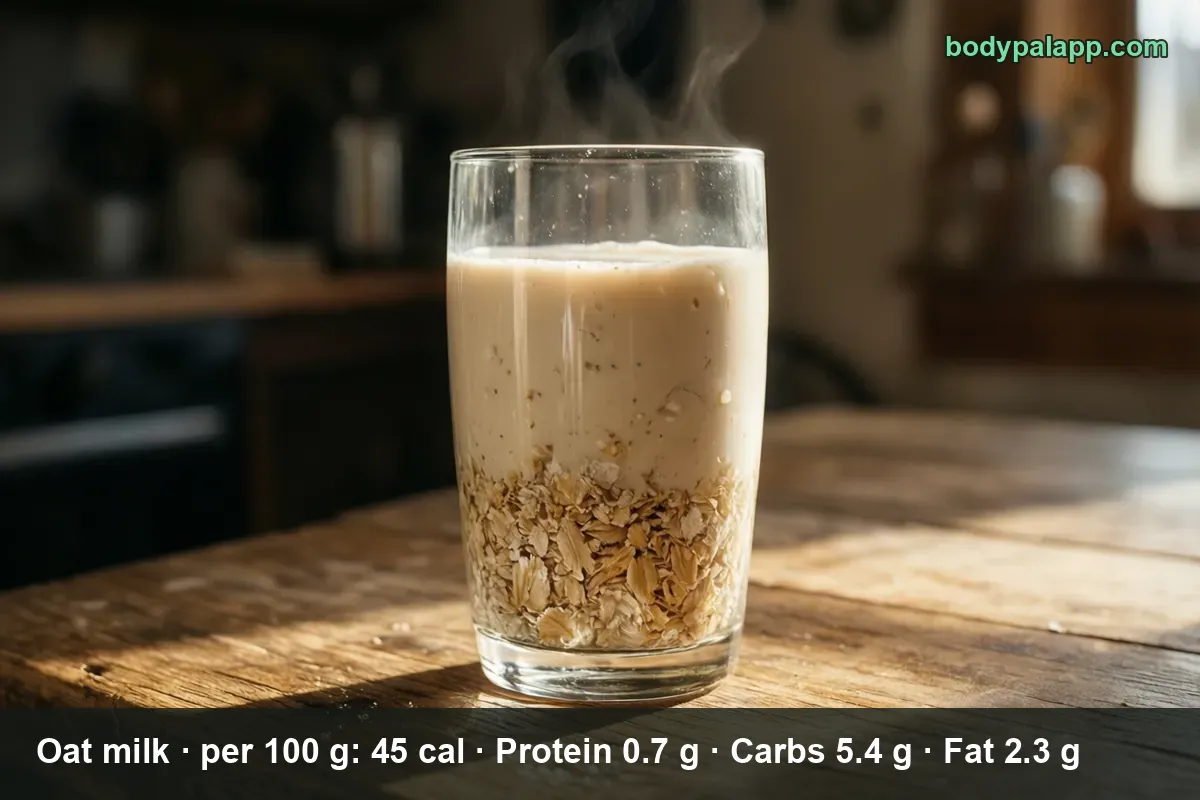
A cup of oat milk holds 110 calories. That is a 244 g pour, and per 100 g the drink runs 45 calories. Half a cup takes it to 55, and a 1 fl oz splash in coffee costs 14. Most of that is carbohydrate: 13.1 g a cup, against 1.6 g of protein.
On this page
- Oat milk quick facts
- US servings, from a splash to a full cup
- Unsweetened, chocolate and barista oat milk
- Sodium beats protein in this glass
- How does oat milk compare?
- Most popular oat milk brands
- Oat milk FAQs
Oat milk quick facts
The row below is USDA's FNDDS 2705412, "Oat milk" — the carton drink as Americans actually pour it, lightly sweetened and fortified. It was chosen over the Foundation record because it carries a full profile, sugars and saturated fat included, plus a household measure of one cup. The Foundation entry covers unsweetened oat milk only and appears further down as its own version.
| Nutrient | Per 100 g | Per 1 cup (244 g) | % Daily Value |
|---|---|---|---|
| Calories | 45 | 110 | — |
| Total fat | 2.33 g | 5.7 g | 7% |
| Saturated fat | 0.19 g | 0.5 g | 2% |
| Carbohydrate | 5.37 g | 13.1 g | 5% |
| Dietary fiber | 0.5 g | 1.2 g | 4% |
| Total sugars | 2.04 g | 5.0 g | — |
| Protein | 0.66 g | 1.6 g | 3% |
| Sodium | 43 mg | 105 mg | 5% |
% Daily Value is based on a 2,000-calorie diet.
Verified nutrition data
Numbers on this page come from USDA FoodData Central, the U.S. Department of Agriculture’s food composition database, and from manufacturer labels where a branded product is named. Last verified September 2026. How we verify our data →
Two rows you would see on a carton are missing here on purpose. USDA does not publish added sugars for this survey record, and trans fat is absent from this FNDDS edition, so neither line can be filled honestly. Cholesterol is zero, as it is in every plant drink, and potassium comes in at 18 mg per 100 g, or 44 mg a cup — about 1% of the Daily Value. Calcium and vitamin D are the reason many people switch to fortified cartons in the first place, but this record does not report them, so this page puts no number on either.
US servings, from a splash to a full cup
| Serving | Weight | Calories |
|---|---|---|
| 1 fl oz, a splash in coffee | 30.5 g | 14 kcal |
| 1 oz | 28 g | 13 kcal |
| Enough for one cup of hot cereal | 61 g | 27 kcal |
| 1/2 cup | 122 g | 55 kcal |
| 1 cup | 244 g | 110 kcal |
| Per 100 g | 100 g | 45 kcal |
One cup at 244 g and the fluid-ounce splash are USDA household measures for this record, and so is the cereal pour of 61 g. The half cup and the dry ounce are our own arithmetic from the USDA 100 g figure, not USDA servings.
Two traps live in this table. The first is the difference between a fluid ounce and an ounce by weight: a fluid ounce of oat milk weighs 30.5 g, because the drink is slightly denser than water, so logging "1 oz" when you poured "1 fl oz" undercounts you by about a calorie each time. Small, until you do it three times a day. The second is the coffee habit. A splash is 14 calories and nobody logs it; four splashes across a workday are 56, which is half a cup of oat milk you never noticed drinking.
Cereal is the honest test case. The USDA pour for one cup of hot oatmeal is 61 g of oat milk, 27 calories — a rounding error next to the oats. A latte is the opposite story, because the milk, not the espresso, is nearly the whole drink.
Unsweetened, chocolate and barista oat milk
| Version | Per 100 g | Typical serving | Calories |
|---|---|---|---|
| Oat milk, carton, as poured | 45 kcal | 1 cup (244 g) | 110 kcal |
| Unsweetened, plain, refrigerated | 48.3 kcal | 1 cup (244 g) | 118 kcal |
| Chocolate oat milk (Oatly) | 62 kcal | 1 cup (240 ml) | 149 kcal |
| Barista oat milk (Minor Figures) | 47 kcal | 8 fl oz (236.5 ml) | 111 kcal |
Here is the result almost nobody expects: the unsweetened record is the higher-calorie one. USDA's laboratory entry for unsweetened, plain, refrigerated oat milk lands at 48.3 calories per 100 g and 118 a cup, above the 45 and 110 of the sweetened carton. These are two different records of two different products, not the same carton measured twice, and the gap comes from what is in the bottle: the unsweetened sample carries more fat, 2.75 g per 100 g against 2.33 g, and no measurable fiber. Fat is more than twice as calorie-dense as sugar, so taking the sugar out and leaving the fat in does not automatically buy you calories back. Its calories are also derived by Atwater calculation rather than measured directly, which is worth knowing before treating an 8-calorie difference as gospel.
Chocolate is where the real jump is. Oatly's chocolate carton is 62 calories per 100 g against 50 for its original, so the same cup goes from 120 to 149 — 29 extra calories with no change in volume, all of it from added cocoa and sugar.
Barista formulas are the surprise in the other direction. Minor Figures' barista oat milk is 47 calories per 100 g, 111 in an 8 fl oz glass, essentially the same as the plain carton despite being built to foam. The organic version of the same brand is the outlier at 59 per 100 g, 140 per serving, which is a reminder that "organic" and "lighter" are unrelated words on a carton. Nature's Promise plant-based oat milk sits between them at 54 per 100 g, 130 a cup. Across the brands USDA lists, the working range for a cup of oat milk is roughly 110 to 150.
Sodium beats protein in this glass
A cup of oat milk delivers 105 mg of sodium, 5% of the FDA Daily Value of 2,300 mg, and 1.6 g of protein, which is 3% of the 50 g Daily Value. The drink brings more salt than protein, proportionally speaking. That 105 mg is roughly a twentieth of a teaspoon of table salt, so it is not a problem by itself; it only matters if you are drinking three cups a day and watching sodium closely.
Protein is the row that catches people out. Oat milk is a cereal drink, and cereals are not protein foods. Where dairy and soy give you eight grams or so a cup, oat milk gives you about a fifth of that. If you swapped four cups of dairy milk a week for oat milk purely on calories, you would also be removing most of that protein from the week. MyPlate counts only fortified soy beverages inside the Dairy Group for exactly this nutritional reason; oat milk is treated as its own thing.
Saturated fat, on the other hand, is a non-issue: 0.5 g a cup, 2% of the Daily Value. And the fiber that oat drinks are marketed on is thinner than the marketing suggests — 1.2 g a cup, 4% of the 28 g Daily Value, because most of the oat bran is strained out during production.
How does oat milk compare?
| Drink | Per 100 g | US serving | Calories |
|---|---|---|---|
| Oat milk | 45 kcal | 1 cup, 244 g | 110 kcal |
| Rice milk | 47 kcal | 1 cup, 244 g | 115 kcal |
| Soy milk, unsweetened | 38 kcal | 1 cup, 244 g | 93 kcal |
| Coconut milk beverage | 31 kcal | 1 cup, 244 g | 76 kcal |
Of these four, only rice milk costs more per cup than oat milk, and only by five calories. Coconut is the lightest of the group at 76, and unsweetened soy sits in the middle at 93.
Our take: for pure calorie counting, coconut beverage wins and oat milk is second-heaviest of the four. For a breakfast that keeps you full, unsweetened soy is the better buy — 93 calories a cup with 8.7 g of protein and 3.1 g of carbohydrate, against oat milk's 110 calories, 1.6 g of protein and 13.1 g of carbohydrate. Oat milk earns its place on taste and on how it behaves in coffee, not on its numbers. If you drink one cup a day the difference is 17 calories against soy; if you drink a 16 oz latte every morning, it is worth choosing on purpose.
Most popular oat milk brands in the United States
Ranked by how widely each product appears among foods sold in the United States, from the BodyPal food database of over 3.3 million products. Calories are the figures printed on each Nutrition Facts label, checked against USDA FoodData Central.
| Product | Calories (per 100 g) |
|---|---|
| Minor Figures Barista Oat Milk | 47 cal |
| Minor Figures Organic Barista Oat Milk | 59 cal |
| Oatly The Original Oat-Milk | 50 cal |
| Oatly Chocolate Oat Milk | 62 cal |
| Nature's Promise Original Plant-Based Oat Milk | 54 cal |
Brand popularity: BodyPal food database. Nutrition: manufacturer labels / USDA FoodData Central.
Oat milk FAQs
How many calories are in a cup of oat milk?
A cup of oat milk is 110 calories at 244 g, based on USDA's FNDDS record for the carton drink. That works out to 45 calories per 100 g. Half a cup is 55, and a 1 fl oz splash in coffee is 14. Branded cartons run a little higher, roughly 110 to 150 per cup.
How much sugar is in oat milk?
A cup holds 5.0 g of total sugars, from 2.04 g per 100 g. Some of that is sugar released when the oat starch is broken down during processing, not sugar poured into the vat. USDA does not publish an added sugars figure for this record, so the split between the two cannot be given here.
Does oat milk have protein?
Very little: 1.6 g in a cup, which is 3% of the 50 g Daily Value. Unsweetened soy milk gives 8.7 g in the same cup for fewer calories. If you are using a plant drink to hit a protein target, oat milk is the wrong tool; if you are using it for coffee, it does not matter.
Is unsweetened oat milk lower in calories?
Not in USDA's data: the unsweetened, plain, refrigerated record is 48.3 calories per 100 g and 118 a cup, above the 45 and 110 of the sweetened carton. Different products, different fat content: the unsweetened sample carries 2.75 g of fat per 100 g against 2.33 g, and fat outweighs the sugar removed.
How many calories in barista oat milk?
Minor Figures barista oat milk is 47 calories per 100 g, or 111 in an 8 fl oz serving — practically the same as a plain carton, despite the higher fat that makes it foam. The organic version of the same brand is heavier at 59 per 100 g, 140 per serving. Check the carton, not the category.
How many calories in Oatly original oat milk?
Oatly The Original is 50 calories per 100 g, so a 1 cup (240 ml) glass is 120 calories. The chocolate version is 62 per 100 g and 149 a cup — 29 more for the same glass. Both sit slightly above USDA's generic oat milk row of 45 per 100 g.
Is oat milk healthier than almond milk?
On calories they are close: the almond milk row USDA publishes alongside this one is the chocolate version, 43 calories per 100 g and 105 a cup, against oat milk's 45 and 110. Plain unsweetened almond milk is not in this data set, so no number is given for it here rather than guessing one.
Is oat milk good for weight loss?
It fits if you count it: a cup is 110 calories, so two coffees and a bowl of cereal can add 250 to a day almost invisibly. If calories are the priority, coconut beverage at 76 a cup is lighter; if fullness is, unsweetened soy at 93 a cup brings 8.7 g of protein with it.
Similar foods
- Kefir — 104 cal per cup
- Egg Beater — 29 cal per 1/4 cup
- 2% Milk — 122 cal per cup
- Apple With Peanut Butter — 95 cal per medium apple, sliced
- Egg White — 17 cal per large egg white
- Egg Whites — 17 cal per egg white
Count it without the math
Point the camera at the glass and BodyPal logs the pour for you, splash or full cup.


How long does it take to burn off oat milk?
A 1-cup (244 g) serving is 110 kcal. Enter your weight and the amount you ate to see how long it takes you to burn that off:
lb
| Activity | Time to burn 110 kcal |
|---|---|
| Walking, brisk | 22 min |
| Cycling, moderate | 14 min |
| Swimming, moderate | 16 min |
| Jogging | 13 min |
| Weight training, moderate | 24 min |
Times are for a 155 lb adult at a steady pace; change the weight to see yours. The amount is set to the portion in the text (244 g); change it to what you actually ate. BodyPal works this out from your steps automatically.
One food is easy to picture; a whole day is harder. See how many calories you need a day and what a deficit actually looks like.