Egg beater calories come to 29 for a 1/4 cup (60 g) and 48 per 100 g of the liquid, fat-free product. Look at where those calories come from: 83% is protein and none is fat. Sodium is the only real cost, at 119 mg per 1/4 cup.
29kcal
1 1/4 cup · 60 g, liquid, fat free
83%protein
6 gProtein
1 gCarbs
0 gFat
How to burn off 29 kcal
—Walking, brisk
—Jogging
—Cycling, moderate
—Swimming
Skip the math. BodyPal counts these calories from your steps and workouts automatically.
Nutrition facts
Liquid, fat free · per 60 g
Calories
29 kcal
Protein
6 g
Carbohydrate
1.2 g
Fat
0 g
Saturated fat
0 g
Cholesterol
0 mg
Sodium
119 mg
Potassium
128 mg
Iron
1.2 mg
Source: USDA FoodData Central
🛡️
Verified nutrition data
Numbers on this page come from USDA FoodData Central, the U.S. Department of Agriculture’s food composition database, and from manufacturer labels where a branded product is named. Last verified September 2026. How we verify our data →
Egg beater: calories, protein and sodium by serving
Percent of daily value uses the FDA reference of 2,000 kcal a day.
Serving
kcal
Protein
Carbs
Fat
Sodium
% DV kcal
1/4 cup (60 g)
29
6 g
1.2 g
0 g
119 mg
1%
1 cup (240 g)
115
24 g
4.8 g
0 g
478 mg
6%
100 g
48
10 g
2 g
0 g
199 mg
2%
3 × 1/4 cup (60 g)
86
18 g
358 mg
5 × 1/4 cup (60 g)
144
30 g
597 mg
A full cup is still only 115 calories
The label serving is 1/4 cup, or 60 g. It comes to 29 calories and 6 g of protein, which is just 1% of the daily calorie value and 12% of the protein value. On its own, that is a small number.
Most people pour more than one serving, and the total grows in step with the pour. Two 1/4-cup pours (120 g) give 58 calories and 12 g of protein. Three pours (180 g) reach 86 calories and 18 g of protein, which makes a solid scramble. A 1 cup portion (240 g) comes to 115 calories with 24 g of protein, or 48% of the protein daily value.
Even a big batch stays modest. Five 1/4-cup pours, 5 × 1/4 cup (300 g) in total, add up to 144 calories and 30 g of protein. Few breakfast proteins scale this cheaply. How much you pour sets the calorie total, because the carton holds no fat that could push it up. The bigger swings come from the pan and the fillings, covered below.
Protein is 83% of every calorie
Per 100 g, egg beater carries 10 g of protein, 2 g of carbs and 0 g of fat. That gives a calorie split of 83% protein and 17% carbs, with fat at 0%. Very few foods are this lopsided.
The carbs are all sugars: 2 g per 100 g, or 1.2 g in a 1/4 cup. Fiber is 0, saturated fat is 0 and cholesterol is 0. The USDA row calls it an egg substitute, liquid or frozen, fat free, and the numbers match that name. Nothing else rides along with the protein.
That makes it useful if you are trying to reach a protein target without spending many calories. The tradeoff is that a dish with zero fat can feel light, so what you cook it with and what you serve beside it matter more than usual. A plain scramble from the carton is lean. A cheesy omelet made from the same carton is a different meal.
Sodium is the row to watch
Sodium is the one number on this label that adds up. A 1/4 cup has 119 mg, which is 5% of the daily value. Per 100 g it is 199 mg, or 9%.
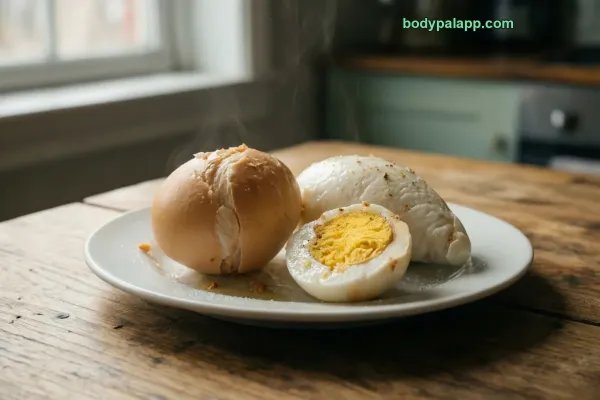
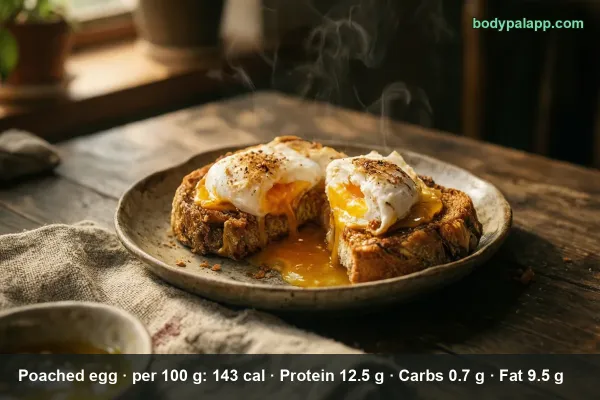
Bigger portions change the picture. A 1 cup portion carries 478 mg, which is 21% of the daily value, and 5 × 1/4 cup reaches 597 mg. By weight the liquid product runs saltier than a boiled egg, which has 124 mg per 100 g, and less salty than a poached egg at 297 mg.
If you watch sodium, go easy on salty add-ins like cheese, ham, bacon or bottled salsa, and taste before you reach for the shaker. Potassium is 213 mg per 100 g. That is a modest amount and does little to offset the sodium in a large serving.
Fat-free means you choose the fat
The carton brings 0 g of fat, so almost every extra calorie in an egg beater dish comes from the pan and the fillings. A pour of oil, a pat of butter or a handful of cheese can easily cost more than the 29 calories in the egg product itself. Use a nonstick pan or a light spray, and the dish keeps its lean profile.
Vegetables are the cheapest way to add volume. Spinach, peppers, onions, tomatoes and mushrooms bulk up a scramble without moving the totals much. Whole-grain toast, fruit or beans on the side bring the fiber that the egg product lacks, which rounds out the plate.
Flavored versions such as Egg Beaters Garden Vegetable Real Egg Product and Egg Beaters Southwestern Style Real Egg Product appear in the brand table on this page, next to Egg Beaters 100% Liquid Egg Whites. Check those rows before you swap one for another. If you are cooking a loaded omelet, BodyPal can log the finished dish from a photo, which helps when the fillings carry most of the calories.
How does egg beater compare?
Here is how egg beater stacks up against egg white, boiled egg and poached egg, per 100 g and per usual serving.
Verdict: For the fewest calories by weight, egg beater at 48 per 100 g and egg white at 52 are nearly tied, and both sit far below a boiled egg at 155. Pick the boiled egg if you want a whole egg with its fat. If you are counting every calorie, stay with the carton.
Most popular egg beater brands in the United States
A 1/4 cup serving (60 g) is 29 calories. A full cup (240 g) is 115 calories.
Is egg beater good for weight loss?
It has 48 calories per 100 g with 10 g protein and 0 g fat, so a 1/4 cup serving adds 29 calories and 6 g protein.
Egg beater vs egg white: which has fewer calories?
Egg beater is 48 calories per 100 g and egg white 52, so per 60 g that is 29 calories against 31.
How much protein is in egg beater?
10 g per 100 g, which is 6 g in a 1/4 cup serving (60 g) and 24 g in a full cup (240 g).
What are the nutrition facts for egg beater?
A 1/4 cup (60 g) of egg beater has 29 calories, 6 g of protein, 1.2 g of carbs, 0 g of fat and 119 mg of sodium. All of the carbs are sugars, and it has no fiber or cholesterol.
How much fat is in egg beater?
Egg beater has 0 g of fat per 1/4 cup and per 100 g, including 0 g of saturated fat. Fat supplies 0% of its calories, while protein supplies 83% and carbs 17%.
How many calories are in a cup of egg beaters?
A 1 cup (240 g) portion of egg beaters has 115 calories. It also delivers 24 g of protein and 478 mg of sodium, which is 21% of the daily value.
What is egg beater nutrition per 100 g?
Per 100 g, egg beater has 48 calories, 10 g of protein, 2 g of carbs, 0 g of fat, 199 mg of sodium and 213 mg of potassium. All 2 g of carbs are sugars.