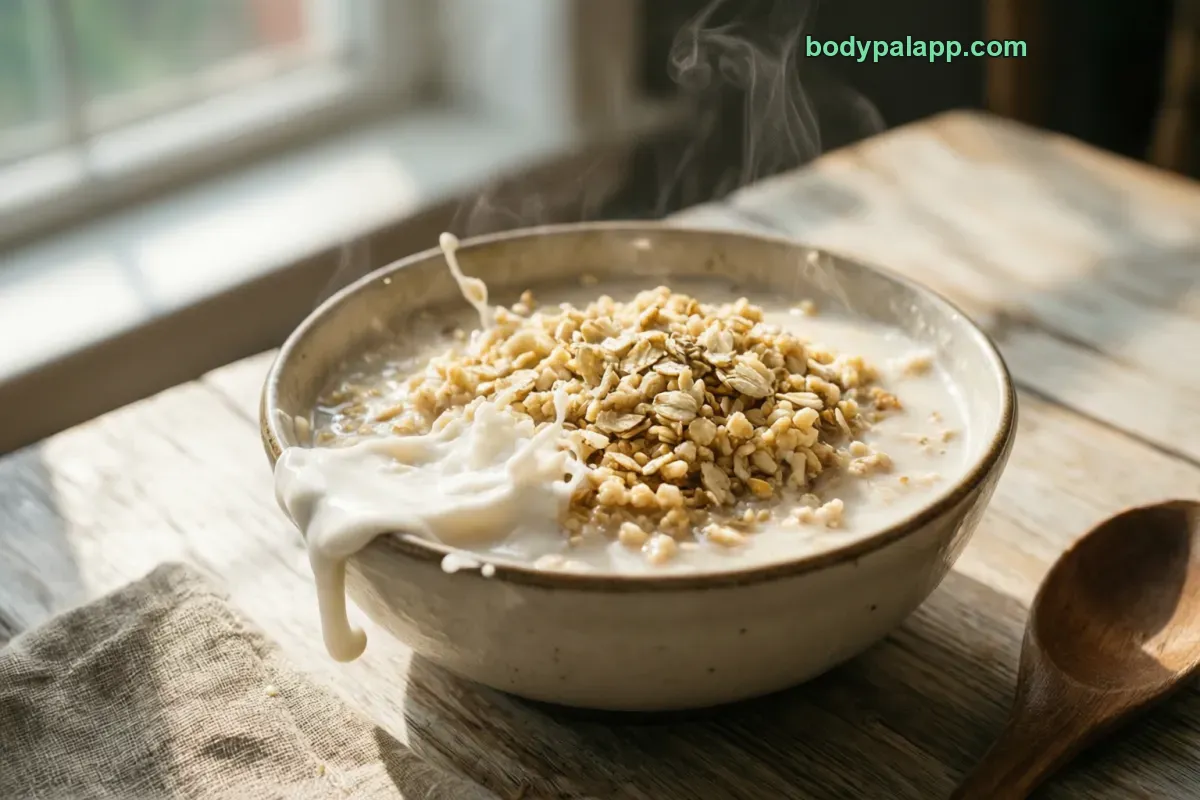
Oats and milk calories come to 278 for 1 cup (240 g) and 116 per 100 g, for oatmeal cooked with milk and no added fat. The number worth noticing is protein: that cup carries 13.3 g, or 27% of the daily value, which is a solid share for a bowl most people treat as pure carbs.
278kcal
1 cup · 240 g, cooked with milk, no fat
19%protein
13.3 gProtein
39 gCarbs
7.8 gFat
How to burn off 278 kcal
—Walking, brisk
—Jogging
—Cycling, moderate
—Swimming
Skip the math. BodyPal counts these calories from your steps and workouts automatically.
Nutrition facts
Cooked with milk, no fat · per 240 g
Calories
278 kcal
Protein
13.3 g
Carbohydrate
39 g
Fat
7.8 g
Saturated fat
3.5 g
Cholesterol
22 mg
Sodium
252 mg
Potassium
516 mg
Iron
1.6 mg
Source: USDA FoodData Central
🛡️
Verified nutrition data
Numbers on this page come from USDA FoodData Central, the U.S. Department of Agriculture’s food composition database, and from manufacturer labels where a branded product is named. Last verified September 2026. How we verify our data →
Oats and milk: calories, protein and sodium by serving
Percent of daily value uses the FDA reference of 2,000 kcal a day.
Serving
kcal
Protein
Carbs
Fat
Sodium
% DV kcal
1 cup (240 g)
278
13.3 g
39 g
7.8 g
252 mg
14%
Instant packet (148 g)
164
7.3 g
25.3 g
4.5 g
108 mg
8%
Non-dairy milk, 1 cup (240 g)
228
8 g
34.6 g
6.5 g
281 mg
11%
100 g
116
5.6 g
16.2 g
3.3 g
105 mg
6%
3 × 1 cup (240 g)
835
40 g
756 mg
5 × 1 cup (240 g)
1,392
66.7 g
1,260 mg
One cup is a 278-calorie breakfast, and bowls run bigger
The reference serving is 1 cup (240 g) of oatmeal made with milk, at 278 calories and 14% of a daily calorie value. That is a moderate breakfast on paper. In practice, cereal bowls at home often hold more than a measured cup, so the real total depends on how full you pour.
Scale it up and the numbers move fast. Two cups (480 g) reach 557 calories with 26.7 g of protein. Three cups (720 g) come to 835 calories. If you batch-cook and eat from the pot over a day, 5 cups (1,200 g) add up to 1,392 calories and 1,260 mg of sodium, so it pays to portion before you sit down.
The smaller option is an instant packet prepared with milk. At 148 g it lands at 164 calories, 7.3 g of protein and 8% of the daily calorie value. If you want a lighter start, the packet size is a built-in limit; if you want staying power, the full cup gives you nearly double the protein.
Carbs supply 56% of the calories, protein a solid 19%
Split by source, oats cooked with milk get 56% of their calories from carbohydrate, 25% from fat and 19% from protein. Per 100 g that works out to 16.2 g of carbs, 5.6 g of protein and 3.3 g of fat. It is a carb-led food, but not a carb-only one.
The fat is modest and partly saturated: 1.4 g per 100 g, with 7.8 g of total fat in a full cup. Since the recipe uses no added fat, almost all of that comes along with the oats and milk themselves. Stir in butter or nut butter and the fat share climbs quickly.
Sugar is the row people misread. A cup holds 12.2 g of sugars before you add anything, which reflects the milk in the pot rather than a sweetener. Fiber sits at 4.1 g per cup, or 1.7 g per 100 g. Brown sugar, honey or syrup on top stack added sugar onto a base that already has some.
Swapping in non-dairy milk costs you protein
The milk you pour changes more than calories. A cup made with non-dairy milk comes to 228 calories, but protein drops from 13.3 g to 8 g, which is 16% of the daily value instead of 27%. If the bowl is meant to keep you full until lunch, that gap matters.
Sugars fall too, from 12.2 g to 5.3 g per cup, and fiber is about the same at 4.3 g. Sodium moves the other way: 281 mg for the non-dairy version against 252 mg with milk, or 12% versus 11% of the daily value. Neither figure is high for a breakfast, but the non-dairy cup is not the lower-sodium pick.
Our take: choose dairy milk if protein is your priority and the non-dairy cup if you want fewer calories and less sugar in the base. Either way, the toppings usually decide the final total more than the milk does.
A cup leaves plenty of room for smart toppings
At 278 calories, a cup of oats and milk takes up a modest slice of a day and brings 13.3 g of protein, 4.1 g of fiber and only 252 mg of sodium. That makes it an easy base to build on rather than a meal you need to offset later.
Fruit adds volume and sweetness without the jump that syrup brings. Nuts or seeds add fat and crunch, so measure them rather than pouring from the bag. If you want more protein, pair the bowl with eggs or yogurt on the side instead of doubling the oats, since a second cup pushes the meal to 557 calories.
The easiest way to keep the numbers honest is to log the bowl as you actually serve it. BodyPal can log oats and milk from a photo, which helps when your cup is really a cup and a half.
How does oats and milk compare?
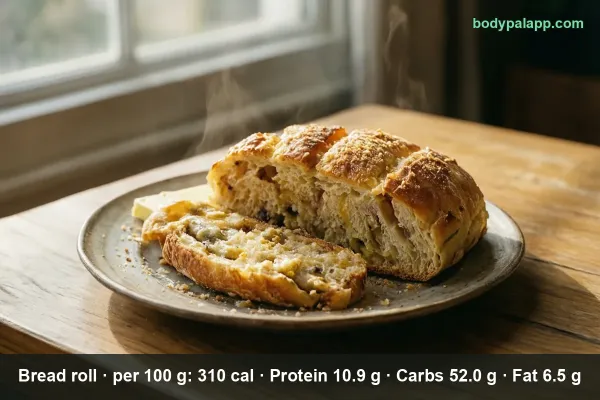
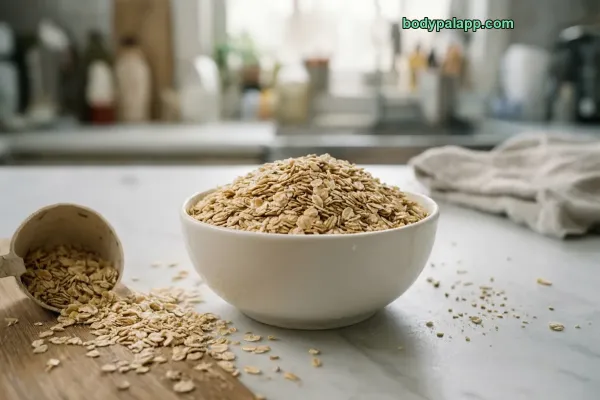
Here is how oats and milk stack up against dry oats, rolled oats and a bread roll with butter, per 100 g and per usual serving.
Verdict: For a filling breakfast with fewer calories per bite, pick oats and milk at 116 per 100 g; dry and rolled oats show 379 per 100 g only because no liquid has been added yet. If you watch sodium, skip the bread roll and butter, which packs 310 calories and 467 mg of sodium per 100 g against 105 mg here.
Oats and milk FAQs
How many calories are in a cup of oats and milk?
About 278 calories in one cup (240 g) of oatmeal cooked with milk and no added fat. With fat added it is about 307 calories.
Is oatmeal with milk good for weight loss?
One cup has 278 calories with 13.3 g of protein and 4.1 g of fiber. Per 100 g it is 116 calories.
Oats with milk vs oats with non-dairy milk: which has fewer calories?
A cup made with non-dairy milk is about 228 calories, compared with 278 for a cup made with milk. The milk version has more protein, 13.3 g vs 8.0 g.
How many carbs and sugar are in oats and milk?
One cup has 39.0 g of carbs, of which 12.2 g is sugar. Per 100 g that is 16.2 g of carbs and 5.1 g of sugar.
How many calories are in an instant oatmeal packet made with milk?
An instant packet prepared with milk (148 g) has 164 calories. It also brings 7.3 g of protein, 25.3 g of carbs and 4.5 g of fat, which is 8% of the daily calorie value.
How much protein is in oatmeal made with milk?
One cup (240 g) of oats cooked with milk has 13.3 g of protein, or 27% of the daily value. Per 100 g it is 5.6 g, and protein supplies 19% of the calories.
How much sodium is in a cup of oats and milk?
A cup of oats and milk has 252 mg of sodium, 11% of the 2300 mg daily value. Per 100 g the figure is 105 mg, so it stays a low-sodium breakfast unless you salt it.
How many calories are in 2 cups of oatmeal with milk?
Two cups (480 g) of oats cooked with milk come to 557 calories. That portion carries 26.7 g of protein and 504 mg of sodium, so the protein doubles along with the calories.
How much fiber does oats and milk have?
A cup of oats and milk has 4.1 g of fiber, and 100 g has 1.7 g. The non-dairy milk version is about the same at 4.3 g per cup.