Orange jello calories come to 80 for 1/4 package (21 g) of dry mix and 381 per 100 g of powder. What stands out is the sugar: 19 g of that 21 g serving is sugar, and carbs supply 95% of the calories. There is no fat, no fiber and only a gram of protein.
80kcal
1 quarter package · 21 g, packaged, per label
5%protein
1 gProtein
19 gCarbs
0 gFat
How to burn off 80 kcal
—Walking, brisk
—Jogging
—Cycling, moderate
—Swimming
Skip the math. BodyPal counts these calories from your steps and workouts automatically.
Nutrition facts
Packaged, per label · per 21 g
Calories
80 kcal
Protein
1 g
Carbohydrate
19 g
Fat
0 g
Saturated fat
0 g
Cholesterol
0 mg
Sodium
80 mg
Potassium
0 mg
Source: USDA FoodData Central
🛡️
Verified nutrition data
Numbers on this page come from USDA FoodData Central, the U.S. Department of Agriculture’s food composition database, and from manufacturer labels where a branded product is named. Last verified September 2026. How we verify our data →
Orange jello: calories, protein and sodium by serving
Percent of daily value uses the FDA reference of 2,000 kcal a day.
Serving
kcal
Protein
Carbs
Fat
Sodium
% DV kcal
1/4 package (21 g)
80
1 g
19 g
0 g
80 mg
4%
100 g
381
4.8 g
90.5 g
0 g
381 mg
19%
3 × 1/4 package (21 g)
240
3 g
240 mg
5 × 1/4 package (21 g)
400
5 g
400 mg
A quarter package is an 80-calorie dessert
The label serving is 1/4 package (21 g) of dry mix, which lands at 80 calories, or 4% of a 2000-calorie day. That is a small number for something that sets into a full bowl once you add water. The water adds volume and no calories, so the calories in the bowl are the calories in the powder.
Portions add up in a straight line. Two quarter-package servings (42 g of mix) bring 160 calories, three servings (63 g) bring 240, and five servings (105 g) reach 400. Most people who eat jello straight from the fridge take more than one scoop, so count the scoops against the quarter-package mark rather than guessing.
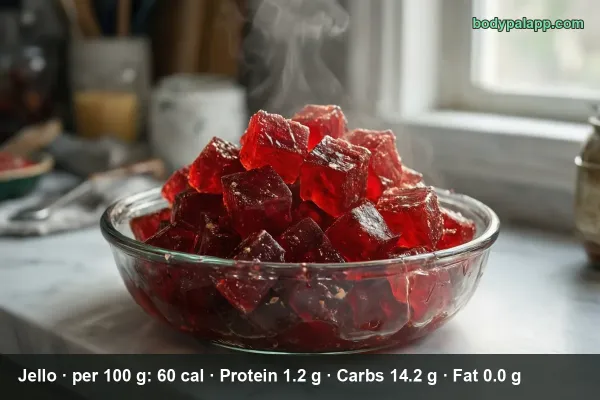
Do not read the 381 per 100 g figure as the weight of the jiggly dessert on your spoon. It describes the dry powder, which is almost pure sugar. Prepared jello is mostly water, which is why the plain jello page lists only 60 calories per 100 g. Same food, different state.
Nearly every calorie is sugar
The calorie split is blunt: 95% carbs, 5% protein and 0% fat. Per 100 g of mix there are 90.5 g of carbs, and all 90.5 g are sugars. Fiber is 0, so nothing slows that sugar down or adds bulk beyond the water you mix in.
The protein comes from gelatin, the ingredient that makes it set. It reaches 4.8 g per 100 g of powder, which works out to about 1 g per serving and 2% of the daily value. That is not enough to count as a protein source. Two servings give 2 g; five give 5 g.
So the honest description is flavored sugar held in a gel. That is fine for a dessert, as long as you treat it as one. Its appeal is the low calorie count per bowl, not its nutrient profile, and the label backs that up: fat, saturated fat and cholesterol all read 0.
Sodium is modest, but it is there
A sweet dessert carrying sodium surprises some readers. One quarter-package serving has 80 mg, which is 3% of the daily value. Per 100 g of mix the figure is 381 mg, or 17% of the daily value, but you would need several servings of powder to get there.
Stack servings and it climbs with the calories: 160 mg for two, 240 mg for three and 400 mg for five. None of these is a big number on its own. If you watch sodium closely, it is still worth logging, since small amounts from desserts and snacks add up over a day.
Store brands follow the same recipe pattern. Jell-O, Meijer, Tops, Hy-Vee and Hill Country Fare all sell orange gelatin dessert mixes, and the label is the place to check sugar and sodium for the box you actually bought.
Pair it with protein to make it a snack
On its own, orange jello is a light, sweet finish with almost no protein, so it will not keep you full for long. If you want it to work as a snack rather than a treat, pair it with a protein food such as plain yogurt or cottage cheese, or fold in fresh fruit for some fiber.
It also works as a portion-control tool. A set bowl looks generous for 80 calories, which makes it an easy swap when you want something sweet after dinner. The catch is the sugar, so if you track added sugar, give it a line in your log like any other dessert.
BodyPal can log a bowl of jello from a photo, which saves you from weighing the powder after it has already set.
How does orange jello compare?
Here is orange jello mix next to prepared jello, orange sherbet and Orange Leaf frozen yogurt, per 100 g and per usual serving.
Verdict: Per 100 g the 381 here is dry powder, so judge by serving: 80 calories for a quarter package beats 107 for a 1/2 cup of orange sherbet and 278 for a cup of Orange Leaf frozen yogurt. For the lightest dessert pick jello; if you want something creamy with a little more protein, Orange Leaf brings 4 g per 100 g but costs the most calories.
Most popular orange jello brands in the United States
How many calories are in a serving of orange jello?
One 21 g serving of dry mix, the quarter package that makes half a cup, is 80 calories. The mix itself is 381 calories per 100 g.
Is orange jello good for weight loss?
A serving adds 80 calories, and all of it is carbohydrate: 19 g carbs and 0 g fat per 21 g serving.
Orange jello vs orange sherbet: which is lighter?
Orange sherbet is 144 calories per 100 g of dessert, while a standard orange jello serving comes from 21 g of mix and is 80 calories.
How much sugar is in orange jello?
A 21 g serving has 19 g sugars, which works out to 90.5 g per 100 g of dry mix.
Does orange jello have any fat?
No. Orange jello mix has 0 g fat per 100 g and per serving, and saturated fat and cholesterol are also 0. Its calories come 95% from carbs and 5% from protein.
Is the 381 calories per 100 g for prepared jello?
No, 381 calories per 100 g describes the dry mix. Prepared jello is mostly water, which is why the plain jello page shows 60 calories per 100 g. A quarter package of mix makes an 80-calorie portion.
How much protein is in orange jello?
About 1 g per 1/4 package (21 g), which is 2% of the daily value. Per 100 g of mix it is 4.8 g, all from gelatin. That is too little to count as a protein source.
How much sodium does orange jello have?
A 1/4 package serving has 80 mg of sodium, 3% of the daily value. Per 100 g of mix it is 381 mg, or 17% of the daily value. Two servings bring 160 mg.
How many calories are in two servings of orange jello?
Two quarter-package servings (42 g of mix) have 160 calories. Three servings (63 g) have 240 calories, and five servings (105 g) reach 400 calories, with sugar making up nearly all of it.