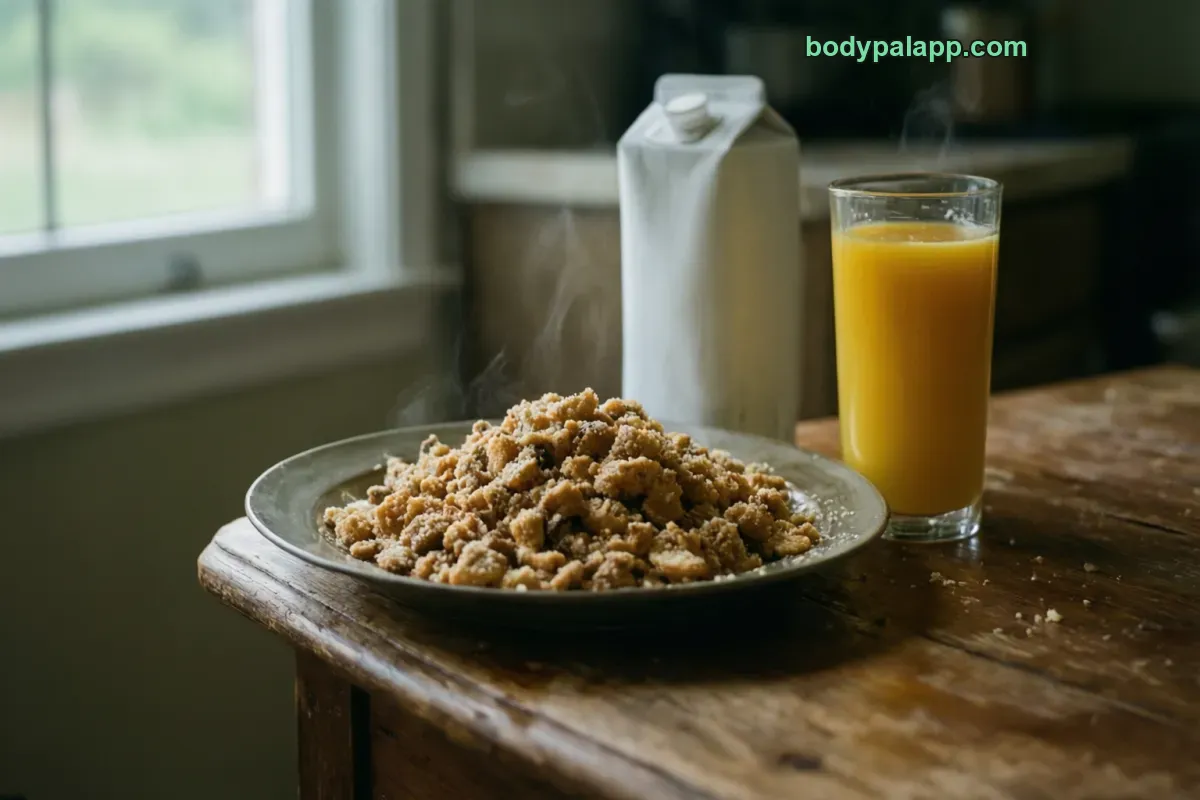
Tropicana orange juice calories come to 110 for an 8 fl oz cup (240 g) and 46 per 100 g, straight from the label. The number that matters more is the sugar: 22 g in that cup, and 93% of the calories come from carbohydrate. There is almost no protein, no fat and no fiber to slow it down.
110kcal
1 8 fl oz cup · 240 g, packaged, per label
7%protein
2 gProtein
26 gCarbs
0 gFat
How to burn off 110 kcal
—Walking, brisk
—Jogging
—Cycling, moderate
—Swimming
Skip the math. BodyPal counts these calories from your steps and workouts automatically.
Nutrition facts
Packaged, per label · per 240 g
Calories
110 kcal
Protein
2 g
Carbohydrate
26 g
Fat
0 g
Saturated fat
0 g
Cholesterol
0 mg
Sodium
0 mg
Potassium
451 mg
Source: USDA FoodData Central
🛡️
Verified nutrition data
Numbers on this page come from USDA FoodData Central, the U.S. Department of Agriculture’s food composition database, and from manufacturer labels where a branded product is named. Last verified September 2026. How we verify our data →
Tropicana orange juice: calories, protein and sodium by serving
Percent of daily value uses the FDA reference of 2,000 kcal a day.
Serving
kcal
Protein
Carbs
Fat
Sodium
% DV kcal
8 fl oz (240 g)
110
2 g
26 g
0 g
0 mg
6%
15.2 oz bottle (456 g)
214
3.1 g
50.3 g
0.3 g
5 mg
11%
100 g
46
0.8 g
10.8 g
0 g
0 mg
2%
3 × 8 fl oz (240 g)
331
6 g
0 mg
5 × 8 fl oz (240 g)
552
10 g
0 mg
The 15.2 oz bottle is a 214-calorie drink
The label serving is 8 fl oz (240 g), worth 110 calories, or 6% of a 2,000-calorie daily value. That is a modest number on its own. The trouble is that few people pour exactly one measured cup, and juice goes down fast because there is nothing to chew.
The single-serve 15.2 oz bottle (456 g) holds 214 calories, which is 11% of the daily value in one grab-and-go drink. It also carries 49.5 g of sugar and 50.3 g of carbs. Treat it as close to two cups, because that is what it is.
Refills add up in a straight line. Two 8 fl oz cups bring you to 221 calories, three reach 331, and five reach 552. If you keep a carton in the fridge and top up a tall glass through the morning, measure once so you know what your usual pour actually is. A large tumbler can quietly double the label number.
Carbs supply nearly every calorie
The calorie split is lopsided: 93% carbohydrate, 7% protein and 0% fat. Per 100 g, Tropicana lists 10.8 g of carbs, of which 9.2 g are sugars, plus 0.8 g of protein and 0 g of fat. In practice, this is a sugar drink with vitamins attached rather than a balanced food.
Those sugars come from the oranges, since the USDA row describes it as 100% juice. That matters for the ingredient list, not for the calorie count. Your body still gets 22 g of sugar from a cup, with no fiber listed on the cup serving to slow absorption.
Protein barely registers. A cup gives 2 g, which is 4% of the daily value, and even the full bottle reaches only 3.1 g. If you were counting on breakfast juice to hold you until lunch, the macros explain why it usually does not.
Sugar is the row to watch, not sodium
Sodium is a non-issue here. The cup lists 0 mg, and the 15.2 oz bottle lists only 5 mg, which still rounds to 0% of the 2,300 mg daily value. Fat, saturated fat and cholesterol are all 0 per 100 g as well.
Sugar is the line that deserves your attention. A cup carries 22 g and the bottle 49.5 g, almost all of the carbohydrate on the label. Because juice is liquid, those grams arrive quickly and without the bulk of a whole orange.
Fiber is the gap. Per 100 g the label shows 0 g, and the bottle row lists just 0.9 g against a 28 g daily value. On the plus side, the juice does supply potassium: 188 mg per 100 g. If you like orange juice for its potassium, a smaller glass still delivers some of it without the full sugar load of a big pour.
Pair it with protein and keep the glass small
Orange juice works best as a side, not the meal. Because it brings almost no protein or fat, it pairs well with foods that do: eggs, Greek yogurt, cottage cheese or a slice of whole-grain toast with nut butter. That combination makes the breakfast more filling than juice and a pastry would.
Portion is the main lever you control. An 8 fl oz cup at 110 calories fits easily into most days; the 214-calorie bottle or a refilled tumbler is where totals creep up. A small juice glass, rather than a tall one, keeps the pour close to the label serving without any measuring.
Tropicana sells several versions on this page, including Grovestand and the larger 100% Orange Juice bottle, so check the label of the one you buy. If you track your intake, BodyPal can log your glass from a photo, which makes it easier to see how often juice shows up in a typical week.
How does tropicana orange juice compare?
Here is how Tropicana stacks up against fresh orange juice, a standard glass of orange juice and the juice of one orange, per 100 g and per usual serving.
Verdict: Per 100 g these are essentially the same drink: Tropicana at 46 calories sits between fresh juice at 45 and a glass at 47, so choose on taste and price, not calories. If you want the smallest serving, squeeze one orange for 39 calories instead of pouring a cup at 110 or more.
Most popular tropicana orange juice brands in the United States
Ranked by popularity in the BodyPal database
# Productkcal / 100 g
1Tropicana Orange Juice8 fl oz · 240 g46 kcal
2Tropicana Orange Juice 15.2 oz Bottle15.2 oz · 456 g47 kcal
3Tropicana Grovestand Orange Juice8 fl oz · 240 g44 kcal
4Tropicana 100% Orange Juice 32 oz Bottle8 fl oz · 240 g47 kcal
How many calories are in a cup of Tropicana orange juice?
An 8 fl oz (240 g) serving has about 110 calories. The 15.2 oz bottle (456 g) has about 214.
Is Tropicana orange juice good for weight loss?
One 8 fl oz cup has 110 calories, 0 g fat and 0 g fiber. Most of its 26.0 g of carbs is sugar.
Tropicana vs fresh squeezed orange juice: which has fewer calories?
They are nearly the same: 46 calories per 100 g for Tropicana and 45 for fresh squeezed orange juice.
How much sugar is in Tropicana orange juice?
An 8 fl oz cup has 22.0 g of sugar out of 26.0 g of carbs, or 9.17 g of sugar per 100 g.
How many calories are in a 15.2 oz bottle of Tropicana orange juice?
A 15.2 oz bottle (456 g) has 214 calories, about 11% of a 2,000-calorie daily value. It also carries 49.5 g of sugar and 50.3 g of carbs, so it counts as close to two cups.
How many calories are in two cups of Tropicana orange juice?
Two 8 fl oz cups (480 g) come to 221 calories. Three cups reach 331 and five reach 552, so a habit of refilling the glass adds up faster than most people expect.
Does Tropicana orange juice have any protein?
Very little. An 8 fl oz cup has 2 g of protein, or 4% of the daily value, and protein supplies only 7% of the calories. Pair it with eggs or yogurt if you want breakfast to keep you full.
Does Tropicana orange juice contain fiber?
The label lists 0 g of fiber per 100 g and per cup. The 15.2 oz bottle row shows just 0.9 g against a 28 g daily value, so juice is not a meaningful fiber source.
Is there sodium in Tropicana orange juice?
Practically none. A cup lists 0 mg of sodium and the 15.2 oz bottle lists 5 mg, which is still 0% of the 2,300 mg daily value. Sugar, not sodium, is the number worth watching.