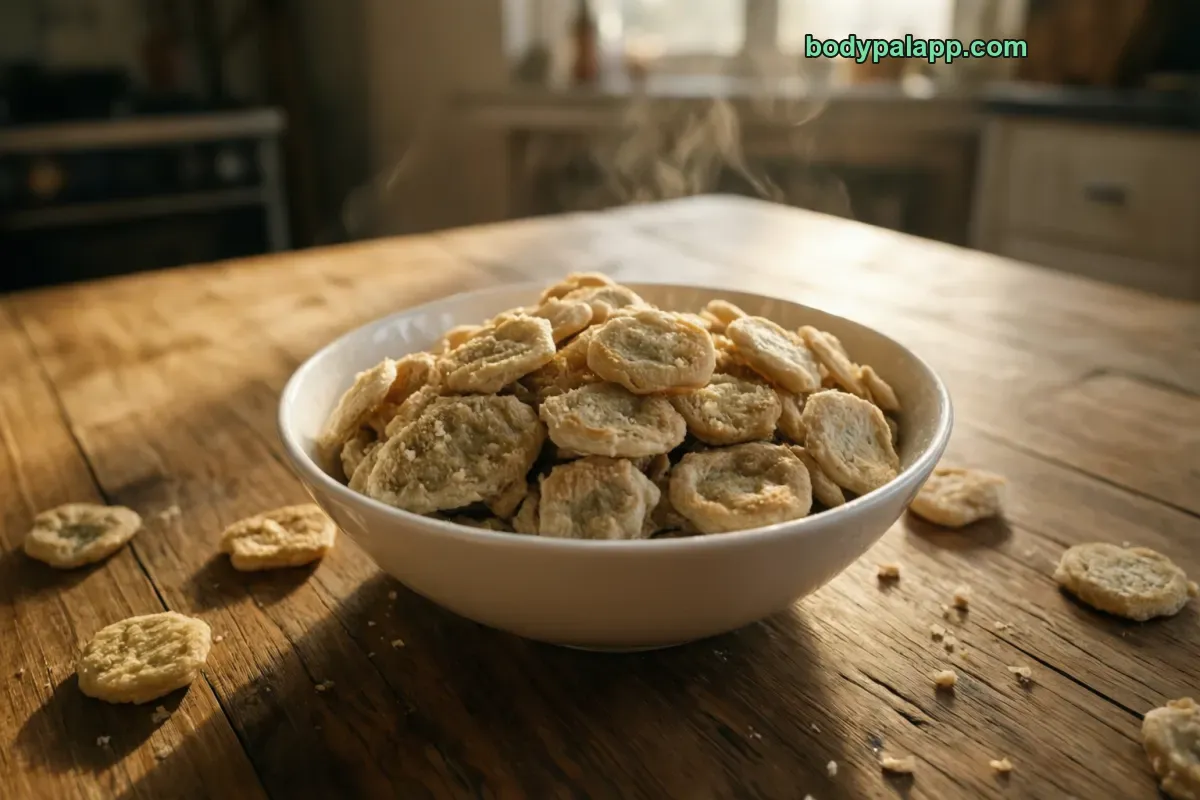
Oyster crackers calories come to 209 for 1 cup (50 g) and 418 per 100 g. Sodium is what to watch. That same cup carries 471 mg, 20% of the daily value, and gives you only 4.7 g of protein. They are tiny crackers that pour fast, so a handful can easily turn into a lot.
209kcal
1 cup · 50 g, plain, ready to eat
9%protein
4.7 gProtein
37 gCarbs
4.3 gFat
How to burn off 209 kcal
—Walking, brisk
—Jogging
—Cycling, moderate
—Swimming
Skip the math. BodyPal counts these calories from your steps and workouts automatically.
Nutrition facts
Plain, ready to eat · per 50 g
Calories
209 kcal
Protein
4.7 g
Carbohydrate
37 g
Fat
4.3 g
Saturated fat
0.8 g
Cholesterol
0 mg
Sodium
471 mg
Potassium
76 mg
Iron
2.8 mg
Source: USDA FoodData Central
🛡️
Verified nutrition data
Numbers on this page come from USDA FoodData Central, the U.S. Department of Agriculture’s food composition database, and from manufacturer labels where a branded product is named. Last verified September 2026. How we verify our data →
Oyster crackers: calories, protein and sodium by serving
Percent of daily value uses the FDA reference of 2,000 kcal a day.
Serving
kcal
Protein
Carbs
Fat
Sodium
% DV kcal
1 cup (50 g)
209
4.7 g
37 g
4.3 g
471 mg
10%
Serving bag (15 g)
63
1.4 g
11.1 g
1.3 g
141 mg
3%
1 cracker (1 g)
4
0.1 g
0.7 g
0.1 g
9 mg
0%
100 g
418
9.5 g
74.1 g
8.6 g
941 mg
21%
3 × 1 cup (50 g)
627
14.2 g
1,412 mg
5 × 1 cup (50 g)
1,045
23.7 g
2,353 mg
A cup is 209 calories, and refills add up quickly
Each cracker weighs about 1 g and has about 4 calories. That looks like nothing, which is the problem. Nobody eats one oyster cracker. You pour them, and the pour is what counts. A full cup (50 g) comes to 209 calories, about 10% of the daily value, while a single-serve bag (15 g) is a much smaller 63 calories.
Seconds are where the total climbs. Two cups weigh 100 g and come to 418 calories with 941 mg of sodium. Three cups reach 627 calories and 1,412 mg of sodium. A big bowl of chowder topped again and again over an evening can reach five cups, or 1,045 calories and 2,353 mg of sodium, which is more sodium than the full 2300 mg daily value.
If you want the crunch without the drift, buy the serving bags or measure a portion into a small cup before you sit down. The 15 g bag is a built-in limit. A box sitting next to the soup pot has no limit at all.
Nearly three quarters of the calories are refined carbs
Carbs supply 72% of the calories in oyster crackers. Fat supplies 19% and protein only 9%. Per 100 g that works out to 74.1 g of carbs, 8.6 g of fat and 9.5 g of protein. These are basically wheat crackers with a little fat for texture, and the nutrition reflects that.
Fiber is low at 2.8 g per 100 g, and a cup gives you just 1.4 g against a daily value of 28 g. Sugar is barely there at 1.3 g per 100 g, so the carbs are almost all starch. Saturated fat is modest at 1.7 g per 100 g, and cholesterol is 0.
In practice, a cup gives you 37 g of carbs, 4.3 g of fat and 4.7 g of protein. That is quick energy with little protein or fiber to slow it down. They will not keep you full the way the soup under them can. Treat them as a topping that adds crunch, not as part of the meal's substance.
Sodium is the row to watch
Oyster crackers have 941 mg of sodium per 100 g, which is 41% of the 2300 mg daily value. A cup brings 471 mg, or 20%. Even the small 15 g bag adds 141 mg, about 6% of the day. Calories per cup are only 10% of the daily value, so the salt is out of proportion to the energy.
What makes it worse is what you eat them with. Oyster crackers usually go into clam chowder, chili or tomato soup, and canned or restaurant versions of those are rarely low in salt. So the 471 mg from a cup lands on top of whatever the bowl already has.
If you watch sodium, the fix is simple. Use a measured handful instead of a cup, choose a lower-sodium soup, or swap in a cracker with less salt. Seasoned versions like ranch or parmesan peppercorn flavors can be saltier still, so check the label on flavored bags.
They work best as a garnish, not a side
The smartest way to eat oyster crackers is to treat them like croutons. A small scatter over a bowl of soup adds crunch for a few dozen calories. A cup on the side is a different matter: 209 calories of starch with little protein to show for it.
Pair them with something that does the work they cannot. A broth-based soup with beans, chicken or vegetables brings the protein and fiber the crackers are missing. A bowl of chili with lean meat makes a few crackers a reasonable finish. On their own as a snack, oyster crackers are easy to eat past the point of hunger, because there is little in them to slow you down.
Brands such as Olde Cape Cod, Great Value and Skyline Chili sell plain and soup-style versions, and the plain ones are what these numbers describe. If you are logging a bowl, BodyPal can log the soup and crackers from a photo, which helps you catch the second and third pours that usually go unrecorded.
How does oyster crackers compare?
Here is how oyster crackers compare with saltines, soda crackers and rice crackers, per 100 g and per usual serving.
Verdict: Calories barely differ: saltines and soda crackers match oyster crackers at 418 per 100 g, and rice crackers are at 416. If sodium is your concern, pick rice crackers at 233 mg per 100 g against 941 mg. Otherwise choose by texture, since saltines, soda crackers and oyster crackers have the same numbers in different shapes.
Most popular oyster crackers brands in the United States
These are all dry crackers weighed the same way as the numbers above; the seasoned and buttery versions read higher because they carry more fat. Source: manufacturer labels / USDA FoodData Central.
Oyster crackers FAQs
How many calories are in oyster crackers?
A cup of oyster crackers (50 g) is 209 calories, and a 15 g serving bag is 63 calories. One single oyster cracker is about 4 calories.
Are oyster crackers good for weight loss?
A 15 g serving is 63 calories with 1.4 g protein and 0.4 g fiber, while a full cup is 209 calories, 37 g carbs and 471 mg sodium. Per 100 g they are 418 calories, the same as saltines.
Oyster crackers vs saltine crackers: which has fewer calories?
Neither. USDA lists oyster crackers with saltines at 418 calories per 100 g, 9.5 g protein and 8.6 g fat, so the difference is shape, not calories.
How many carbs are in oyster crackers?
Oyster crackers have 74.1 g carbs per 100 g, which is 37 g in a cup (50 g) and 11.1 g in a 15 g serving, with 2.8 g fiber per 100 g.
How many calories are in one oyster cracker?
One oyster cracker weighs about 1 g and has about 4 calories. The catch is that people eat them by the handful. A full cup of 50 g comes to 209 calories.
How many calories are in a small bag of oyster crackers?
A 15 g serving bag of oyster crackers has 63 calories, 141 mg of sodium and 1.4 g of protein. That makes the bag a handy portion limit compared with pouring from a box.
How much sodium is in oyster crackers?
Oyster crackers have 471 mg of sodium per cup (50 g), which is 20% of the daily value. Per 100 g they have 941 mg, or 41%, so the salt adds up fast on top of a salty soup.
Do oyster crackers have much protein or fiber?
Not much. A cup has 4.7 g of protein and 1.4 g of fiber, and protein supplies only 9% of the calories. Most of the energy, 72%, comes from carbs.
Are oyster crackers high in fat?
No. Oyster crackers have 8.6 g of fat per 100 g, including 1.7 g saturated, and fat makes up 19% of the calories. A cup has 4.3 g of fat and 0 cholesterol.