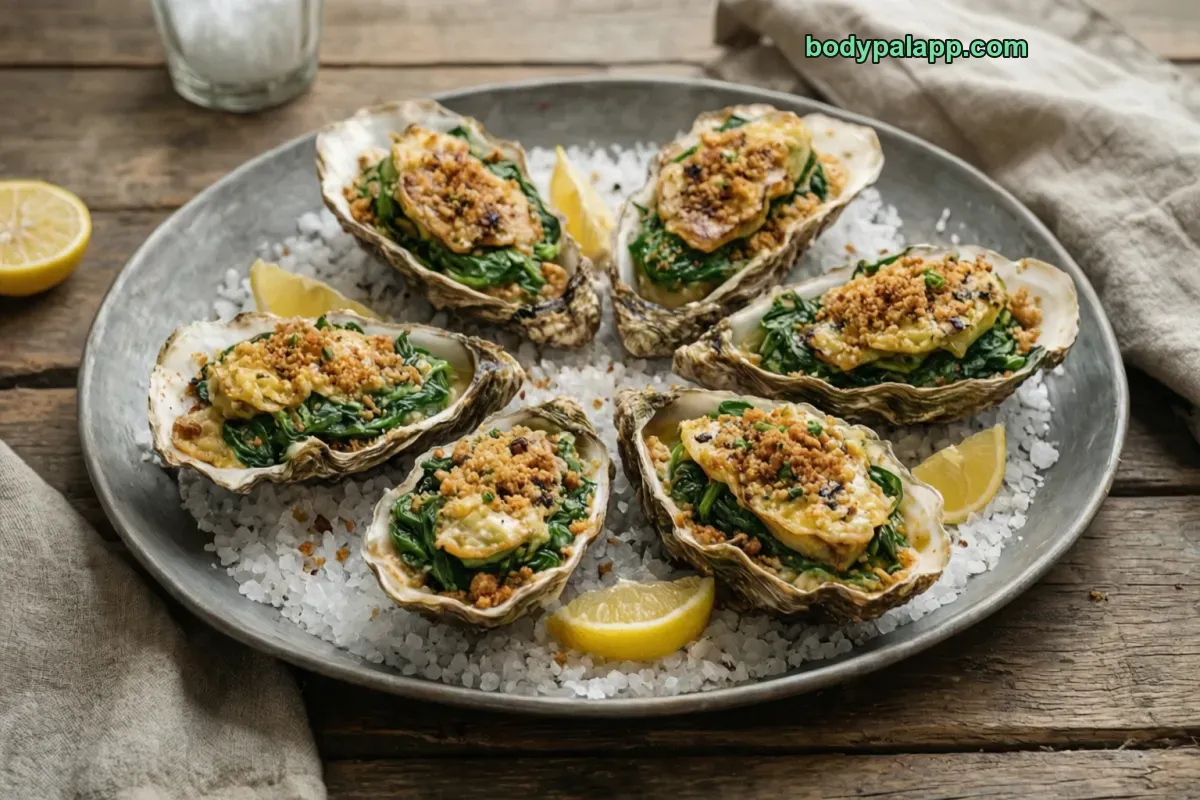
Oysters Rockefeller calories come to 40 for one baked oyster (30 g) and 134 per 100 g. Half of those calories come from fat, mostly the butter in the spinach topping, so each dressed oyster is far richer than a plain one. Sodium also climbs quickly once a single bite turns into a full plate.
40kcal
1 baked oyster · 30 g, baked, spinach and butter
22%protein
2.3 gProtein
3 gCarbs
2.3 gFat
How to burn off 40 kcal
—Walking, brisk
—Jogging
—Cycling, moderate
—Swimming
Skip the math. BodyPal counts these calories from your steps and workouts automatically.
Nutrition facts
Baked, spinach and butter · per 30 g
Calories
40 kcal
Protein
2.3 g
Carbohydrate
2.8 g
Fat
2.3 g
Saturated fat
1 g
Cholesterol
11 mg
Sodium
129 mg
Potassium
74 mg
Iron
1 mg
Source: USDA FoodData Central
🛡️
Verified nutrition data
Numbers on this page come from USDA FoodData Central, the U.S. Department of Agriculture’s food composition database, and from manufacturer labels where a branded product is named. Last verified September 2026. How we verify our data →
Oysters Rockefeller: calories, protein and sodium by serving
Percent of daily value uses the FDA reference of 2,000 kcal a day.
Serving
kcal
Protein
Carbs
Fat
Sodium
% DV kcal
1 oyster (30 g)
40
2.3 g
2.8 g
2.3 g
129 mg
2%
3 oz serving (85 g)
114
6.5 g
8 g
6.4 g
366 mg
6%
4 oz plate (113 g)
151
8.6 g
10.6 g
8.5 g
486 mg
8%
100 g
134
7.6 g
9.4 g
7.5 g
430 mg
7%
3 × 1 oyster (30 g)
121
6.9 g
387 mg
5 × 1 oyster (30 g)
201
11.5 g
645 mg
Five oysters land at 201 calories
A single oyster Rockefeller (30 g) carries 40 calories, 2.3 g of protein and 129 mg of sodium. That is a small bite, and restaurants rarely serve just one. Most plates come as a half dozen or more, so the per-oyster number only matters once you multiply it.
Two oysters add up to 80 calories, three reach 121 and five come to 201. A 3 oz serving (85 g) lands at 114 calories, about 6% of the daily value, while a 4 oz plate (113 g) is 151 calories and 8% of the daily value. Each extra oyster adds the same 40 calories, so counting shells is the simplest way to track the total.
As an appetizer, that is modest. The total moves when oysters Rockefeller stop being a starter and become the main course. Double the plate and you are in entree territory, with fat and sodium rising at exactly the same pace as the calories.
Half the calories come from fat
Per 100 g, oysters Rockefeller carry 7.5 g of fat, 9.4 g of carbs and 7.6 g of protein. In calorie terms that splits into 50% fat, 28% carbs and 22% protein. The oyster itself is lean; the butter, breadcrumbs and spinach topping supply most of the energy.
Saturated fat is 3.2 g per 100 g, a large share of the total fat that points straight at the butter. Fiber reaches 1.9 g per 100 g, a small bonus from the spinach. Sugars stay low at 1.2 g, so the carbs are mostly starch from the crumb topping.
Protein is respectable but not the headline. A 4 oz plate gives 8.6 g, or 17% of the daily value, while the same plate brings 8.5 g of fat. If you want shellfish mainly for protein, the rich topping works against you, because it adds calories much faster than it adds protein.
Sodium climbs faster than calories
Sodium sits at 430 mg per 100 g, or 19% of the daily value. One oyster has 129 mg, which looks harmless on its own. The catch is that almost nobody orders a single oyster.
Three oysters bring 387 mg and five bring 645 mg. A 4 oz plate reaches 486 mg, which is 21% of the daily value, while that same plate covers only 8% of daily calories. That gap is the real story: oysters Rockefeller spend your sodium budget far faster than your calorie budget.
If you watch sodium, count oysters rather than plates, and keep the rest of the meal light on salty extras like buttered bread or cured meats. Cholesterol is 36 mg per 100 g and potassium 245 mg, neither a major factor at a typical appetizer portion.
Treat them as a starter, not the meal
At 114 calories for a 3 oz serving, oysters Rockefeller fit easily into a dinner as a starter. The trouble starts when the starter turns into a second main course. A plate of five oysters at 201 calories, plus bread and a cocktail, can outweigh the entree that follows.
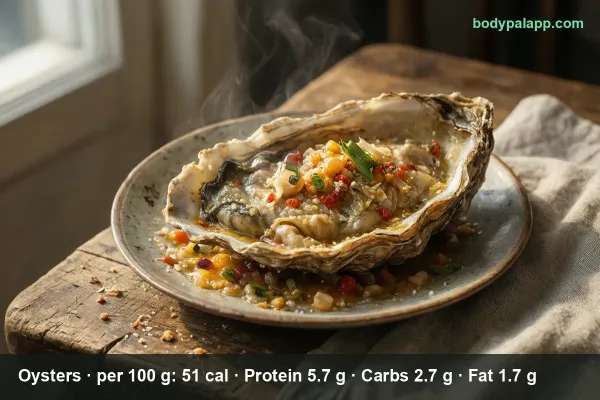
Pair them with food that balances the butter: a green salad with a light dressing, grilled fish or steamed vegetables. These add volume without stacking more saturated fat on top of the 3.2 g per 100 g already in the dish. If you want more oysters for fewer calories, raw oysters are the leaner path, as the table below shows.
Packaged versions such as Phillips Oysters Rockefeller and Savory Bay by Handy Oysters Rockefeller make the dish easy at home; check the label, since toppings vary. BodyPal can log oysters Rockefeller from a photo, which helps when the shell count is hard to remember.
How does oysters Rockefeller compare?
Here is how oysters Rockefeller stack up against plain and raw oysters, per 100 g and per usual serving.
Verdict: For weight loss, raw oysters win clearly at 51 calories and 85 mg of sodium per 100 g, with only 1.7 g of fat. Order oysters Rockefeller as an occasional treat starter, because the butter topping is what pushes the calories up so sharply.
Most popular oysters Rockefeller brands in the United States
2Savory Bay by Handy Oysters Rockefeller3 oysters · 198 g131 kcal
Frozen retail trays carry more butter and cheese per oyster, so one label reads 278 calories per 100 g against 134 for the standard recipe. Source: manufacturer labels / USDA FoodData Central.
Oysters Rockefeller FAQs
How many calories are in one oyster Rockefeller?
One baked oyster (30 g) is about 40 calories. A 3 oz serving (85 g) comes to 114 calories.
Is oysters Rockefeller good for weight loss?
At 134 calories per 100 g the dish sits in the middle: a 3 oz serving (85 g) is 114 calories with 6.4 g fat, while a 4 oz plate (113 g) reaches 151 calories and 8.5 g fat.
Oysters Rockefeller vs raw oysters: which has fewer calories?
Raw oysters have 51 calories per 100 g, against 134 for oysters Rockefeller, because the baked version adds butter, cheese and breadcrumbs.
How much protein is in oysters Rockefeller?
There is 7.6 g of protein per 100 g, so one oyster (30 g) gives about 2.3 g and a 3 oz serving about 6.5 g.
How many calories are in 5 oysters Rockefeller?
Five oysters Rockefeller (150 g) come to 201 calories. They also carry 11.5 g of protein and 645 mg of sodium, so a five-oyster plate is closer to a light meal than a single bite.
How much sodium is in oysters Rockefeller?
Oysters Rockefeller have 430 mg of sodium per 100 g, which is 19% of the daily value. One oyster carries 129 mg, and a 4 oz plate reaches 486 mg, or 21% of the daily value.
How many calories are in a 3 oz serving of oysters Rockefeller?
A 3 oz serving (85 g) has 114 calories, about 6% of the daily value. It provides 6.5 g of protein, 8 g of carbs and 6.4 g of fat.
How much fat is in oysters Rockefeller?
Oysters Rockefeller contain 7.5 g of fat per 100 g, including 3.2 g of saturated fat. Fat supplies 50% of the calories, mostly from the butter in the baked spinach topping.
Are oysters Rockefeller high in carbs?
Not very. They have 9.4 g of carbs per 100 g, with 1.9 g of fiber and 1.2 g of sugars. Carbs make up 28% of the calories, mostly from the crumb topping.