
How many calories are in an oyster?
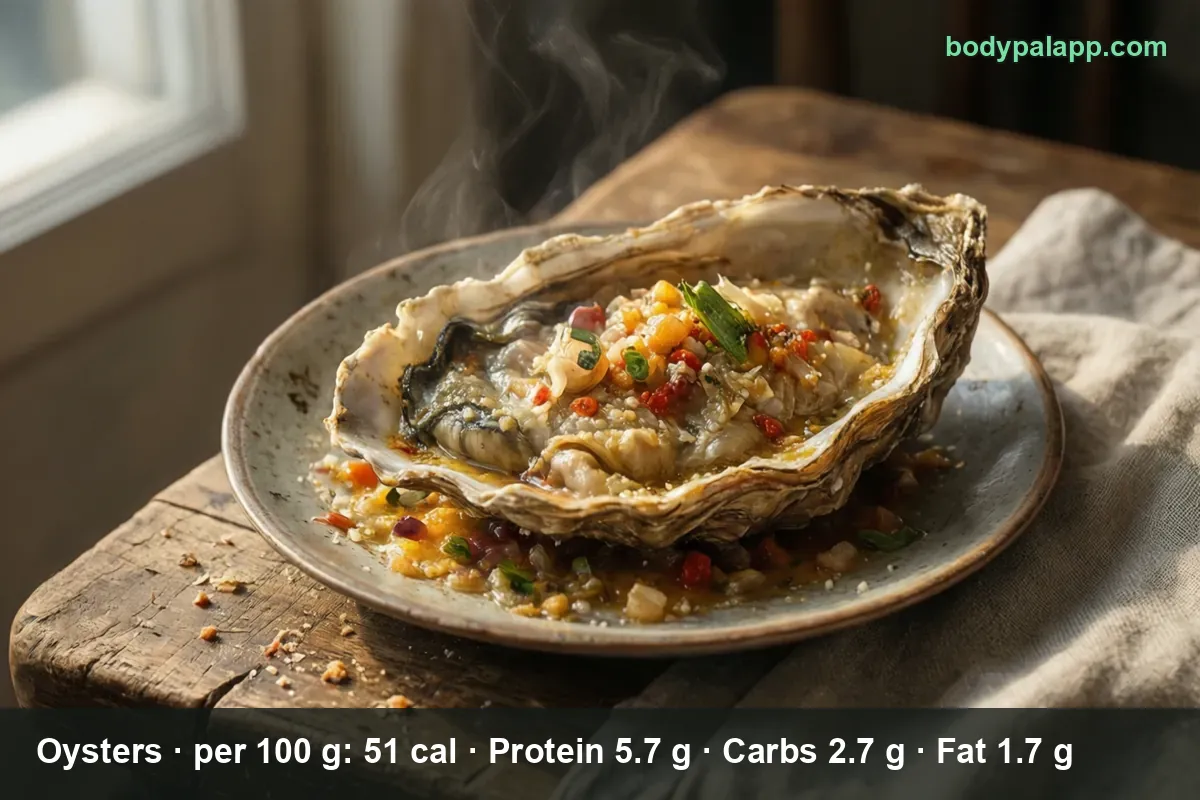
Half a dozen raw oysters on the half shell is 46 calories: 90 g of shucked meat at 51 calories per 100 g. One oyster is about 8. That makes raw oysters the lightest thing per gram at most raw bars, and it is the fryer, not the oyster, that changes the math.
On this page
- Oyster quick facts
- US servings from one oyster to a full cup
- What cooking does to an oyster
- Species and packaging change the number
- Cholesterol and protein are the rows to watch
- How do oysters compare?
- Most popular oysters brands
- FAQ
Oyster quick facts
The row used here is FNDDS 2706351, "Oysters, raw" — the record for shucked raw meat, the thing you actually swallow when the tray arrives. It carries the household measures Americans order in, one oyster and one cup, and its values are identical to the older SR Legacy record 171978 for wild eastern oysters, so nothing shifts by picking one over the other.
Shell weight is not counted anywhere on this page. A medium oyster is roughly 15 g of meat once shucked, and that is the figure every serving below is built from.
| Nutrient | Per 100 g | Per 6 oysters (90 g) | % Daily Value |
|---|---|---|---|
| Calories | 51 | 46 | — |
| Total fat | 1.71 g | 1.5 g | 2% |
| Saturated fat | 0.47 g | 0.4 g | 2% |
| Carbohydrate | 2.72 g | 2.4 g | 1% |
| Dietary fiber | 0 g | 0 g | 0% |
| Total sugars | 0.62 g | 0.6 g | — |
| Protein | 5.71 g | 5.1 g | 10% |
| Sodium | 85 mg | 77 mg | 3% |
% Daily Value is based on a 2,000-calorie diet.
Verified nutrition data
Numbers on this page come from USDA FoodData Central, the U.S. Department of Agriculture’s food composition database, and from manufacturer labels where a branded product is named. Last verified September 2026. How we verify our data →
Two rows are missing on purpose. USDA does not publish added sugars or trans fat for this record, so they are left out rather than written as zero. Cholesterol and potassium do exist: 40 mg and 156 mg per 100 g, which works out to 36 mg of cholesterol and 140 mg of potassium in half a dozen — 12% and 3% of the FDA Daily Values.
US servings from one oyster to a full cup
| Serving | Weight | Calories |
|---|---|---|
| 1 medium oyster | 15 g | 8 kcal |
| 1 oz shucked | 28 g | 14 kcal |
| 3 oz shucked | 85 g | 43 kcal |
| 6 oysters, half dozen | 90 g | 46 kcal |
| 1 cup shucked | 225 g | 115 kcal |
| Per 100 g | 100 g | 51 kcal |
One oyster, 3 oz and 1 cup are USDA household measures. The half dozen and the ounce are our own arithmetic from the USDA 100 g figure, not USDA servings — 90 g and 28 g scaled from 51 calories per 100 g.
A dozen, the way most raw bars sell them, comes to about 180 g and 92 calories — our own arithmetic from the USDA 100 g figure, not a USDA serving. Shell size swings that more than anything else on the menu: a dozen small Kumamoto-style oysters lands nearer 75 calories, a dozen big ones nearer 150. Nobody weighs oysters at the bar, so treat any dozen as roughly 100 calories and move on.
The cup is where people go wrong. A cup of shucked raw oysters is 225 g and 115 calories, with 12.8 g of protein and 191 mg of sodium. Hold that thought for the fried section, because a cup of fried oysters weighs less and costs far more.
What cooking does to an oyster
| Version | Per 100 g | Typical serving | Calories |
|---|---|---|---|
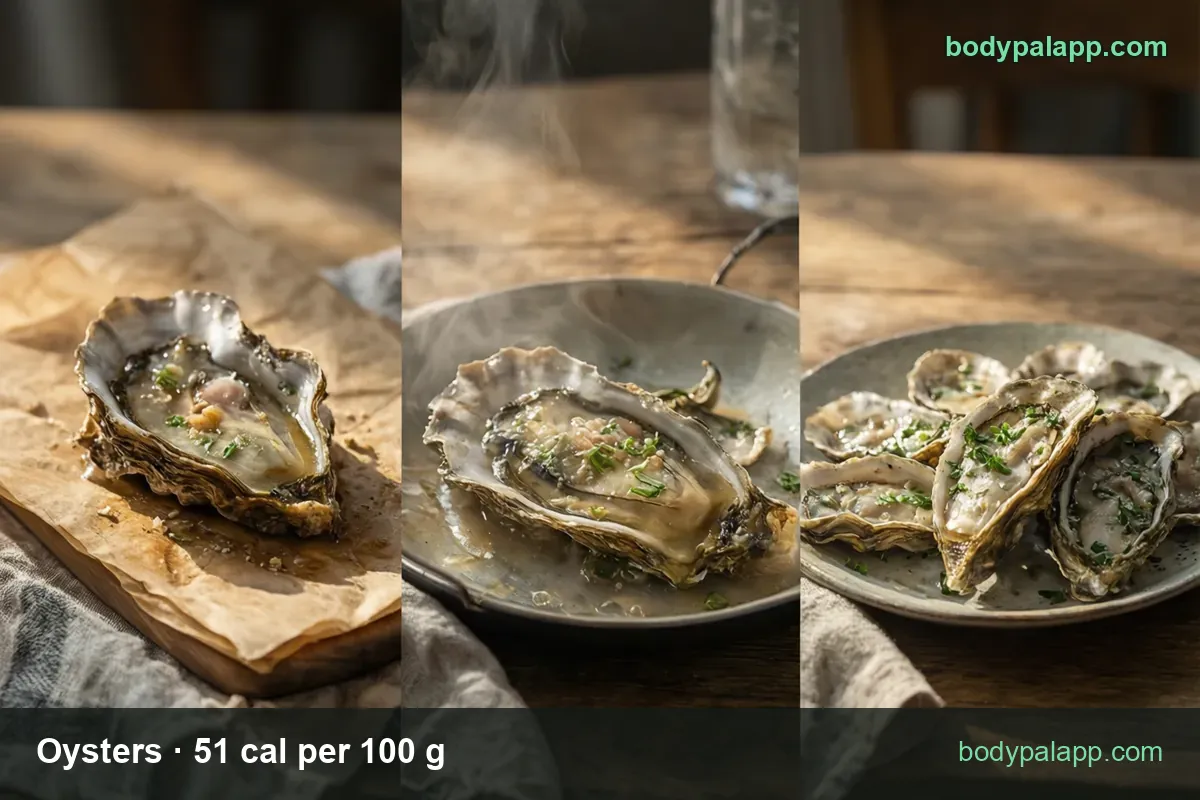
| Raw, on the half shell | 51 kcal | 6 oysters (90 g) | 46 kcal |
| Steamed | 65 kcal | 6 oysters (90 g) | 59 kcal |
| Baked or broiled, chargrilled style | 104 kcal | 6 oysters (90 g) | 94 kcal |
| Fried | 203 kcal | 1 cup (135 g) | 274 kcal |
Steaming adds nothing at all. The jump from 51 to 65 calories per 100 g is water leaving the meat, so the same oyster simply weighs less and every remaining gram counts for more. Half a dozen steamed is 59 calories.
Chargrilled oysters are a different animal, and the butter is why. At 104 calories per 100 g they double the raw figure, with saturated fat climbing from 0.47 g to 1.77 g per 100 g and sodium to 321 mg. Six of them run 94 calories and 289 mg of sodium, 13% of the daily limit before you touch the hot sauce.
Fried is the outlier and the reason this page exists. At 203 calories per 100 g, breaded oysters are four times the raw meat, though the oyster inside has not changed. One fried piece is about 30 calories against 8 raw. And the cup trap closes here: a cup of fried oysters is only 135 g, lighter than the 225 g cup of raw, yet it carries 274 calories — nearly two and a half times as many — plus 551 mg of sodium, roughly a quarter teaspoon of table salt.
Species and packaging change the number
| Version | Per 100 g | Typical serving | Calories |
|---|---|---|---|
| Eastern, wild, raw | 51 kcal | 3 oz (85 g) | 43 kcal |
| Pacific, raw | 81 kcal | 3 oz (85 g) | 69 kcal |
| Eastern, farmed, raw | 59 kcal | 3 oz (85 g) | 50 kcal |
| Canned, drained | 74 kcal | 1 can (115 g) | 85 kcal |
West Coast Pacific oysters are the dense ones: 81 calories and 9.45 g of protein per 100 g against 51 and 5.71 for the eastern wild oyster. Less water per gram, more of everything else. Three ounces of Pacific meat is 69 calories with 8.0 g of protein.
Farmed eastern oysters sit in between at 59 calories, but the row that moves most is sodium — 178 mg per 100 g against 85 mg for wild, more than double. On 3 oz that is 151 mg versus 72 mg. Nobody tastes the difference; the label would.
Canned oysters are drained meat without the shell liquor, 74 calories and 122 mg of sodium per 100 g. A standard 115 g can is 85 calories with 8.8 g of protein and 140 mg of sodium, which makes it one of the cheapest protein cans on the shelf. Smoked canned oysters are a separate product: Bumble Bee Premium Select Fancy Smoked Oysters list 110 calories per quarter-cup (56 g), because they are packed in oil rather than water.
Cholesterol and protein are the rows to watch
Half a dozen raw oysters is 46 calories and 5.1 g of protein — 10% of the Daily Value from something that barely registers on a calorie budget. Per calorie, that ratio beats almost anything fried in the same kitchen.
Cholesterol is the row that surprises people. Those same six oysters carry 36 mg, 12% of the 300 mg Daily Value, and a cup of shucked raw oysters reaches 90 mg, or 30%. The Dietary Guidelines for Americans no longer set a numeric daily cholesterol cap, and they recommend 8 oz of seafood a week — which, if every ounce were raw oysters, would total about 116 calories for the week by our own arithmetic from the 100 g figure. Seafood is not where a calorie problem starts.
Sodium behaves the same way: 77 mg in a raw half dozen is nothing, 3% of the daily limit. Fry the same meat and a single cup carries 551 mg, 24%. The oyster is not salty. The coating and the pot are.
How do oysters compare?
| Shellfish | Per 100 g | US serving | Calories | Protein |
|---|---|---|---|---|
| Oysters, raw | 51 kcal | 3 oz (85 g) | 43 kcal | 4.9 g |
| Clams, raw | 86 kcal | 3 oz (85 g) | 73 kcal | 12.5 g |
| Scallops, steamed | 87 kcal | 3 oz (85 g) | 74 kcal | 13.0 g |
| Shrimp, steamed | 90 kcal | 3 oz (85 g) | 77 kcal | 14.6 g |
Our take: oysters are the lightest of the four by a clear margin — 51 calories per 100 g against 86, 87 and 90 — but they are also the weakest on protein, with shrimp carrying three times as much per gram. If the goal is to eat a big plate for very few calories, order them raw and order plenty. If the goal is protein per calorie for a real meal, shrimp or scallops do more work, and the gap only widens once the oysters go into batter.
Most popular oysters brands in the United States
Ranked by how widely each product appears among foods sold in the United States, from the BodyPal food database of over 3.3 million products. Calories are the figures printed on each Nutrition Facts label, checked against USDA FoodData Central.
| Product | Calories (per 100 g) |
|---|---|
| Bumble Bee Premium Select Fancy Smoked Oysters | 196 cal |
Brand popularity: BodyPal food database. Nutrition: manufacturer labels / USDA FoodData Central.
Oyster FAQs
How many calories are in one oyster?
One medium raw oyster on the half shell weighs about 15 g of meat and carries 8 calories. That is our own arithmetic from the USDA 100 g figure of 51 calories, not a USDA serving. A large oyster closer to 25 g lands near 13 calories, about the same as a saltine cracker.
How many calories in 6 raw oysters?
Half a dozen raw oysters is 46 calories, based on 90 g of shucked meat at 51 calories per 100 g. That half dozen also brings 5.1 g of protein, 77 mg of sodium and 36 mg of cholesterol, which is 12% of the Daily Value on a 2,000-calorie diet.
How many calories in a dozen oysters?
A dozen raw oysters is about 92 calories, from roughly 180 g of meat. That is our own arithmetic from the USDA 100 g figure, not a USDA serving, and shell size moves it: a dozen small ones can land near 75 calories, a dozen large near 150.
Are fried oysters high in calories?
Fried oysters run 203 calories per 100 g, four times raw oysters at 51. One breaded piece is about 30 calories against 8 raw, and a full cup of fried oysters weighs only 135 g yet delivers 274 calories plus 551 mg of sodium, roughly a quarter teaspoon of table salt.
How much protein is in oysters?
Raw oysters carry 5.71 g of protein per 100 g, so half a dozen gives 5.1 g and a full cup 12.8 g. That is 10% of the Daily Value for the half dozen at only 46 calories, though shrimp carries three times as much protein per gram.
Do oysters have carbs?
Yes — raw oysters hold 2.72 g of carbohydrate per 100 g, or 2.4 g in half a dozen, which is 1% of the Daily Value. The carbohydrate is stored glycogen, so oysters carry more than double the carbs of shrimp at 1.15 g, and farmed eastern oysters roughly twice as much again at 5.53 g.
Are oysters high in cholesterol?
Half a dozen raw oysters carries 36 mg of cholesterol, 12% of the 300 mg Daily Value, at only 46 calories. A dozen doubles that to 24%. It is high per calorie and modest per plate, and the FDA Daily Value is the reference point printed on every Nutrition Facts label.
Raw or steamed oysters: which has more calories?
Steamed oysters win at 65 calories per 100 g against 51 raw, because steam drives off water and concentrates the meat. Half a dozen steamed is 59 calories versus 46 raw. Nothing is added in the pot; the same oyster simply weighs less, so every gram counts for more.
Similar foods
- Raw Oysters — 43 cal per 6 oysters
- Ceviche — 158 cal per cup
- Oysters Steamed — 10 cal per oyster
- Shrimp Caesar Salad — 159 cal per salad
- Crab — 112 cal per cup
- Crab Claw — 71 cal per 3 oz
Count it without the math
Point the camera at the tray and BodyPal counts the oysters for you, raw or breaded.


How long does it take to burn off oysters?
Half a dozen oysters (90 g) is 46 kcal. Enter your weight and the amount you ate to see how long it takes you to burn that off:
lb
| Activity | Time to burn 46 kcal |
|---|---|
| Walking, brisk | 9 min |
| Cycling, moderate | 6 min |
| Swimming, moderate | 7 min |
| Jogging | 5 min |
| Weight training, moderate | 10 min |
Times are for a 155 lb adult at a steady pace; change the weight to see yours. The amount is set to the portion in the text (90 g); change it to what you actually ate. BodyPal works this out from your steps automatically.
Burning it off is one side of it. The other is knowing your number: work out how many calories you need a day, with macros and a goal date.