
How many calories are in crab?
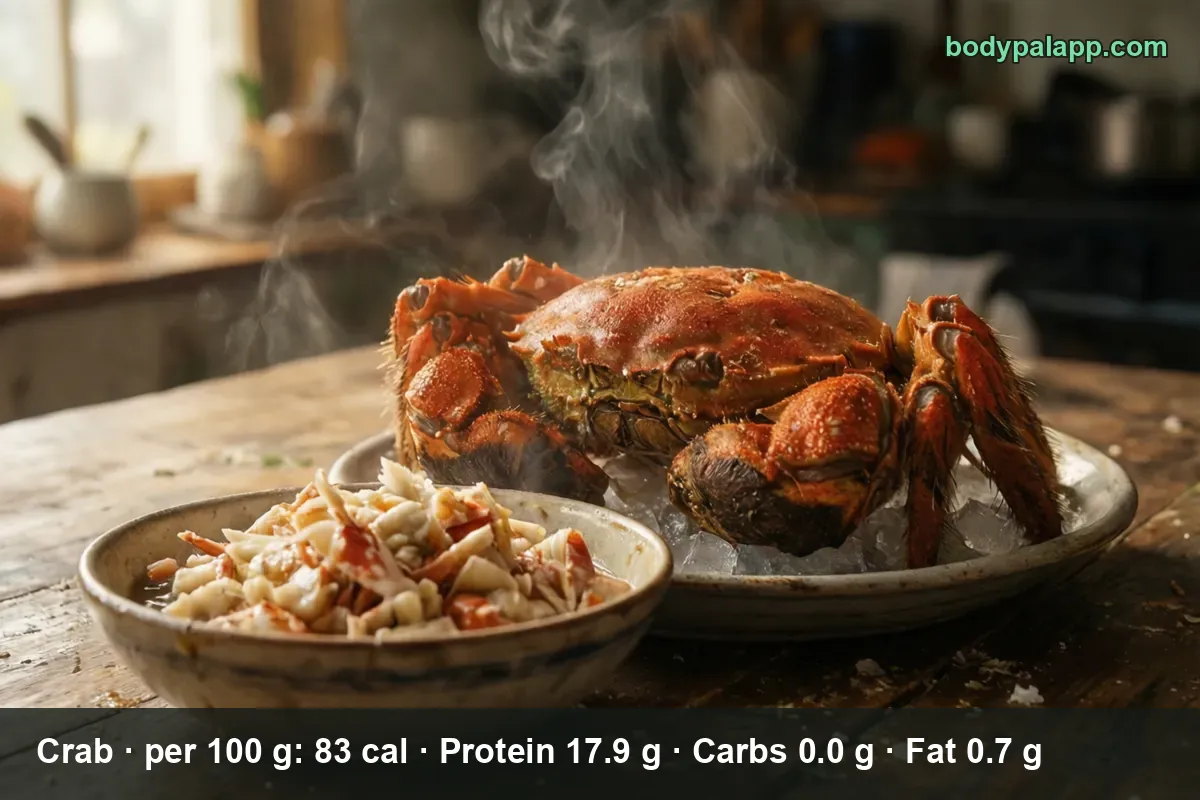
A cup of picked crab meat weighs 135 g and carries 112 calories. Per 100 g cooked crab runs 83 calories, one of the lowest numbers on the seafood counter. A 3-ounce portion is 71. Almost all of it is protein: 24.1 g in that cup, with zero carbs and about a gram of fat.
On this page
- Crab quick facts
- US servings, from one leg to a full cup
- Crab cakes, crab salad and canned crab
- Blue, dungeness, king and snow crab
- Sodium and cholesterol are the rows to watch
- How does crab compare?
- Most popular crab brands
- FAQ
Crab quick facts
The record behind this page is the generic USDA entry FNDDS 2706344, "Crab" — cooked meat, picked out of the shell, the thing that actually lands on your plate or in your log. It was chosen over the species-specific entries for two reasons. It covers blue, dungeness and king together, and it is the only crab record that carries real American household measures: a cup, a single crab, a single leg, a claw.
The values are identical to SR Legacy 174205, blue crab cooked with moist heat, which is the donor behind the generic row. If you steamed or boiled crab and picked the meat, this is your line.
| Nutrient | Per 100 g | Per 1 cup (135 g) | % Daily Value |
|---|---|---|---|
| Calories | 83 | 112 | — |
| Total fat | 0.74 g | 1.0 g | 1% |
| Saturated fat | 0.2 g | 0.3 g | 1% |
| Carbohydrate | 0 g | 0.0 g | 0% |
| Dietary fiber | 0 g | 0.0 g | 0% |
| Total sugars | 0 g | 0.0 g | — |
| Protein | 17.88 g | 24.1 g | 48% |
| Sodium | 395 mg | 533 mg | 23% |
| Cholesterol | 97 mg | 131 mg | 44% |
| Potassium | 259 mg | 350 mg | 7% |
% Daily Value is based on a 2,000-calorie diet.
Verified nutrition data
Numbers on this page come from USDA FoodData Central, the U.S. Department of Agriculture’s food composition database, and from manufacturer labels where a branded product is named. Last verified September 2026. How we verify our data →
Two label rows are missing on purpose. Added sugars and trans fat are not published in this FNDDS edition, so they are left out rather than guessed — on plain steamed crab both would be zero by composition anyway. The Daily Values used here are the FDA reference amounts for the Nutrition Facts label.
US servings, from one leg to a full cup
| Serving | Weight | Calories |
|---|---|---|
| 1 leg, picked meat | 15 g | 12 kcal |
| 1 oz | 28 g | 23 kcal |
| 1 whole small crab, picked | 40 g | 33 kcal |
| 3 oz, the standard seafood portion | 85 g | 71 kcal |
| 1 cup, cooked crabmeat | 135 g | 112 kcal |
| Per 100 g | 100 g | 83 kcal |
The cup, the 3-ounce portion, the single crab and the single leg all come straight from USDA's own portion list for this record. The 1-ounce line is our own arithmetic from the USDA 100 g figure, not a USDA serving — useful when you are picking at a shared platter and counting by the mouthful.
Here is the trap almost nobody catches. Restaurant menus and diet plans talk in 3-ounce portions, but crab meat is airy and stringy, and it fills a measuring cup fast. A cup is 135 g against 85 g, and 112 calories against 71 — close to 60 percent more food than the habit suggests. The sodium moves with it: 533 mg for the cup against about 336 mg for 3 ounces, that second figure again being our scaling of the USDA 100 g number. Weigh the meat if you can. Crab is one of the few foods where the volume measure flatters nobody.
Crab cakes, crab salad and canned crab
Plain crab is light. Almost everything Americans do to crab is not.
| Version | Per 100 g | Typical serving | Calories |
|---|---|---|---|
| Crab, cooked and picked | 83 kcal | 1 cup (135 g) | 112 kcal |
| Canned crab | 83 kcal | 1 standard can (120 g) | 100 kcal |
| Imitation crab, surimi | 95 kcal | 3 oz (85 g) | 81 kcal |
| Crab salad | 188 kcal | 1 cup (208 g) | 391 kcal |
| Crab cake | 214 kcal | 1 cake (85 g) | 182 kcal |
| Soft shell crab | 227 kcal | 3 oz (85 g) | 193 kcal |
Canned crab is the honest one: same 83 calories per 100 g as fresh, so a standard can is 100 calories. What changes is salt — 563 mg of sodium per 100 g against 395 mg, which works out to roughly 676 mg for a 120 g can by our own arithmetic from the USDA figure. Drain it and rinse it if that matters to you.
Imitation crab surprises people. Surimi is 95 calories per 100 g, higher than real crab's 83, because starch and binders make up the paste. Three ounces is 81 calories against 71 for the real thing. The popular flake-style tubs in US stores sit right on that line, around 94 calories per 100 g and 80 for a half-cup serving. Cheaper, yes. Lighter, no.
Crab salad is where a light protein becomes a mayonnaise delivery system: 391 calories for a cup, more than three times the same volume of plain meat. A crab cake is 182 calories apiece at 85 g, and the packaged Maryland-style minis run 259 calories per 100 g — about 220 for four little cakes. Soft shell crab, battered and fried whole, is the densest of the lot at 227 calories per 100 g; the 193 for a 3-ounce piece is our own scaling of that number, as is the 81 for surimi.
Blue, dungeness, king and snow crab
Species matters more here than cooking does, and that is unusual. Blue crab actually loses a little concentration in the pot: 87 calories per 100 g raw, 83 cooked with moist heat, because it takes on water rather than shedding it the way a steak does.
| Crab | USDA record | Per 100 g | Sodium per 100 g |
|---|---|---|---|
| Blue, raw | 174204 | 87 kcal | 293 mg |
| Blue, cooked | 174205 | 83 kcal | 395 mg |
| Alaska king, cooked | 174202 | 97 kcal | 1072 mg |
| Dungeness, cooked | 172007 | 110 kcal | 378 mg |
| Queen or snow, cooked | 172008 | 115 kcal | 691 mg |
| Blue swimming, lump, pasteurized | 2684446 | 81 kcal | 331 mg |
Snow crab is the heaviest per gram at 115 calories, dungeness close behind at 110, and both are at least a third denser than the 83-calorie generic. Alaska king lands in the middle at 97. Pasteurized lump meat, the refrigerated tubs sold for crab cakes and dips, is the lightest of the six records at 81 calories per 100 g.
Legs are usually sold in the shell, which is why a package can claim a very low number — one national Alaska king legs-and-claws pack lists 47 calories per 100 g and 80 for a 6-ounce piece, but that weight includes shell you will not eat. Compare meat with meat: 97 calories per 100 g for cooked king crab, or 82 for a 3-ounce serving of picked meat, our own arithmetic from that 100 g figure.
Sodium and cholesterol are the rows to watch
Nothing about crab's calorie count needs managing. Two other rows do.
Sodium first. Crab lives in the sea and is usually boiled in salted water, so 100 g of cooked meat carries 395 mg — 17 percent of the FDA's 2,300 mg Daily Value before you touch a shaker. A cup takes that to 533 mg, or 23 percent, which is roughly a quarter teaspoon of table salt. Cooked Alaska king is the outlier: 1,072 mg per 100 g, 47 percent of a day's value, at almost the same calories as blue crab. If you are watching sodium, blue or dungeness meat is the better pick, and drawn butter is a smaller problem than the boil.
Cholesterol next. A cup delivers 131 mg, 44 percent of the 300 mg Daily Value, from a food with 1.0 g of fat and 0.3 g of it saturated. Shellfish concentrate cholesterol in the meat rather than in fat, which is why the two rows point in opposite directions on this label.
The upside is the protein column. Crab is a protein food under USDA's MyPlate, and 24.1 g in a 112-calorie cup is 48 percent of the Daily Value for less than a tenth of a day's calories. Very few foods do that.
How does crab compare?
| Seafood | Per 100 g | US serving | Calories |
|---|---|---|---|
| Crab, cooked | 83 kcal | 3 oz (85 g) | 71 kcal |
| Scallops, steamed or boiled | 87 kcal | 3 oz (85 g) | 74 kcal |
| Shrimp, steamed or boiled | 90 kcal | 3 oz (85 g) | 77 kcal |
| Lobster | 97 kcal | 3 oz (85 g) | 82 kcal |
The three neighbor servings are our own arithmetic from each record's 100 g figure. Protein per 100 g runs 17.88 g for crab, 15.24 g for scallops, 17.19 g for shrimp and 20.91 g for lobster.
Our take: crab is the lightest of the four, per 100 g and per 3-ounce serving, and the whole spread is only 11 calories wide — so pick by taste and price, not by the calorie column. If you want the most protein per calorie, lobster edges it. If you are eating for fullness on a cut, a full cup of picked crab at 112 calories and 24 g of protein is the best value on this table. The decision that actually moves your day is what happens next: plain meat with lemon stays at 112, the same meat folded into salad hits 391.
Most popular crab brands in the United States
Ranked by how widely each product appears among foods sold in the United States, from the BodyPal food database of over 3.3 million products. Calories are the figures printed on each Nutrition Facts label, checked against USDA FoodData Central.
| Product | Calories (per 100 g) |
|---|---|
| Fishin' Company Wild Alaska King Crab Legs & Claws | 47 cal |
| Trans-Ocean Flake Style Imitation Crab | 94 cal |
| Van Cleve Seafood Blue Crab Pie | 310 cal |
| Boss Lump Crab Meat | 80 cal |
| Quality Catch Gumbo Blue Crab | 106 cal |
| Phillips Maryland Style Crab Cake Minis | 259 cal |
Brand popularity: BodyPal food database. Nutrition: manufacturer labels / USDA FoodData Central.
Crab FAQs
How many calories are in crab meat?
Cooked crab meat is 83 calories per 100 g, so a 3-ounce portion is 71 calories and a full cup of picked meat is 112. That is USDA's generic record for cooked crab, covering blue, dungeness and king. Protein is 17.88 g per 100 g, and carbohydrate is zero.
How many calories in a cup of crab meat?
A cup of cooked, picked crab meat weighs 135 g and holds 112 calories. It also carries 24.1 g of protein, 533 mg of sodium and 131 mg of cholesterol, which is 48 percent, 23 percent and 44 percent of the Daily Values. Total fat stays at 1.0 g.
How many calories in crab legs?
One leg of picked meat, 15 g, is about 12 calories, and a whole small crab at 40 g is 33. Cooked Alaska king crab runs 97 calories per 100 g of meat, so 3 ounces is 82 calories by our own arithmetic. Package numbers are lower only because they include shell.
Is crab high in protein?
Yes: 17.88 g per 100 g, and 24.1 g in a one-cup serving, which is 48 percent of the 50 g Daily Value for 112 calories. Among the shellfish compared on this page only lobster is denser, at 20.91 g per 100 g. Crab has no carbohydrate at all.
Is crab high in cholesterol?
A cup of crab meat has 131 mg of cholesterol, 44 percent of the 300 mg Daily Value, and 100 g has 97 mg. That is a lot for a food carrying 112 calories and 1.0 g of fat, because shellfish hold cholesterol in the meat rather than in fat.
How much sodium is in crab?
Cooked crab is 395 mg of sodium per 100 g, so a cup is 533 mg, or 23 percent of the 2,300 mg Daily Value. Cooked Alaska king crab is far saltier at 1,072 mg per 100 g, 47 percent of the day. Canned crab sits at 563 mg per 100 g.
Is imitation crab lower in calories than real crab?
No — imitation crab, or surimi, is 95 calories per 100 g against 83 for real cooked crab, so 3 ounces is 81 calories versus 71. The starch and binders that hold the paste together add the difference. Store flake-style tubs run about 94 calories per 100 g, or 80 per half cup.
How many calories in a crab cake?
One crab cake of 85 g is 182 calories, at 214 per 100 g, which is more than a cup and a half of plain crab meat. Breading and binder do it. Packaged Maryland-style minis are 259 calories per 100 g, about 220 calories for four cakes weighing 85 g.
Similar foods
- Crab Claw — 71 cal per 3 oz
- Crab Meat — 71 cal per 3 oz portion
- Shrimp Raw — 72 cal per 3 oz
- Tuna Fish (Canned Tuna) — 98 cal per can
- Canned Tuna — 142 cal per can
- Tuna In Water — 142 cal per can
Count it without the math
Point the camera at the plate and BodyPal counts the crab for you, cup or claw.


How long does it take to burn off crab?
A 1-cup (135 g) serving is 112 kcal. Enter your weight and the amount you ate to see how long it takes you to burn that off:
lb
| Activity | Time to burn 112 kcal |
|---|---|
| Walking, brisk | 22 min |
| Cycling, moderate | 14 min |
| Swimming, moderate | 16 min |
| Jogging | 13 min |
| Weight training, moderate | 25 min |
Times are for a 155 lb adult at a steady pace; change the weight to see yours. The amount is set to the portion in the text (135 g); change it to what you actually ate. BodyPal works this out from your steps automatically.
Want the bigger picture? Calculate your daily calorie needs — your maintenance figure, a target for losing or gaining, and the date you get there.