
How many calories are in a shrimp caesar salad?
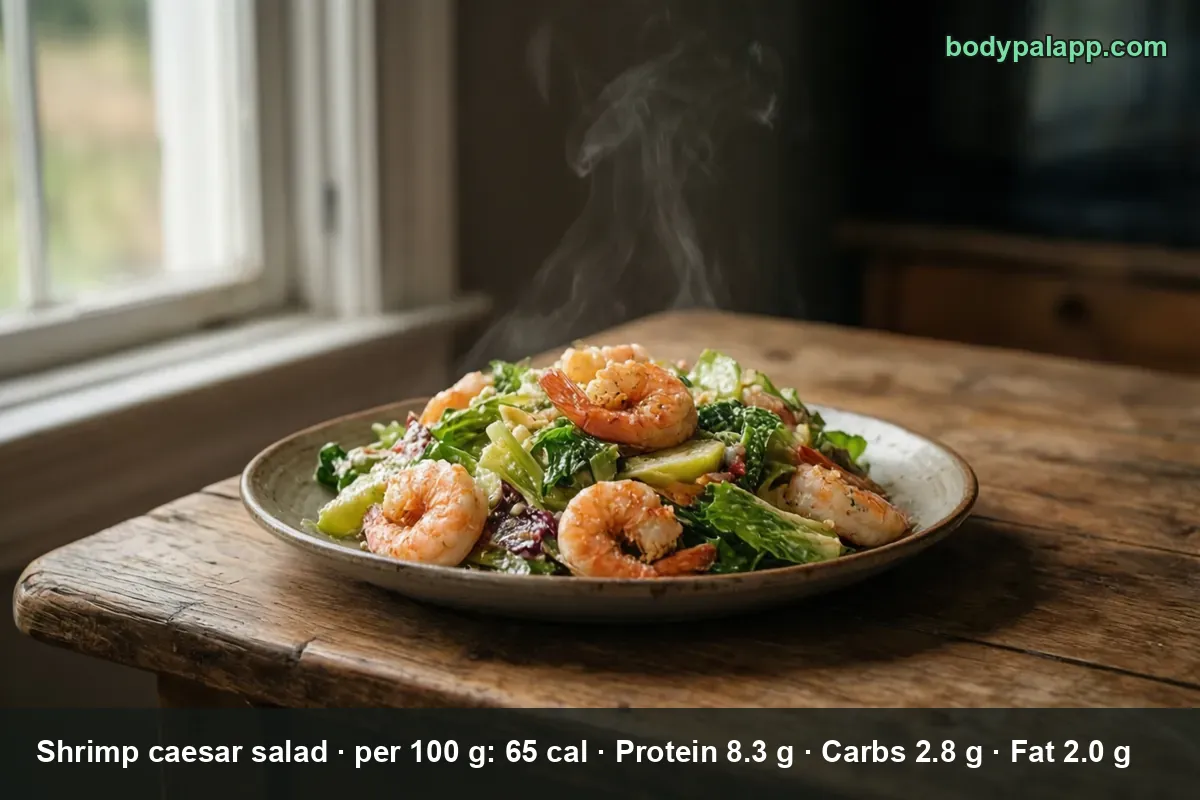
A restaurant-size shrimp caesar salad — 244 g of shrimp over romaine, dressing still on the side — is 159 calories. Per 100 g the plate runs 65 calories, lighter per gram than a plain romaine caesar at 77. Pour two tablespoons of dressing over it and the total jumps to 322.
On this page
- Shrimp caesar salad quick facts
- US servings from one cup to an entree plate
- The dressing weighs more than the salad
- The caesar salad family by the numbers
- Cholesterol and sodium are the rows to watch
- How does shrimp caesar salad compare?
- Shrimp caesar salad FAQs
Shrimp caesar salad quick facts
There is no USDA record called "shrimp caesar salad." The closest match, and the one this page is built on, is FNDDS 2706841, "Shrimp garden salad, shrimp, lettuce, eggs, tomato and/or carrots, other vegetables, no dressing". That is exactly what arrives when you order one: shrimp on a bed of leaves with a little chopped egg and vegetable, and the dressing in its own cup. Caesar dressing lives in a separate USDA record, so it gets counted separately below rather than blended into the headline number.
That split is the honest way to do it. Kitchens dress a salad by eye, and the difference between a light drizzle and a heavy toss is bigger than the difference between most salads on a menu.
| Nutrient | Per 100 g | Per 1 salad (244 g) | % Daily Value |
|---|---|---|---|
| Calories | 65 | 159 | — |
| Total fat | 2.04 g | 5.0 g | 6% |
| Saturated fat | 0.545 g | 1.3 g | 7% |
| Carbohydrate | 2.77 g | 6.8 g | 2% |
| Dietary fiber | 0.8 g | 2.0 g | 7% |
| Total sugars | 1.25 g | 3.1 g | — |
| Protein | 8.28 g | 20.2 g | 40% |
| Sodium | 289 mg | 705 mg | 31% |
| Cholesterol | 126 mg | 307 mg | 102% |
| Potassium | 196 mg | 478 mg | 10% |
% Daily Value is based on a 2,000-calorie diet.
Verified nutrition data
Numbers on this page come from USDA FoodData Central, the U.S. Department of Agriculture’s food composition database, and from manufacturer labels where a branded product is named. Last verified September 2026. How we verify our data →
Two rows you would expect on a package label are missing here: added sugars and trans fat. This FNDDS release does not publish either value for composite dishes, so rather than guess, they stay off the table. Everything else comes straight from the record, and the percentages use the FDA Daily Values printed on the Nutrition Facts label.
The headline is the protein-to-calorie ratio. Forty percent of a day's protein for 159 calories is a ratio almost nothing else on a lunch menu matches, and it comes with 2.0 g of fiber and 478 mg of potassium attached.
US servings from one cup to an entree plate
| Serving | Weight | Calories |
|---|---|---|
| 1 oz | 28 g | 18 kcal |
| 1 cup | 95 g | 62 kcal |
| 2 cups | 190 g | 124 kcal |
| One salad, fast food or deli order | 244 g | 159 kcal |
| 3 cups, entree plate | 285 g | 185 kcal |
| Per 100 g | 100 g | 65 kcal |
The 244 g order is a real USDA household measure attached to the record, and so is the 95 g cup. The 2-cup, 3-cup and 1 oz lines are our own arithmetic from the USDA 100 g figure, not USDA servings — useful when you are logging a side salad or half a takeout container.
Here is the cup trap. A cup of loose leaves with shrimp on top weighs 95 g, while a cup of a mayonnaise-bound deli shrimp salad weighs 182 g, because the second one is dense and packed. Log "1 cup shrimp salad" from the wrong list and you are off by nearly 300 calories. Weigh the plate once and the guesswork disappears.
The dressing weighs more than the salad
Two tablespoons of regular caesar dressing is 30 g and 163 calories. That is more than the entire 244 g salad it goes on. It also brings 17.4 g of fat, 2.6 g of saturated fat and 363 mg of sodium, and at 542 calories per 100 g it is one of the most concentrated things in the refrigerator door.
| Plate | Weight | Calories | Sodium |
|---|---|---|---|
| Salad, no dressing | 244 g | 159 kcal | 705 mg |
| Salad + 2 tbsp dressing | 274 g | 322 kcal | 1068 mg |
Dressed, the meal doubles to 322 calories and the sodium reaches 1,068 mg — 46% of a day in one bowl. Restaurant ladles are rarely two tablespoons, either; a generous toss can run three or four.
The practical move is not to skip it. Ask for the dressing on the side, dip the fork rather than pouring, and one tablespoon covers a whole plate for 82 calories. That single habit is worth more than any swap on this page.
The caesar salad family by the numbers
| Version | Per 100 g | Typical serving | Calories |
|---|---|---|---|
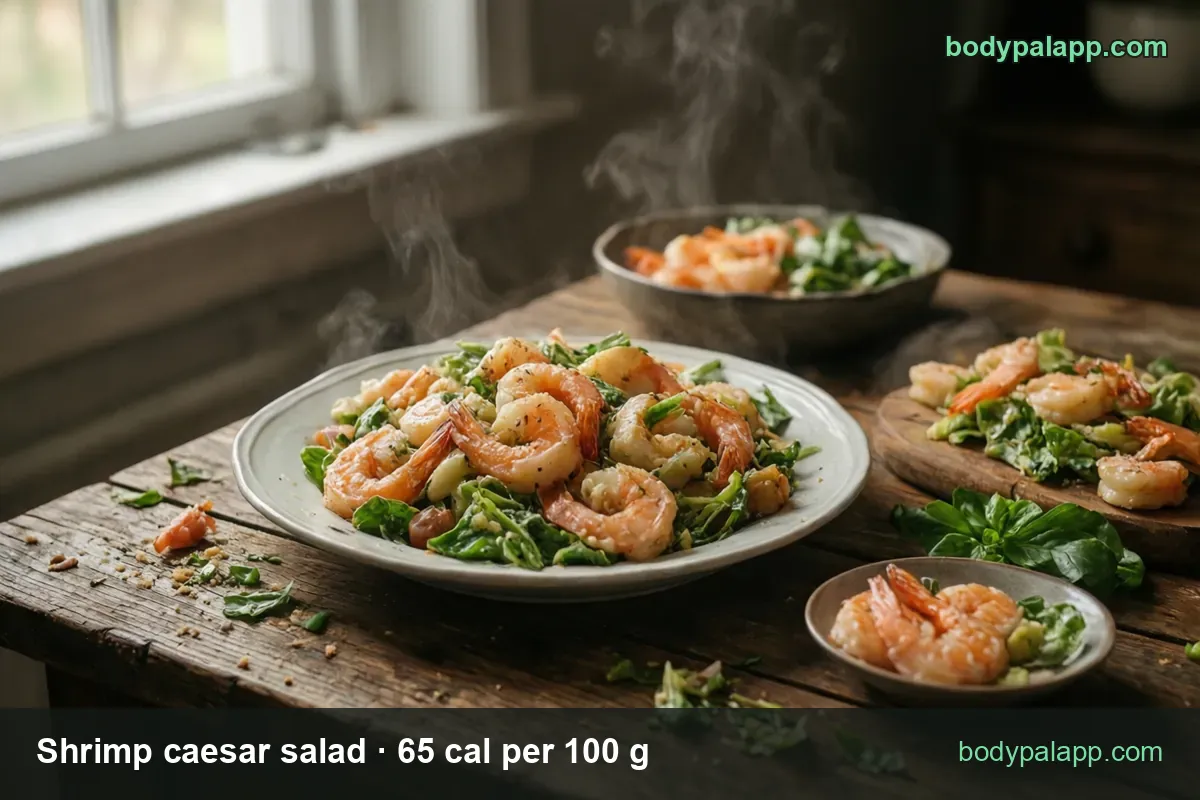
| Shrimp caesar salad, no dressing | 65 kcal | one salad, 244 g | 159 kcal |
| Caesar dressing, add-on | 542 kcal | 2 tbsp, 30 g | 163 kcal |
| Caesar salad, romaine, no shrimp | 77 kcal | 1 cup, 79 g | 61 kcal |
| Chicken caesar salad, no dressing | 63 kcal | one salad, 286 g | 180 kcal |
| Breaded fried chicken caesar salad | 115 kcal | one salad, 314 g | 361 kcal |
| Shrimp alone, steamed or boiled | 90 kcal | 1 cup, 135 g | 122 kcal |
| Deli shrimp salad, mayonnaise-bound | 196 kcal | 1 cup, 182 g | 357 kcal |
Three of those deserve a sentence. The classic caesar with romaine, croutons and cheese but no shrimp is 77 calories per 100 g — heavier per gram than the shrimp version, because bread and parmesan outweigh lean seafood. Swapping grilled chicken for breaded fried chicken takes the same salad from 180 to 361 calories, which is the single most expensive decision on a caesar menu. And a mayonnaise-bound deli shrimp salad, despite the similar name, is a different food entirely at 196 calories per 100 g.
There is also a build with no tomato or carrot, FNDDS 2706842, at 67 calories per 100 g. Take away the watery vegetables and the salad gets slightly denser, not lighter — a 244 g plate of that version — our own scaling of the USDA 100 g figure, not a USDA serving — is 163 calories. Four calories. It is a rounding error, and worth knowing so you stop agonizing over the vegetable list.
One more thing the recipe sites never mention. USDA carries two rows for cooked shrimp itself: steamed or boiled shrimp at 90 calories and 248 mg of sodium per 100 g, and a raw-material record for cooked mixed-species shrimp at 119 calories and 947 mg of sodium per 100 g. The gap is not the cooking method — it is the moisture-retention treatment used on much of the frozen supply, which holds water and salt in the flesh. If your shrimp came out of a bag and tasted slightly briny before you seasoned it, the higher sodium row is closer to your plate than the salad's 289 mg per 100 g suggests.
Cholesterol and sodium are the rows to watch
The 244 g plate carries 307 mg of cholesterol, which is 102% of the 300 mg Daily Value still printed on the Nutrition Facts label. Shrimp and chopped egg do that together. Current federal guidance no longer sets a numeric daily cap on dietary cholesterol, but the label value has not changed, so a food tracker will flag this plate even though its total fat is only 6% DV and its saturated fat 7%. That mismatch — a cholesterol number more than fifteen times the fat number in DV terms — is unusual, and it is worth understanding before you decide anything based on the red bar in an app.
Sodium is the row that actually moves. Undressed, the plate is 705 mg, roughly a third of a teaspoon of table salt and 31% of a day. Add two tablespoons of caesar and it is 1,068 mg, 46% of a day, before anything else you eat. If you are watching sodium, dressing on the side is the lever, not the shrimp.
On the other side of the ledger, 20.2 g of protein from a 159-calorie plate puts one meal most of the way to a typical target, and seafood is one of the protein food groups MyPlate specifically asks Americans to eat more of. A shrimp caesar with the dressing controlled is a genuinely strong lunch. A shrimp caesar swimming in dressing is a fat-delivery vehicle with lettuce in it.
How does shrimp caesar salad compare?
| Salad | Per 100 g | US serving | Calories |
|---|---|---|---|
| Shrimp caesar salad, no dressing | 65 kcal | one salad, 244 g | 159 kcal |
| Caesar salad with romaine, no dressing | 77 kcal | 1 cup, 79 g | 61 kcal |
| Chicken caesar garden salad, no dressing | 63 kcal | one salad, 286 g | 180 kcal |
| Deli shrimp salad, mayonnaise-bound | 196 kcal | 1 cup, 182 g | 357 kcal |
Our take: of these four, only the chicken caesar garden salad is lighter per gram, and only by 2 calories per 100 g — a difference you cannot taste or measure at home. Their protein is nearly identical too, 8.52 g against 8.28 g per 100 g, so the real split is cholesterol and what the kitchen does with the protein. For weight loss, shrimp undressed is the pick: 159 calories for a full plate and 20.2 g of protein is hard to beat. For pure satiety per dollar, the chicken plate is 286 g of food. The one to avoid on a calorie budget is the deli shrimp salad — same word, triple the density, 357 calories for a single cup.
Shrimp caesar salad FAQs
How many calories are in a shrimp caesar salad?
159 calories for a 244 g plate of shrimp over romaine with no dressing, or 65 calories per 100 g. That plate also carries 20.2 g of protein and 705 mg of sodium. Two tablespoons of regular caesar dressing push the meal to 322 calories.
How many calories does caesar dressing add?
163 calories for 2 tablespoons (30 g) of regular caesar dressing, which is more than the 159 calories in the whole 244 g salad underneath it. Those two tablespoons also bring 17.4 g of fat and 363 mg of sodium. One tablespoon instead of two costs 82 calories.
How much protein is in a shrimp caesar salad?
20.2 g of protein in a 244 g plate, which is 40% of the Daily Value on a 2,000-calorie diet. Per 100 g it is 8.28 g, more than double the 4 g in a plain romaine caesar with no shrimp. The shrimp does most of that work.
Is shrimp caesar salad good for weight loss?
159 calories for a full 244 g plate with 20.2 g of protein is an unusually good ratio for a lunch, and undressed it stays there. The catch is the dressing: 2 tablespoons add 163 calories and double the meal. Ask for it on the side and dip the fork.
Shrimp caesar salad vs chicken caesar salad calories?
180 calories for a 286 g chicken caesar garden salad versus 159 for a 244 g shrimp plate, both undressed. Per gram the chicken version is slightly lighter, 63 calories per 100 g against 65, and its protein is close at 8.52 g against 8.28 g. Cholesterol is where the two split.
How much cholesterol is in a shrimp caesar salad?
307 mg of cholesterol in a 244 g plate, which is 102% of the 300 mg Daily Value, from the shrimp and the chopped egg together. Per 100 g the salad holds 126 mg. Total fat on the same plate is only 5.0 g, or 6% of the Daily Value.
How many carbs are in a shrimp caesar salad?
6.8 g of carbohydrate in a 244 g plate, which is 2% of the Daily Value, and 2.0 g of that is fiber. Per 100 g the salad has 2.77 g of carbs and 1.25 g of total sugars, all of it from the vegetables. Croutons are what change this number.
How many calories in one cup of shrimp caesar salad?
62 calories in 1 cup (95 g) without dressing, at 65 calories per 100 g. That cup carries 7.9 g of protein and about 275 mg of sodium. A cup is a side portion; the 244 g plate most people order is closer to two and a half cups of leaves and shrimp.
Similar foods
- Oysters Steamed — 10 cal per oyster
- Ceviche — 158 cal per cup
- Oyster — 8 cal per oyster
- Raw Oysters — 43 cal per 6 oysters
- Crab — 112 cal per cup
- Crab Claw — 71 cal per 3 oz
Count it without the math
Point the camera at the plate and BodyPal counts the shrimp, the leaves and the dressing separately.


How long does it take to burn off 159 kcal of shrimp Caesar salad?
One salad (244 g) is 159 kcal. Enter your weight and the amount you ate to see how long it takes you to burn that off:
lb
| Activity | Time to burn 159 kcal |
|---|---|
| Walking, brisk | 32 min |
| Cycling, moderate | 20 min |
| Swimming, moderate | 23 min |
| Jogging | 19 min |
| Weight training, moderate | 35 min |
Times are for a 155 lb adult at a steady pace; change the weight to see yours. The amount is set to the portion in the text (244 g); change it to what you actually ate. BodyPal works this out from your steps automatically.
Want the bigger picture? Calculate your daily calorie needs — your maintenance figure, a target for losing or gaining, and the date you get there.