
How Many Calories in Ceviche?
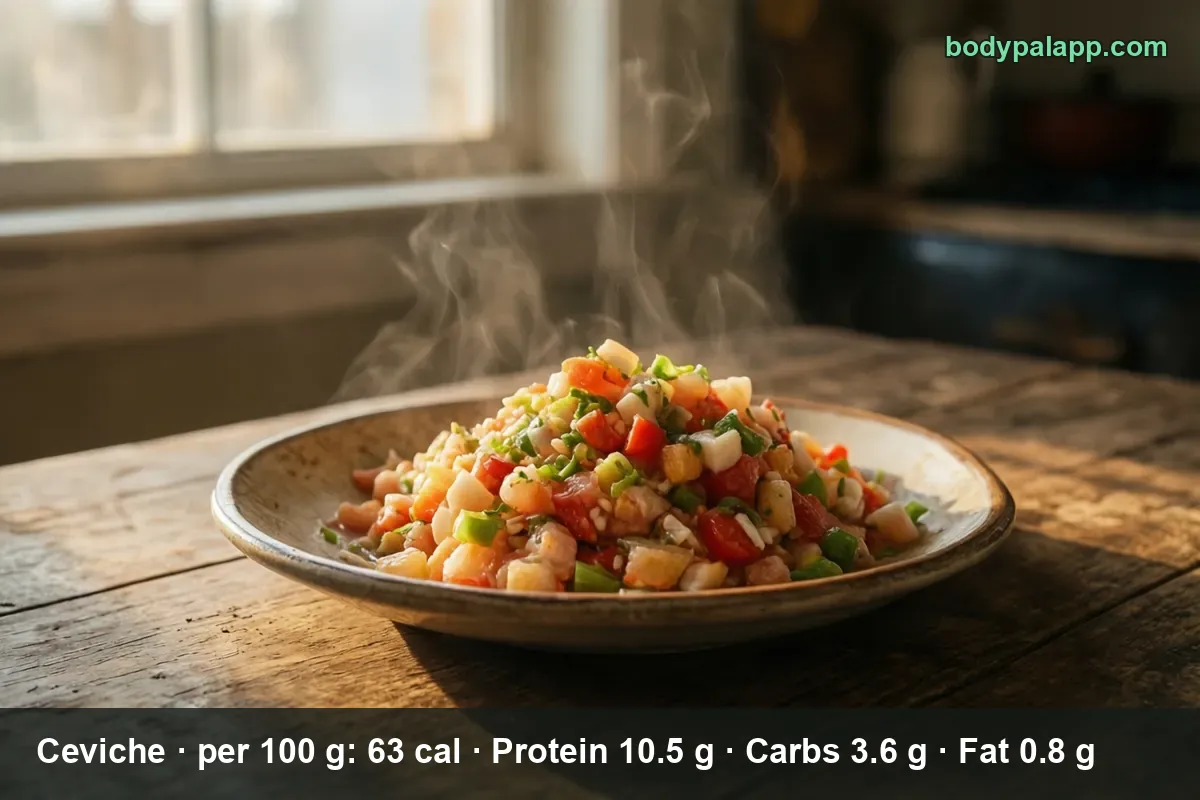
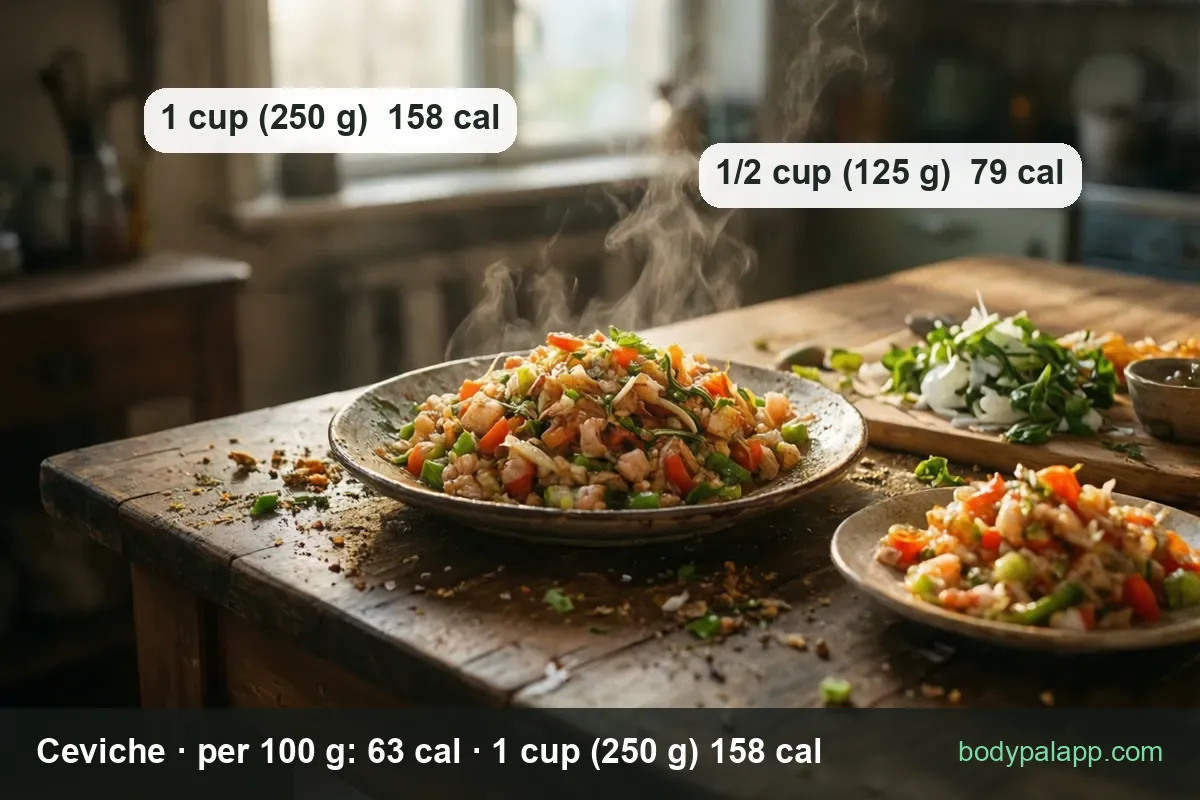
A cup of ceviche — 250 g of it — is 158 calories, at 63 calories per 100 g. Half a cup is 79. The 3 oz appetizer scoop a restaurant hands you is 54. That makes ceviche one of the few dishes on any menu that ends up lighter, gram for gram, than the raw fish it was built from.
On this page
- Ceviche quick facts
- Why ceviche is lighter than the fish in it
- Ceviche servings, from a scoop to a cup
- Fish, shrimp, krab and the deli tub
- Sodium is what the tub costs you
- 26 grams of protein for 158 calories
- How does ceviche compare?
- Most popular ceviche brands
- FAQ
Ceviche quick facts
Every figure here comes off one line: FNDDS 2706463, "Ceviche", USDA's record for the finished dish rather than its parts — white fish diced small, cured in citrus, mixed with onion, tomato and pepper. USDA weighs a cup of it at 250 g, which is heavier than a cup of most salads because the dish is wet and packs down.
| Nutrient | Per 100 g | Per 1 cup (250 g) | % Daily Value |
|---|---|---|---|
| Calories | 63 | 158 | — |
| Total fat | 0.76 g | 1.9 g | 2% |
| Saturated fat | 0.16 g | 0.4 g | 2% |
| Carbohydrate | 3.58 g | 9.0 g | 3% |
| Dietary fiber | 0.5 g | 1.3 g | 4% |
| Total sugars | 1.34 g | 3.4 g | — |
| Protein | 10.53 g | 26.3 g | 53% |
| Sodium | 149 mg | 373 mg | 16% |
% Daily Value is based on a 2,000-calorie diet.
Verified nutrition data
Numbers on this page come from USDA FoodData Central, the U.S. Department of Agriculture’s food composition database, and from manufacturer labels where a branded product is named. Last verified September 2026. How we verify our data →
Two label rows are missing on purpose. This edition of FNDDS publishes no added sugars and no trans fat figure for its mixed dishes, so rather than borrow a number from somewhere else and pretend it belongs here, those rows are absent. Total sugars carry no Daily Value on a US label, which is why that cell is blank.
Two more nutrients sit outside the standard label and come from the same record. Cholesterol is 18 mg per 100 g, 45 mg in a cup, about 15% of the 300 mg Daily Value. Potassium is 282 mg per 100 g, 705 mg in a cup, also around 15% of the day.
Now read the two right-hand columns against each other. A cup is 158 calories, roughly 8% of a 2,000-calorie day. The same cup is 53% of the protein. Ceviche returns more than six times more protein than it costs in calories, and that ratio is the single most useful thing on this page.
Why ceviche is lighter than the fish in it
Here is the number that surprises people who log it: ceviche has fewer calories per 100 g than the fish it is made of.
Raw tilapia is 96 calories per 100 g. Raw shrimp is 85. Ceviche is 63. Nothing has been removed — the difference is that something has been added. Lime juice, onion, tomato and pepper bring weight and almost no calories with them, so every 100 g of finished dish contains less fish than 100 g of fish does.
Protein tells the same story from the other side. Tilapia carries 20.08 g of protein per 100 g; ceviche carries 10.53 g. The fish has not changed. It has been cut with vegetables and marinade, which is why both the calories and the protein fall by roughly the same proportion.
This is the opposite of what heat does. Cooking drives water out, so a fillet shrinks and everything left behind concentrates. USDA's baked and fried tilapia lines land at 160 and 237 calories per 100 g — two and a half to nearly four times the same weight of ceviche. Acid firms the protein without evaporating anything, which is exactly why the weight stays high and the calorie density stays low.
Worth saying plainly: ceviche is not cooked with heat, and the citrus does not make it safe the way an oven does. FDA's guidance on selecting and serving raw seafood applies to it the way it applies to sushi.
Ceviche servings, from a scoop to a cup
| Serving | Weight | Calories |
|---|---|---|
| One ounce | 28 g | 18 |
| 3 oz appetizer scoop | 85 g | 54 |
| Half a cup | 125 g | 79 |
| One cup (USDA serving) | 250 g | 158 |
| Whole 100 g | 100 g | 63 |
The gap between the two servings people actually use is close to three times. A 3 oz scoop is 54 calories; a full cup is 158. Both get described as "some ceviche" and only one of them is a course.
That 250 g cup is the row worth memorizing, because it is heavier than intuition says. Ceviche is diced solids sitting in their own juice, so the measure fills with dense, wet food and comes out at a quarter of a kilogram — nothing like a cup of leaves. If you log a cup when you ate a small dish, you have tripled the entry.
The other direction matters too. At 18 calories an ounce, ceviche is one of the cheapest things you can spoon onto a tostada while you wait for the main course.
Fish, shrimp, krab and the deli tub
Ceviche is a method, not a recipe, so the calorie range is wide. USDA keeps one line for the classic dish and a shelf of branded records for the tubs sold in supermarkets, and between them the number runs from 38 to 165 calories per 100 g.
| Version | Per 100 g | Typical serving | Calories |
|---|---|---|---|
| Classic fish ceviche (USDA dish) | 63 | 1 cup (250 g) | 158 |
| Store tub, white fish only | 38 | ¼ cup (65 g) | 25 |
| Store tub, mixed seafood | 46 | ¼ cup (65 g) | 30 |
| Krab (surimi) ceviche | 53 | ½ cup (113 g) | 60 |
| Deli style, with oil or avocado | 165 | 3 oz (85 g) | 140 |
| Vegetable or cauliflower ceviche | 76 | 1 package (225 g) | 171 |
| Lomi salmon (the Hawaiian cousin) | 60 | 3 oz (85 g) | 51 |
The store tubs are lighter than the restaurant dish, not heavier. At 38 and 46 calories per 100 g they sit below USDA's 63, because a packaged salad carries proportionally more onion, pepper and marinade and less fish. A quarter cup is 25 to 30 calories. It is also, for the same reason, less protein per bite than a plate made in a kitchen.
One tub breaks the pattern completely. The deli-style version at 165 calories per 100 g is 2.6 times the classic dish, and the reason is 14.12 g of fat per 100 g against 0.76. That is oil, or avocado, or both. Nothing else in ceviche can move the number that far, since the undressed dish carries 0.76 g of fat per 100 g, so any tub much above 100 calories has been dressed.
Krab ceviche is a different food wearing the name. At 53 calories per 100 g it looks like a reasonable swap, and on calories it is. On protein it is not: 2.65 g per 100 g against 10.53, with 10.62 g of carbohydrate against 3.58, because surimi is fish paste bound with starch. A half-cup tub is 60 calories and delivers roughly a quarter of the protein the same volume of real ceviche would.
Vegetable ceviche is not the diet option. The cauliflower version runs 76 calories per 100 g, above the fish dish, and a single 225 g package is 171 calories. Removing the fish removes the protein and changes very little else.
Lomi salmon is the closest relative USDA lists: raw salmon with tomato and onion, no citrus cure, 60 calories per 100 g. Almost identical calories, more fat at 1.86 g per 100 g, and noticeably less protein at 7.55 g.
One gap to name rather than paper over: USDA has no separate line for shrimp ceviche as a dish. The mixed seafood tub at 46 calories per 100 g is the closest published figure, and raw shrimp on its own is 85 calories per 100 g with 20.1 g of protein if you want to build the estimate yourself.
Sodium is what the tub costs you
Calories are why people look ceviche up. Sodium is the number that separates the homemade plate from the refrigerated one.
- One cup of USDA ceviche, 250 g: 373 mg — 16% of the day
- Half a cup, 125 g: 186 mg — 8%
- A half-cup store tub at the salty end, 100 g: 660 mg — 29%
USDA's dish is 149 mg of sodium per 100 g. The branded tubs run 270 to 754 mg per 100 g. That means a half-cup serving from a supermarket container can carry more sodium than a full cup of the restaurant dish, at less than half the calories — a case where the lighter option is the saltier one.
The Daily Value is 2,300 mg. A cup of ceviche is about a sixth of a teaspoon of table salt, which is modest for a savory dish of that size. Two half-cup servings from a salty tub reach 1,320 mg, and that is more than half the day from something eaten as a snack.
The reason is preservation, not seasoning. Salt and acid together are what keep a packaged raw-fish salad stable on a shelf, so the tub is doing a job your own lime and onion are not asked to do. If you are watching sodium, the fix is not a different brand — it is a smaller scoop, or a bowl made at home where the only salt is the one you add.
26 grams of protein for 158 calories
Divide protein by calories and ceviche wins its category outright. It carries 16.7 g of protein per 100 calories. Lomi salmon gives 12.6, a dressing-free seafood garden salad 12.8, shrimp gumbo 10.7. The only thing on the list that beats it is the raw tilapia fillet at 20.9 g per 100 calories — and that is the same fish, before the vegetables arrived.
In a real serving that means 26.3 g of protein in a cup, 53% of the Daily Value, for 1.9 g of fat and 9.0 g of carbohydrate. There is no other 158-calorie dish in USDA's seafood section that puts up that protein figure.
MyPlate files seafood in the protein group, and the Dietary Guidelines for Americans ask for about 8 ounces of it a week. A cup of ceviche is not 8 ounces of fish, though — the 250 g includes the onion, tomato, pepper and juice, and the protein figure tells you the fish share is roughly half. Two cups a week and you are close to the target, with 316 calories spent on it.
The carbohydrate line deserves one sentence for anyone counting those instead. A cup is 9.0 g with 1.3 g of fiber, so about 7.7 g net, all of it from the vegetables — the fish brings none.
How does ceviche compare?
Five USDA lines from the same neighborhood, at 100 g and at the 3 oz (85 g) serving that all of them share:
| Dish | Per 100 g | 3 oz (85 g) | Protein | Carbs | Fat |
|---|---|---|---|---|---|
| Fish, tilapia, raw | 96 | 82 | 17.1 g | 0 g | 1.4 g |
| Ceviche | 63 | 54 | 9.0 g | 3.0 g | 0.6 g |
| Seafood garden salad, no dressing | 62 | 53 | 6.7 g | 2.4 g | 1.7 g |
| Shrimp gumbo | 61 | 52 | 5.5 g | 3.9 g | 1.6 g |
| Lomi salmon | 60 | 51 | 6.4 g | 2.8 g | 1.6 g |
Our take: four of these five land within three calories of each other at the same weight, so the calorie column is not where the decision is. Protein is. At 3 oz, ceviche puts 9.0 g on the plate against 5.5 g for the gumbo and 6.4 g for the lomi salmon, for the same 51 to 54 calories — it is simply the better trade, and it is the pick if you want the plate to hold you.
The raw tilapia row is a reference point, not a suggestion: it is denser in everything because it is undiluted fish. Note the fat column too. Ceviche is 0.6 g at 3 oz against 1.6 g for the gumbo and the lomi salmon, and that gap widens once the gumbo arrives as a bowl rather than three ounces.
Most popular ceviche brands in the United States
Ranked by how widely each product appears among foods sold in the United States, from the BodyPal food database of over 3.3 million products. Calories are the figures printed on each Nutrition Facts label, checked against USDA FoodData Central.
| Product | Calories (per 100 g) |
|---|---|
| Frankly Fresh Ceviche Salad | 60 cal |
| Papa John's Salads & Produce Ceviche | 45 cal |
| Culinaria All Natural Ceviche Salad | 50 cal |
| Simply Fresh KRAB Ceviche | 53 cal |
| King Fish Wave Fish Ceviche | 38 cal |
| King Fish Wave Mixed Ceviche | 46 cal |
Brand popularity: BodyPal food database. Nutrition: manufacturer labels / USDA FoodData Central.
Ceviche FAQs
How many calories are in ceviche?
158 calories in a 1-cup serving, which USDA weighs at 250 g, or 63 calories per 100 g. Half a cup is 79 and a 3 oz appetizer scoop is 54. Store-bought tubs run lower, from 38 calories per 100 g, and deli versions made with oil reach 165.
How many calories are in 1 cup of ceviche?
158 calories. USDA's cup of ceviche weighs 250 g because the dish is dense and wet, which is far heavier than a cup of salad. That serving also carries 26.3 g of protein, 1.9 g of fat and 9.0 g of carbohydrate, so it works out at about 8% of a 2,000-calorie day.
How many calories are in a 3 oz serving of ceviche?
54 calories for 85 g, the size most restaurants serve as an appetizer. One ounce is 18 calories. The gap between a 3 oz scoop and a full cup is nearly three times, so it is worth knowing which one landed in front of you before you log it.
How much protein is in ceviche?
10.53 g per 100 g, which is 26.3 g in a 1-cup serving — 53% of the Daily Value. Measured per calorie it is 16.7 g per 100 calories, more than lomi salmon at 12.6 or shrimp gumbo at 10.7. Krab ceviche is the exception at 2.65 g per 100 g.
Is ceviche high in sodium?
Not the restaurant dish: 149 mg per 100 g, so 373 mg in a cup, 16% of the 2,300 mg Daily Value. Packaged tubs are a different story at 270 to 754 mg per 100 g. A half-cup tub at the salty end carries 660 mg — more than a whole cup of the USDA dish.
Is ceviche keto friendly?
A cup holds 9.0 g of carbohydrate with 1.3 g of fiber, so roughly 7.7 g net for 158 calories. The carbohydrate comes from the tomato, onion and pepper rather than the fish, which contributes none. Fat is only 1.9 g a cup, so it is lean protein rather than a high-fat dish.
How many calories are in store-bought ceviche?
Between 38 and 165 calories per 100 g in USDA's branded records. Fish-only tubs are 38 and mixed seafood 46, both below the 63 of the restaurant dish, because they carry more vegetable and marinade. The 165 figure is a deli style with added oil, at 14.12 g of fat per 100 g.
Is ceviche a good choice if you are counting calories?
On the numbers, yes: 158 calories a cup with 26.3 g of protein and 1.9 g of fat is the best protein-per-calorie trade in USDA's seafood mixed dishes. The two things to watch are the serving size, since a cup is 250 g, and the sodium in packaged tubs.
Similar foods
- Oysters Steamed — 10 cal per oyster
- Shrimp Caesar Salad — 159 cal per salad
- Oyster — 8 cal per oyster
- Raw Oysters — 43 cal per 6 oysters
- Crab — 112 cal per cup
- Crab Claw — 71 cal per 3 oz
Count it without the math
Point the camera at the bowl and BodyPal works out whether that is a scoop or a cup, and what the sodium came to.


How long does it take to burn off ceviche?
A 1-cup (250 g) serving is 158 kcal. Enter your weight and the amount you ate to see how long it takes you to burn that off:
lb
| Activity | Time to burn 158 kcal |
|---|---|
| Walking, brisk | 32 min |
| Cycling, moderate | 20 min |
| Swimming, moderate | 23 min |
| Jogging | 19 min |
| Weight training, moderate | 35 min |
Times are for a 155 lb adult at a steady pace; change the weight to see yours. The amount is set to the portion in the text (250 g); change it to what you actually ate. BodyPal works this out from your steps automatically.
Want the bigger picture? Calculate your daily calorie needs — your maintenance figure, a target for losing or gaining, and the date you get there.