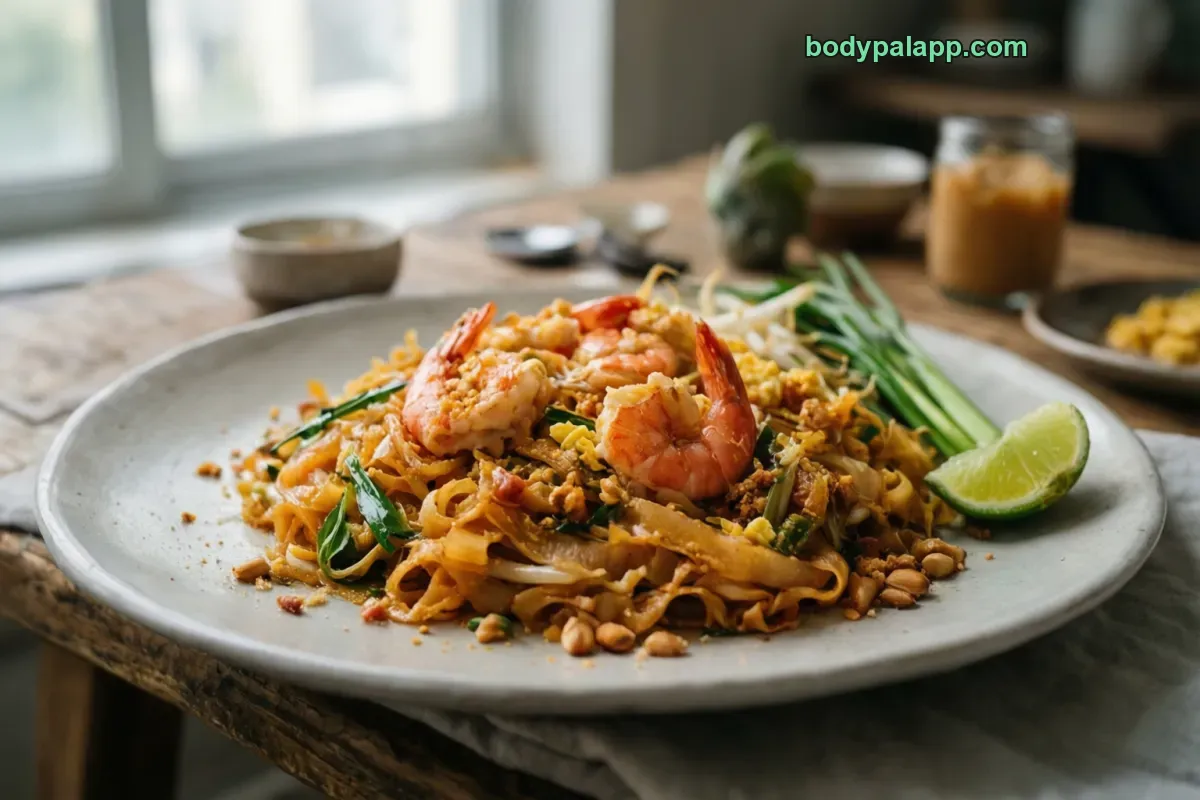
Pad thai with shrimp calories come to 294 for 1 cup (200 g) and 147 per 100 g. The thing to notice is how fast portions climb: a 12 oz portion lands at 500 calories, and fat supplies 41% of the energy, slightly more than the noodles' 40% from carbs.
294kcal
1 cup · 200 g, seafood pad thai, prepared
18%protein
13.7 gProtein
30 gCarbs
13.6 gFat
How to burn off 294 kcal
—Walking, brisk
—Jogging
—Cycling, moderate
—Swimming
Skip the math. BodyPal counts these calories from your steps and workouts automatically.
Nutrition facts
Seafood pad thai, prepared · per 200 g
Calories
294 kcal
Protein
13.7 g
Carbohydrate
30 g
Fat
13.6 g
Saturated fat
2.3 g
Cholesterol
120 mg
Sodium
698 mg
Potassium
260 mg
Iron
1.2 mg
Source: USDA FoodData Central
🛡️
Verified nutrition data
Numbers on this page come from USDA FoodData Central, the U.S. Department of Agriculture’s food composition database, and from manufacturer labels where a branded product is named. Last verified September 2026. How we verify our data →
Pad thai with shrimp: calories, protein and sodium by serving
Percent of daily value uses the FDA reference of 2,000 kcal a day.
Serving
kcal
Protein
Carbs
Fat
Sodium
% DV kcal
1 cup (200 g)
294
13.7 g
30.1 g
13.6 g
698 mg
15%
12 oz portion (340 g)
500
23.3 g
51.2 g
23.2 g
1,187 mg
25%
100 g
147
6.8 g
15.1 g
6.8 g
349 mg
7%
3 × 1 cup (200 g)
882
41 g
2,094 mg
5 × 1 cup (200 g)
1,470
68.4 g
3,490 mg
A takeout box can quietly hit 500 calories
The reference serving here is 1 cup (200 g), which gives 294 calories, 13.7 g of protein and 15% of the daily calorie value. That is a modest plate. The trouble is that few restaurant orders stop at one cup, and noodles pack down tightly, so a container looks smaller than it weighs.
A 12 oz portion (340 g) is closer to what a typical takeout box holds, and it brings 500 calories, a quarter of the daily value at 25%. Two cups (400 g) reach 588 calories, and three cups (600 g) reach 882. If you split a large order, the difference between sharing and finishing it yourself is several hundred calories.
The useful habit is to weigh or estimate grams once. At 147 calories per 100 g, every extra 100 g of noodles on the plate adds roughly that much again. BodyPal can log the dish from a photo, which helps when the portion came in a box rather than a measuring cup.
Fat and noodles split the calories almost evenly
Per 100 g, seafood pad thai carries 6.8 g of protein, 15.1 g of carbs and 6.8 g of fat. Protein and fat weigh the same, but fat has more than twice the energy per gram, so it ends up supplying 41% of the calories. Carbs supply 40% and protein 18%.
That fat share comes from the oil in the wok and from peanuts, not from the shrimp, which are very lean on their own. The noodles carry the carb load, while the sauce adds sugar: 4.2 g per 100 g, or 8.4 g in a cup and 14.3 g in a 12 oz portion. Fiber is low at 1.2 g per 100 g, so a cup gives just 2.4 g.
Protein is still respectable for a noodle dish. One cup covers 27% of the daily value, and the 12 oz portion covers 47%. If protein is your goal, though, the shrimp are doing the work, and more shrimp with fewer noodles shifts the balance in your favor.
Sodium is the row to watch
Fish sauce, soy and tamarind make pad thai salty. A single cup holds 698 mg of sodium, which is 30% of the daily value, while the calories in that same cup are only 15% of the daily value. Sodium runs ahead of calories, and that gap grows with the portion.
The 12 oz portion delivers 1,187 mg, or 52% of the daily value, in one meal. Two cups reach 1,396 mg and three cups reach 2,094 mg, which leaves very little room for anything salty later in the day. Per 100 g the figure is 349 mg.
If you watch sodium, ask for sauce on the side or eat a smaller noodle portion with extra vegetables. Plain water and unsalted sides are the easy companions here. Cholesterol is also on the higher side at 60 mg per 100 g, mostly from shrimp and egg, while saturated fat stays modest at 1.1 g per 100 g.
Treat one cup as the meal, not the starter
At 294 calories, one cup of shrimp pad thai fits comfortably into most days as a main course. It becomes a problem only when it is the side to spring rolls, a second noodle dish and a sweet Thai tea. Decide on the portion first and build the rest of the meal around it.
The dish is light on fiber and potassium, with 130 mg of potassium per 100 g, so pair it with something crunchy and green. A cucumber salad, steamed greens or a pile of bean sprouts and lime adds volume for few calories. Extra plain shrimp raises protein without adding much fat.
Leftovers are an advantage. Splitting a 12 oz portion into two meals turns a 500-calorie dinner into two lighter plates, each close to the 1 cup serving. That is the simplest swap on the menu, and it costs nothing in flavor.
How does pad thai with shrimp compare?
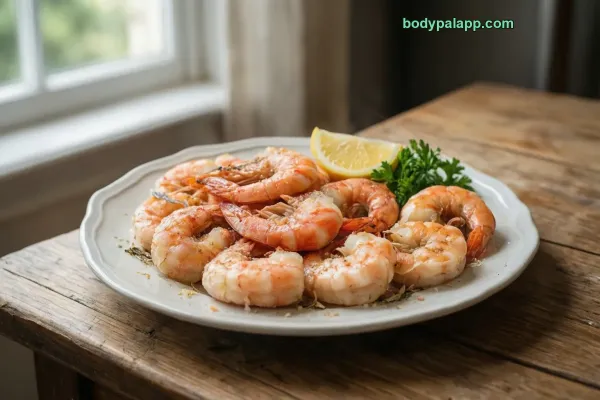
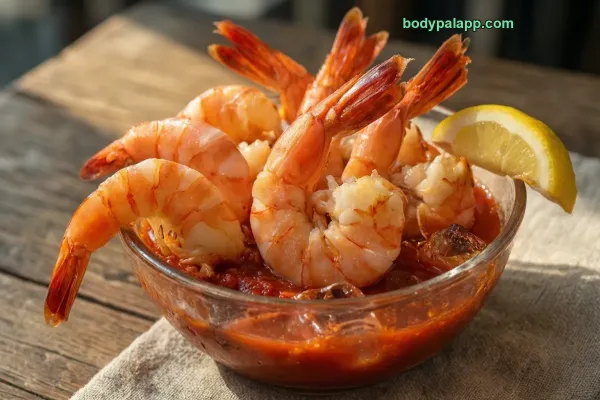
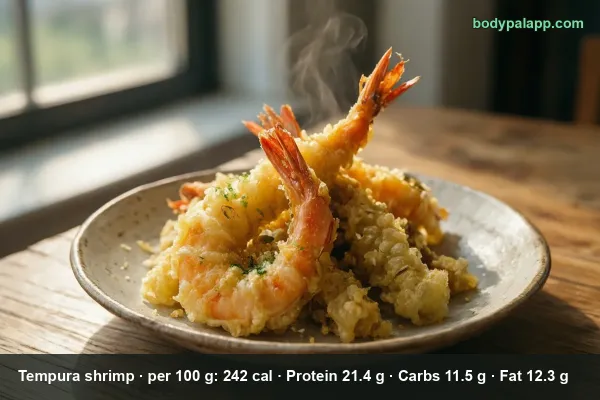
This table compares pad thai with shrimp against plain shrimp, cocktail shrimp and tempura shrimp, per 100 g and per usual serving.
Verdict: For weight loss, plain or cocktail shrimp win clearly at 99 calories per 100 g and 24 g of protein, about 0.7 times the calories of pad thai. Tempura shrimp is the heavier pick at 242 calories per 100 g, about 1.6 times more, so if you want shrimp with carbs, pad thai beats the fried version.
Pad thai with shrimp FAQs
How many calories are in one cup of pad thai with shrimp?
About 294 calories per cup (200 g). A 12 oz portion (340 g) is about 500 calories.
Is pad thai with shrimp good for weight loss?
It has 147 calories per 100 g. One cup (200 g) brings 294 calories, 30.1 g carbs and 13.6 g fat.
Pad thai with shrimp vs plain shrimp: which has fewer calories?
Plain cooked shrimp has 99 calories and 24.0 g protein per 100 g. Pad thai with shrimp has 147 calories and 6.8 g protein per 100 g.
How much protein is in pad thai with shrimp?
One cup (200 g) has 13.7 g protein, or 6.8 g per 100 g. The same cup has 698 mg sodium.
How many calories are in a takeout box of shrimp pad thai?
A 12 oz portion (340 g), close to a typical takeout box, has 500 calories. That is 25% of the daily value, with 23.3 g of protein and 1,187 mg of sodium.
How much sodium is in shrimp pad thai?
One cup (200 g) contains 698 mg of sodium, 30% of the daily value. A 12 oz portion rises to 1,187 mg, or 52% of the daily value, which makes sodium the standout number.
How many carbs are in pad thai with shrimp?
One cup has 30.1 g of carbs, including 8.4 g of sugars and 2.4 g of fiber. Per 100 g that is 15.1 g of carbs, and carbs supply 40% of the dish's calories.
Is pad thai with shrimp high in fat?
Fat supplies 41% of the calories, the largest share. One cup has 13.6 g of fat, but saturated fat is modest at 1.1 g per 100 g, since most of the fat comes from cooking oil and peanuts.
How many calories are in two cups of shrimp pad thai?
Two cups (400 g) come to 588 calories, with 27.4 g of protein and 1,396 mg of sodium. Three cups (600 g) reach 882 calories.