Passion fruit calories come to 17 for one fruit (18 g) and 97 per 100 g of purple, raw pulp. The number to notice is fiber: a single fruit carries 1.9 g, and 100 g holds 10.4 g. That is a lot of fiber for so few calories, though a full cup of pulp changes the math fast.
17kcal
1 passion fruit · 18 g, purple, raw
8%protein
0.4 gProtein
4 gCarbs
0.1 gFat
How to burn off 17 kcal
—Walking, brisk
—Jogging
—Cycling, moderate
—Swimming
Skip the math. BodyPal counts these calories from your steps and workouts automatically.
Nutrition facts
Purple, raw · per 18 g
Calories
17 kcal
Protein
0.4 g
Carbohydrate
4.2 g
Fat
0.1 g
Saturated fat
0 g
Cholesterol
0 mg
Sodium
5 mg
Potassium
63 mg
Iron
0.3 mg
Source: USDA FoodData Central
🛡️
Verified nutrition data
Numbers on this page come from USDA FoodData Central, the U.S. Department of Agriculture’s food composition database, and from manufacturer labels where a branded product is named. Last verified September 2026. How we verify our data →
Passion fruit: calories, protein and sodium by serving
Percent of daily value uses the FDA reference of 2,000 kcal a day.
Serving
kcal
Protein
Carbs
Fat
Sodium
% DV kcal
1 fruit (18 g)
17
0.4 g
4.2 g
0.1 g
5 mg
1%
1 cup (236 g)
229
5.2 g
55.2 g
1.7 g
66 mg
11%
100 g
97
2.2 g
23.4 g
0.7 g
28 mg
5%
3 × 1 fruit (18 g)
52
1.2 g
15 mg
5 × 1 fruit (18 g)
87
2 g
25 mg
One passion fruit is a 17-calorie snack
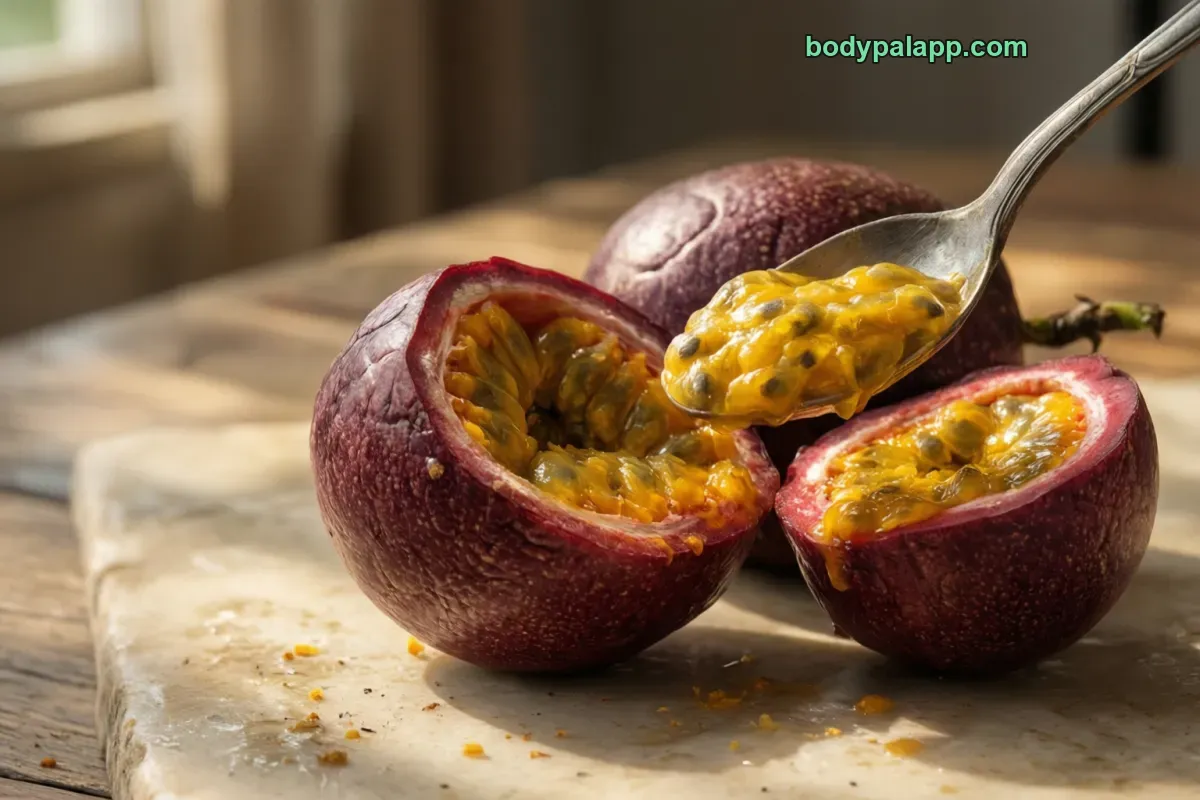
A purple passion fruit gives you only about 18 g of edible pulp and seeds, so one fruit lands at 17 calories. That is 1% of a 2000-calorie daily value. Most people scoop out one or two at a time, and at that scale passion fruit barely registers in a day's total.
The total climbs slowly by the fruit. Two fruits (36 g) come to 35 calories, three (54 g) to 52, and five (90 g) to 87. Even five fruits stay under what 100 g of pulp delivers, because each fruit is mostly shell and the edible part is small.
The cup is where portions swing. A cup of pulp weighs 236 g and brings 229 calories, 11% of the daily value, with 55.2 g of carbs and 26.4 g of sugars. You would need to crack open a pile of fruit to fill that cup, so it usually means bought pulp or a smoothie base. If you log passion fruit, count fruits rather than guess a cup.
Carbs supply 86% of the calories
Passion fruit is a carbohydrate food. Carbs supply 86% of its calories, protein 8% and fat 6%. Per 100 g that works out to 23.4 g of carbs, 2.2 g of protein and 0.7 g of fat, with just 0.1 g saturated and 0 mg cholesterol.
The carb figure looks high next to many fruits, but read the breakdown. Of those 23.4 g per 100 g, 10.4 g is fiber and 11.2 g is sugars. Almost half the carbohydrate is fiber, which is why the calorie count stays moderate despite the carb load.
Protein is small but not zero. At 2.2 g per 100 g, passion fruit has more than many fruits, yet one fruit still gives only 0.4 g. Treat it as a carb and fiber source, not a protein one. Fat is close to irrelevant: 0.1 g per fruit, even with all the edible seeds included.
Fiber is the row that stands out
Most nutrition rows on this page are quiet. Fiber is not. One fruit gives 1.9 g, 100 g gives 10.4 g, and a cup of pulp delivers 24.5 g. Against a daily value of 28 g, that cup comes close to a full day's fiber on its own.
The seeds are a big part of that number. They are eaten with the pulp, and they make passion fruit feel more filling than its calorie count suggests. If you are not used to much fiber, a cup in one sitting is a lot; a few fruits spread through the day is easier going.
The other rows stay low. Sodium is 28 mg per 100 g, 5 mg per fruit and 66 mg per cup, which is 3% of the 2300 mg daily value. Potassium is 348 mg per 100 g, measured against a 4700 mg daily value. Sugars run 2 g per fruit and 11.2 g per 100 g, so the sweet-tart taste comes with a modest sugar hit at normal portions.
Pair it with protein to round out a snack
Because passion fruit is mostly carbs and fiber, it works best alongside something with protein. Spooned over plain Greek yogurt or cottage cheese, a fruit or two adds strong flavor for 17 to 35 calories. Stirred into oatmeal or a chia pudding, it adds tartness and more fiber.
Flavored products are a different case. Items like Chobani Greek Yogurt Mango Passion Fruit, Ellenos Passion Fruit Greek Yogurt or Dafruta Passion Fruit Juice Concentrate use passion fruit as a flavor, and their labels, not the raw pulp numbers here, decide their calories. Juice drinks in particular lose the seeds and the fiber that make the whole fruit filling.
The figures on this page come from the USDA row for purple, raw passion fruit (granadilla). If you eat the fruit fresh, count by the fruit and you will be close. BodyPal can also log passion fruit from a photo, which helps when it is scattered over a bowl rather than eaten on its own.
How does passion fruit compare?
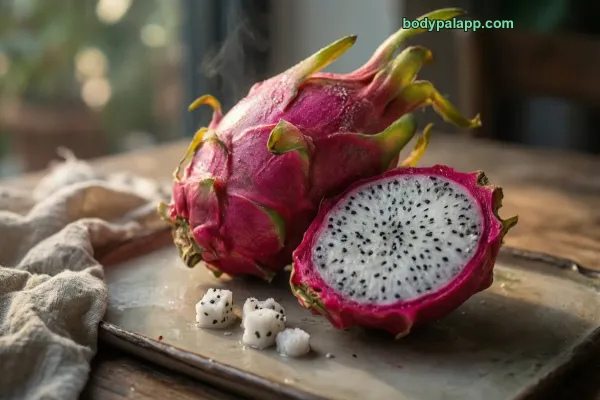
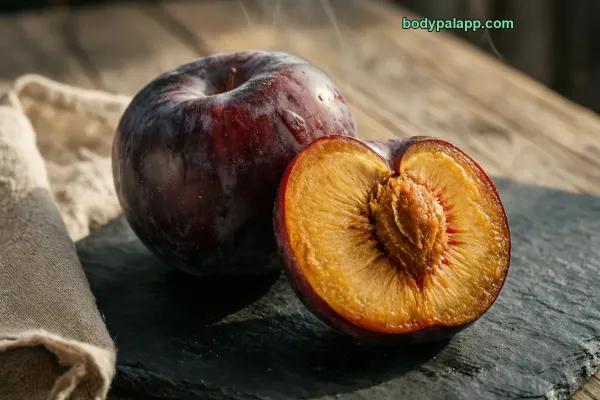
Here is how passion fruit stacks up against dragon fruit, fresh cherries and black plum, per 100 g and per usual serving.
Verdict: If you want the fewest calories per bite, black plum at 46 per 100 g and fresh cherries at 63 per 100 g beat passion fruit's 97, and a cup of cherries comes to just 97 calories. Pick passion fruit when you want a small, intensely flavored portion with 10.4 g of fiber per 100 g, and eat it by the fruit rather than the cup.
Most popular passion fruit brands in the United States
Ranked by popularity in the BodyPal database
# Productkcal / 100 g
1Ellenos Passion Fruit Greek Yogurt5.3 oz · 150 g133 kcal
2Materne GoGo squeeZ Apple Peach Passion Fruit Pouches1 pouch · 120 g67 kcal
3Dafruta Passion Fruit Juice Concentrate1 fl oz · 30 ml17 kcal
4Dafruta Passion Fruit Juice Drink Blend From Concentrate8 fl oz · 240 ml62 kcal
6Chobani Low-Fat Greek Yogurt Passion Fruit on the Bottom1 container · 150 g93 kcal
These are passion fruit flavored yogurts, pouches and juices rather than the fresh fruit, so their calories come largely from added sugar and dairy and do not match the raw numbers above. Source: manufacturer labels / USDA FoodData Central.
Passion fruit FAQs
How many calories are in one passion fruit?
One passion fruit is about 17 calories for its 18 g of edible pulp. A full cup of pulp (236 g) is 229 calories.
Is passion fruit good for weight loss?
Passion fruit is 97 calories per 100 g with 10.4 g of fiber, so a single fruit adds only 17 calories and about 1.9 g of fiber.
Passion fruit vs dragon fruit: which has fewer calories?
Dragon fruit is lower at 68 calories per 100 g, against 97 for passion fruit. Passion fruit brings 2.2 g of protein and 10.4 g of fiber per 100 g.
How much sugar is in a passion fruit?
One 18 g fruit has about 2 g of sugar. Per 100 g, passion fruit has 11.2 g of sugar within 23.4 g of total carbs.
How many calories are in a cup of passion fruit pulp?
A cup of passion fruit pulp (236 g) has 229 calories, 11% of a 2000-calorie daily value. It also carries 55.2 g of carbs, 24.5 g of fiber and 26.4 g of sugars, so it is a much bigger serving than one fruit.
How much fiber is in passion fruit?
One passion fruit has 1.9 g of fiber, and 100 g of pulp has 10.4 g. A full cup brings 24.5 g, close to the 28 g daily value, mostly thanks to the edible seeds.
Is passion fruit high in carbs?
Yes for a fruit: 100 g has 23.4 g of carbs, and carbs supply 86% of its calories. Almost half of that is fiber (10.4 g), and one fruit holds only 4.2 g of carbs.
How much protein does passion fruit have?
Passion fruit has 2.2 g of protein per 100 g, but one fruit gives just 0.4 g. A cup of pulp reaches 5.2 g, 10% of the daily value, so pair it with a protein food.
How many calories are in 5 passion fruits?
Five passion fruits (90 g of pulp) come to 87 calories, with 2 g of protein and 25 mg of sodium. Three fruits are 52 calories and two are 35.