
How many calories are in pecans?
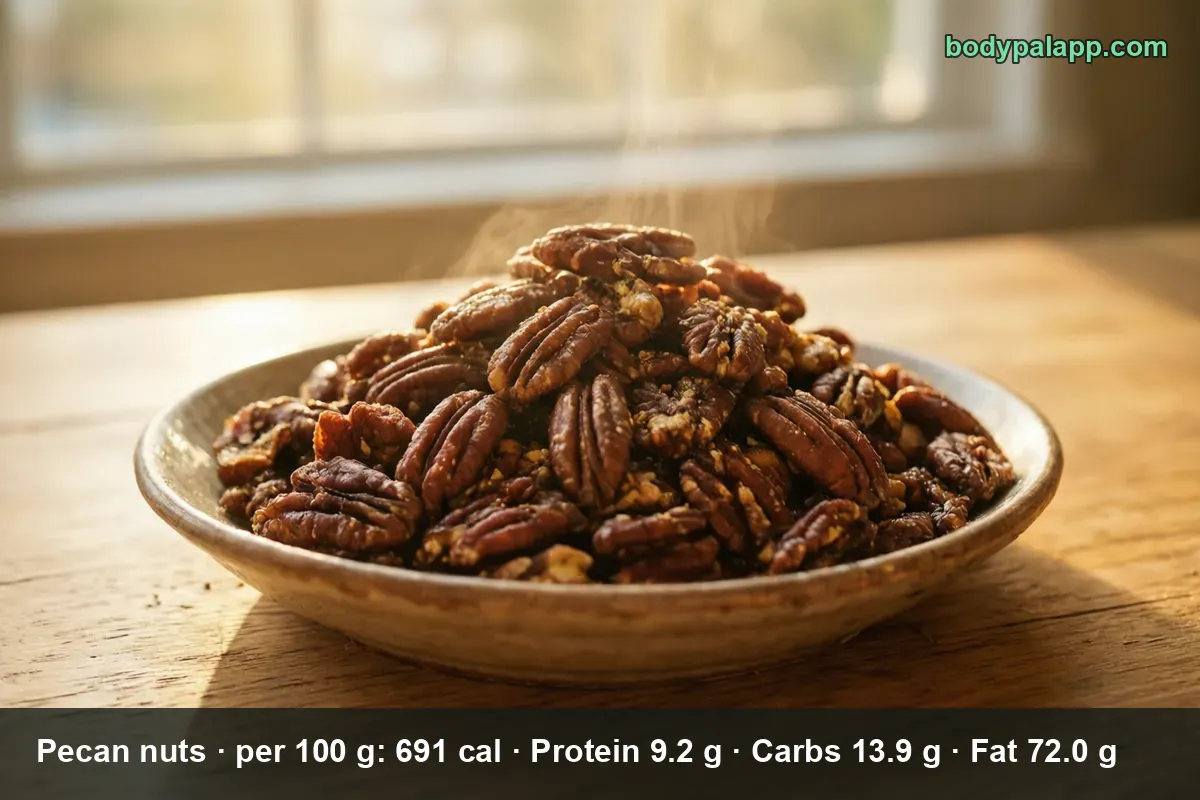
A 1-ounce serving of raw pecans, about 19 halves, carries 196 calories. Per 100 g the same nut runs 691 calories, which puts pecans among the densest things you can put in a bowl. Almost all of that is fat: 20.4 g in the ounce, against 2.6 g of protein and 3.9 g of carbohydrate.
On this page
- Pecan quick facts
- US servings from 10 halves to a full cup
- Roasted and salted pecans
- What the fat and fiber rows mean
- How do pecans compare to other nuts?
- Most popular pecan nuts brands
- FAQ
Pecan quick facts
The row below is SR Legacy 170182, "Nuts, pecans", the plain shelled kernel you tip out of a bag or crack out of a shell. It is the food most people are holding when they look this up, and it is the one USDA edition that carries the full picture: fiber, sugars, potassium and cholesterol all measured rather than left blank.
There is a newer Foundation record for raw halves, and it does not agree with this one. It puts the same nut at 750 calories per 100 g with 5.79 g of fiber instead of 9.6 g. That is a difference in laboratory edition and calorie method, not a difference in the nut, so it lives further down this page as a variant rather than at the top of it.
| Nutrient | Per 100 g | Per 1 oz, 19 halves (28.35 g) | % Daily Value |
|---|---|---|---|
| Calories | 691 | 196 | — |
| Total fat | 71.97 g | 20.4 g | 26% |
| Saturated fat | 6.18 g | 1.8 g | 9% |
| Carbohydrate | 13.86 g | 3.9 g | 1% |
| Dietary fiber | 9.6 g | 2.7 g | 10% |
| Total sugars | 3.97 g | 1.1 g | — |
| Protein | 9.17 g | 2.6 g | 5% |
| Sodium | 0 mg | 0 mg | 0% |
% Daily Value is based on a 2,000-calorie diet.
Verified nutrition data
Numbers on this page come from USDA FoodData Central, the U.S. Department of Agriculture’s food composition database, and from manufacturer labels where a branded product is named. Last verified September 2026. How we verify our data →
Two rows you will see on a printed label are missing here on purpose. SR Legacy does not publish added sugars or trans fat for this record, so there is nothing honest to put in those cells. Cholesterol is 0 mg, as it is in every plant food, and potassium comes in at 410 mg per 100 g, which is 116 mg and 2% of the Daily Value in one ounce.
US servings from 10 halves to a full cup
| Serving | Weight | Calories |
|---|---|---|
| 10 halves | 14.9 g | 103 kcal |
| 1/4 cup halves | 24.8 g | 171 kcal |
| 1 oz, 19 halves | 28.35 g | 196 kcal |
| 1 cup halves | 99 g | 684 kcal |
| 1 cup chopped | 109 g | 753 kcal |
| Per 100 g | 100 g | 691 kcal |
The ounce and the two cup measures are USDA household measures for this record. The 10 halves and the quarter cup are our own arithmetic from the USDA 100 g figure, not USDA servings, so treat them as close estimates rather than label values.
The interesting line is the pair of cups. One cup of halves weighs 99 g and costs 684 calories. Chop those same halves and the pieces settle tighter, so 109 g fit in the identical cup, and the count goes to 753. That is 69 calories of difference created by a knife, before a single extra nut goes in. Pie and cookie recipes almost always call for chopped, which is why baked pecan numbers run high.
For everyday snacking, the ounce is the measure worth learning. At 196 calories it sits in the same range as a candy bar, and a hand that dips twice has quietly spent nearly 400.
Roasted and salted pecans
| Version | Per 100 g | Typical serving | Calories |
|---|---|---|---|
| Raw pecans (SR Legacy, main row) | 691 kcal | 1 oz, 19 halves (28.35 g) | 196 kcal |
| Dry roasted, salted | 710 kcal | 1 oz (28.35 g) | 201 kcal |
| Dry roasted, unsalted | 710 kcal | 1 oz (28.35 g) | 201 kcal |
| Oil roasted, salted | 715 kcal | 1 oz, 15 halves (28.35 g) | 203 kcal |
| Oil roasted, unsalted | 715 kcal | 1 oz, 15 halves (28.35 g) | 203 kcal |
| Raw halves, Foundation edition | 750 kcal | 1 oz (28.35 g) | 213 kcal |
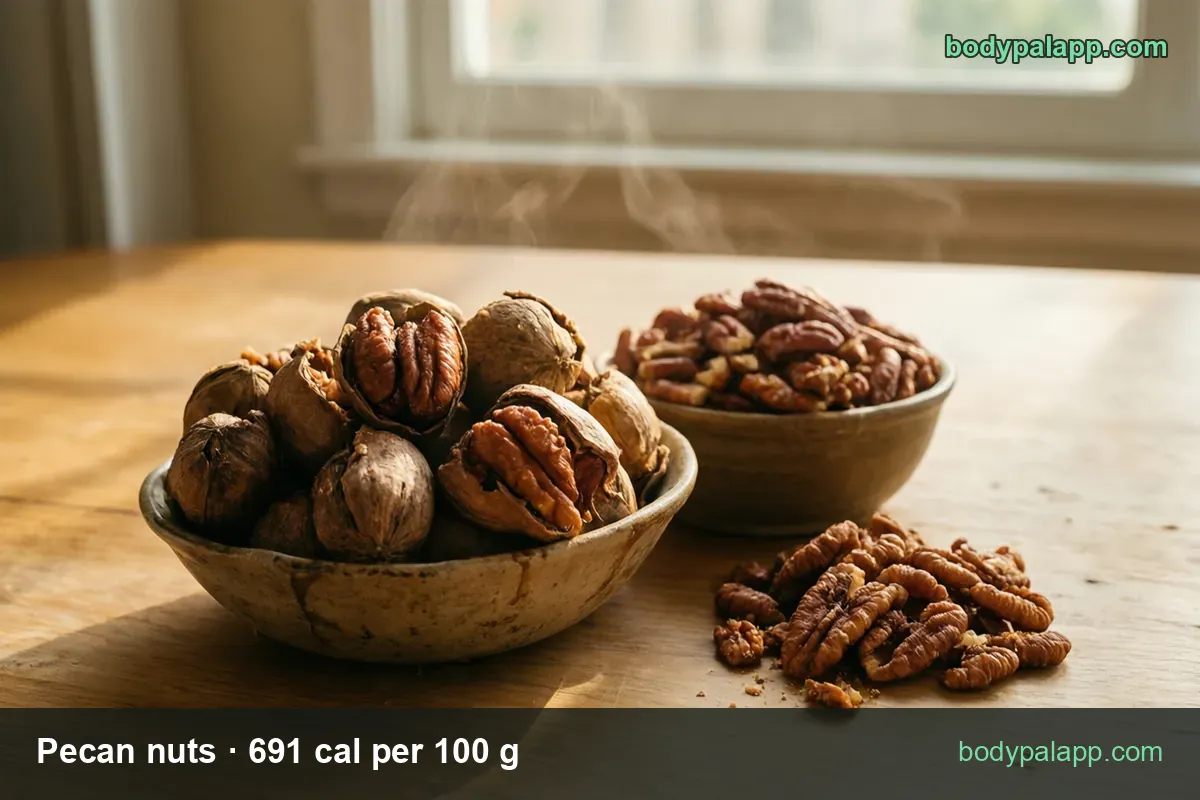
Roasting looks dramatic per 100 g and turns out to be trivial per handful. Dry roasted pecans gain 19 calories per 100 g over raw because the heat drives off water and concentrates what is left; oil roasted gain 24 because a little of the frying oil stays behind. On the ounce you actually eat, that is 196 against 201 and 203. Five to seven calories. Nobody needs to choose raw over roasted for the calorie count.
Salt is the row that genuinely changes. Salted and unsalted versions are identical in calories, fat and fiber, and differ only in sodium, which we cover below.
The Foundation record is the outlier at 750 calories per 100 g and 213 per ounce, 17 more than the SR Legacy row. Same nut, newer analysis, different calorie method. If your bag's label reads noticeably higher than 196 per ounce, this is usually why.
One more USDA detail worth noticing: the raw record counts 19 halves to the ounce, while the oil roasted records count 15. Halves are not uniform, so the count per ounce moves with the size of the nut in the bag.
What the fat and fiber rows mean
One ounce of pecans covers 26% of the Daily Value for total fat, which is more than most people expect from a snack that disappears in six bites. Saturated fat is the calmer number: 6.18 g out of the 71.97 g of total fat per 100 g, under a tenth of it, which lands at 1.8 g and 9% of the Daily Value in that ounce.
Fiber is the quiet win. The SR Legacy record gives 9.6 g per 100 g, so one ounce delivers 2.7 g, or 10% of the day, from a serving you can hold in a closed fist. The Dietary Guidelines treat nuts as a food to include rather than ration, and MyPlate files them in the protein foods group even though the fat row is the one doing the calorie work.
Sodium is where the bag matters more than the nut. Raw pecans are 0 mg per 100 g and unsalted roasted pecans are 1 mg, effectively nothing. Oil roasted with salt runs 393 mg per 100 g, and the dry roasted salted record 383 mg. Scaled to an ounce, that is about 111 mg and 109 mg, roughly 5% of the Daily Value each. Per 100 g, the salted version carries something like a sixth of a teaspoon of table salt. If you are watching sodium, unsalted is the easy pick and costs you nothing in calories.
For anyone counting net carbs, the ounce holds 3.9 g of carbohydrate against 2.7 g of fiber, which leaves about 1.2 g by our own subtraction from the USDA figures. That is why pecans show up on low-carb plates so often.
How do pecans compare to other nuts?
| Nut | Per 100 g | US serving | Calories |
|---|---|---|---|
| Pecans, raw | 691 kcal | 1 oz (28.35 g) | 196 kcal |
| Macadamia nuts, raw | 718 kcal | 1 oz (28.35 g) | 204 kcal |
| Pine nuts, dried | 673 kcal | 1 oz (28.35 g) | 191 kcal |
| Brazil nuts, dried | 659 kcal | 1 oz (28.35 g) | 187 kcal |
Our take: at the top of the nut aisle, the choice barely matters. Across these four, the whole spread is 187 to 204 calories per ounce, 17 calories between the lightest and the heaviest, and only macadamias sit above pecans. Swapping pecans for brazil nuts saves nine calories per handful, which is noise next to a second handful. Pecans do lose one comparison outright: pine nuts and brazil nuts carry roughly 13.7 g and 14.3 g of protein per 100 g against pecans' 9.17 g, so if protein is what you want from a nut, pecans are not the one. If you want fiber and a nut that behaves in baking, they are.
Most popular pecan nuts brands in the United States
Ranked by how widely each product appears among foods sold in the United States, from the BodyPal food database of over 3.3 million products. Calories are the figures printed on each Nutrition Facts label, checked against USDA FoodData Central.
| Product | Calories (per 100 g) |
|---|---|
| Nut-Tritious Foods Pecan Nut Butter | 677 cal |
| Open Nature Dark Chocolate Cinnamon Pecan Bar | 575 cal |
| It's Delish Pecan Nuts | 689 cal |
| Glaser Organic Farms Pure Raw Pecan Nut Butter | 675 cal |
| Artisana Organics Raw Pecan Nut Butter with Cashews | 656 cal |
| Nutrail Cinnamon Pecan Nut Granola | 533 cal |
Brand popularity: BodyPal food database. Nutrition: manufacturer labels / USDA FoodData Central.
Pecan FAQs
How many calories are in 1 oz of pecans?
196 calories in a 1-ounce serving, which USDA counts as 19 raw halves. That ounce brings 20.4 g of fat, 2.6 g of protein and 2.7 g of fiber. Dry roasted, the same ounce reaches 201 calories, and oil roasted 203, so the pan barely changes the count.
How many calories are in a cup of pecans?
684 calories in one cup of pecan halves, which weighs 99 g. Chop the same cup and 109 g fit into it, which is 753 calories, 69 more from nothing but a knife. A cup is a baking measure here, not a snack portion; a quarter cup, 24.8 g, is 171.
How many calories in 10 pecan halves?
103 calories for 10 raw pecan halves, roughly 14.9 g. That weight and calorie count are our own arithmetic from the USDA 100 g figure of 691 calories, not a USDA serving. Ten halves is close to half of the standard ounce, and it carries about 10.7 g of fat.
Are roasted pecans higher in calories than raw?
Yes, but barely: raw pecans are 691 calories per 100 g, dry roasted 710 and oil roasted 715. On a real 1-ounce handful that is 196 against 201 and 203, a gap of five to seven calories. Roasting drives off water, so what is left is more concentrated per gram.
How much protein is in pecans?
2.6 g of protein in a 1-ounce serving, and 9.17 g per 100 g. That ounce covers 5% of the Daily Value, so pecans read as a fat food with a little protein attached. MyPlate files nuts under protein foods, but the fat row, at 26% of the day, is the one that moves your total.
How much fiber do pecans have?
2.7 g of fiber in one ounce, 10% of the Daily Value, scaled from 9.6 g per 100 g in the SR Legacy record. The newer Foundation analysis of raw halves lists only 5.79 g per 100 g, so the fiber line on a bag depends on which USDA edition the label copied.
Do pecans have sodium?
Raw pecans have none, 0 mg per 100 g, and unsalted roasted pecans have 1 mg. Salted is a different food: oil roasted with salt is 393 mg per 100 g, which works out to about 111 mg in an ounce, 5% of the Daily Value. Check the bag, not the nut.
How many pecans are in one ounce?
19 halves make the USDA ounce of raw pecans, 28.35 g and 196 calories. For oil roasted pecans USDA counts 15 halves to the ounce, because roasted halves weigh more each. Pecan halves vary in size, so use 19 as a guide and weigh the bowl when the number matters.
Similar foods
- Pecans — 213 cal per oz
- Pistachios — 332 cal per cup in shell
- Falafel Ball — 87 cal per ball
- Cheez-its — 303 cal per cup, bite size
- Croutons — 186 cal per cup
- Baklava — 352 cal per piece
Count it without the math
Point the camera at the bowl and BodyPal counts the pecans for you, halves or chopped.


How long does it take to burn off pecans?
A 1-ounce serving (28.35 g) is 196 kcal. Enter your weight and the amount you ate to see how long it takes you to burn that off:
lb
| Activity | Time to burn 196 kcal |
|---|---|
| Walking, brisk | 39 min |
| Cycling, moderate | 24 min |
| Swimming, moderate | 28 min |
| Jogging | 23 min |
| Weight training, moderate | 44 min |
Times are for a 155 lb adult at a steady pace; change the weight to see yours. The amount is set to the portion in the text (28.35 g); change it to what you actually ate. BodyPal works this out from your steps automatically.
One food is easy to picture; a whole day is harder. See how many calories you need a day and what a deficit actually looks like.