
How many calories are in pecans?
One ounce of pecans — 28.35 g, or about 19 halves — is 213 calories. Per 100 g pecans run 750 calories, which makes them heavier per gram than walnuts, macadamias or pine nuts. Almost all of that is fat: 73.28 g per 100 g, against 12.7 g of carbohydrate and 9.96 g of protein.
On this page
- Pecan quick facts
- US servings from one nut to a full cup
- Roasted and honey glazed pecans
- Pecan pie is mostly filling
- Fat carries the calories
- How do pecans compare with other nuts?
- Most popular pecan brands
- Pecan FAQs
Pecan quick facts
The row below is FNDDS 2707521, "Pecans, NFS" — plain pecan halves, the thing most people are holding when they look this up. It is the only entry for ordinary halves that carries a full profile plus US household measures, and its energy matches the Foundation record 2346395 at 750.152 calories per 100 g, which has no sugars value at all.
| Nutrient | Per 100 g | Per 1 oz (28.35 g) | % Daily Value |
|---|---|---|---|
| Calories | 750 | 213 | — |
| Total fat | 73.28 g | 20.8 g | 27% |
| Saturated fat | 6.46 g | 1.8 g | 9% |
| Carbohydrate | 12.7 g | 3.6 g | 1% |
| Dietary fiber | 5.8 g | 1.6 g | 6% |
| Total sugars | 3.97 g | 1.1 g | — |
| Protein | 9.96 g | 2.8 g | 6% |
| Sodium | 0 mg | 0 mg | 0% |
% Daily Value is based on a 2,000-calorie diet.
Verified nutrition data
Numbers on this page come from USDA FoodData Central, the U.S. Department of Agriculture’s food composition database, and from manufacturer labels where a branded product is named. Last verified September 2026. How we verify our data →
Two label rows are missing here on purpose. USDA does not publish added sugars or trans fat for this record, so both are left out rather than guessed. Cholesterol is 0 mg, as it is for every plant food, and potassium is 360 mg per 100 g, which works out to 102 mg per ounce — 2% of the Daily Value, using the FDA's Daily Value reference.
US servings from one nut to a full cup
| Serving | Weight | Calories |
|---|---|---|
| 1 pecan half | 1.5 g | 11 kcal |
| 1/4 cup halves | 25 g | 188 kcal |
| 1 oz, the label serving | 28.35 g | 213 kcal |
| One snack pack | 50 g | 375 kcal |
| 1 cup halves | 100 g | 750 kcal |
| Per 100 g | 100 g | 750 kcal |
The single nut, the ounce, the 50 g pack and the cup are all USDA household measures for this record. The quarter cup is our own arithmetic from the USDA 100 g figure, not a USDA serving.
Here is the trap worth the whole page. A cup of pecan halves weighs 100 g, so it is three and a half label servings, not one — 750 calories against 213. Nuts are light in the hand and heavy in the count, and a cup poured into a salad or a bowl of oatmeal outweighs the rest of the meal. If you are logging by eye, log by ounce.
Retail bags land close to the generic figure. Fisher pecan halves list 190 calories per 1 oz (28 g) and Setton Farms naturals 210 per 1/4 cup (30 g); Emerald's glazed pecans drop to 170 per 3 tbsp (28 g), because the sugar coating displaces some of the nut.
Roasted and honey glazed pecans
| Version | Per 100 g | Per 1 oz (28.35 g) | Sodium per 100 g |
|---|---|---|---|
| Raw halves, Foundation record | 750 kcal | 213 kcal | 0 mg |
| Pecans, SR Legacy | 691 kcal | 196 kcal | 0 mg |
| Dry roasted, no salt added | 710 kcal | 201 kcal | 1 mg |
| Oil roasted, salted | 715 kcal | 203 kcal | 393 mg |
| Honey roasted | 681 kcal | 193 kcal | 383 mg |
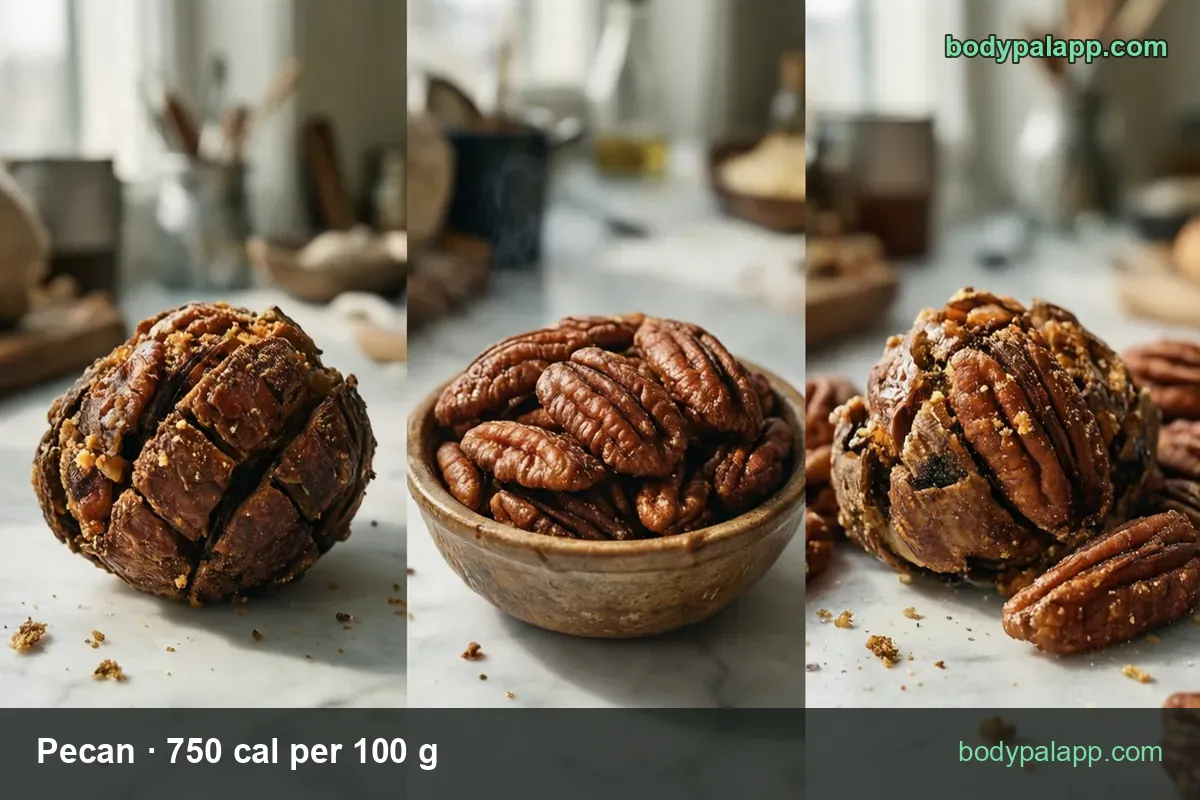
Roasting barely moves the number. Dry roasted unsalted pecans read 710 calories per 100 g and oil roasted salted 715, both within a few percent of raw. The bigger spread on that table is between USDA editions, not between cooking methods: the older SR Legacy entry for raw pecans reads 691 while the current FNDDS and Foundation records both say 750. Same nut, different lab years.
What roasting does change is sodium and sugar. Plain pecans carry no sodium at all. Oil roasted salted pecans carry 393 mg per 100 g, about 111 mg per ounce by our own arithmetic — 5% of the Daily Value, roughly a twentieth of a teaspoon of table salt. Honey roasted pecans go the other way: sugars jump from 3.97 g per 100 g to 24.41 g, and carbohydrate from 12.7 g to 30.25 g, for 6.9 g of sugars in a single ounce.
Pecan pie is mostly filling
| Pecan pie | Per 100 g | Slice | Calories |
|---|---|---|---|
| Restaurant or homemade | 449 kcal | one regular slice, 150 g | 674 kcal |
| Commercially prepared | 407 kcal | one regular slice, 150 g | 611 kcal |
Both slice figures are our own arithmetic from the USDA 100 g values, since neither record ships a 150 g household measure.
A slice of pecan pie is lighter per gram than the nuts on top of it, which surprises people. That is because the nuts are the smallest part of the slice by weight; the rest is corn syrup, sugar, eggs and crust. The giveaway is the sugar row — 31.01 g per 100 g in the homemade version against 3.97 g in plain pecans. The commercial pie is thinner on filling and lands at 407 calories per 100 g with 25.18 g of sugars.
Fat carries the calories
Fat is 73.28 g of every 100 g of a pecan, and 20.8 g of it rides in every ounce — 27% of the Daily Value in one small handful. Saturated fat stays low for that volume of fat at 1.8 g per ounce, 9% of the DV, so the fat here is overwhelmingly unsaturated.
The row that flatters pecans is fiber: 1.6 g per ounce, 6% of the Daily Value, arriving with only 3.6 g of total carbohydrate. Net carbohydrate lands near 2 g an ounce, which is why pecans show up in low-carb eating so often. The Dietary Guidelines for Americans count nuts inside the protein foods group and suggest keeping them unsalted where you can — the sodium table above shows why that instruction exists.
If you are watching calories rather than carbs, the honest read is the opposite: 213 calories is a lot for something that disappears in three bites. Pecans are best used as a topping measured with a spoon, not a bowl food.
How do pecans compare with other nuts?
| Nut | Per 100 g | US serving | Calories |
|---|---|---|---|
| Pecans | 750 kcal | 1 oz, 28.35 g | 213 kcal |
| Walnuts | 730 kcal | 1 oz, 28.35 g | 207 kcal |
| Macadamia nuts | 716 kcal | 1 oz, 28.35 g | 203 kcal |
| Pine nuts | 673 kcal | 1 oz, 28.35 g | 191 kcal |
Our take: pecans are the heaviest of the four per gram, but the gap is small — 22 calories an ounce separates them from pine nuts, which is less than the difference between a level ounce and a generous one. Portion size beats nut choice every time here. If you want more protein for the same calories, walnuts give 14.56 g per 100 g against pecans' 9.96 g. If you want the nut that tastes richest for the fewest grams poured, pecans win on flavor per piece, and a measured ounce is the whole trick.
Most popular pecan brands in the United States
Ranked by how widely each product appears among foods sold in the United States, from the BodyPal food database of over 3.3 million products. Calories are the figures printed on each Nutrition Facts label, checked against USDA FoodData Central.
| Product | Calories (per 100 g) |
|---|---|
| Setton Farms Natural Pecans | 700 cal |
| Fisher Pecan Halves 2 oz Pack | 696 cal |
| Fisher Pecan Halves | 679 cal |
| Emerald Glazed Pecans | 607 cal |
Brand popularity: BodyPal food database. Nutrition: manufacturer labels / USDA FoodData Central.
Pecan FAQs
How many calories are in 1 oz of pecans?
One ounce of pecans is 213 calories. That is 28.35 g, or about 19 halves at roughly 1.5 g each. Pecans run 750 calories per 100 g, higher than the walnuts, macadamias and pine nuts on this page. Retail bags are close: Fisher lists 190 calories per 28 g ounce.
How many calories are in a cup of pecan halves?
A cup of pecan halves weighs 100 g and carries 750 calories — three and a half ounce servings sitting in one bowl. It beats a 150 g slice of pecan pie, which is 674 calories. This is the single most common logging mistake with nuts, so weigh the cup once.
How many calories in one pecan half?
One pecan half weighs about 1.5 g and carries 11 calories, using USDA's own single-nut measure. Ten halves come to 110 calories and twenty to 220, by our arithmetic. Eating straight from an open bag is how a handful becomes 400 calories without a single moment that felt like a meal.
How much protein is in pecans?
Pecans carry 9.96 g of protein per 100 g, which is 2.8 g per ounce, or 6% of the Daily Value. That is modest for a nut: walnuts bring 14.56 g per 100 g and pine nuts 13.69 g. Pecans are a fat food first, with 73.28 g per 100 g, and protein comes along quietly.
Do roasted pecans have more calories than raw?
No — dry roasted unsalted pecans read 710 calories per 100 g and oil roasted salted 715, slightly lower than the 750 for plain pecans in USDA's current record. The older SR Legacy entry for raw pecans says 691, so differences between USDA editions are wider than the effect of roasting.
How much sodium is in salted pecans?
Oil roasted salted pecans carry 393 mg of sodium per 100 g, which is about 111 mg per ounce — 5% of the Daily Value, or roughly a twentieth of a teaspoon of table salt. Honey roasted sit at 383 mg per 100 g. Plain and dry roasted unsalted pecans have essentially none.
How many calories in a slice of pecan pie?
A regular 150 g slice of pecan pie is 674 calories, at 449 per 100 g. The nuts are the smaller part of that weight. Corn syrup, sugar and eggs do most of the work, which is why the pie carries 31.01 g of sugars per 100 g against 3.97 g in plain pecans.
Are pecans keto friendly?
An ounce of pecans has 3.6 g of carbohydrate and 1.6 g of fiber, leaving about 2 g of net carbs, with 20.8 g of fat alongside it. That fits most low-carb plans easily. Portion is the catch: a full cup takes you to 12.7 g of carbohydrate and 750 calories.
Similar foods
- Pecans — 684 cal per cup halves
- Pistachios — 332 cal per cup in shell
- Falafel Ball — 87 cal per ball
- Cheez-its — 303 cal per cup, bite size
- Croutons — 186 cal per cup
- Baklava — 352 cal per piece
Count it without the math
Point the camera at the bowl and BodyPal counts the pecans for you, halves, handfuls and all.


How long does it take to burn off pecans?
One ounce (28.35 g) is 213 kcal. Enter your weight and the amount you ate to see how long it takes you to burn that off:
lb
| Activity | Time to burn 213 kcal |
|---|---|
| Walking, brisk | 43 min |
| Cycling, moderate | 27 min |
| Swimming, moderate | 30 min |
| Jogging | 25 min |
| Weight training, moderate | 47 min |
Times are for a 155 lb adult at a steady pace; change the weight to see yours. The amount is set to the portion in the text (28.35 g); change it to what you actually ate. BodyPal works this out from your steps automatically.
Burning it off is one side of it. The other is knowing your number: work out how many calories you need a day, with macros and a goal date.