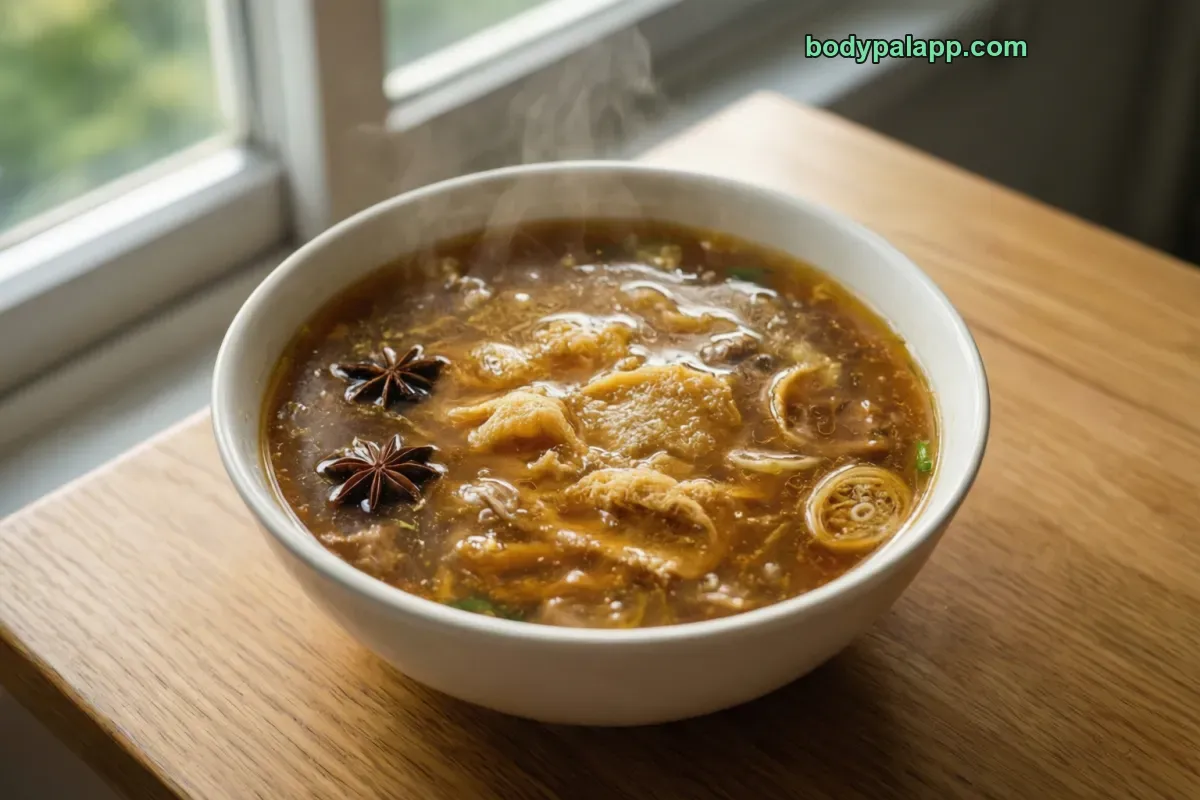
Pho broth calories come to 13 for 1 cup (213 g) and 6 per 100 g, based on the USDA row for a lower-sodium beef broth. The energy barely registers. Sodium is the number that matters: a 16 oz bowl holds 817 mg, or 36% of the daily value, so salt shapes this broth far more than its calories do.
13kcal
1 cup · 213 g, beef broth, ready to serve
75%protein
2.6 gProtein
0 gCarbs
0.2 gFat
How to burn off 13 kcal
—Walking, brisk
—Jogging
—Cycling, moderate
—Swimming
Skip the math. BodyPal counts these calories from your steps and workouts automatically.
Nutrition facts
Beef broth, ready to serve · per 213 g
Calories
13 kcal
Protein
2.6 g
Carbohydrate
0.4 g
Fat
0.2 g
Saturated fat
0.1 g
Cholesterol
0 mg
Sodium
383 mg
Potassium
49 mg
Iron
0.1 mg
Source: USDA FoodData Central
🛡️
Verified nutrition data
Numbers on this page come from USDA FoodData Central, the U.S. Department of Agriculture’s food composition database, and from manufacturer labels where a branded product is named. Last verified September 2026. How we verify our data →
Pho broth: calories, protein and sodium by serving
Percent of daily value uses the FDA reference of 2,000 kcal a day.
Serving
kcal
Protein
Carbs
Fat
Sodium
% DV kcal
1 cup (213 g)
13
2.6 g
0.4 g
0.2 g
383 mg
1%
16 oz bowl (454 g)
27
5.4 g
1 g
0.4 g
817 mg
1%
100 g
6
1.2 g
0.2 g
0.1 g
180 mg
0%
3 × 1 cup (213 g)
38
7.7 g
1,150 mg
5 × 1 cup (213 g)
64
12.8 g
1,917 mg
A full 16 oz bowl of broth is only 27 calories
Portion size hardly changes the energy total. One cup (213 g) has 13 calories, and a 16 oz bowl (454 g) has 27. That is 1% of a 2000-calorie daily value either way. Even sipping your way through a large restaurant bowl keeps the broth itself below what a single cracker would add.
Scale up and the gap stays small. Two cups (426 g) come to 26 calories, three cups (639 g) to 38, and five cups (1,065 g) to 64. Five cups is a lot of liquid, and it still lands below 100 calories.
The catch is that sodium climbs much faster than calories. Two cups carry 767 mg, three cups 1,150 mg, and five cups 1,917 mg. If you drink the whole bowl and then refill it, the calorie count stays trivial while the salt adds up quickly.
Three quarters of the calories come from protein
Per 100 g, pho broth has 1.2 g protein, 0.2 g carbs and 0.1 g fat. In calorie terms that works out to 75% protein, 13% carbs and 11% fat. Few foods have a split this lean, mostly because there is so little of anything in the liquid.
Do not mistake that split for a protein source, though. One cup gives 2.6 g of protein, 5% of the daily value, and the 16 oz bowl gives 5.4 g, or 11%. It takes five cups to reach 12.8 g. The broth flavors the meal; the beef in the bowl does the protein work.
Sugar is also negligible at 0.4 g per cup and 0.9 g per bowl in this USDA row. Saturated fat and cholesterol both read 0. Restaurant broths simmered with bones, marrow and rock sugar can differ, so treat these numbers as a clean, ready-to-serve baseline rather than a match for every pho shop.
Sodium is the row to watch, even in a lower-sodium broth
Calories in this broth are close to zero, so sodium becomes the main nutrition decision. At 180 mg per 100 g, one cup supplies 383 mg, which is 17% of the 2,300 mg daily value. A 16 oz bowl reaches 817 mg, or 36%.
Note that the reference row is already a lower-sodium product. Regular cartons and restaurant pots are often seasoned more heavily, and fish sauce, hoisin and sriracha added at the table push the total higher still. So the 817 mg figure is closer to a floor than a ceiling for a typical bowl.
If you watch sodium, the simplest lever is to eat the noodles, beef and herbs and leave part of the broth in the bowl. Potassium is low at 23 mg per 100 g, so the broth does little to balance the salt on its own. Fresh lime, basil, bean sprouts and chili add flavor without adding sodium.
The noodles and beef decide what the bowl costs you
Because the broth adds only 27 calories to a 16 oz bowl, nearly everything else in a bowl of pho comes from what floats in it. Rice noodles bring most of the carbs, while sliced beef, brisket or meatballs bring the protein and much of the fat. Portion those, and you have controlled the meal.
On a lighter day, a bowl heavy on herbs, sprouts and lean beef with a modest scoop of noodles keeps the total reasonable and still feels like a full meal. On a hungrier day, more noodles or fattier cuts raise it, and the broth stays a small part of the story either way.
Broth on its own also works as a warm, low-energy snack or a starter before a meal. If you log meals, BodyPal can record a bowl from a photo, which helps when the broth, noodles and toppings arrive together.
How does pho broth compare?
Here is how pho broth stacks up against corn chowder, chicken dumpling and avocado roll, per 100 g and per usual serving.
Verdict: For the fewest calories, pho broth wins easily: at 6 per 100 g it is far below corn chowder at 99, avocado roll at 93 and chicken dumpling at 144. For staying full, chicken dumpling makes more sense with 15.7 g protein per 100 g, but at 351 calories per cup it is about 24 times the energy of the broth.
Most popular pho broth brands in the United States
Cartons are labeled ready to serve, the same state as the numbers above, while a broth bomb is a concentrate meant to be diluted, so it reads higher per 100 g. Source: manufacturer labels / USDA FoodData Central.
Pho broth FAQs
How many calories are in pho broth?
About 13 calories in a cup (213 g) of pho broth, or 27 calories in a 16 oz bowl (454 g). Per 100 g the broth is 6 calories.
Is pho broth good for weight loss?
A cup has 13 calories, 0.2 g fat and 0.4 g carbs, so the broth itself adds very little. In a full bowl of pho the noodles and meat carry almost all the calories.
Pho broth vs chicken broth: which has fewer calories?
Both are about 6 calories per 100 g. A cup of pho broth (213 g) is 13 calories, while a cup of ready-to-serve chicken broth (249 g) is 15 calories.
How much sodium and protein are in pho broth?
A cup (213 g) has about 383 mg of sodium and 2.6 g of protein. A 16 oz bowl (454 g) has about 817 mg of sodium and 5.4 g of protein.
How many calories are in a 16 oz bowl of pho broth?
A 16 oz bowl (454 g) of pho broth has 27 calories, about 1% of the daily value. It also carries 817 mg of sodium, which is 36% of the daily value, so salt is the bigger consideration.
How much sodium is in one cup of pho broth?
One cup (213 g) contains 383 mg of sodium, or 17% of the 2,300 mg daily value. That figure comes from a lower-sodium beef broth, so many restaurant broths will likely be saltier.
Does pho broth have any sugar or fat?
Very little. One cup has 0.4 g of sugar and 0.2 g of fat, with 0 g saturated fat and 0 mg cholesterol in this USDA row. Restaurant versions seasoned with rock sugar may contain more.
How many calories are in 100 g of pho broth?
100 g of pho broth has 6 calories, with 1.2 g protein, 0.2 g carbs and 0.1 g fat. Protein supplies 75% of those calories, carbs 13% and fat 11%.
How many calories are in 3 cups of pho broth?
Three cups (639 g) of pho broth come to 38 calories with 7.7 g of protein. Sodium rises to 1,150 mg, so a large serving adds far more salt than energy.