
How many calories in pico de gallo?
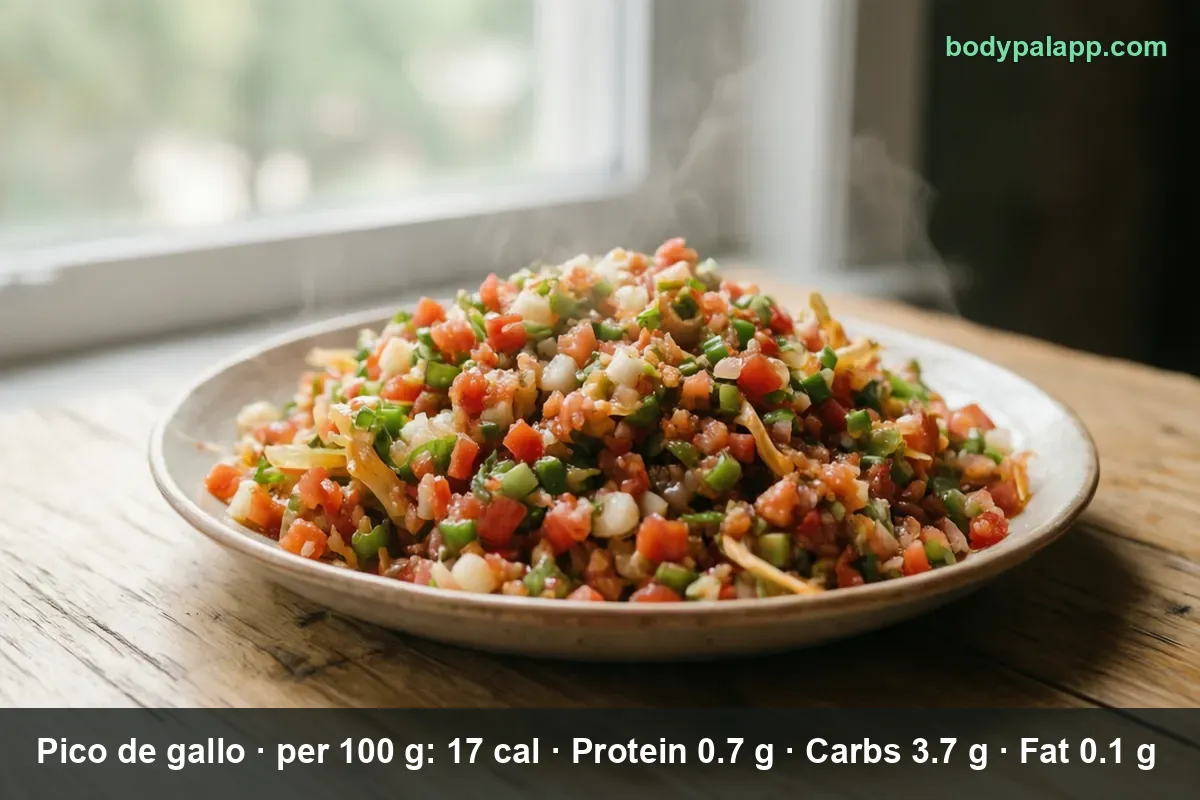
A full cup of pico de gallo — 240 g, about what fills a small serving bowl — is 41 calories. Per 100 g it runs 17, and the two-tablespoon scoop most people actually lift onto a taco is 5. That makes it close to the lightest thing on a Mexican table. Calories are not the number to watch here. Sodium is.
On this page
- Pico de gallo quick facts
- The sodium is the whole story
- Cup, spoon, ounce
- Fresh chopped against cooked salsa
- What the deli tub changes
- Tortilla chips and guacamole
- How does pico de gallo compare?
- Most popular pico de gallo brands
- FAQ
Pico de gallo quick facts
There is exactly one generic USDA record for this food, and it is worth naming before the table. Foundation Foods has nothing called pico de gallo; neither does SR Legacy. The figures below come from the survey database: USDA FoodData Central 2709737, "Salsa, pico de gallo", filed under tomato-based condiments. Read it as raw chopped tomato, onion, chile and cilantro with salt and lime, because that is what it describes.
| Nutrient | Per 100 g | Per 1 cup (240 g) | % Daily Value |
|---|---|---|---|
| Calories | 17 cal | 41 cal | — |
| Total fat | 0.14 g | 0.3 g | 0% |
| Saturated fat | 0.02 g | 0.05 g | 0% |
| Carbohydrate | 3.7 g | 8.9 g | 3% |
| Dietary fiber | 1.1 g | 2.6 g | 9% |
| Total sugars | 2.13 g | 5.1 g | — |
| Protein | 0.71 g | 1.7 g | 3% |
| Sodium | 443 mg | 1063 mg | 46% |
% Daily Value is based on a 2,000-calorie diet.
Verified nutrition data
Numbers on this page come from USDA FoodData Central, the U.S. Department of Agriculture’s food composition database, and from manufacturer labels where a branded product is named. Last verified September 2026. How we verify our data →
Two rows are missing on purpose. Added sugars and trans fat are not measured in this record, so writing 0 g for either would be an invention rather than a reading — a fresh salsa almost certainly has no added sugar, but the data does not say so and neither will this page. Cholesterol is a genuine zero, which is unremarkable for chopped vegetables, so it stays out of the table too. Potassium is in the record and worth a line: 157 mg per 100 g, or 377 mg in a cup, 8% of the Daily Value.
Look at the shape of the table and the story writes itself. Every macro row is close to nothing. One mineral row is at 46%.
The sodium is the whole story
A cup of pico de gallo carries 1,063 mg of sodium. The Daily Value the FDA prints on the label is 2,300 mg, so one bowl of a 41-calorie condiment spends 46% of the day's allowance. In kitchen terms, 2,300 mg is roughly a teaspoon of table salt; a cup of this is a little under half of one.
That ratio is unusual. Foods that spend half a day's sodium normally spend a chunk of the day's energy along with it. This one spends 46% of the sodium and 2% of a 2,000-calorie day.
Scale it down and it becomes manageable, which is the useful part. Only the cup comes from USDA; the smaller amounts below are our own scaling of the 443 mg per 100 g figure:
- 2 tablespoons (32 g): 142 mg, 6% of the Daily Value
- 1/4 cup (60 g): 266 mg, 12%
- 1/2 cup (120 g): 532 mg, 23%
- 1 cup (240 g): 1,063 mg, 46%
The two-tablespoon scoop is the honest everyday portion, and at 6% it is a non-event. The cup is what happens when a bowl goes on the table between four people and one of them keeps going. CDC guidance on sodium points at exactly this pattern: the problem is rarely the salt shaker, it is the accumulation across foods nobody thinks of as salty.
Homemade changes this more than any other variable. Salt is the one ingredient in pico de gallo added purely by hand, and the USDA record is an average of how Americans actually make and buy it. Chop the same tomatoes, onion and chile and salt them lightly and the sodium column drops as far as you push it, while the calorie column barely moves at all. Nothing else in this food is negotiable — the vegetables are the vegetables.
Cup, spoon, ounce
| Serving | Weight | Calories |
|---|---|---|
| 2 tablespoons | 32 g | 5 cal |
| 1 oz | 28 g | 5 cal |
| 1/4 cup | 60 g | 10 cal |
| 1/2 cup | 120 g | 20 cal |
| 1 cup, the USDA measure | 240 g | 41 cal |
| 100 g | 100 g | 17 cal |
The 240 g cup is not a guess. It is the household measure filed against record 2709737 in the USDA portion table, and the 32 g row is the same record's unspecified-quantity serving, which lands within a few grams of what fresh-salsa labels print for 2 tablespoons. The half cup, quarter cup and 1 oz rows are our own scaling from those two, not separate USDA portions.
Here is the trap. On a label, "1 oz" and "1 cup" both read as small, tidy amounts. One is 28 g and the other is 240 g — an eightfold difference in the same food, 5 calories against 41. Sodium moves with it, from 124 mg to 1,063 mg. When a recipe or a tracker offers you both, the choice is not cosmetic.
Raw against cooked does not apply to pico de gallo, and that is the point of it. There is no cooked version in USDA because heating it makes it something else. The distinction that matters for this food is fresh-chopped against simmered, and that lives in the next section.
Fresh chopped against cooked salsa
Put pico de gallo next to USDA record 2709738, "Salsa, red", and the same basket of vegetables reads twice as heavy: 34 calories per 100 g against 17. Two tablespoons is 11 calories rather than 5.
The gap is not a disagreement between sources. It is what cooking does. Simmering a red salsa drives off water, so every remaining gram carries more tomato solids; many jarred versions add a little sugar or oil on top of that. Same ingredients, half the water, double the density. The generic "Salsa, NFS" record sits at the same 34, because it averages fresh and cooked together — which is why a tracker entry simply called "salsa" will overstate a bowl of pico de gallo by roughly two to one.
Protein tells the same story from the other side. Red salsa shows 1.44 g per 100 g against 0.71 g for pico de gallo, and carbohydrate 6.74 g against 3.7 g. Nothing has been added except concentration.
For anyone counting, the practical version is short. If it was chopped this morning and never saw heat, use 17. If it came out of a jar and pours rather than spoons, use 34.
What the deli tub changes
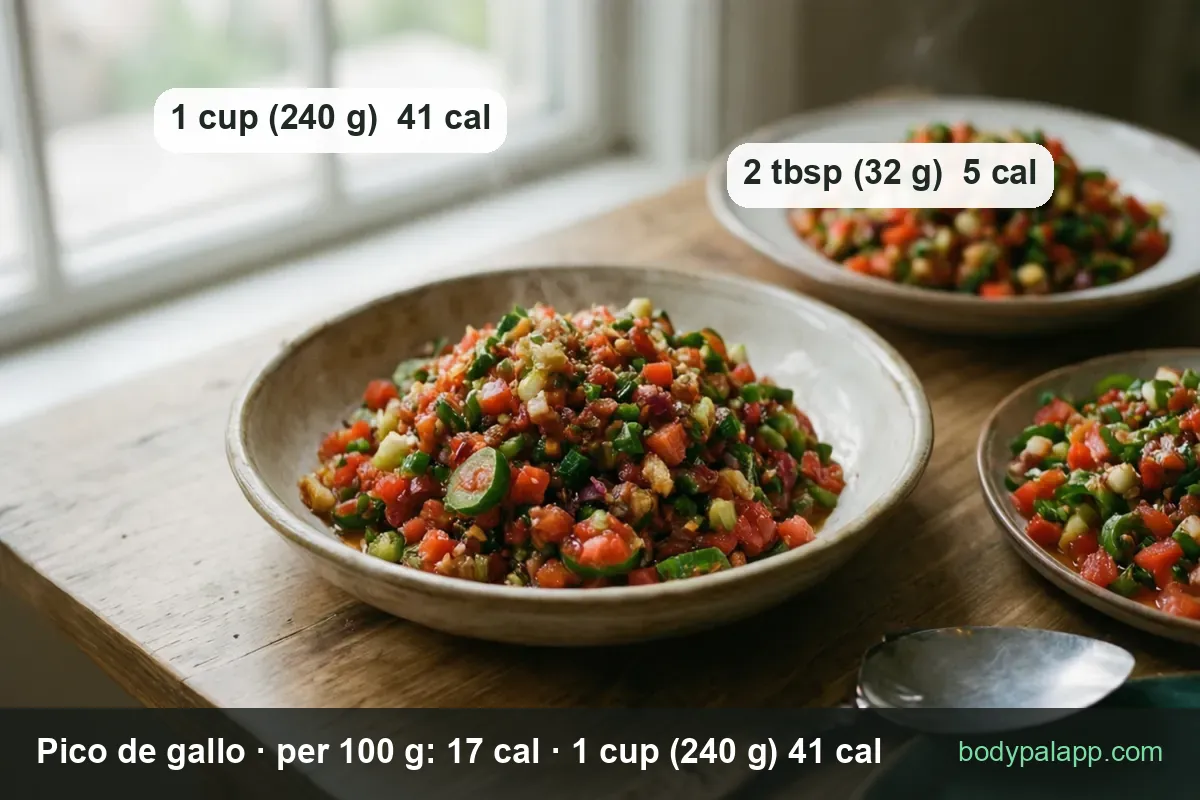
Refrigerated tubs are where the tidy single number falls apart. Across clean USDA Branded records for American retail, fresh pico de gallo runs from 15 to 35 calories per 100 g — a 2.3-fold spread inside one product name. Sunset Salsa declares 15, Tabla Fresca 17, which is the survey figure almost exactly, Pacifica Fresh 32 and Dean's Famous Organic 35.
Nothing on the front of the tub predicts which one you have picked up. The difference comes from ratio: more onion and chile against more tomato, and whether any oil went in. Fifteen calories per 100 g and thirty-five per 100 g look identical through the lid.
The serving sizes are equally slippery. Most tubs print 2 tablespoons at 24 to 34 g, which is 5 calories on the lighter recipes and 10 on a dense one like Pacifica Fresh. San Miguel prints 60 g and Dean's prints 2 oz, both landing at 20. Market Cuts prints 3 oz — 86 g, 20 calories. A "serving" of pico de gallo can therefore be anything from 24 g to 86 g depending on whose tub it is, so comparing two labels by their per-serving column compares two different amounts of salsa.
One more reason to read the panel: several records under this name are clearly mislabeled. A handful declare 0 calories per 100 g while also declaring 3.57 g of carbohydrate, which is arithmetically impossible, and one reports 7.14 g of protein — ten times what any chopped tomato salsa contains. Those were excluded from the range above rather than averaged into it.
Tortilla chips and guacamole
Two things usually arrive with pico de gallo, and only one of them is cheap.
Guacamole is the expensive one. The USDA Branded record for Calavo's guacamole made with pico de gallo (2016431) is 150 calories per 100 g, so 2 tablespoons is 45 calories against 5 for the salsa alone. That is a ninefold step, and it is all avocado fat. Neither is a bad choice, but they are not interchangeable on a plate, and a scoop of one logged as the other is a 40-calorie error every time.
Tortilla chips are the other one, and they are not costed on this page because the salsa is not what you are eating. A scoop of pico de gallo is 5 calories; the chip carrying it is many times that. If you log the bowl and skip the basket, you have logged the wrong food. Log the chips by count or by weight and treat the pico de gallo as the rounding error it genuinely is.
Which is the real argument for this stuff. As a way of putting flavor, moisture and 2.6 g of fiber onto a plate for 41 calories, chopped raw vegetables are hard to beat — MyPlate counts tomato, onion and chile in the vegetable group, and the Dietary Guidelines for Americans put most adults well short on that group. Pico de gallo is one of the few condiments that adds to it instead of sitting alongside it.
How does pico de gallo compare?
Every row below is a USDA survey record, priced at the same 2 tablespoons (32 g) so the measures line up.
| Sauce | Per 100 g | Per 2 tbsp (32 g) | Protein | Carbs | Fat |
|---|---|---|---|---|---|
| Pico de gallo | 17 cal | 5 cal | 0.2 g | 1.2 g | 0.04 g |
| Taco sauce | 11 cal | 4 cal | 0.4 g | 0.2 g | 0.2 g |
| Enchilada sauce, red | 30 cal | 10 cal | 0.2 g | 1.6 g | 0.3 g |
| Salsa, red | 34 cal | 11 cal | 0.5 g | 2.2 g | 0.06 g |
| Tomato chili sauce | 92 cal | 29 cal | 0.8 g | 6.3 g | 0.1 g |
Our take: taco sauce is technically the lightest at 4 calories per two tablespoons, but the one-calorie saving is meaningless and it gives you a thin coating instead of something to chew. Pico de gallo is the pick, and not because of the calorie column — because at 17 per 100 g you can use a genuinely generous amount and still be cheap. A quarter cup, which is four ordinary spoonfuls, is 10 calories and brings fiber and volume with it.
The row to avoid on a plate you are counting is tomato chili sauce at 92 per 100 g. It is more than five times pico de gallo, with 19.79 g of carbohydrate per 100 g against 3.7 g, and because it is a cooking sauce it goes on by the quarter cup rather than the spoonful. That is where a condiment stops being a condiment.
Most popular pico de gallo brands in the United States
Ranked by how widely each product appears among foods sold in the United States, from the BodyPal food database of over 3.3 million products. Calories are the figures printed on each Nutrition Facts label, checked against USDA FoodData Central.
| Product | Calories (per 100 g) |
|---|---|
| Dean's Famous Organic Pico de Gallo | 35 cal |
| Sunset Salsa Handcrafted Pico de Gallo | 15 cal |
| Pacifica Fresh Medium Pico de Gallo | 32 cal |
| San Miguel Medium Salsa Pico de Gallo | 33 cal |
| Tabla Fresca Fresh Pico de Gallo | 17 cal |
| Created Fresh Pico de Gallo | 21 cal |
Brand popularity: BodyPal food database. Nutrition: manufacturer labels / USDA FoodData Central.
Pico de gallo FAQs
How many calories are in pico de gallo?
41 calories in a 1-cup (240 g) serving, at 17 calories per 100 g, using USDA FoodData Central record 2709737. The everyday two-tablespoon scoop is 5 calories and a half cup is 20. It is one of the lightest things you can put on a taco.
How many calories in 2 tablespoons of pico de gallo?
5 calories for 32 g, the serving most fresh-salsa labels print. That comes with 1.2 g of carbohydrate, 0.2 g of protein and 142 mg of sodium, which is 6% of the Daily Value. One ounce (28 g) is the same 5 calories.
How much sodium is in pico de gallo?
443 mg per 100 g, which makes 1,063 mg in a full cup — 46% of the 2,300 mg Daily Value. That is the one number on this food worth watching, since the calories are negligible. Two tablespoons is 142 mg, or 6%.
Is pico de gallo healthy?
By the numbers it is chopped vegetables: 17 calories per 100 g, 1.1 g of fiber, 0.14 g of fat and no cholesterol. A cup gives 2.6 g of fiber, 9% of the Daily Value, and 377 mg of potassium. The sodium is the counterweight at 46% of a day in that same cup.
Pico de gallo or salsa — which has fewer calories?
Pico de gallo, by half — 17 calories per 100 g against 34 for USDA's red salsa, or 5 calories per 2 tablespoons against 11. Cooking drives off water and concentrates the tomato, so a jarred salsa is denser than the same vegetables chopped raw.
How many carbs are in pico de gallo?
3.7 g per 100 g, so 8.9 g in a full cup and 1.2 g in two tablespoons. Of the cup's total, 5.1 g is sugars, all of it naturally occurring in the tomato and onion, and 2.6 g is fiber. Added sugars are not measured in this USDA record.
Is pico de gallo keto-friendly?
Yes — two tablespoons carry 1.2 g of carbohydrate, and even a full cup is 8.9 g total with 2.6 g of fiber, leaving about 6 g net. Compare that with a cup of red salsa, which starts from 6.74 g of carbohydrate per 100 g rather than 3.7 g.
How many calories in store-bought pico de gallo?
Between 15 and 35 calories per 100 g depending on the tub. Sunset Salsa declares 15, Tabla Fresca 17, Pacifica Fresh 32 and Dean's Famous Organic 35. At the 2-tablespoon serving most of them print, that is 5 calories on the lighter tubs and 10 on the densest, so the spread mainly matters by the cup.
Similar foods
- Cos Lettuce — 8 cal per cup shredded
- Romaine Lettuce — 8 cal per cup
- Zucchini — 33 cal per medium zucchini
- Beefsteak Tomato — 33 cal per large whole tomato
- Big Tomato — 31 cal per large tomato
- Campari Tomato — 18 cal per 100 g
Count it without the math
Point the camera at the bowl and BodyPal logs the salsa and the tortilla chips as separate items, so the 5-calorie scoop and the basket underneath it do not end up as one guess.


How long does it take to burn off pico de gallo?
A 1-cup (240 g) serving is 41 kcal. Enter your weight and the amount you ate to see how long it takes you to burn that off:
lb
| Activity | Time to burn 41 kcal |
|---|---|
| Walking, brisk | 8 min |
| Cycling, moderate | 5 min |
| Swimming, moderate | 6 min |
| Jogging | 5 min |
| Weight training, moderate | 9 min |
Times are for a 155 lb adult at a steady pace; change the weight to see yours. The amount is set to the portion in the text (240 g); change it to what you actually ate. BodyPal works this out from your steps automatically.
Want the bigger picture? Calculate your daily calorie needs — your maintenance figure, a target for losing or gaining, and the date you get there.