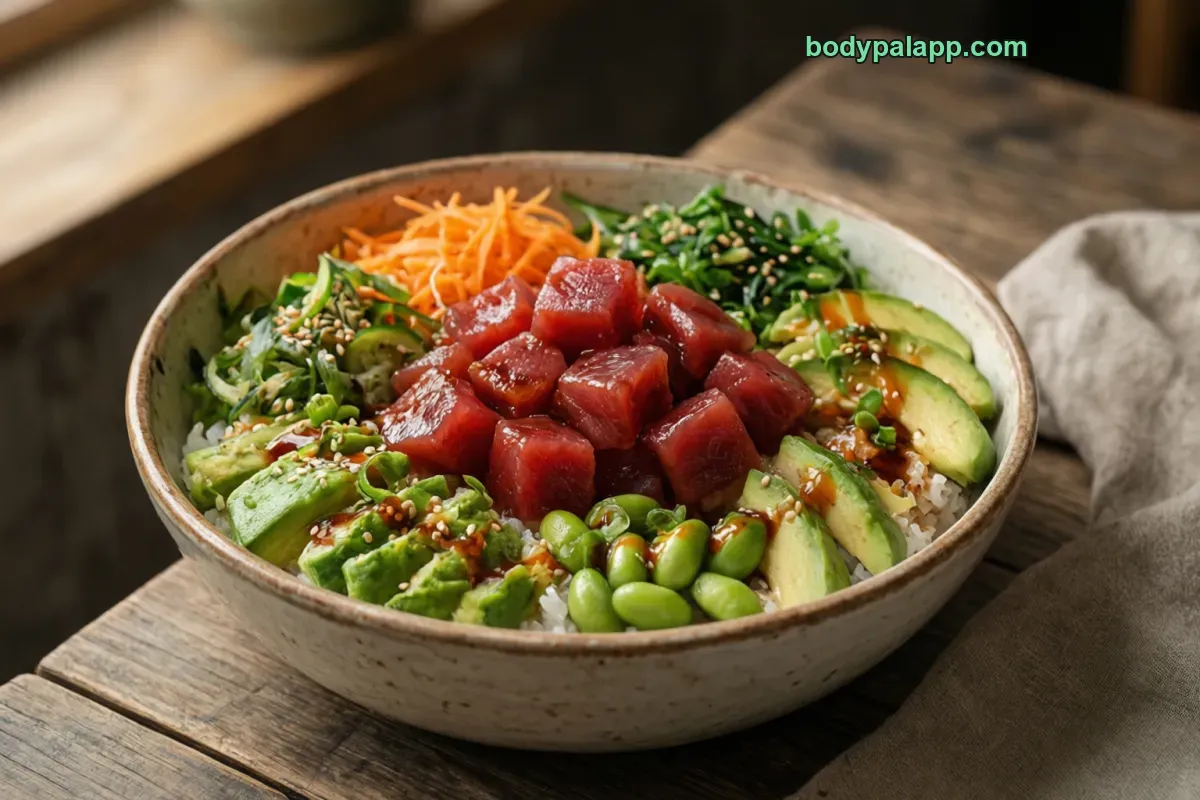
Poke bowl calories come to 569 for a full 428 g bowl, or 133 per 100 g. The protein stands out: that bowl carries 44 g, which is 88% of the daily value. It is a big portion, though, so the total climbs fast once you go past one bowl.
569kcal
1 poke bowl · 428 g, packaged, per label
31%protein
44 gProtein
56 gCarbs
19 gFat
How to burn off 569 kcal
—Walking, brisk
—Jogging
—Cycling, moderate
—Swimming
Skip the math. BodyPal counts these calories from your steps and workouts automatically.
Nutrition facts
Packaged, per label · per 428 g
Calories
569 kcal
Protein
44 g
Carbohydrate
56 g
Fat
19 g
Saturated fat
4 g
Cholesterol
77 mg
Sodium
651 mg
Potassium
419 mg
Source: USDA FoodData Central
🛡️
Verified nutrition data
Numbers on this page come from USDA FoodData Central, the U.S. Department of Agriculture’s food composition database, and from manufacturer labels where a branded product is named. Last verified September 2026. How we verify our data →
Poke bowl: calories, protein and sodium by serving
Percent of daily value uses the FDA reference of 2,000 kcal a day.
Serving
kcal
Protein
Carbs
Fat
Sodium
% DV kcal
1 bowl (428 g)
569
44 g
56 g
19 g
651 mg
28%
Small tuna bowl (164 g)
261
10 g
39 g
7 g
810 mg
13%
100 g
133
10.3 g
13.1 g
4.4 g
152 mg
7%
3 × 1 bowl (428 g)
1,708
132 g
1,952 mg
5 × 1 bowl (428 g)
2,846
220 g
3,253 mg
Bowl size decides the calorie count
A full 428 g bowl lands at 569 calories, about 28% of a 2,000-calorie day. That is a real meal, not a snack. It also brings 56 g of carbs and 19 g of fat, so it fills the plate the way a sit-down lunch does.
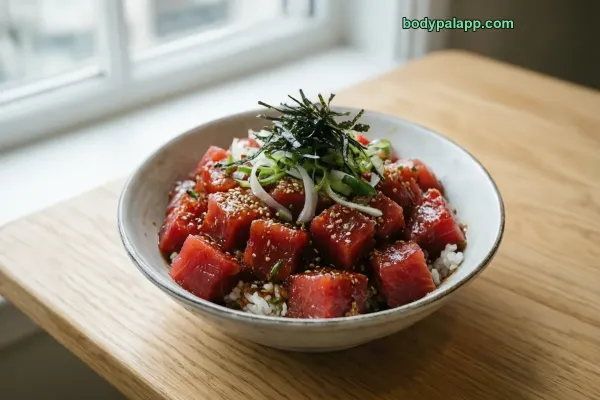
The small tuna bowl looks different. At 164 g it has 261 calories, roughly half the energy of the full bowl. But it is not just a scaled-down copy: it carries only 10 g of protein against 39 g of carbs, and its sodium is higher at 810 mg. Smaller does not always mean leaner per bite.
Doubling up is where totals get heavy. Two full bowls reach 1,138 calories across 856 g of food. Three bowls hit 1,708 calories. If you are sharing a big order or eating poke twice in a day, count each bowl rather than guessing.
Calories split almost evenly three ways
Few meals are this balanced. Protein supplies 31% of the calories, carbs 39% and fat 30%. No single macro dominates, which is why the bowl tends to sit well for hours.
Per 100 g you get 10.3 g of protein, 13.1 g of carbs and 4.4 g of fat. Saturated fat stays low at 0.9 g. Sugars are modest at 1.9 g per 100 g, or 8 g in the full bowl, so most of the carbs come from the rice base rather than sweet sauces.
Fiber is the weak spot. A full bowl gives just 3 g, and 100 g has only 0.7 g. If you want the meal to do more for fullness, extra vegetables, seaweed salad or edamame are the easy levers, and they barely move the calorie total.
Sodium swings with the sauce
The full bowl has 651 mg of sodium, 28% of the 2,300 mg daily value. That is moderate for a restaurant-style meal. Per 100 g it works out to 152 mg.
The small tuna bowl is the warning sign. In just 164 g it packs 810 mg, or 35% of the daily value, more than the bowl almost three times its size. Shoyu, spicy mayo and marinades drive that number, so the dressing matters more than the fish.
Multiples add up quickly here too. Two full bowls bring 1,301 mg and three reach 1,952 mg. If you watch sodium, ask for sauce on the side and skip the extra soy at the table.
One bowl covers lunch on its own
With 44 g of protein and 569 calories, a full bowl can stand alone as a main meal. Adding a side of fried tempura or a sugary drink turns it into something much bigger, so keep sides light: miso soup, cucumber salad or plain green tea.
If your day is calorie-tight, the base is the easiest place to trim. Swapping half the rice for greens cuts carbs without touching the fish. Cholesterol is low at 18 mg per 100 g, and potassium sits at 98 mg per 100 g.
Packaged bowls from brands like Blue Hill Bay, Yummi Sushi or Ace Sushi vary by recipe, so check the label against the numbers here. BodyPal can log a poke bowl from a photo, which helps when the toppings change every visit.
How does poke bowl compare?
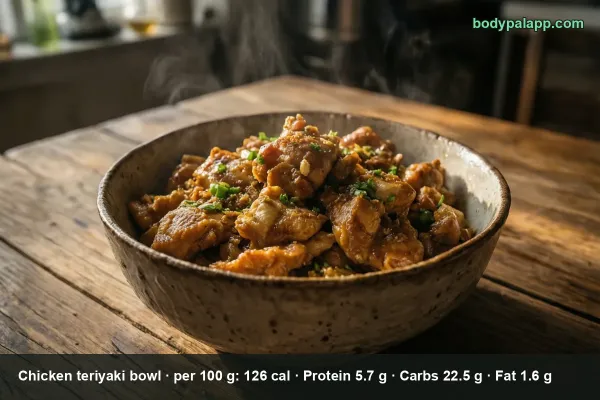
Here is how a poke bowl stacks up against tuna poke, a chicken teriyaki bowl and a ramen bowl, per 100 g and per usual serving.
Verdict: For the fewest calories and the most protein per bite, pick plain tuna poke: 106 calories and 23.9 g of protein per 100 g with only 44 mg of sodium. For a complete meal that keeps you full, the poke bowl beats ramen and teriyaki on protein, with 10.3 g per 100 g against 7.1 g and 5.7 g.
Most popular poke bowl brands in the United States
Ranked by popularity in the BodyPal database
# Productkcal / 100 g
1Blue Hill Bay Smoked Ahi Tuna Poke Bowl1 bowl · 250 g136 kcal
2Yummi Sushi Tuna Poke Bowl361 g136 kcal
3Blue Hill Bay Smoked Salmon Poke Bowl1 bowl · 250 g144 kcal
A 428 g packaged poke bowl has about 569 calories, or 133 per 100 g. A smaller 164 g tuna poke bowl is 261 calories.
Is a poke bowl good for weight loss?
It has 133 calories and 10.3 g of protein per 100 g, and a full 428 g bowl comes to 569 calories.
Poke bowl vs tuna poke: which has fewer calories?
Tuna poke on its own is 106 calories per 100 g, while a poke bowl is 133 per 100 g.
How much protein is in a poke bowl?
About 44 g in a 428 g bowl (10.3 g per 100 g), along with 56 g of carbs and 19 g of fat.
How many calories are in a small tuna poke bowl?
A small tuna poke bowl of 164 g has 261 calories. It carries 39 g of carbs, 7 g of fat and 10 g of protein, plus 810 mg of sodium, which is 35% of the daily value.
How much sodium is in a poke bowl?
A full 428 g poke bowl has 651 mg of sodium, 28% of the 2,300 mg daily value. Per 100 g that is 152 mg. Sauces and marinades account for most of it.
How many carbs are in a poke bowl?
A full poke bowl has 56 g of carbs, and 100 g has 13.1 g. Carbs supply 39% of the calories, mostly from the rice. Sugars are only 8 g per bowl.
How many calories are in two poke bowls?
Two full poke bowls total 1,138 calories across 856 g of food. They also bring 88 g of protein and 1,301 mg of sodium, so it adds up quickly.
Is a poke bowl high in fat?
No, a full bowl has 19 g of fat, and fat makes up 30% of its calories. Per 100 g it is 4.4 g, with only 0.9 g saturated.