
How many calories are in pork butt?
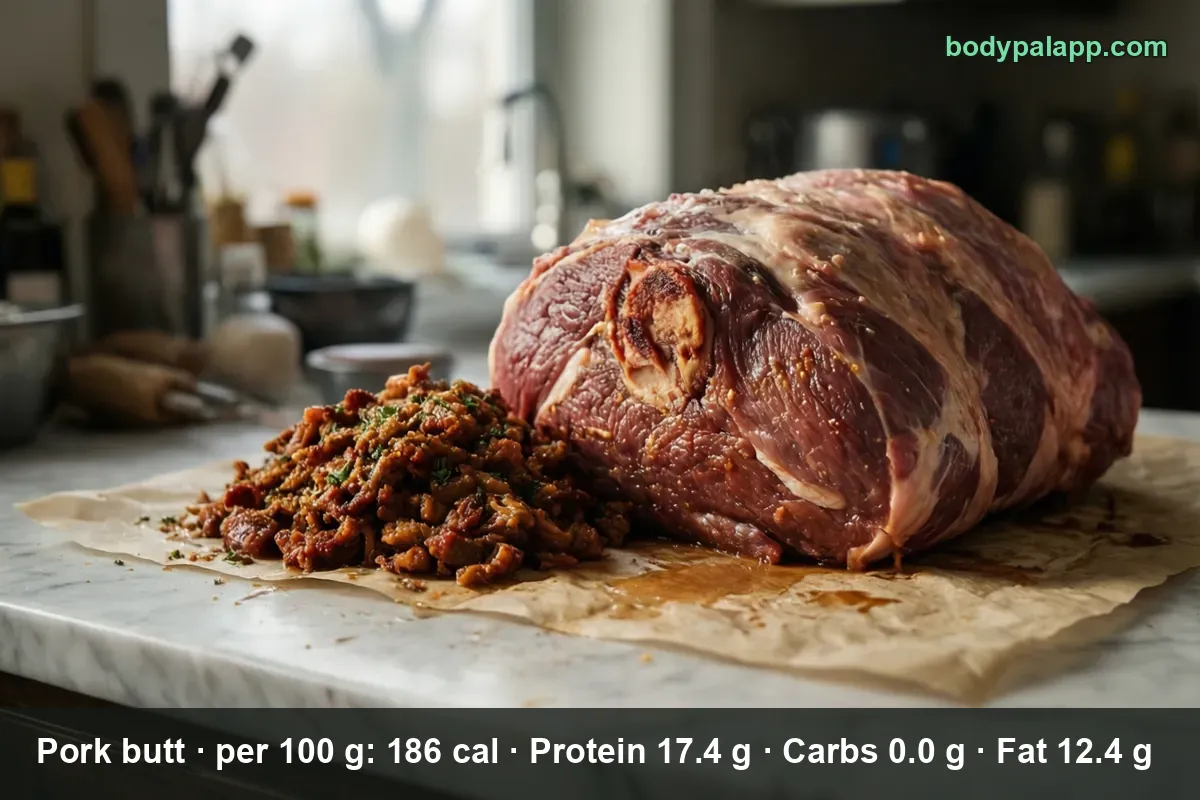
A 4 oz raw pork butt portion, 113 g on the scale, is 210 calories. Per 100 g the cut runs 186 calories, because a Boston butt keeps its fat cap and its marbling. Cook it down and the number per ounce climbs, since the meat sheds water, not fat.
On this page
- Pork butt quick facts
- US servings, from one ounce to a whole pound
- Trimmed, braised and enhanced pork butt
- Saturated fat and sodium are the rows to watch
- How does pork butt compare?
- Most popular pork butt brands
- Pork butt FAQs
Pork butt quick facts
The record behind these numbers is SR Legacy 167849, "Pork, fresh, shoulder, (Boston butt), blade (steaks), separable lean and fat, raw". That is the thing you actually pick up at the meat case: untrimmed, fat cap on, sold raw by the pound. Every other Boston butt record in the database is the same animal after somebody did something to it, so those live further down the page as variants.
USDA lists this cut with no carbohydrate at all, which is why the fiber and sugar rows read zero. There is no added sugars row because the SR Legacy release does not carry added sugars for fresh meat, and fresh pork has none to declare.
| Nutrient | Per 100 g | Per 4 oz raw (113 g) | % Daily Value |
|---|---|---|---|
| Calories | 186 | 210 | — |
| Total fat | 12.36 g | 14.0 g | 18% |
| Saturated fat | 4.35 g | 4.9 g | 25% |
| Carbohydrate | 0 g | 0 g | 0% |
| Dietary fiber | 0 g | 0 g | 0% |
| Total sugars | 0 g | 0 g | — |
| Protein | 17.42 g | 19.7 g | 39% |
| Sodium | 61 mg | 69 mg | 3% |
| Cholesterol | 62 mg | 70 mg | 23% |
| Potassium | 318 mg | 359 mg | 8% |
% Daily Value is based on a 2,000-calorie diet.
Verified nutrition data
Numbers on this page come from USDA FoodData Central, the U.S. Department of Agriculture’s food composition database, and from manufacturer labels where a branded product is named. Last verified September 2026. How we verify our data →
Two numbers in that column deserve a second look before you scroll. One 4 oz raw portion covers 39% of the Daily Value for protein and 23% of the Daily Value for cholesterol, which is a lot of both from a piece of meat that fits in your palm. Percent Daily Values follow the FDA reference amounts for a 2,000-calorie day.
US servings, from one ounce to a whole pound
| Serving | Weight | Calories |
|---|---|---|
| 1 oz raw | 28 g | 53 kcal |
| 3 oz raw | 85 g | 158 kcal |
| 4 oz raw | 113 g | 210 kcal |
| One blade steak, boneless | 288 g | 536 kcal |
| 1 lb raw | 454 g | 844 kcal |
| Per 100 g | 100 g | 186 kcal |
The blade steak and the pound are USDA household measures for this record. The 1 oz and 3 oz lines are our own arithmetic from the USDA 100 g figure, not USDA servings, and they exist because most people weigh a raw portion, not a whole steak.
The pound line is the one that surprises people. A five-pound Boston butt going into the smoker is about 4,220 calories of raw meat before a drop of sauce, and it usually feeds six to eight. That is the honest way to think about a cookout: you are dividing a large number, not eating a small one.
Trimmed, braised and enhanced pork butt
| Version | Per 100 g | Typical serving | Calories |
|---|---|---|---|
| Lean and fat, raw (the main row) | 186 kcal | 4 oz (113 g) | 210 kcal |
| Lean only, trimmed, raw | 132 kcal | 4 oz (113 g) | 149 kcal |
| Lean and fat, braised | 267 kcal | 3 oz (85 g) | 227 kcal |
| Lean only, braised | 233 kcal | 3 oz (85 g) | 198 kcal |
| Enhanced with added solution, raw | 169 kcal | 4 oz (113 g) | 191 kcal |
| Enhanced with added solution, braised | 263 kcal | 3 oz (85 g) | 224 kcal |
| Enhanced, lean only, raw | 122 kcal | 4 oz (113 g) | 138 kcal |
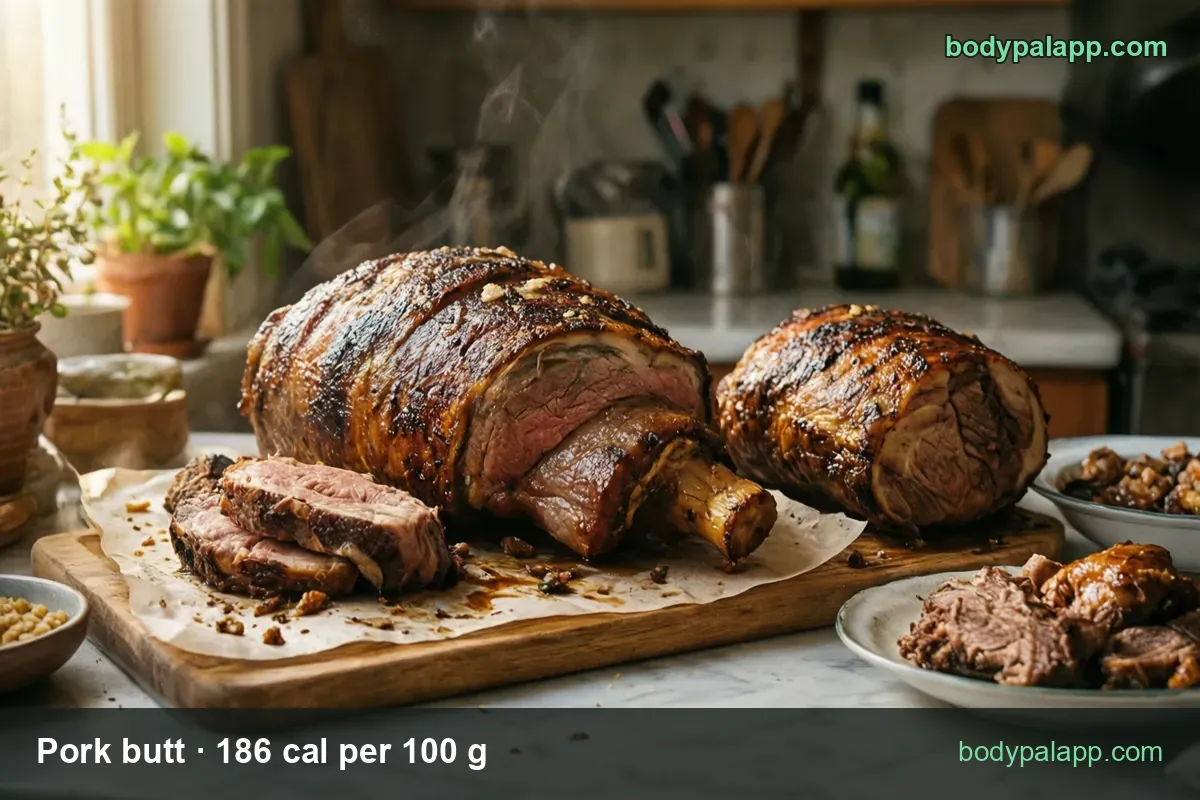
Trimming does the heaviest lifting. Cutting the fat cap off takes 100 g of pork butt from 186 to 132 calories, so a 4 oz portion drops from 210 to 149 while protein edges up to 21.2 g. If you buy the butt whole and trim it yourself, that is roughly a quarter of the calories gone with a knife.
Braising moves the number the other way, and it is not because fat appears from nowhere. The meat loses water, so what is left is denser: 267 calories per 100 g. That is the trap in every logging app. A 3 oz cooked portion at 227 calories outweighs a 4 oz raw portion at 210 calories, even though it is less meat. As a working rule for pork butt, 4 oz raw ends up close to 3 oz cooked once the water is gone, so pick the state you actually weighed and stay with it.
Then there is enhanced pork, the kind sold with an added-solution tag on the label. Raw, it reads 169 calories per 100 g rather than 186, because part of what you bought is brine. The calorie difference is small. The sodium difference is not, and that gets its own section below.
The 138-calorie figure for enhanced lean-only pork is our own arithmetic from the USDA 100 g value, not a USDA serving. One thing this page does not cover: sauced pulled pork. USDA's Boston butt records are meat only, and barbecue sauce is a different food with sugar of its own, so putting a number on a sauced sandwich here would be guessing.
Saturated fat and sodium are the rows to watch
Saturated fat is the first line to check. A 4 oz raw portion carries 4.9 g, which is 25% of the Daily Value, and a 3 oz braised portion carries 5.6 g, or 28%. The Dietary Guidelines for Americans put the ceiling at less than 10% of daily calories from saturated fat, about 22 g on a 2,000-calorie day. One serving of pork butt uses roughly a quarter of that. Trimmed lean pork butt brings the raw 4 oz portion down to 2.3 g, which is 12%.
Sodium is where the label and the meat case part ways. Plain pork butt is a low-sodium food at 61 mg per 100 g, or 69 mg in a 4 oz portion, just 3% of the Daily Value. The enhanced version runs 155 mg per 100 g, so the same 4 oz portion delivers 175 mg, about 8%. Still modest on its own, but it is two and a half times the plain cut before you add a rub, and the rub is usually the bigger number anyway. If you are watching sodium, the unenhanced butt is the better buy.
The good news is the protein column. A 4 oz raw portion is 19.7 g of protein, and 3 oz braised is 21.3 g, or 43% of the Daily Value from a palm-sized piece. MyPlate counts 1 ounce of cooked meat as one ounce-equivalent from the protein group, so that single serving covers about three of them.
How does pork butt compare?
| Cut | Per 100 g | US serving | Calories |
|---|---|---|---|
| Pork butt, lean and fat, raw | 186 kcal | 4 oz (113 g) | 210 kcal |
| Center rib chops, bone-in, raw | 186 kcal | 4 oz (113 g) | 210 kcal |
| Country-style ribs, raw | 189 kcal | 4 oz (113 g) | 214 kcal |
| Pork tenderloin, lean, broiled | 187 kcal | 3 oz (85 g) | 159 kcal |
Our take: raw pork butt is not the fatty outlier people assume. All three raw cuts here land within 3 calories of each other per 100 g, and the butt is tied with a bone-in rib chop. What separates them is what the protein costs you. Broiled tenderloin gives 25.9 g of protein for 159 calories in a 3 oz portion, while braised pork butt gives 21.3 g for 227. For pure calorie efficiency, tenderloin wins and it is not close. Pork butt earns its place on flavor and on the fact that it feeds a crowd cheaply, so buy it untrimmed for a smoke and trimmed lean when the goal is a weekday portion you have to log.
Most popular pork butt brands in the United States
Ranked by how widely each product appears among foods sold in the United States, from the BodyPal food database of over 3.3 million products. Calories are the figures printed on each Nutrition Facts label, checked against USDA FoodData Central.
| Product | Calories (per 100 g) |
|---|---|
| PrairieFresh Signature Pork Butt Bone-In Steak | 152 cal |
| Kroger Boneless Pork Butt Country Style Ribs | 188 cal |
Brand popularity: BodyPal food database. Nutrition: manufacturer labels / USDA FoodData Central.
Pork butt FAQs
How many calories are in pork butt?
A 4 oz raw portion of pork butt is 210 calories, and the cut runs 186 calories per 100 g with the fat cap on. That comes with 19.7 g of protein, 14.0 g of fat and no carbohydrate at all, since fresh pork contains no sugar or starch.
How many calories in 4 oz of pork butt?
210 calories for 4 oz of raw, untrimmed pork butt, which is 113 g on a kitchen scale. Trimmed to lean only, the same 4 oz drops to 149 calories. Enhanced pork butt sold in a solution reads 191 calories for that portion, because part of the weight is brine.
Does pork butt have more calories cooked or raw?
Cooked, by a wide margin per ounce: 267 calories per 100 g braised against 186 raw. Nothing is added during cooking, the meat simply loses water and gets denser. A 3 oz braised portion is 227 calories, more than a larger 4 oz raw portion at 210 calories.
Is pork butt the same as pork shoulder?
USDA files it as "Pork, fresh, shoulder, (Boston butt)" at 186 calories per 100 g, so yes, the butt is part of the shoulder. It comes from the upper shoulder, not the rear of the animal. The lower section, sold as picnic shoulder, is a separate cut with its own records.
How much protein is in pork butt?
19.7 g of protein in a 4 oz raw portion, which is 39% of the Daily Value, from 17.42 g per 100 g. Cooking concentrates it: a 3 oz braised portion carries 21.3 g, and the trimmed lean cut braised reaches 22.6 g in that same 3 oz.
Is pork butt high in fat?
It carries 12.36 g of fat per 100 g, so 14.0 g in a 4 oz raw portion, which is 18% of the Daily Value. Saturated fat is 4.9 g, or 25%. Trimming the fat cap cuts total fat to 6.5 g for the same 4 oz while protein barely moves.
Why is enhanced pork butt higher in sodium?
Enhanced pork butt holds 155 mg of sodium per 100 g against 61 mg in the plain cut, because a salt solution is injected before packing. That is 175 mg in a 4 oz portion instead of 69 mg. Calories move much less, from 186 down to 169 per 100 g.
How many calories in a pound of pork butt?
844 calories in one raw pound, 454 g, of untrimmed pork butt. A whole bone-in Boston butt for a smoker often weighs five to eight pounds, so 4,200 to 6,800 calories of raw meat before sauce. Split across six to eight people, that lands near 700 calories each.
Similar foods
- Beef Cubes — 252 cal per cup
- Beef Cube Steak — 299 cal per steak
- Chicken Hearts — 268 cal per cup, chopped
- Cube Steak — 449 cal per thick steak
- Chicken Leg — 475 cal per leg
- Ground Chicken — 214 cal per 4 oz cooked
Count it without the math
Point the camera at the plate and BodyPal counts the pork for you, fat cap and all.


How long does it take to burn off pork butt?
A 4 oz raw serving (113 g) is 210 kcal. Enter your weight and the amount you ate to see how long it takes you to burn that off:
lb
| Activity | Time to burn 210 kcal |
|---|---|
| Walking, brisk | 42 min |
| Cycling, moderate | 26 min |
| Swimming, moderate | 30 min |
| Jogging | 25 min |
| Weight training, moderate | 47 min |
Times are for a 155 lb adult at a steady pace; change the weight to see yours. The amount is set to the portion in the text (113 g); change it to what you actually ate. BodyPal works this out from your steps automatically.
Burning it off is one side of it. The other is knowing your number: work out how many calories you need a day, with macros and a goal date.