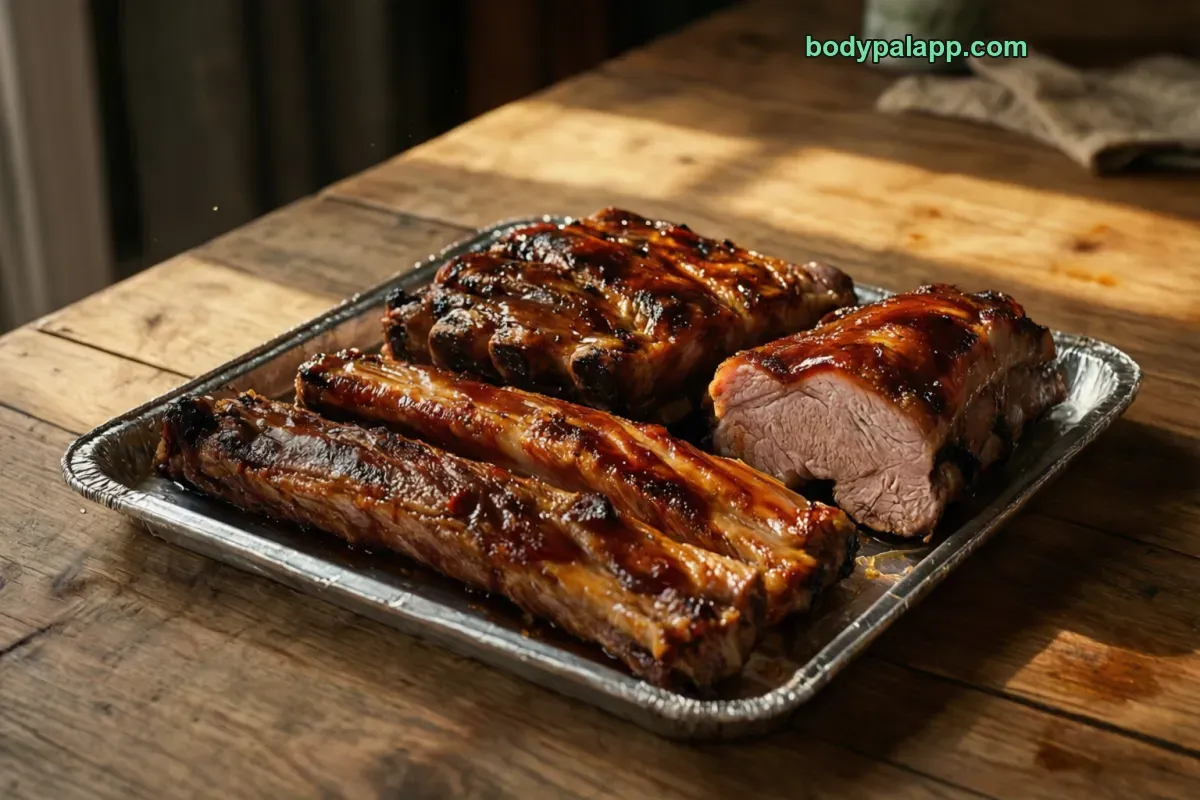
Boneless pork ribs calories come to 305 for a 4 oz portion (113 g) and 270 per 100 g, for country-style ribs roasted with the lean and fat eaten together. Fat supplies 61% of those calories, so how much you trim and how many pieces land on the plate move the total more than anything else.
305kcal
1 4 oz portion · 113 g, country-style, roasted
39%protein
30 gProtein
0 gCarbs
21 gFat
How to burn off 305 kcal
—Walking, brisk
—Jogging
—Cycling, moderate
—Swimming
Skip the math. BodyPal counts these calories from your steps and workouts automatically.
Nutrition facts
Country-style, roasted · per 113 g
Calories
305 kcal
Protein
30 g
Carbohydrate
0 g
Fat
21 g
Saturated fat
7.4 g
Cholesterol
108 mg
Sodium
79 mg
Potassium
498 mg
Iron
1 mg
Source: USDA FoodData Central
🛡️
Verified nutrition data
Numbers on this page come from USDA FoodData Central, the U.S. Department of Agriculture’s food composition database, and from manufacturer labels where a branded product is named. Last verified September 2026. How we verify our data →
Boneless pork ribs: calories, protein and sodium by serving
Percent of daily value uses the FDA reference of 2,000 kcal a day.
Serving
kcal
Protein
Carbs
Fat
Sodium
% DV kcal
4 oz portion (113 g)
305
29.8 g
0 g
20.7 g
79 mg
15%
1 rib, braised (86 g)
235
22.8 g
0 g
15.2 g
50 mg
12%
Lean only, 4 oz (113 g)
247
33 g
0 g
12.9 g
81 mg
12%
100 g
270
26.4 g
0 g
18.3 g
70 mg
14%
3 × 4 oz portion (113 g)
915
89.5 g
237 mg
5 × 4 oz portion (113 g)
1,526
149.2 g
396 mg
A 4 oz portion is 305 calories, and seconds add up fast
The reference here is USDA country-style ribs, boneless and roasted, with lean and fat eaten together. A 4 oz portion (113 g) lands at 305 calories, 15% of the daily value. One braised rib of 86 g comes to 235 calories, or 12% of the day. Those are honest, moderate numbers for a single serving of meat.
Ribs are rarely served in tidy 4 oz portions, though. Two portions (226 g) reach 610 calories, three (339 g) hit 915, and a platter equal to five portions (565 g) climbs to 1,526 calories. Sodium stays modest the whole way, only 396 mg even at the largest amount, so the number that scales is calories, not salt.
The simplest control is counting pieces before you eat rather than after. Plate one portion, then decide on more once it is gone. If you are tracking a restaurant plate, BodyPal can log the food from a photo, which beats guessing at a pile of sauced meat.
Fat supplies 61% of the calories, protein the rest
Per 100 g, these ribs carry 26.4 g of protein, 18.3 g of fat and zero carbohydrate. Because fat packs more energy per gram, it supplies 61% of the calories while protein covers the other 39%. There is no sugar and no fiber in the meat itself.
That protein is still serious. A 4 oz portion delivers 29.8 g, which is 60% of the 50 g daily value used here, and a single braised rib gives 22.8 g. Few foods hand you that much protein with no carbs at all.
If protein per calorie is your goal, the lean-only cut is the better buy. A 4 oz portion of lean meat with the fat trimmed has 247 calories and 33 g of protein, 66% of the daily value. Trimming takes the fat from 20.7 g to 12.9 g per 4 oz portion. That knife work is the biggest single lever on this food, bigger than switching to another pork cut.
Saturated fat and cholesterol are the rows to watch
Of the 18.3 g of fat in 100 g, 6.6 g is saturated. Against the 20 g daily value, that is about a third of the day's amount from a modest serving, and a heaping plate takes you much closer to the full figure.
Cholesterol sits at 96 mg per 100 g, close to a third of the 300 mg daily value. If you track either row, the lean-only portion is the better pick, since most of the gap between it and the standard portion is fat. Cutting away visible fat at the table works the same way.
Sodium is the surprise in the other direction. Plain roasted meat has just 70 mg per 100 g, 3% of the daily value, and 79 mg in a 4 oz portion. Potassium, at 441 mg per 100 g, outweighs it several times over. In a typical rib dinner, the salt comes from rubs and sauce rather than the pork.
Sauce and sides decide the rest of the plate
The figures on this page are for plain roasted meat, with 0 g of carbs and 0 g of sugar. Packaged versions such as Butcher's Prime Boneless Pork Ribs in BBQ Sauce or Tony Roma's Boneless Pork Ribs in Teriyaki Sauce come glazed, and a glaze brings sugar and sodium the meat does not have. For those packs, read the label instead of using the plain numbers.
Because the meat has no fiber and leans on fat for most of its calories, the sides do the balancing. Vegetables, a slaw with a light dressing or a plain grain add bulk and fiber without much fat. Buttery, cheesy sides stack more fat onto a plate that already has plenty.
A sensible frame: settle on one 4 oz portion or one braised rib, then build the rest of the plate around it. At 305 or 235 calories, either leaves room for generous sides in most days of eating.
How does boneless pork ribs compare?
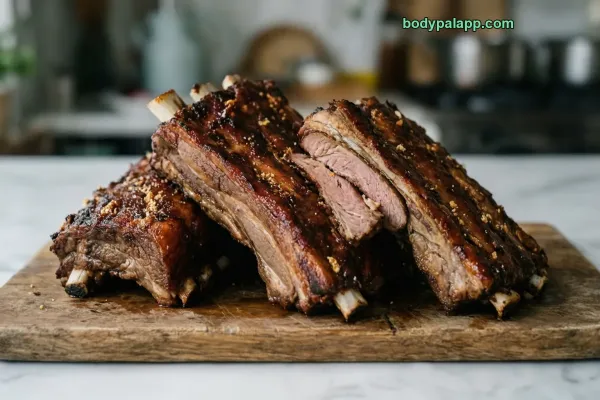
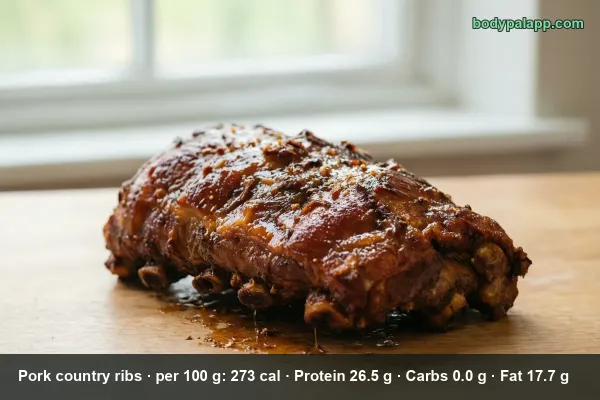
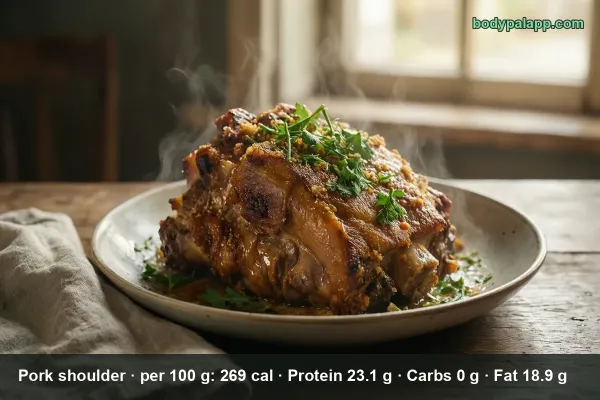
Here is how boneless pork ribs stack up against ribs with bone, pork country ribs and pork shoulder, per 100 g and per usual serving.
Verdict: On calories it is a tie: 270 per 100 g here, 273 for ribs with bone or country ribs, and 269 for pork shoulder. For the most protein per bite pick ribs, at 26.5 g per 100 g versus 23.1 g in shoulder, and if sodium matters the bone-in rib's 58 mg is the lowest on the board.
Most popular boneless pork ribs brands in the United States
Ranked by popularity in the BodyPal database
# Productkcal / 100 g
1Signature Select Boneless Pork Ribs5 oz · 140 g207 kcal
4Butcher's Prime Boneless Pork Ribs in BBQ Sauce5 oz · 140 g193 kcal
5Tony Roma's Boneless Pork Ribs in Teriyaki Sauce5 oz · 140 g200 kcal
6Big Shoulders Boneless Pork Ribs in Original BBQ Sauce5 oz · 140 g214 kcal
7Marketside Boneless Pork Ribs in BBQ Sauce5 oz · 140 g207 kcal
Packaged boneless ribs are mostly sold precooked in sauce, so their labels count the sauce weight and read lower than the plain roasted number above. Source: manufacturer labels / USDA FoodData Central.
Boneless pork ribs FAQs
How many calories are in boneless pork ribs?
A 4 oz portion of roasted boneless pork ribs is about 305 calories. One braised rib without bone (86 g) is about 235 calories.
Are boneless pork ribs good for weight loss?
They have 270 calories, 26.4 g protein and 18.3 g fat per 100 g roasted. Trimmed to lean only, the same 100 g is 219 calories.
Boneless vs bone-in pork ribs: which has fewer calories?
Roasted boneless ribs have 270 calories per 100 g of meat, while bone-in country-style ribs roasted with fat have 359 calories per 100 g of meat.
How much protein is in boneless pork ribs?
A 4 oz portion has about 29.8 g of protein and 20.7 g of fat, with 0 g carbs. Per 100 g it is 26.4 g protein.
How many calories are in one pork rib?
One braised rib of 86 g has 235 calories, with 22.8 g of protein and 15.2 g of fat. That is 12% of the daily calorie value. Bigger, meatier ribs scale up from there, so weigh one if you can.
How many calories are in pork ribs with bone per 100 g?
Pork ribs with bone come to 273 calories per 100 g, with 26.5 g of protein and 17.7 g of fat. That is nearly the same as the 270 per 100 g for boneless, since the meat is essentially the same.
What are the nutrition facts for 100 g of pork ribs?
100 g of boneless pork ribs has 270 calories, 26.4 g of protein, 18.3 g of fat (6.6 g saturated) and 0 g of carbs. It also carries 70 mg of sodium, 96 mg of cholesterol and 441 mg of potassium.
How many calories are in boneless spare ribs?
The closest match in this data is country-style boneless ribs, at 270 calories per 100 g and 305 per 4 oz portion. Sauced restaurant or frozen ribs can run higher, since the glaze adds sugar the plain meat lacks.