
How Many Calories Are in Pork Shoulder?
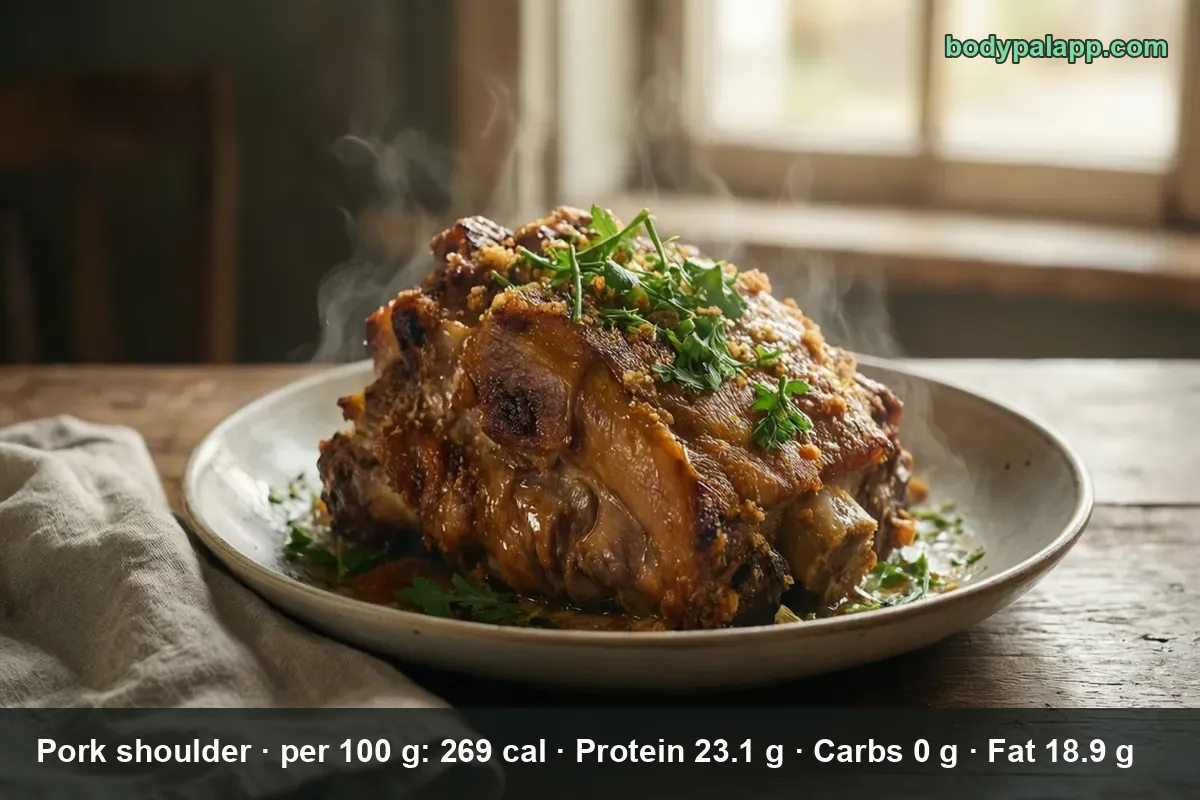
A 3 oz portion of roasted pork shoulder is 229 calories, which works out to 269 per 100 g. That is a Boston butt cooked the way people actually eat it, fat cap and marbling included. Raw, the same cut reads much lower: 210 calories in 4 oz (113 g). A cup of pulled shoulder with no sauce lands at 336.
On this page
- Pork shoulder quick facts
- Why cooking raises the number
- Boston butt or picnic: two cuts with one name
- US serving sizes, ounce by ounce
- What a whole 8-pound butt adds up to
- Steaks, pulled pork and the fat cap
- Sodium: fresh versus cured
- Thiamin, selenium and the saturated fat line
- How does pork shoulder compare?
- Most popular pork shoulder brands
- Pork shoulder FAQs
Pork shoulder quick facts
The reference row here is USDA SR Legacy 168259, "Pork, fresh, shoulder, blade, boston (roasts), separable lean and fat, cooked, roasted." Lean and fat, not trimmed, because that is what comes off a slow-roasted butt and onto the plate.
| Nutrient | Per 100 g | Per 3 oz (85 g) | % Daily Value |
|---|---|---|---|
| Calories | 269 cal | 229 cal | — |
| Total fat | 18.86 g | 16.0 g | 21% |
| Saturated fat | 6.97 g | 5.9 g | 30% |
| Carbohydrate | 0 g | 0 g | 0% |
| Protein | 23.11 g | 19.6 g | 39% |
| Sodium | 67 mg | 57 mg | 2% |
| Cholesterol | 86 mg | 73 mg | 24% |
| Potassium | 332 mg | 282 mg | 6% |
% Daily Value is based on a 2,000-calorie diet.
Verified nutrition data
Numbers on this page come from USDA FoodData Central, the U.S. Department of Agriculture’s food composition database, and from manufacturer labels where a branded product is named. Last verified September 2026. How we verify our data →
Two rows are missing on purpose. Fiber and total sugars both sit at zero in the USDA record, exactly as carbohydrate does, and three consecutive zeros tell you nothing. So here is the sentence instead of the rows: pork shoulder has no carbohydrate at all, which means no fiber and no sugar of any kind. For anyone eating low-carb, the entire calorie count is protein and fat.
Run the check yourself if you like. Using the USDA energy factors for pork, 23.11 g of protein at 4.27 plus 18.86 g of fat at 9.02 gives 268.8, and the database says 269.
Why cooking raises the number
This is the mistake that costs people the most calories, and it hides inside a true statement: cooking does not add calories to meat.
USDA records the same blade steak in both states. Raw and boned out, it weighs 288 g and carries 536 calories. Braised, the same steak is down to 185 g and 494 calories. Mass fell by 36%. Calories fell by 8%, because some fat rendered out into the pan.
But the number per 100 g went the other way, and it went hard: 186 calories raw, 267 cooked. That is a jump of 44%, and nothing was added. Water left, so everything that stayed behind got more concentrated.
The practical rule falls out of it. If you weigh your pork after it comes out of the oven, you have to log it against a cooked value. Weigh a 6 oz piece of finished roast, log it as raw shoulder, and you have just undercounted by more than 40%. The reverse error is just as common in the other direction on the scale at the store.
Boston butt or picnic: two cuts with one name
Recipe sites publish one calorie figure for "pork shoulder." USDA publishes two, and they are 40 calories apart per serving.
The shoulder is split at the butcher counter. The upper half is the Boston butt, sold as roasts and as blade steaks, and roasted it runs 269 calories per 100 g, or 229 per 3 oz. The lower half is the arm picnic, the piece with the shank and the heavy fat cap, and roasted it runs 317 per 100 g, or 269 per 3 oz.
Buy a whole untrimmed shoulder with both halves attached and USDA splits the difference at 292 calories per 100 g. That is not an average of the other two, it is its own record for a different piece of meat.
So the honest answer to "how many calories in pork shoulder" depends on which end of the animal is in your cart. Butt is the leaner half by a clear margin, and it is also the half most people are cooking, since it is what gets sold as a roast for the smoker and the slow cooker.
US serving sizes, ounce by ounce
Everything below is the roasted Boston butt at 269 calories per 100 g. Gram weights for the ounce measures and for the yield row come from the USDA portion table for the same record.
| Portion | Weight | Calories |
|---|---|---|
| 1 oz cooked | 28 g | 75 cal |
| 3 oz cooked, the standard serving | 85 g | 229 cal |
| 4 oz cooked | 113 g | 304 cal |
| 6 oz cooked, a generous plate | 170 g | 457 cal |
| 1 cup diced or shredded | 135 g | 363 cal |
| Meat from 1 lb raw bone-in butt | 262 g | 705 cal |
| 4 oz raw, the package label serving | 113 g | 210 cal |
The cup is the trap. USDA weighs a cup of diced or shredded roast pork at 135 g, so "a cup of pulled shoulder" is 363 calories, 59% more than a 3 oz serving. A cup is not a portion, it is about a portion and a half. Both the FNDDS records for cooked pork agree on that 135 g cup weight, which is why the figure is worth trusting.
The raw row is there because it is what the sticker on the package uses. A 4 oz raw serving of blade steak is 210 calories (USDA 167849); the same 4 oz once cooked is 304. Different weights of meat, same words on the label.
If you want the MyPlate framing, 3 oz of cooked shoulder counts as three ounce-equivalents of protein foods, roughly half of what an adult is pointed toward in a day.
What a whole 8-pound butt adds up to
Nobody publishes this number, and anyone standing over a smoker on a Saturday needs it.
USDA gives a yield row for the reference record: one pound of raw bone-in Boston butt cooks down to 262 g of edible meat, which is 705 calories. The bone and the rendered fat account for the rest.
Scale that to the 8 lb butt that supermarkets and warehouse clubs sell and you get roughly 5,640 calories of finished pork, about 2,096 g of meat, or 24 servings of 3 oz. Feed six people and each one is eating four servings' worth if the pan comes back empty.
That also tells you what a pound of raw shoulder is worth before it hits heat: 844 calories for a boneless pound, and 1,070 for a pound of whole untrimmed shoulder. Cook temperature does not change any of it, though food safety does: USDA FSIS puts fresh pork at 145°F internal with a three-minute rest, and a low-and-slow butt runs far past that on its way to pulling apart.
Steaks, pulled pork and the fat cap
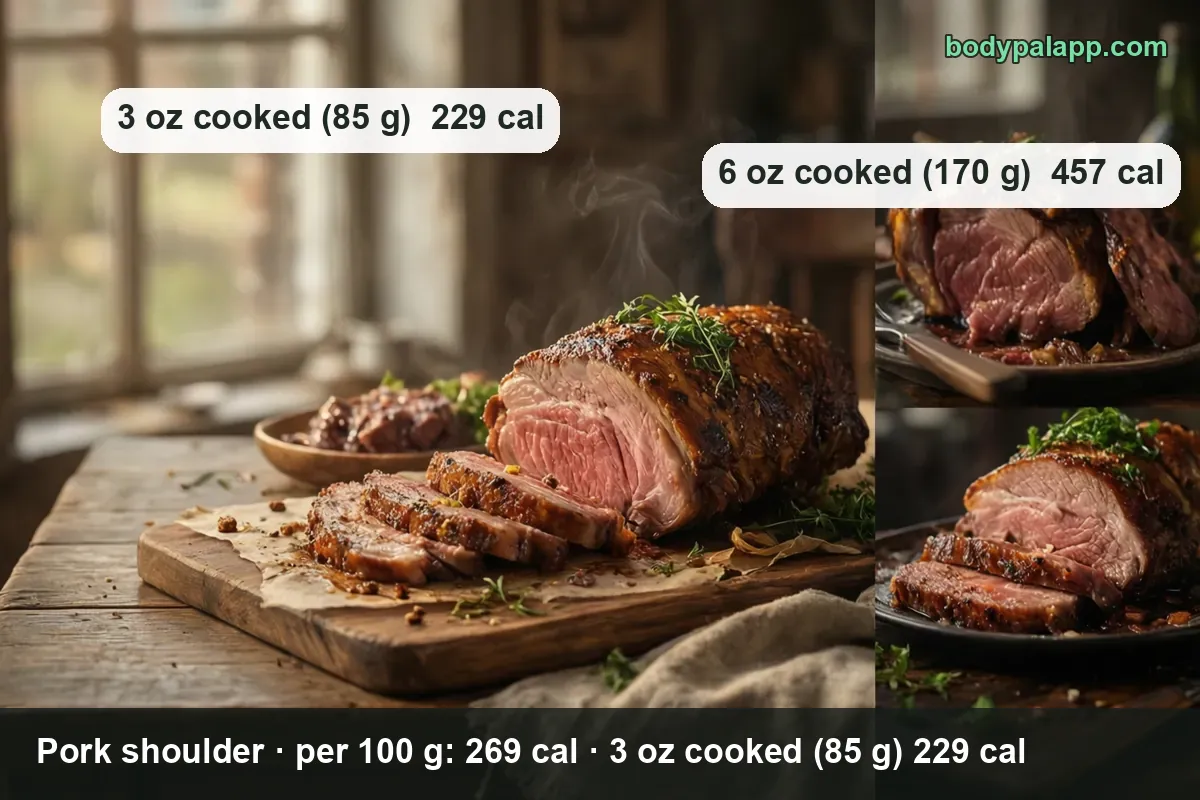
Shoulder steak. A typical blade steak, broiled, comes off the grill at 169 g of boneless meat and 438 calories at 259 per 100 g. Braise it instead and the density climbs to 267 per 100 g, since braising holds fat in that broiling drips away. Steak weights in the USDA data vary a lot, so pin your number to the weight on your plate rather than to the word "steak."
Pulled, no sauce. The FNDDS record for barbecue pork without sauce runs 249 calories per 100 g, a little under the plain roast because more fat renders out over a long cook.
| Pulled shoulder, no sauce | Weight | Calories | Sodium |
|---|---|---|---|
| 3 oz | 85 g | 212 cal | 359 mg (16% DV) |
| 1 cup | 135 g | 336 cal | 570 mg (25% DV) |
| 1 slice | 60 g | 149 cal | 253 mg (11% DV) |
Sauce is a separate question with a separate answer, and a large one: the sauced version of the same USDA record picks up 12.23 g of carbohydrate and 181 mg of sodium per 100 g.
Trimming pays, and it does not cost protein. Cut the visible fat off after roasting and USDA's lean-only record puts a 3 oz serving at 197 calories with 20.6 g of protein, against 229 calories and 19.6 g for lean and fat. That is 14% fewer calories and a gram more protein, because the only thing leaving the plate is fat. Saturated fat drops from 5.9 g to 4.4 g, or 30% of the Daily Value down to 22%.
About that crackling. USDA has no record for roasted skin on a fresh shoulder. "Separable lean and fat" is defined without skin, and the packaged pork-skin snack in the database is a puffed, fried product with 544 calories and 1,818 mg of sodium per 100 g, which is not what comes off your roast. The closest honest figure is the USDA row for cooked pork fat at 626 calories per 100 g, so about 175 calories for a 1 oz shard of fat cap and skin. Add that to a serving and 3 oz of roast plus 1 oz of crackling is roughly 404 calories — a figure built from two USDA rows rather than read off one, which is why it is an estimate and the rest of this page is not.
Sodium: fresh versus cured
Fresh pork shoulder is one of the lowest-sodium things at the meat counter. A 3 oz serving carries 57 mg, which is 2% of the Daily Value. You could eat a pound of it and still be under 300 mg.
Cure the same muscle and the picture inverts. The USDA record for cured shoulder blade roll, roasted, holds 973 mg of sodium per 100 g against 67 mg for the fresh roast, about fourteen times as much. A 3 oz serving of that would be 827 mg, or 36% of the day, from meat that started out nearly sodium-free. Smoked picnic shoulders from the deli case sit in the same range.
The salt is not in the pig. It goes in during processing, and it is the single biggest nutritional difference between the roast you cook and the smoked shoulder you buy ready to eat. If sodium is the number you watch, buying the cut fresh and salting it yourself is the whole fix.
Thiamin, selenium and the saturated fat line
Protein gets the attention on a pork page, and 19.6 g in 3 oz at 39% of the Daily Value is respectable. Two micronutrients quietly beat it.
| Nutrient | Per 3 oz (85 g) | % Daily Value |
|---|---|---|
| Thiamin (B1) | 0.542 mg | 45% |
| Selenium | 29.2 mcg | 53% |
| Zinc | 3.37 mg | 31% |
| Vitamin B12 | 0.75 mcg | 31% |
| Niacin (B3) | 3.45 mg | 22% |
| Vitamin B6 | 0.196 mg | 12% |
| Iron | 1.23 mg | 7% |
Values are against the FDA Daily Values used on the Nutrition Facts label. Pork is the richest everyday source of thiamin in the American diet, and one serving covers half a day of selenium.
The number that deserves a second look is not calories. A 3 oz serving is 229 calories, about 11% of a 2,000-calorie day, which is unremarkable. Its 5.9 g of saturated fat is 30% of the Daily Value, and a 6 oz plate takes that to 59% — nearly the whole day's allowance from one dish. That is the figure to plan the rest of the day around, and it is also the argument for trimming after the roast rests.
How does pork shoulder compare?
All five rows are USDA records for cooked meat, lined up at the same 3 oz serving.
| Cooked cut | Per 100 g | Per 3 oz (85 g) | Protein per 3 oz | Fat per 3 oz |
|---|---|---|---|---|
| Pork shoulder (Boston butt), roasted | 269 cal | 229 cal | 19.6 g | 16.0 g |
| Pork tenderloin, roasted | 147 cal | 125 cal | 22.1 g | 3.4 g |
| Pork loin blade roast, bone-in, roasted | 254 cal | 216 cal | 20.6 g | 14.2 g |
| Beef chuck arm pot roast, braised | 302 cal | 257 cal | 25.6 g | 16.3 g |
| Chicken thigh, meat and skin, roasted | 232 cal | 197 cal | 19.8 g | 12.5 g |
Our take: if the goal is protein per calorie, tenderloin wins and it is not close, with 125 calories carrying more protein than shoulder's 229. If the goal is a roast that shreds, stays moist for hours and feeds a crowd, shoulder earns its 229 and chuck roast is the only cut here that costs more. Chicken thigh with the skin on is the surprise of the table, landing 32 calories under pork shoulder for nearly identical protein.
Most popular pork shoulder brands in the United States
Ranked by how widely each product appears among foods sold in the United States, from the BodyPal food database of over 3.3 million products. Calories are the figures printed on each Nutrition Facts label, checked against USDA FoodData Central.
| Product | Calories (per 100 g raw) |
|---|---|
| Prairie Fresh Boneless Pork Shoulder Butt | 232 cal |
| IBP Boneless Pork Shoulder Picnic Cushion Meat (Tyson) | 196 cal |
| IBP Bone-In Pork Shoulder Butt Roast (Tyson) | 188 cal |
| Kroger Boneless Pork Butt Country Style Ribs | 188 cal |
| Farmer John Boneless Pork Shoulder Butt | 188 cal |
Brand popularity: BodyPal food database. Nutrition: manufacturer labels / USDA FoodData Central.
Pork shoulder FAQs
Why does the calorie number go up when you cook pork shoulder?
Because water leaves the meat and the calories concentrate. USDA gives the same blade steak at 288 g raw and 185 g braised, so mass drops 36% while calories fall only 8%. Per 100 g the value climbs from 186 to 267, a 44% jump with nothing added to the pan.
How many calories are in pork shoulder?
269 calories per 100 g of roasted Boston butt, or 229 calories in a 3 oz (85 g) serving with the fat left on. That serving carries 19.6 g of protein, 16.0 g of fat and no carbohydrate. Trimmed of visible fat after roasting, the same 3 oz is 197 calories.
How many calories in a pork shoulder roast?
705 calories for the meat from one pound of raw bone-in Boston butt, which cooks down to 262 g. An 8 lb butt therefore yields roughly 5,640 calories of finished pork, about 24 servings of 3 oz. A cup of the shredded result is 363 calories.
How many calories in a pork shoulder steak?
438 calories for a broiled blade steak of 169 g boneless, at 259 calories per 100 g. Braised instead of broiled, the same cut runs 267 per 100 g because less fat drips away. Steak weights vary widely, so match the number to what your scale says.
How many calories in 4 oz of raw pork shoulder?
210 calories in 4 oz (113 g) of raw blade steak, at 186 per 100 g. That is the serving printed on most packages. Cooked, 4 oz of the same meat is 304 calories, because the piece you weigh after roasting has lost water.
How many calories in 1 cup of pulled pork shoulder with no sauce?
336 calories per cup (135 g), using the USDA record for barbecue pork without sauce at 249 per 100 g. That cup also carries 570 mg of sodium, 25% of the Daily Value. A 3 oz portion of the same pulled pork is 212 calories.
How much protein is in pork shoulder?
19.6 g in a 3 oz serving, which is 39% of the Daily Value, or 23.11 g per 100 g. Trimming the visible fat after cooking raises it slightly to 20.6 g while cutting calories from 229 to 197. Pork tenderloin does better per calorie at 22.1 g for 125 calories.
Is pork shoulder healthy?
The sodium is very low at 57 mg per 3 oz, only 2% of the Daily Value, and one serving supplies 45% of the day's thiamin and 53% of its selenium. The catch is saturated fat: 5.9 g per serving is 30% of the Daily Value, and a 6 oz plate reaches 59%. Trimming after roasting brings that down to 22%.
Similar foods
- Ham Hock — 228 cal per hock
- Beef Tenderloin — 278 cal per steak
- Chicken Tenders — 136 cal per tender
- Lamb Shoulder — 227 cal per 3 oz portion
- Chicken Egg Roll — 170 cal per egg roll
- Ground Beef Patty — 231 cal per medium patty
Count it without the math
Point the camera at the plate and BodyPal works out whether that is 3 oz or a cup and a half of pulled shoulder.


How long does it take to burn off pork shoulder?
3 oz cooked (85 g), roasted Boston butt is 229 kcal. Enter your weight and the amount you ate to see how long it takes you to burn that off:
lb
| Activity | Time to burn 229 kcal |
|---|---|
| Walking, brisk | 46 min |
| Cycling, moderate | 29 min |
| Swimming, moderate | 33 min |
| Jogging | 27 min |
| Weight training, moderate | 51 min |
Times are for a 155 lb adult at a steady pace; change the weight to see yours. The amount is set to the portion in the text (85 g); change it to what you actually ate. BodyPal works this out from your steps automatically.
One food is easy to picture; a whole day is harder. See how many calories you need a day and what a deficit actually looks like.