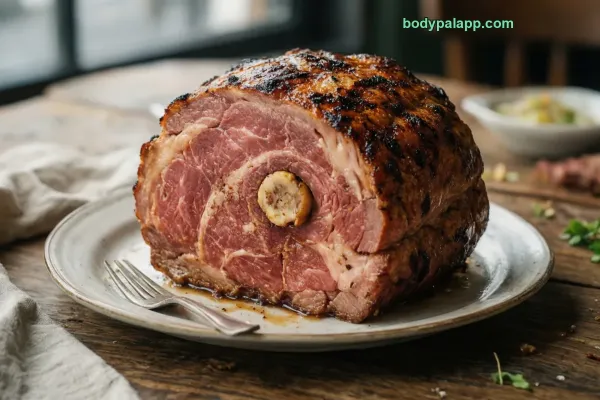
Ham hock calories come to 228 for one cooked hock (85 g) and 268 per 100 g. What stands out is the balance: fat supplies 77% of those calories, and a single hock already carries 884 mg of sodium, 38% of the daily value, before anything else goes into the pot.
228kcal
1 ham hock · 85 g, cooked
22%protein
12.4 gProtein
1 gCarbs
19.4 gFat
How to burn off 228 kcal
—Walking, brisk
—Jogging
—Cycling, moderate
—Swimming
Skip the math. BodyPal counts these calories from your steps and workouts automatically.
Nutrition facts
Cooked · per 85 g
Calories
228 kcal
Protein
12.4 g
Carbohydrate
0.9 g
Fat
19.4 g
Saturated fat
6.9 g
Cholesterol
51 mg
Sodium
884 mg
Potassium
218 mg
Iron
0.6 mg
Source: USDA FoodData Central
🛡️
Verified nutrition data
Numbers on this page come from USDA FoodData Central, the U.S. Department of Agriculture’s food composition database, and from manufacturer labels where a branded product is named. Last verified September 2026. How we verify our data →
Ham hock: calories, protein and sodium by serving
Percent of daily value uses the FDA reference of 2,000 kcal a day.
Serving
kcal
Protein
Carbs
Fat
Sodium
% DV kcal
1 hock (85 g)
228
12.4 g
0.9 g
19.4 g
884 mg
11%
1 cup (140 g)
375
20.5 g
1.5 g
31.9 g
1,456 mg
19%
Pickled (117 g)
200
22.4 g
0 g
12.3 g
1,229 mg
10%
100 g
268
14.6 g
1.1 g
22.8 g
1,040 mg
13%
3 × 1 hock (85 g)
683
37.3 g
2,652 mg
5 × 1 hock (85 g)
1,139
62.2 g
4,420 mg
One hock is 228 calories, a cup of meat is 375
A single cooked hock of 85 g lands at 228 calories, about 11% of a 2000-calorie daily value. That is a moderate number for a piece of pork, and it is how most recipes use it: one hock simmered in beans, greens or soup to season the whole pot.
The total climbs fast once you eat the meat on its own. A cup of picked meat weighs 140 g and comes to 375 calories, 19% of the daily value, with 20.5 g of protein and 31.9 g of fat. Two hocks reach 456 calories, three reach 683, and five come to 1,139.
The practical takeaway is simple. If the hock flavors a pot that feeds several people, each bowl carries only a share of those calories. If you strip the meat and eat it as the main protein, count it like a fatty cut, because a cup is closer to a full meal than a side.
Fat is three quarters of the calories
Per 100 g, ham hock has 22.8 g of fat, 14.6 g of protein and just 1.1 g of carbs. Turned into calories, that is 77% fat, 22% protein and 2% carbs. This is a fat-led food that happens to contain protein, not a lean protein source.
Saturated fat is 8.1 g per 100 g, set against a daily value of 20 g, so a generous serving takes a real bite out of that line. Cholesterol is 60 mg per 100 g against a daily value of 300 mg. Fiber is 0 and sugars are 1.1 g, which mostly reflect the cure.
Protein still counts for something. One hock gives 12.4 g, 25% of the daily value, and a cup gives 20.5 g, 41% of it. You just pay more calories for each gram than you would with a leaner ham. If protein per calorie is your goal, the hock is the wrong cut; if flavor per spoonful is the goal, it earns its place.
Sodium is the row to watch
Ham hock is cured, and the numbers show it. Per 100 g it carries 1,040 mg of sodium, 45% of the daily value. One hock brings 884 mg, or 38%, and a cup of meat brings 1,456 mg, which is 63% of the daily value in one portion.
Multiply the hocks and sodium passes the daily value quickly. Two hocks hold 1,768 mg, three hold 2,652 mg, and five hold 4,420 mg. That last figure is almost double the 2300 mg daily value, before you count any salt, stock or bacon added to the same pot.
If you watch sodium, let the hock do the seasoning and skip extra salt until the end, then taste. Potassium sits at 257 mg per 100 g, a modest amount next to the sodium, so pairing the hock with potassium-rich beans and greens is a sensible way to balance the bowl.
Pickled hock trades fat for protein
The pickled version reads differently. A 117 g serving of pickled hock comes to 200 calories with 22.4 g of protein, 45% of the daily value, plus 12.3 g of fat and 0 carbs. Compared with a cooked hock, you get more protein and less fat for fewer calories, though sodium rises to 1,229 mg, or 53% of the daily value.
Cooked hock is mostly a seasoning ingredient. It works best shared across a large pot of split peas, collards, lentils or white beans, where the fiber and bulk come from the vegetables and legumes and the hock adds smoky depth. Brands like Goodnight Brothers Carolina Cured Sliced Ham Hocks are sold for exactly that use.
When you log it, separate what you actually ate from what went into the pot. A few spoonfuls of shredded meat in a bowl of beans is a very different entry than a whole hock on the plate. BodyPal can log the dish from a photo, which helps when the meat is mixed into a soup.
How does ham hock compare?
Here is how ham hock stacks up against other ham cuts, per 100 g and per usual serving.
Verdict: For the fewest calories pick ham lunch meat at 101 per 100 g, and for the most protein per calorie pick ham steak, with 19.6 g of protein at 122 calories per 100 g. Ham hock, at 268 per 100 g and more than double the steak, belongs in the pot as a flavoring rather than on the plate as the main protein.
Most popular ham hock brands in the United States
Ranked by popularity in the BodyPal database
# Productkcal / 100 g
1Goodnight Brothers Carolina Cured Sliced Ham Hocks2 oz · 56 g196 kcal
Cured hocks are labeled in their raw, cured state, so they read lower per 100 g than the cooked meat above. Source: manufacturer labels / USDA FoodData Central.
Ham hock FAQs
How many calories are in one ham hock?
One cooked ham hock counts as an 85 g portion of meat, which is 228 calories. Per 100 g the meat is 268 calories.
Is ham hock good for weight loss?
It is one of the richer pork cuts at 268 calories per 100 g, with 22.8 g fat and 14.6 g protein per 100 g, so an 85 g hock takes 228 calories out of the day.
Ham hock vs ham slice: which has fewer calories?
Ham slice has 164 calories per 100 g against 268 for ham hock, a difference of 104 calories per 100 g.
How much protein is in a ham hock?
An 85 g ham hock has 12.4 g protein, along with 884 mg sodium and 19.4 g fat.
Is ham hock good for you?
One hock gives 12.4 g of protein, 25% of the daily value, but also 19.4 g of fat and 884 mg of sodium. It fits best as a seasoning shared across a pot of beans or greens, not as a daily lean protein.
How much sodium is in a ham hock?
One cooked hock has 884 mg of sodium, 38% of the daily value. Per 100 g it is 1,040 mg, or 45%, and a cup of meat reaches 1,456 mg, which is 63% of the daily value.
How many calories are in a cup of ham hock meat?
A cup of ham hock meat (140 g) has 375 calories, 19% of the daily value. It also brings 20.5 g of protein, 31.9 g of fat and 1,456 mg of sodium.
Does pickled ham hock have fewer calories?
Yes. A 117 g serving of pickled hock has 200 calories with 22.4 g of protein and 12.3 g of fat. Sodium is higher, though, at 1,229 mg, or 53% of the daily value.
How much fat is in ham hock?
One cooked hock has 19.4 g of fat, and 100 g has 22.8 g, of which 8.1 g is saturated. Fat supplies 77% of the calories in ham hock.