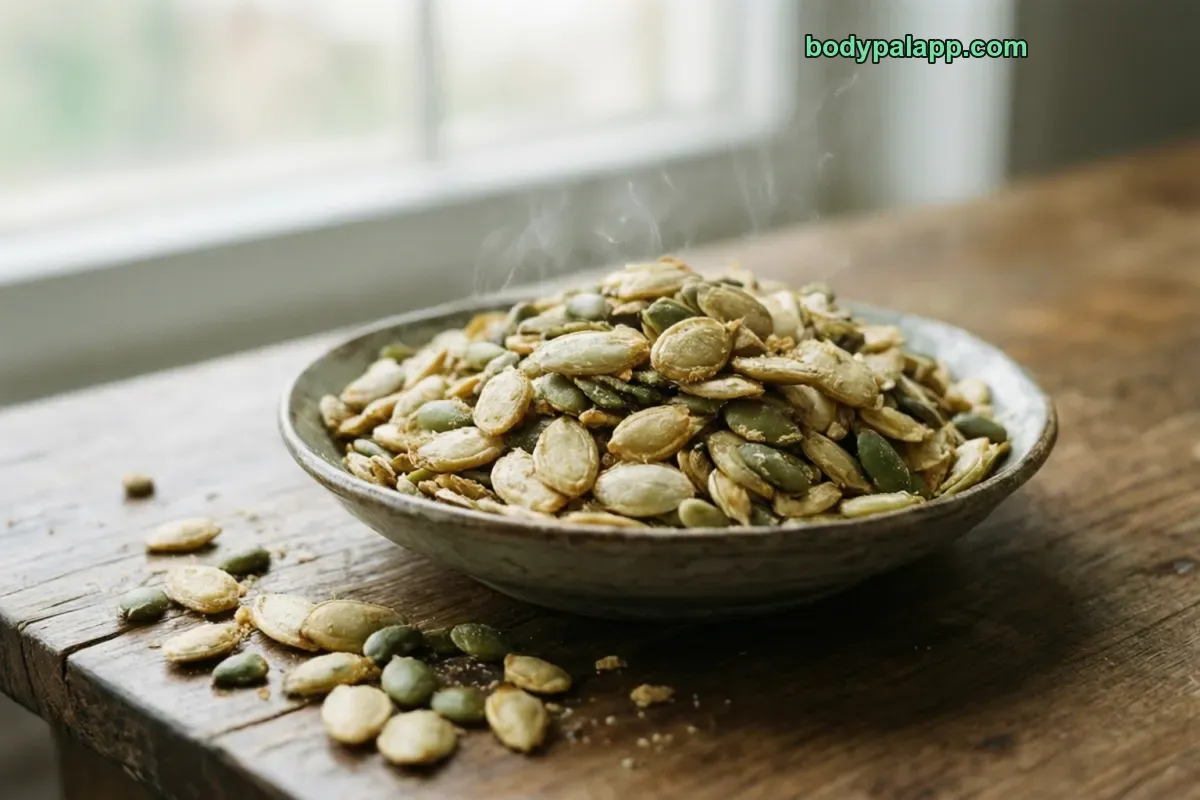
Pumpkin seeds calories come to 161 for a 1 oz (28 g) handful of roasted, unsalted kernels, and 574 per 100 g. Fat supplies 71% of those calories, so the portion, not the seed, decides whether this is a light topping or a meal's worth of energy. The protein is real, but so is the density.
161kcal
1 ounce · 28 g, kernels, roasted, unsalted
19%protein
8.4 gProtein
4 gCarbs
13.7 gFat
How to burn off 161 kcal
—Walking, brisk
—Jogging
—Cycling, moderate
—Swimming
Skip the math. BodyPal counts these calories from your steps and workouts automatically.
Nutrition facts
Kernels, roasted, unsalted · per 28 g
Calories
161 kcal
Protein
8.4 g
Carbohydrate
4.1 g
Fat
13.7 g
Saturated fat
2.4 g
Cholesterol
0 mg
Sodium
5 mg
Potassium
221 mg
Iron
2.3 mg
Source: USDA FoodData Central
🛡️
Verified nutrition data
Numbers on this page come from USDA FoodData Central, the U.S. Department of Agriculture’s food composition database, and from manufacturer labels where a branded product is named. Last verified September 2026. How we verify our data →
Pumpkin seeds: calories, protein and sodium by serving
Percent of daily value uses the FDA reference of 2,000 kcal a day.
Serving
kcal
Protein
Carbs
Fat
Sodium
% DV kcal
1 oz (28 g)
161
8.4 g
4.1 g
13.7 g
5 mg
8%
1 cup (118 g)
677
35.2 g
17.4 g
57.9 g
21 mg
34%
In shell (28 g)
125
5.2 g
15.1 g
5.4 g
5 mg
6%
100 g
574
29.8 g
14.7 g
49.1 g
18 mg
29%
3 × 1 oz (28 g)
482
25.1 g
15 mg
5 × 1 oz (28 g)
804
41.8 g
25 mg
One ounce is 161 calories, a cup is 677
The standard serving is 1 oz (28 g), and it lands at 161 calories with 8.4 g of protein and 13.7 g of fat. That is 8% of the daily value for calories and 17% of the daily value for protein. For a snack, that trade is respectable. The catch is size: an ounce fits in a cupped palm, which is why it rarely feels like enough.
The trouble starts when the bag stays open. Two ounces (56 g) bring 321 calories, three ounces (84 g) reach 482, and five ounces (140 g) climb to 804. A full cup (118 g) is 677 calories, 34% of the daily value, with 57.9 g of fat. That is a full meal's worth of energy, often eaten as a garnish or a handful while doing something else.
If you sprinkle seeds on salads, yogurt or oatmeal, weigh them once so you know what an ounce looks like in your spoon or bowl. A loose scoop drifts from one ounce toward two without any visual warning, and that single drift doubles the total from 161 to 321. The seeds did not change. The scoop did.
Fat supplies 71% of the calories
Per 100 g, roasted pumpkin seed kernels carry 49.1 g of fat, 29.8 g of protein and 14.7 g of carbs. Turn those grams into calories and fat accounts for 71%, protein for 19% and carbs for just 9%. This is a fat food with a strong protein side, not a protein food that happens to contain fat. Of that fat, 8.5 g per 100 g is saturated.
The protein is still the headline in the nuts and seeds aisle. One ounce delivers 8.4 g, and a cup reaches 35.2 g, which is 70% of the protein daily value. That makes pumpkin seeds one of the more useful ways to add protein to a plant-based plate, as long as you account for the fat that rides along with it.
Carbs barely register. Sugars are only 1.3 g per 100 g, and 6.5 g of the carbohydrate is fiber, so seeds add almost no sugar to whatever they top. If you track carbs closely, pumpkin seeds are one of the easier crunchy toppings to fit in. If you track fat or total calories, they are one of the harder ones.
Seeds in the shell log as a different food
Every number above is for hulled kernels, the flat green pepitas sold in bags. Whole seeds in the shell, the kind left over after carving a pumpkin, log differently. In the shell, 28 g comes to 125 calories, with 5.2 g of protein, 5.4 g of fat and 15.1 g of carbs.
The shell adds bulk and fiber in place of fat. The same 28 g carries 5.2 g of fiber in the shell versus 1.8 g as kernels, while calories drop from 161 to 125. Cracking or chewing through each shell also slows the pace of a snack, which makes a handful last longer than the same weight of pepitas.
If you roast your own seeds at home, pick the in-shell entry when you log them. Logging them as kernels overstates the calories and fat and understates the fiber. If you buy hulled kernels, stick with the main entry and the ounce serving, since that is how the package and this page both measure them.
Unsalted seeds barely touch sodium
Roasted without salt, an ounce of pumpkin seeds has 5 mg of sodium, which shows up as 0% of the daily value. Even a full cup stays at 21 mg, or 1%. Potassium is the bigger mineral line, at 788 mg per 100 g, and cholesterol is 0.
That picture changes with the label. Roasted and salted versions, such as Nature's Harvest Roasted & Salted Pumpkin Seeds, and seasoned ones like Nature's Eats Italian Herb Pumpkin Seeds carry sodium this entry does not show. If you watch sodium, read the package, or choose plain kernels like Nature's Promise Raw Pumpkin Seeds or Nature's Place Organic Pumpkin Seeds.
Because they are dense, pumpkin seeds work best as a topping rather than the main event. An ounce over yogurt, soup, salad or a grain bowl adds crunch and protein without taking over the plate. BodyPal can log the seeds from a photo of the bowl, but a kitchen scale is still the simplest way to keep an ounce an ounce.
How does pumpkin seeds compare?
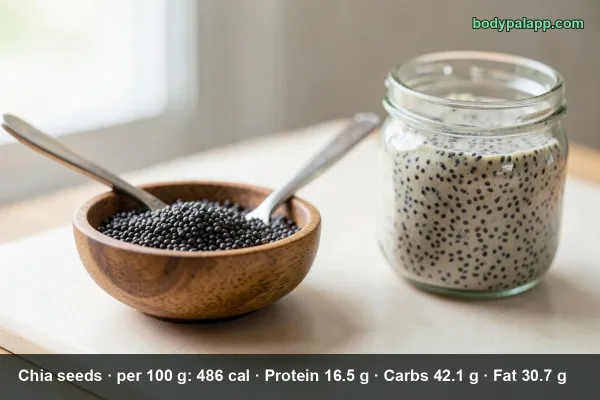
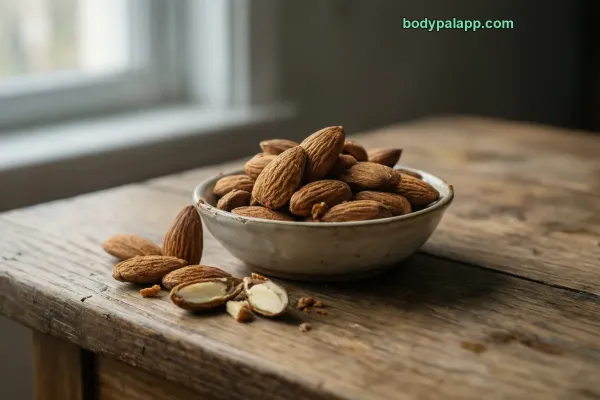
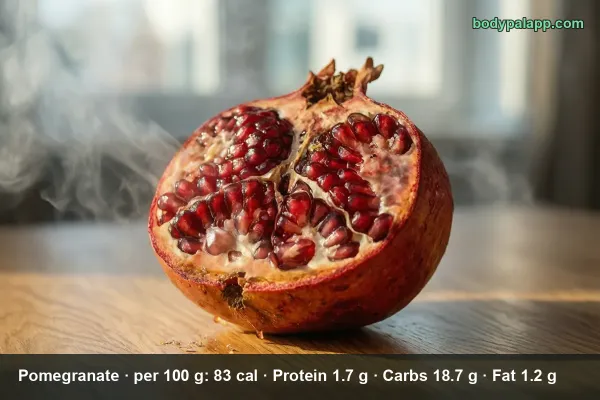
Here is how roasted pumpkin seeds stack up against chia seeds, almonds and pomegranate seeds, per 100 g and per usual serving.
Verdict: For the fewest calories pick pomegranate seeds at 83 per 100 g, though they bring only 1.7 g of protein. For protein, pumpkin seeds win with 29.8 g per 100 g against 21 g in almonds and 16.5 g in chia seeds, at nearly the same calories as almonds.
Most popular pumpkin seeds brands in the United States
Most of these packs are shelled kernels like the figures above, so their labels land near 574 calories per 100 g; products still in the shell read lower per gram. Source: manufacturer labels / USDA FoodData Central.
Pumpkin seeds FAQs
How many calories are in pumpkin seeds?
One ounce of shelled pumpkin seeds (28 g) is about 161 calories, and a full cup (118 g) is 677. Per 100 g the kernels have 574 calories.
Are pumpkin seeds good for weight loss?
They are calorie dense at 574 calories per 100 g, so a 28 g ounce costs 161 calories while a 118 g cup costs 677. The same ounce carries 8.4 g of protein and 1.8 g of fiber.
Pumpkin seeds vs chia seeds: which has more calories?
Pumpkin seed kernels have 574 calories per 100 g against 486 for chia seeds, so an ounce is 161 calories versus 136.
How much protein is in pumpkin seeds?
An ounce (28 g) has 8.4 g of protein and 13.7 g of fat. Per 100 g that is 29.84 g of protein and 49.05 g of fat.
How many calories are in one ounce of pumpkin seeds?
One ounce (28 g) of roasted, unsalted pumpkin seed kernels has 161 calories. It also brings 8.4 g of protein, 13.7 g of fat and 1.8 g of fiber, which is about 8% of the daily value for calories.
What are the nutrition facts for 100 g of pumpkin seeds?
100 g of roasted pumpkin seed kernels has 574 calories, 29.8 g of protein, 49.1 g of fat (8.5 g saturated), 14.7 g of carbs, 6.5 g of fiber and 1.3 g of sugars. Sodium is 18 mg.
Are pumpkin seeds calorie dense?
Yes. At 574 calories per 100 g, pumpkin seeds pack a lot of energy into a small volume, and 71% of those calories come from fat. A cup (118 g) reaches 677 calories, so measured portions matter.
What nutrients stand out in pumpkin seeds?
Protein and potassium. Per 100 g, pumpkin seeds have 29.8 g of protein and 788 mg of potassium, plus 6.5 g of fiber. Unsalted kernels stay low in sodium at 18 mg per 100 g.