
How many calories are in chia seeds?
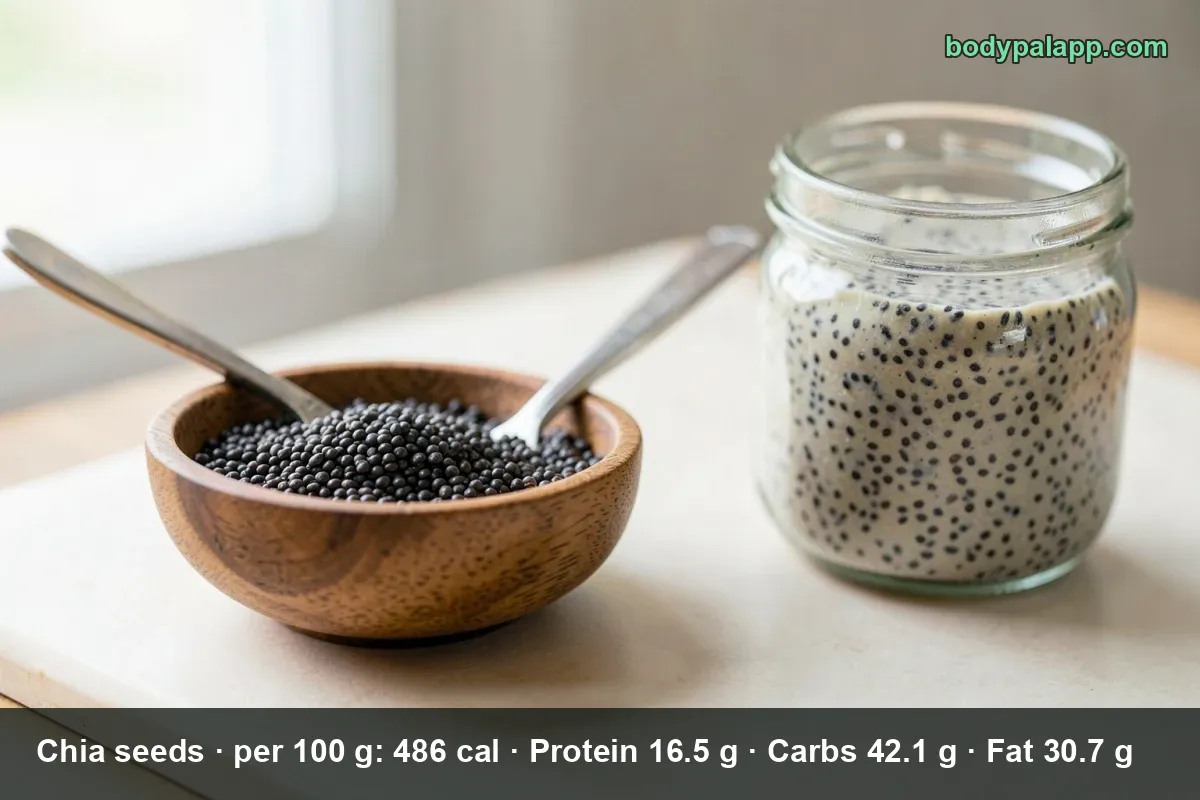
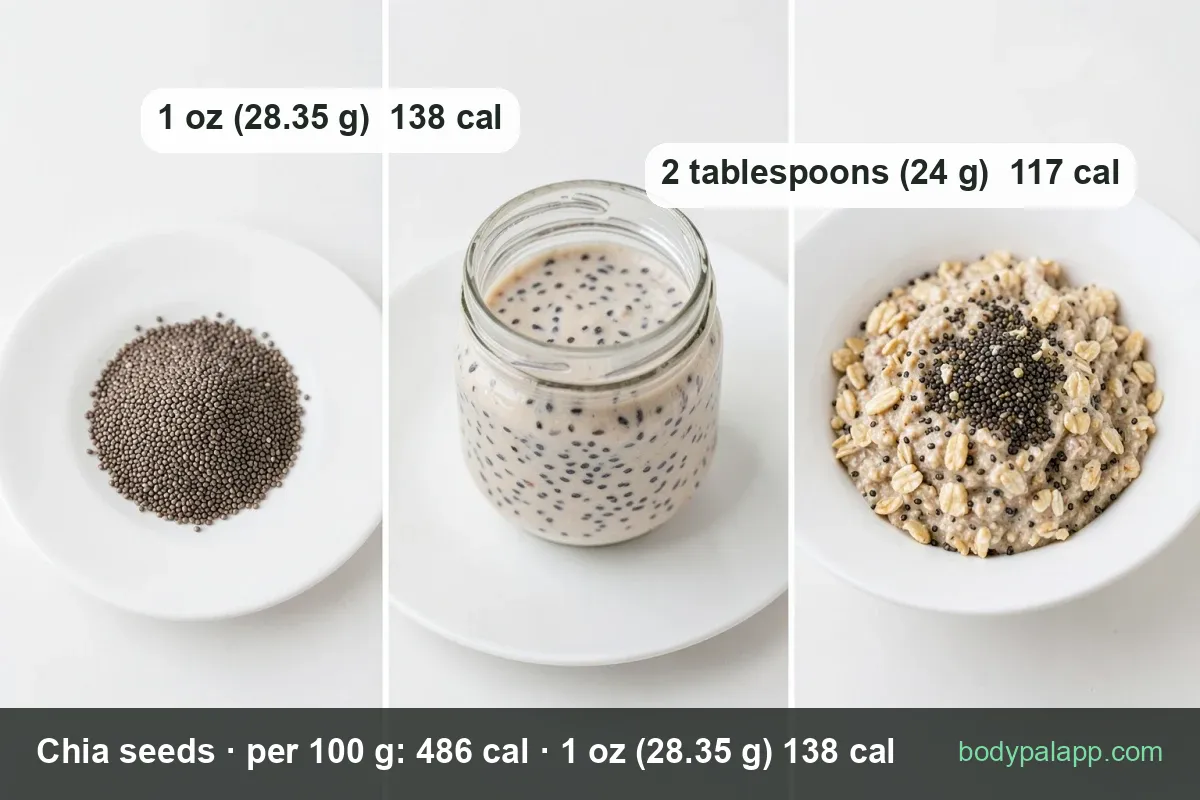
A 1 oz scoop of dry chia seeds, 28.35 g, is 138 calories. Per 100 g the seeds run 486 calories, one of the densest things in the pantry by weight. The saving grace is that almost nobody eats an ounce at once: two tablespoons is the usual pour.
On this page
- Chia seed quick facts
- US servings, from one tablespoon to a full cup
- Black chia, white chia and the other USDA rows
- Why the bag says 150 and USDA says 146
- Fiber is the row that changes the math
- How do chia seeds compare?
- Most popular chia seeds brands
- FAQ
Chia seed quick facts
The row used here is SR Legacy 170554, "Seeds, chia seeds, dried". It matches what you actually have in your hand: a bag of whole dry seeds, black or white, straight off the shelf. It also carries the complete profile — fiber, saturated fat, 0.14 g of trans fat — and it already comes with a 1 oz household measure, so the main serving below needs no scaling.
USDA has two other entries for the same seed. One is a survey record that copies these values and adds a cup measure; the other is a Foundation record with a higher calorie figure, and the section on variants explains why.
| Nutrient | Per 100 g | Per 1 oz (28.35 g) | % Daily Value |
|---|---|---|---|
| Calories | 486 | 138 | — |
| Total fat | 30.74 g | 8.7 g | 11% |
| Saturated fat | 3.33 g | 0.9 g | 5% |
| Carbohydrate | 42.12 g | 11.9 g | 4% |
| Dietary fiber | 34.4 g | 9.8 g | 35% |
| Protein | 16.54 g | 4.7 g | 9% |
| Sodium | 16 mg | 5 mg | 0% |
% Daily Value is based on a 2,000-calorie diet.
Verified nutrition data
Numbers on this page come from USDA FoodData Central, the U.S. Department of Agriculture’s food composition database, and from manufacturer labels where a branded product is named. Last verified September 2026. How we verify our data →
There is no total sugars row and no added sugars row on this page, because USDA does not publish sugar values for the dried seed in this record. The survey record puts total sugars at 1.55 g per 100 g, which works out to under half a gram in an ounce — small enough that it would round to zero on a label anyway. Cholesterol is 0 mg. Potassium is 407 mg per 100 g, or 115 mg in an ounce, 2% of the Daily Value.
US servings, from one tablespoon to a full cup
| Serving | Weight | Calories |
|---|---|---|
| 1 tablespoon | 12 g | 58 kcal |
| 2 tablespoons | 24 g | 117 kcal |
| 1 oz | 28.35 g | 138 kcal |
| 3 tablespoons | 30 g | 146 kcal |
| 1 cup | 168 g | 816 kcal |
| Per 100 g | 100 g | 486 kcal |
Only the 1 oz line and the 100 g line come from USDA directly. The tablespoon, three-tablespoon and cup rows are our own arithmetic from the USDA 100 g figure of 486, not USDA servings, using the standard 12 g tablespoon that US chia labels themselves use.
The cup row is the trap. A cup of dry chia is 816 calories — nearly six times the ounce and about seven times the two-tablespoon scoop that goes into overnight oats. Recipes that say "a cup of chia" almost always mean a cup of finished pudding, where the seeds are a fraction of the volume and the rest is milk or water. If you log a cup of seeds by mistake, you have added 700 calories that never touched your bowl.
Two tablespoons is the honest default for most people: 24 g, 117 calories, and 8.3 g of fiber by the same scaling.
Black chia, white chia and the other USDA rows
| Version | Per 100 g | Typical serving | Calories |
|---|---|---|---|
| Chia seeds, survey row | 486 kcal | 1 cup, 168 g | 816 kcal |
| Chia seeds, dry, raw (Foundation) | 517 kcal | 1 oz, 28.35 g | 147 kcal |
| Black chia, retail label (Woodstock) | 500 kcal | 3 Tbsp, 30 g | 150 kcal |
| Whole white chia, retail label (Salba) | 467 kcal | 1 Tbsp, 15 g | 70 kcal |
The survey row is the same analysis as the main record, republished with a cup measure attached, so its 100 g numbers are identical. The Foundation row is the odd one: 517 calories per 100 g, 31 more than the main record, because its energy is calculated with Atwater factors applied to the carbohydrate as a whole rather than measured after discounting the fiber. Same seed, different accounting.
Color is not a calorie question. Black and white chia come from the same plant and USDA keeps one record for both. The 467 on a white-chia bag and the 500 on a black-chia bag are label conventions, not a difference you can taste or count — the seeds are within a few calories of each other per gram.
Why the bag says 150 and USDA says 146
Pick up six US chia bags and the panels say 500, 533, 500, 500, 500 and 500 calories per 100 g. USDA says 486. On the 30 g serving three of those six bags print, that is 150 to 160 calories on the bag against 146 from the USDA row — a spread of up to 14 calories on a scoop of seeds.
The gap sits in the fiber. Chia is 34.4 g of fiber per 100 g, and how much energy you assign to fiber that passes through undigested changes the total. USDA's reference row nets some of it out; label math often does not, and then rounds to the nearest ten. Neither number is wrong. If you want one rule: log the bag's number when you are cooking from that bag, and the USDA number when you are comparing chia against other foods on this site, but do not mix them inside the same day.
Fiber is the row that changes the math
One ounce of chia delivers 9.8 g of fiber, 35% of the FDA Daily Value of 28 g. There is almost nothing else in a US kitchen that gets a third of a day's fiber into 138 calories. Even the modest two-tablespoon pour is 8.3 g, close to 30% of the day, for 117 calories.
That matters because fiber is one of the nutrients the Dietary Guidelines for Americans flag as underconsumed across nearly the whole population. If your fiber intake is the number you are trying to move, chia is efficient in a way that bran cereal and salad greens are not: it is dense, so it is expensive per gram of seed, but cheap per gram of fiber.
The rest of the profile is quieter than the marketing suggests. Protein is 4.7 g per ounce, 9% of the Daily Value — real, but a seed, not a protein food. Fat is 8.7 g per ounce at 11% DV, and only 0.9 g of that is saturated, 5% DV. Sodium is 5 mg an ounce, effectively zero, which makes chia a free ingredient if sodium is the number you watch.
One warning worth stating plainly: soaking does not change calories. Two tablespoons of dry seeds are 117 calories whether you eat them dry, stirred into yogurt, or swelled into half a jar of gel. Water has no calories. Measure the seeds before the liquid, always.
How do chia seeds compare?
| Food | Per 100 g | US serving | Calories |
|---|---|---|---|
| Chia seeds | 486 kcal | 1 oz, 28.35 g | 138 kcal |
| Trail mix with nuts and fruit | 454 kcal | 1 oz, 28.35 g | 129 kcal |
| Trail mix with pretzels or granola | 476 kcal | 1 oz, 28.35 g | 135 kcal |
| Peanut butter, reduced fat | 520 kcal | 1 oz, 28.35 g | 147 kcal |
Our take: by the ounce these four are almost interchangeable — 129 to 147 calories, a spread of 18. Chia sits in the middle at 138 and is the lightest of the group per gram except the two trail mixes. What separates it is what comes with the calories: 9.8 g of fiber per ounce and 5 mg of sodium, against 7.3 g of protein per ounce from the reduced-fat peanut butter, which is the better pick if protein is what you are chasing. For fiber, chia wins the ounce outright. For a snack you actually eat by the handful, trail mix is the honest comparison, and chia is not a snack — it is an ingredient measured in spoons.
Most popular chia seeds brands in the United States
Ranked by how widely each product appears among foods sold in the United States, from the BodyPal food database of over 3.3 million products. Calories are the figures printed on each Nutrition Facts label, checked against USDA FoodData Central.
| Product | Calories (per 100 g) |
|---|---|
| Nature's Intent Organic Chia Seeds | 500 cal |
| Nature's Earthly Choice Organic Chia Seeds | 533 cal |
| Bob's Red Mill Organic Whole Chia Seeds | 500 cal |
| Woodstock Black Chia Seeds | 500 cal |
| Chosen Foods Chia Seeds | 500 cal |
| Navitas Organics Organic Chia Seeds | 500 cal |
Brand popularity: BodyPal food database. Nutrition: manufacturer labels / USDA FoodData Central.
Chia seed FAQs
How many calories are in 1 oz of chia seeds?
One ounce is 138 calories, from the USDA record at 486 calories per 100 g. That ounce weighs 28.35 g, roughly two and a half tablespoons, and it brings 9.8 g of fiber, 4.7 g of protein and 8.7 g of fat, with only 5 mg of sodium alongside them.
How many calories are in 1 tablespoon of chia seeds?
One tablespoon of dry chia weighs 12 g and comes to 58 calories. That figure is our own arithmetic from the USDA 100 g number of 486, not a USDA serving. Two tablespoons, the amount most overnight-oats and smoothie recipes call for, is 24 g and 117 calories.
How much fiber is in a serving of chia seeds?
An ounce gives 9.8 g of fiber, 35% of the FDA Daily Value of 28 g. Two tablespoons work out to 8.3 g and a single tablespoon to 4.1 g, both scaled from the USDA figure of 34.4 g per 100 g. Very little else does that for 138 calories.
How much protein is in chia seeds?
An ounce holds 4.7 g of protein, 9% of the Daily Value, and 100 g holds 16.54 g. That is respectable for a seed but it is not a protein food: the same ounce of reduced-fat peanut butter carries 7.3 g. Treat chia's protein as a bonus on top of the fiber.
How many calories are in a cup of chia seeds?
A cup of dry seeds is 168 g and 816 calories, scaled by us from the USDA 100 g figure. That is nearly six times an ounce and about seven times a two-tablespoon scoop. If a recipe mentions a cup of chia, check whether it means dry seeds or finished pudding.
Do soaked chia seeds have fewer calories than dry?
No, the calories are identical: 117 for two tablespoons whether dry or soaked, because water adds none. Soaking makes 24 g of seeds swell into a jar of gel, but the seed weight has not changed. Weigh or spoon the seeds dry, before the liquid goes in, and log that number.
Why does the package say more calories than USDA?
US chia bags print 500 to 533 calories per 100 g against USDA's 486, which is 150 to 160 per 30 g serving instead of 146. The difference is how the energy in 34.4 g of fiber is counted, plus label rounding. Use one source consistently rather than mixing them.
Are black and white chia seeds different in calories?
Not meaningfully: USDA keeps a single record at 486 calories per 100 g for both. Retail panels vary a little by brand — a black chia bag lists 500 per 100 g and 150 per 3 Tbsp, a white chia bag 467 per 100 g and 70 per 1 Tbsp — but that is label convention, not seed color.
Similar foods
- Corn Nuts — 126 cal per oz
- Sesame sticks — 151 cal per oz
- Watermelon Seed — 156 cal per ounce
- Cashew Nuts — 163 cal per oz
- Cashews — 161 cal per oz
- Honey Roasted Peanuts — 161 cal per oz
Count it without the math
Point the camera at the jar and BodyPal counts the spoonful for you, before the water goes in.


How long does it take to burn off chia seeds?
A 1 oz (28.35 g) serving is 138 kcal. Enter your weight and the amount you ate to see how long it takes you to burn that off:
lb
| Activity | Time to burn 138 kcal |
|---|---|
| Walking, brisk | 28 min |
| Cycling, moderate | 17 min |
| Swimming, moderate | 20 min |
| Jogging | 16 min |
| Weight training, moderate | 31 min |
Times are for a 155 lb adult at a steady pace; change the weight to see yours. The amount is set to the portion in the text (28.35 g); change it to what you actually ate. BodyPal works this out from your steps automatically.
Want the bigger picture? Calculate your daily calorie needs — your maintenance figure, a target for losing or gaining, and the date you get there.