
How Many Calories Are in Sesame Sticks?
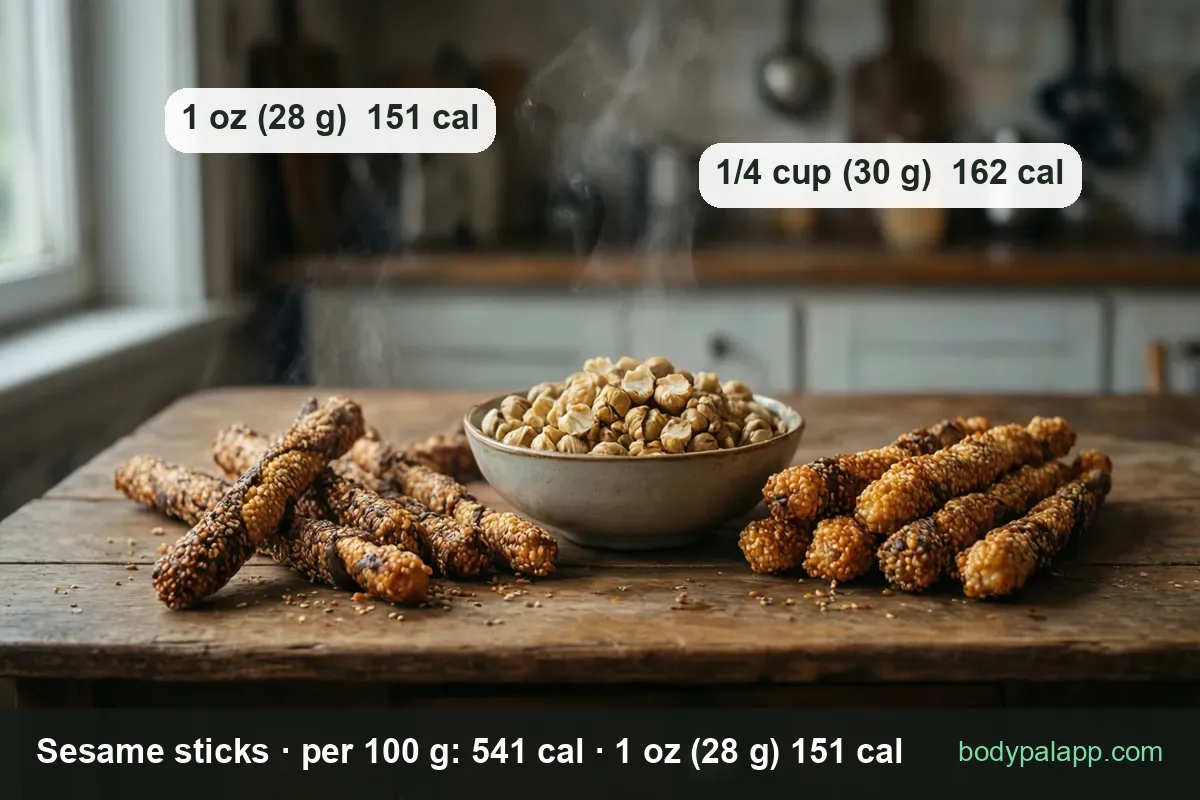
A 1 oz (28 g) handful of salted sesame sticks is 151 calories, or 541 calories per 100 g. The quarter-cup scoop many American labels use is a little heavier at 30 g, which puts it at 162 calories. The figure almost nobody checks is sodium: 417 mg in that single ounce, 18% of a day.
On this page
- Sesame stick quick facts
- The ounce, the quarter cup and the handful
- Salted, unsalted and honey roasted
- The sodium gap that costs nothing
- How sesame sticks compare with other snacks
- The seed does not make it a health food
- Sesame stick brands
- FAQ
Sesame stick quick facts
The reference here is the plain salted, wheat-based stick you scoop out of a bulk bin or shake out of a cellophane bag: USDA SR Legacy 168856, "Snacks, sesame sticks, wheat-based, salted".
| Nutrient | Per 100 g | Per 1 oz (28 g) | % Daily Value |
|---|---|---|---|
| Calories | 541 kcal | 151 kcal | — |
| Total fat | 36.7 g | 10.3 g | 13% |
| Saturated fat | 6.48 g | 1.8 g | 9% |
| Carbohydrate | 46.5 g | 13.0 g | 5% |
| Dietary fiber | 2.8 g | 0.8 g | 3% |
| Total sugars | 0.19 g | 0.05 g | — |
| Protein | 10.9 g | 3.1 g | 6% |
| Sodium | 1488 mg | 417 mg | 18% |
% Daily Value is based on a 2,000-calorie diet, using the FDA's Daily Values. Total sugars have no Daily Value, so that row carries a dash.
Verified nutrition data
Numbers on this page come from USDA FoodData Central, the U.S. Department of Agriculture’s food composition database, and from manufacturer labels where a branded product is named. Last verified September 2026. How we verify our data →
Two rows carry the whole page. Fat is 10.3 g an ounce, which is where the calories live — sesame sticks are dough extruded and fried, and a third of their weight is oil. Sodium is 417 mg, and that is the one people would change if they saw it.
Added sugars and trans fat are missing on purpose. The SR Legacy analysis of this food never measured them, and a blank is more honest than a zero.
The ounce, the quarter cup and the handful
| Serving | Weight | Calories |
|---|---|---|
| 1 oz, the label serving | 28 g | 151 kcal |
| 1/4 cup, scooped | 30 g | 162 kcal |
| 2 oz, a small snack bag | 57 g | 308 kcal |
| 100 g | 100 g | 541 kcal |
Here is the small trap. American snack labels are written in ounces, but sesame sticks are sold loose, and people measure them with a cup. A quarter cup comes to 29–31 g depending on how thick the sticks are, so the measuring cup hands you about 7% more food than the ounce on the label. That is 162 calories instead of 151 — not much once, and about 330 calories a month if the bowl comes out every evening.
USDA lists two household measures for this food: 1 oz at 28.35 g, which works out to 153 calories, and 2 oz at 57 g. The page uses 28 g for the ounce because that is the number printed on US bags, and the two-calorie difference is nothing but rounding on the gram weight.
A word on the 100 g row: nobody eats it. 100 g of sesame sticks is 541 calories, the size of a full meal, and it is roughly three and a third quarter-cup scoops. It is in the table because it is the number every database quotes, not because it is a serving.
Sesame sticks also skip the raw-versus-cooked question that trips people up with meat and rice. They arrive fried and finished, so what is on the label is what goes in the bowl.
Salted, unsalted and honey roasted
| Version | Per 100 g | Typical serving | Calories | Sodium per 100 g |
|---|---|---|---|---|
| Salted, the standard stick | 541 kcal | 1 oz (28 g) | 151 kcal | 1488 mg |
| Unsalted | 541 kcal | 1 oz (28 g) | 151 kcal | 29 mg |
| Honey roasted | 533–571 kcal | 1/4 cup (30 g) | 160 kcal | 1179–1286 mg |
| Wide sticks | 548 kcal | 1/4 cup (31 g) | 170 kcal | — |
| Loose in a snack mix | 500 kcal | 1/3 cup (30 g) | 150 kcal | — |
The honey-roasted row is the one that surprises people. Glazing sounds like the indulgent option, so shoppers assume the plain stick must be the lighter one. It is not, in either direction that matters: US labels for honey-roasted sesame sticks run 533 to 571 calories per 100 g, straddling the 541 of the plain USDA row. Honey adds sugar without removing oil, and fat stays at 32–39 g per 100 g right across the shelf.
Wide sticks are a packing story, not a recipe story. At 548 calories per 100 g they are barely different from the standard stick, but the fatter shape means 31 g fits in the same quarter cup instead of 29 g, so the scoop lands at 170 calories.
The snack-mix row reads low at 500 calories per 100 g, and that is dilution rather than virtue. Corn sticks and pretzels are lighter than a fried sesame stick, so they pull the average down; the sesame sticks in the bag are exactly the same food.
Two things did not make the cut. Pretzel-style sesame sticks show up under the same name at 429 calories per 100 g with only 10.71 g of fat, which is baked pretzel dough with seeds on it, not a fried stick. And snack mixes sold as sesame sticks are a mixed bag by definition. Neither is the food this page is about.
The sodium gap that costs nothing
This is where sesame sticks earn a page of their own, because the salt does something the calories do not.
- 1 oz (28 g) salted: 417 mg of sodium — 18% of the day
- 2 oz (57 g), a small bag: 834 mg — 36% of the day
- 1 oz (28 g) unsalted: 8 mg
The salted and unsalted USDA rows are the same recipe. Same 541 calories, same 10.9 g of protein, same 36.7 g of fat, same everything — SR Legacy 170653 differs from the salted row only in the salt shaker. Sodium falls from 1,488 mg per 100 g to 29 mg. That is about fifty times less sodium for identical calories, which is a rarer trade than it sounds; most snack swaps cost you something.
For scale, the CDC puts most American sodium intake well above the recommended limit, and the FDA Daily Value is 2,300 mg. Two ounces of salted sesame sticks in front of a movie is more than a third of that, before dinner has been cooked. If you want it in kitchen terms, 417 mg is roughly a sixth of a teaspoon of table salt per handful.
The honest catch: the unsalted version is hard to find. Every one of the eight US brand labels we checked is either salted or honey roasted, with sodium between 1,179 and 1,500 mg per 100 g. If the bulk bin only has the salted kind, the lever you actually have is the size of the scoop, not the recipe.
How sesame sticks compare with other snacks
| Snack (USDA row) | Per 100 g | Per 1 oz (28 g) | Protein per oz | Fat per oz |
|---|---|---|---|---|
| Sesame sticks, salted | 541 kcal | 151 kcal | 3.1 g | 10.3 g |
| Corn chips, plain | 539 kcal | 151 kcal | 1.7 g | 9.3 g |
| Potato chips, unsalted | 536 kcal | 150 kcal | 2.0 g | 9.7 g |
| Pork rinds, plain | 544 kcal | 152 kcal | 17.2 g | 8.8 g |
| Granola bar, chocolate-coated peanut butter | 536 kcal | 150 kcal | 2.7 g | 8.7 g |
Per ounce there is nothing between them: 150, 150, 151, 151, 152. Five snacks that feel like five different decisions land within two calories of each other, because all five are roughly a third fat by weight, and fat is what sets the price.
Our take: sesame sticks are not the lighter crunch, so do not pick them for that. If protein is what you want out of a savory snack, pork rinds are the only row here that delivers it — 17.2 g in the same ounce that gives you 3.1 g from sesame sticks, and they carry no carbohydrate at all. What sesame sticks genuinely have is an unsalted twin at the same 151 calories, identical in everything but the salt.
The seed does not make it a health food
Sesame sticks sit in the bulk aisle next to almonds, dried mango and pumpkin seeds, which does most of the persuading before anyone reads a label. The word "sesame" reads as seed, seed reads as healthy, and the stick gets filed with the trail mix.
The stick is mostly wheat flour and oil. Sesame is the flavor and the coating, not the bulk, and that shows up in two numbers. Fiber is 2.8 g per 100 g, or 0.8 g in a handful, which is 3% of the day — real sesame seeds carry roughly four times that per 100 g. Protein looks better on paper at 10.9 g per 100 g, but an ounce is 3.1 g, 6% of the Daily Value, and most of it comes from the flour rather than the seed.
None of that makes sesame sticks a bad snack. It makes them a fried snack food with a seed on the outside, which is a different thing from a seed. MyPlate treats snacks as part of the day's total rather than a separate category, and that is the useful way to think about a handful here: 151 calories and 417 mg of sodium out of the day's budget, spent on something crunchy and salty. Spend it deliberately and it is fine. Spend it out of a bag on the couch, where two ounces disappear without a decision, and it is 308 calories and over a third of your sodium.
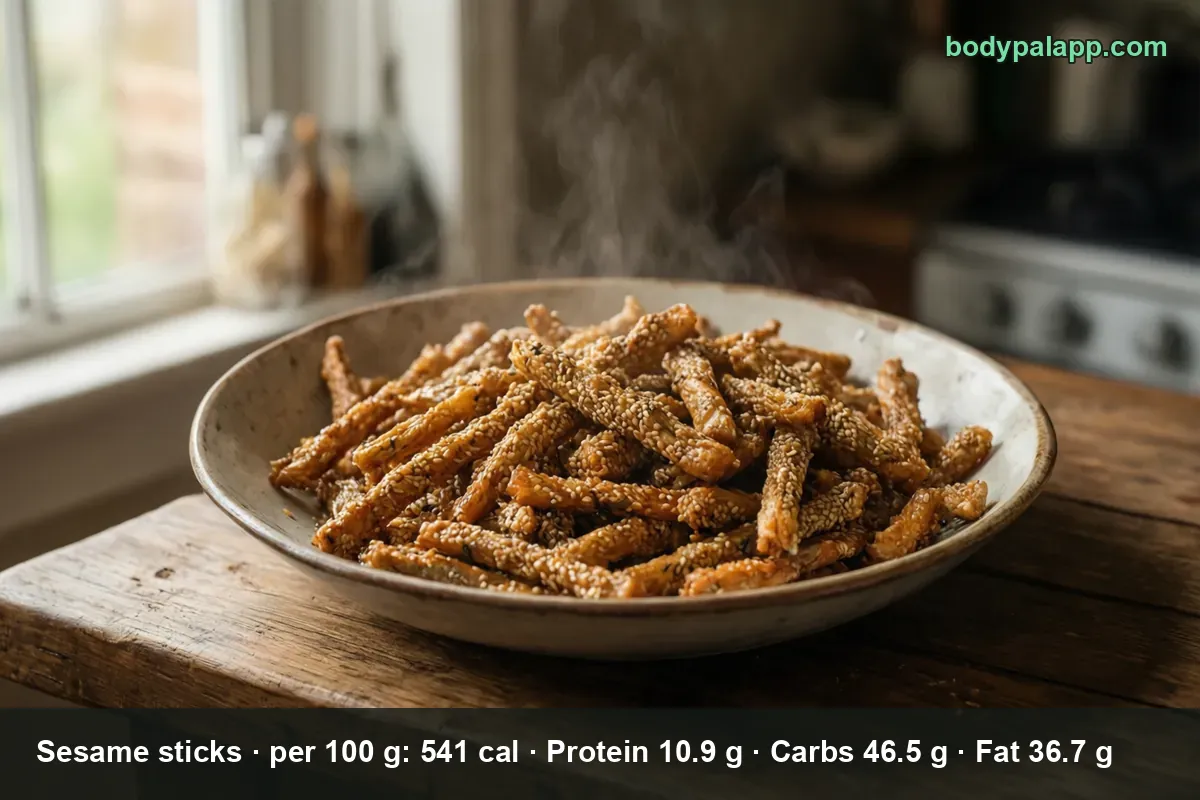
The one behavior worth changing: put the handful in a bowl. The bowl in the photo at the top of this page holds far more than an ounce, and the difference between 151 and 541 calories is entirely a matter of how many times you go back.
Most popular sesame sticks brands in the United States
Ranked by how widely each product appears among foods sold in the United States, from the BodyPal food database of over 3.3 million products. Calories are the figures printed on each Nutrition Facts label, checked against USDA FoodData Central.
| Product | Calories (per 100 g) |
|---|---|
| Clover Valley Honey Roasted Sesame Sticks | 536 cal |
| Nature's Harvest Sesame Sticks Honey Roasted | 533 cal |
| Snack Worthy Sesame Sticks | 552 cal |
| Snack Worthy Wide Sesame Sticks | 548 cal |
| Snack Worthy Honey Roast Sesame Sticks | 533 cal |
| PF Snacks Salted Sesame Sticks | 567 cal |
Brand popularity: BodyPal food database. Nutrition: manufacturer labels / USDA FoodData Central.
Sesame stick FAQs
How many calories are in sesame sticks?
151 calories in a 1 oz (28 g) serving of salted sesame sticks, which is 541 calories per 100 g. That handful carries 10.3 g of fat, 3.1 g of protein and 417 mg of sodium. The numbers come from USDA SR Legacy row 168856.
How many calories are in a handful of sesame sticks?
About 151 calories, taking a handful as the 1 oz (28 g) label serving. Scooped with a measuring cup instead, a quarter cup weighs about 30 g and comes to 162 calories. Two handfuls, or 2 oz (57 g), reach 308 calories.
How many calories are in 1/4 cup of sesame sticks?
162 calories for a quarter cup at 30 g. US brand labels measure the scoop at 29 to 31 g depending on how thick the sticks are, so a cup measure gives you roughly 7% more than the 1 oz serving printed on the bag. Wide sticks reach 170 calories per quarter cup.
How many calories are in honey roasted sesame sticks?
Around 160 calories for a quarter cup (30 g), and 533 to 571 calories per 100 g across US labels. That brackets the 541 of the plain salted stick, so the honey glaze is not the lighter choice. Fat stays at 32 to 39 g per 100 g either way.
How much sodium is in sesame sticks?
417 mg in a 1 oz (28 g) serving, or 1,488 mg per 100 g. That is 18% of the FDA Daily Value of 2,300 mg for one handful, and 36% if you eat a 2 oz bag. The unsalted USDA row has 29 mg per 100 g, about 8 mg per ounce.
Are sesame sticks healthy?
They are a fried wheat snack at 541 calories per 100 g, closer to a potato chip than to sesame seeds. An ounce gives 0.8 g of fiber and 3.1 g of protein, 3% and 6% of the day. Sodium is the number to watch at 417 mg per ounce.
Sesame sticks or potato chips: which has fewer calories?
Potato chips, by one calorie. An ounce of plain potato chips is 150 calories against 151 for sesame sticks, and per 100 g it is 536 against 541. Sesame sticks do carry more protein, 3.1 g an ounce against 2.0 g for the chips.
How much protein is in sesame sticks?
3.1 g in a 1 oz (28 g) serving, which is 6% of the Daily Value, from 10.9 g per 100 g. Most of it comes from the wheat flour rather than the sesame. For comparison, plain pork rinds give 17.2 g of protein in the same ounce.
Similar foods
- Watermelon Seed — 156 cal per ounce
- Cashew Nuts — 163 cal per oz
- Cashews — 161 cal per oz
- Honey Roasted Peanuts — 161 cal per oz
- Pumpkin Seeds — 161 cal per oz
- Sunflower Seeds — 163 cal per ounce
Count it without the math
Point the camera at the bowl and BodyPal logs the calories and the sodium together, so the second scoop shows up in the day the way it actually lands.


How long does it take to burn off sesame sticks?
A 1 oz (28 g) serving is 151 kcal. Enter your weight and the amount you ate to see how long it takes you to burn that off:
lb
| Activity | Time to burn 151 kcal |
|---|---|
| Walking, brisk | 30 min |
| Cycling, moderate | 19 min |
| Swimming, moderate | 22 min |
| Jogging | 18 min |
| Weight training, moderate | 34 min |
Times are for a 155 lb adult at a steady pace; change the weight to see yours. The amount is set to the portion in the text (28 g); change it to what you actually ate. BodyPal works this out from your steps automatically.
This table assumes you know your daily total. If you do not, the daily calorie calculator works it out from five numbers.