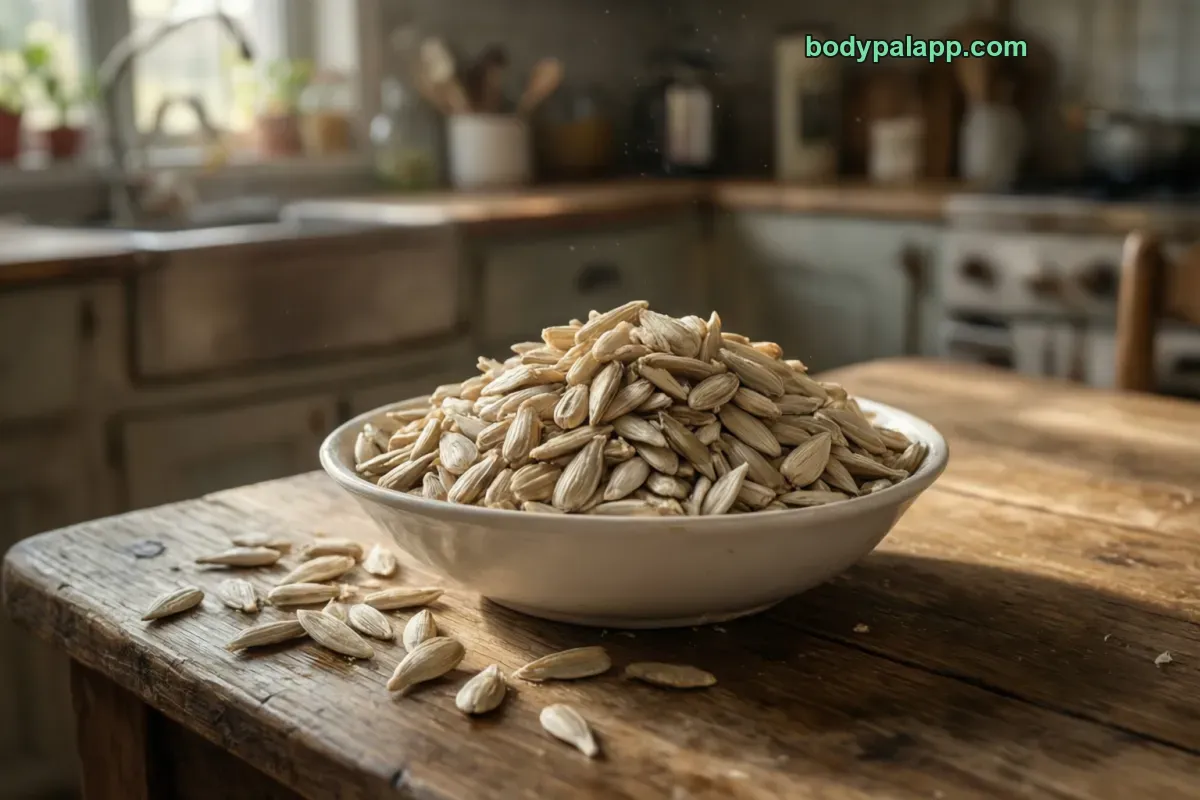
Sunflower seeds calories come to 163 for a 1 oz (28 g) handful of dry roasted, unsalted kernels, and 582 per 100 g. Fat supplies 72% of those calories, so the total climbs fast once you stop counting. A full cup of kernels reaches 745 calories, which is 37% of a 2000-calorie daily value.
163kcal
1 ounce · 28 g, dry roasted kernels, unsalted
12%protein
5.4 gProtein
7 gCarbs
13.9 gFat
How to burn off 163 kcal
—Walking, brisk
—Jogging
—Cycling, moderate
—Swimming
Skip the math. BodyPal counts these calories from your steps and workouts automatically.
Nutrition facts
Dry roasted kernels, unsalted · per 28 g
Calories
163 kcal
Protein
5.4 g
Carbohydrate
6.7 g
Fat
13.9 g
Saturated fat
1.5 g
Cholesterol
0 mg
Sodium
1 mg
Potassium
238 mg
Iron
1.1 mg
Source: USDA FoodData Central
🛡️
Verified nutrition data
Numbers on this page come from USDA FoodData Central, the U.S. Department of Agriculture’s food composition database, and from manufacturer labels where a branded product is named. Last verified September 2026. How we verify our data →
Sunflower seeds: calories, protein and sodium by serving
Percent of daily value uses the FDA reference of 2,000 kcal a day.
Serving
kcal
Protein
Carbs
Fat
Sodium
% DV kcal
1 oz (28 g)
163
5.4 g
6.7 g
13.9 g
1 mg
8%
1 cup kernels (128 g)
745
24.7 g
30.8 g
63.7 g
4 mg
37%
1 cup in shell (46 g)
268
8.9 g
11.1 g
22.9 g
1 mg
13%
100 g
582
19.3 g
24.1 g
49.8 g
3 mg
29%
3 × 1 oz (28 g)
489
16.2 g
3 mg
5 × 1 oz (28 g)
815
27.1 g
4 mg
A cup of kernels is a 745-calorie snack
The standard 1 oz (28 g) serving is 163 calories, about 8% of the daily value. That is a modest number for a snack. The trouble is that an ounce of kernels looks small in the palm, and few people stop there.
Here is how the total moves as the handfuls add up. Two ounces (56 g) bring 326 calories. Three ounces (84 g) reach 489. Five ounces (140 g), which is roughly what disappears from an open bag during a movie, land at 815 calories. A cup of kernels (128 g) sits at 745, close to the five-ounce mark.
The practical fix is to portion before you eat. Pour one ounce into a bowl and close the bag. If you track your intake, BodyPal can log the seeds from a photo of the bowl, which makes it easier to notice when one serving quietly became three.
Fat is nearly three quarters of the energy
Per 100 g, sunflower kernels carry 49.8 g of fat, 24.1 g of carbs and 19.3 g of protein. Translated into calories, fat supplies 72%, carbs 15% and protein 12%. That split is why the calorie number is high even though a serving weighs so little.
Most of that fat is unsaturated. Saturated fat is only 5.2 g per 100 g, and cholesterol is 0. Sugar is low too, at 2.7 g per 100 g and 0.8 g per ounce, so the carbs here are mostly starch and fiber rather than anything sweet.
Protein is a real contributor but not the headline. One ounce gives 5.4 g, about 11% of the daily value, and a cup of kernels gives 24.7 g, or 49%. If protein is your main goal, seeds work better as a supporting player next to a leaner protein source than as the main event.
Fiber is the quiet strength, salt depends on the bag
Fiber is where sunflower seeds earn their place. There are 11.1 g per 100 g and 3.1 g in a single ounce. Against a daily value of 28 g, a cup of kernels with 14.2 g covers about half. Potassium is also generous at 850 mg per 100 g.
Sodium is a non-issue for the plain kernels this page describes. Dry roasted without salt, they carry 3 mg per 100 g and 1 mg per ounce, which rounds to 0% of the 2300 mg daily value. Even five ounces add only 4 mg.
That changes the moment seasoning goes on. Flavored in-shell seeds such as Spitz Smoky BBQ, Spitz Dill Pickle or Spitz Chili Lime are coated in salty seasoning, and the shell itself carries some of it to your lips as you crack each one. If you watch sodium, read the label on flavored bags rather than relying on the unsalted numbers here.
Shells slow you down, kernels do not
A cup of seeds measured in the shell is logged at 46 g of edible seed and 268 calories, about 13% of the daily value. Compare that with 745 calories for a cup of shelled kernels. The difference is simply volume: shells take up space in the cup that you never eat.
In-shell seeds also change how you eat. Cracking each one takes time, so a cup lasts a long stretch and the calories arrive slowly. Shelled kernels go down by the spoonful, which is why they are easier to overdo.
For a balanced snack, pair an ounce of kernels with something watery and low in calories, such as fruit or raw vegetables, so the plate feels bigger without the total running away. Kernels also work as a topping on salads, oatmeal or yogurt, where a small sprinkle adds crunch and fiber without dominating the meal.
How does sunflower seeds compare?
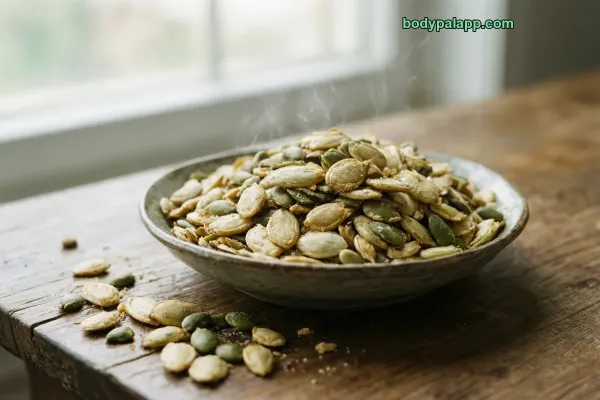
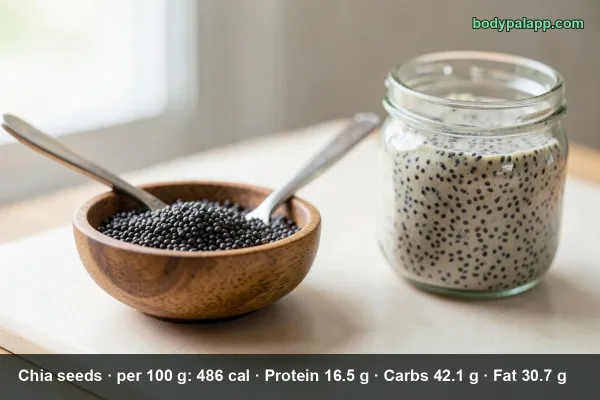
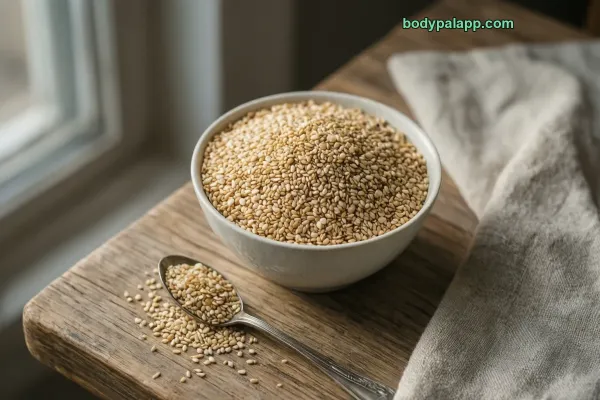
Here is how sunflower seeds stack up against pumpkin, chia and sesame seeds, per 100 g and per usual serving.
Verdict: For protein, pick pumpkin seeds: they carry 29.8 g per 100 g against 19.3 g here, at a nearly identical 574 calories. If you want the lightest seed, chia comes in at 486 per 100 g, while sesame at 573 is essentially a calorie twin of sunflower.
Most popular sunflower seeds brands in the United States
Ranked by popularity in the BodyPal database
# Productkcal / 100 g
1Spitz Sunflower Seeds1 oz · 28 g643 kcal
2Spitz Sunflower Seeds Original28 g607 kcal
3Spitz Smoky BBQ Sunflower Seeds1 oz · 28 g643 kcal
4Spitz Chili Lime Sunflower Seeds1 oz · 28 g643 kcal
5Spitz Dill Pickle Sunflower Seeds1 oz · 28 g643 kcal
6Spitz Cracked Pepper Sunflower Seeds1 oz · 28 g643 kcal
Flavored and salted packs read 607 to 643 calories per 100 g, higher than the 582 of the plain dry roasted kernels above. Source: manufacturer labels / USDA FoodData Central.
Sunflower seeds FAQs
How many calories are in an ounce of sunflower seeds?
A 1 oz portion of dry roasted kernels is 163 calories. A full cup of kernels (128 g) is 745 calories, and 100 g is 582.
Are sunflower seeds good for weight loss?
They are energy dense at 582 calories per 100 g, so the portion size decides: a measured ounce is 163 calories. That ounce carries 5.4 g protein, 3.1 g fiber and 13.9 g fat.
Sunflower seeds vs pumpkin seeds: which has fewer calories?
Pumpkin seeds are slightly lower at 574 calories per 100 g against 582 for sunflower seeds. Per ounce that is 161 calories against 163.
How much protein is in sunflower seeds?
19.3 g per 100 g, which works out to 5.4 g in a 1 oz portion and 24.7 g in a cup of kernels (128 g).
Do sunflower seeds have a lot of calories?
Yes, by weight they do: 582 calories per 100 g of dry roasted kernels. A normal 1 oz (28 g) serving is a more manageable 163 calories, so portion size decides whether they fit your day.
How many calories are in sunflower seeds with the shell?
A cup of seeds measured in the shell comes to 268 calories, based on 46 g of edible seed. The shells fill much of the cup, so it holds far fewer calories than a cup of shelled kernels.
How many calories are in a cup of shelled sunflower seeds?
A cup of kernels without the shell weighs 128 g and has 745 calories. That is 37% of a 2000-calorie daily value, along with 63.7 g of fat and 24.7 g of protein.
What nutrients are in an ounce of sunflower seeds?
An ounce of dry roasted kernels gives 163 calories, 13.9 g of fat, 6.7 g of carbs, 5.4 g of protein and 3.1 g of fiber. Unsalted, it carries just 1 mg of sodium and 0.8 g of sugar.