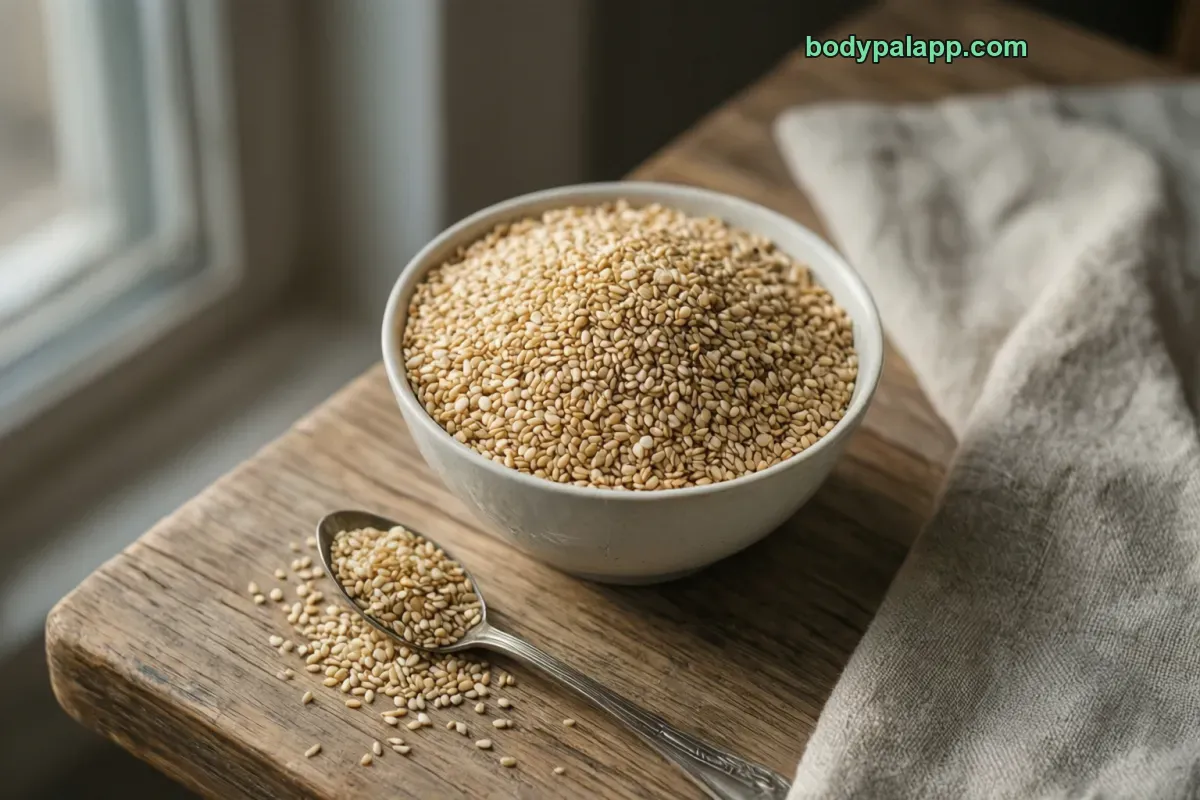
Sesame seeds calories come to 52 for 1 tbsp (9 g) and 573 per 100 g. The thing to notice is density: fat supplies 73% of that energy, so a sprinkle stays small while a free pour adds up fast. A full cup reaches 825 calories, which makes the spoon you use the real deciding factor.
52kcal
1 tablespoon · 9 g, whole, dried
12%protein
1.6 gProtein
2 gCarbs
4.5 gFat
How to burn off 52 kcal
—Walking, brisk
—Jogging
—Cycling, moderate
—Swimming
Skip the math. BodyPal counts these calories from your steps and workouts automatically.
Nutrition facts
Whole, dried · per 9 g
Calories
52 kcal
Protein
1.6 g
Carbohydrate
2.1 g
Fat
4.5 g
Saturated fat
0.6 g
Cholesterol
0 mg
Sodium
1 mg
Potassium
42 mg
Iron
1.3 mg
Source: USDA FoodData Central
🛡️
Verified nutrition data
Numbers on this page come from USDA FoodData Central, the U.S. Department of Agriculture’s food composition database, and from manufacturer labels where a branded product is named. Last verified September 2026. How we verify our data →
Sesame seeds: calories, protein and sodium by serving
Percent of daily value uses the FDA reference of 2,000 kcal a day.
Serving
kcal
Protein
Carbs
Fat
Sodium
% DV kcal
1 tbsp (9 g)
52
1.6 g
2.1 g
4.5 g
1 mg
3%
1 oz (28 g)
160
5 g
6.6 g
13.9 g
3 mg
8%
1 cup (144 g)
825
25.5 g
33.8 g
71.5 g
16 mg
41%
100 g
573
17.7 g
23.5 g
49.7 g
11 mg
29%
3 × 1 tbsp (9 g)
155
4.8 g
3 mg
5 × 1 tbsp (9 g)
258
8 g
5 mg
A tablespoon is 52 calories, a cup is 825
The default serving is 1 tbsp (9 g), and it carries 52 calories, 4.5 g of fat and 1.6 g of protein. That is 3% of the daily calorie value. At this size sesame seeds are a garnish, and they barely move the total for a meal.
Free pouring is where the number climbs. Two tablespoons (18 g) come to 103 calories, three (27 g) to 155, and five (45 g) to 258. A 1 oz (28 g) portion lands at 160 calories, or 8% of the daily value, which is close to the three-tablespoon figure. If you shake seeds straight from the jar, you are probably closer to those larger rows than to the single spoon.
The cup is the number to respect. 1 cup (144 g) holds 825 calories, 41% of the daily value, along with 71.5 g of fat. Few people eat a cup on its own, but baking recipes and homemade seed bars often call for one, so divide the total by the pieces you actually cut rather than guessing.
Fat supplies 73% of the calories
Per 100 g, sesame seeds hold 49.7 g of fat, 23.5 g of carbs and 17.7 g of protein. Turned into calories, fat accounts for 73%, carbs for 15% and protein for 12%. That split puts sesame much closer to a cooking fat than to a grain, which is why the label looks so heavy for something so small.
Only 7 g of the 49.7 g of fat is saturated, against a daily value of 20 g, so most of the fat is not the saturated kind. Sugar is close to zero at 0.3 g per 100 g, and cholesterol is 0, as you would expect from a plant seed.
Protein is respectable for a seed. 1 cup (144 g) delivers 25.5 g, 51% of the daily value, while 1 oz (28 g) gives 5 g, or 10%. You eat a lot of fat to get there, though. Treat sesame as a flavor and texture add-on that brings some protein, not as your protein source.
Fiber is the surprise, sodium barely registers
At 11.8 g of fiber per 100 g, sesame seeds carry more fiber than their size suggests. A tablespoon adds 1.1 g, an ounce 3.3 g and a cup 17 g, measured against a daily value of 28 g. Small amounts will not cover much of that, but the fiber comes along for free with every spoonful.
Fiber also explains much of the carb line. Of the 23.5 g of carbs per 100 g, about half is fiber and only 0.3 g is sugar. So the carb number on the label overstates how starchy or sweet these seeds really are.
Sodium is a non-issue in plain seeds: 11 mg per 100 g and 1 mg per tablespoon, which rounds to 0% of the 2300 mg daily value. Flavored products are a different story. A wasabi-coated pack such as Roland Wasabi Sesame Seeds or a salted blend is its own food, so read that label if you watch sodium. Potassium sits at 468 mg per 100 g.
Use them as a finish, not a snack
Sesame seeds earn their place as a topping. A tablespoon over a stir-fry, a salad or a bowl of rice adds 52 calories, crunch and a nutty note, which is a fair trade for most plates. Eaten by the handful, they turn into a dense snack that is easy to underestimate.
The figures here are for whole, dried seeds, the USDA row behind this page. Roasted, organic or flavored packs from brands such as AFC Roasted Sesame Seeds, Shiloh Farms or Great Value can differ, so the package label is the better reference for those.
If you track intake, measure with a spoon instead of shaking from the jar. The jump from one tablespoon to five is 52 to 258 calories, and that gap hides easily on a plate. BodyPal can log sesame seeds from a photo of your meal, which helps when they are scattered over a dish.
How does sesame seeds compare?
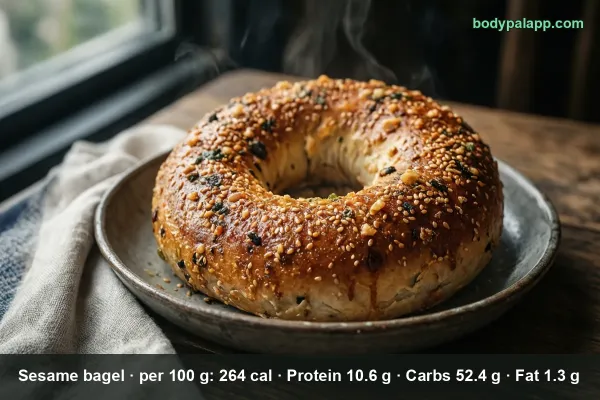
Here is how sesame seeds stack up against a sesame bagel, hummus and avocado oil, per 100 g and per usual serving.
Verdict: Avocado oil is the only one denser than the seeds at 884 calories per 100 g, so if you want added fat that also brings fiber and protein, sprinkle seeds instead of pouring oil. For sesame flavor with fewer calories, hummus at 229 per 100 g beats the 264 of a sesame bagel and leaves the seeds as a garnish.
Most popular sesame seeds brands in the United States
Spice-jar labels round calories on servings smaller than a teaspoon, so their per-100 g figures read higher than the 573 above. Source: manufacturer labels / USDA FoodData Central.
Sesame seeds FAQs
How many calories are in a tablespoon of sesame seeds?
About 52 calories in a 9 g tablespoon. One ounce (28 g) is 160 calories and a full cup (144 g) is 825.
Are sesame seeds good for weight loss?
They are calorie-dense at 573 calories per 100 g, but a 9 g tablespoon adds only 52 calories, with 1.1 g of fiber and 1.6 g of protein.
Sesame seeds vs a sesame bagel: which has more calories?
Per 100 g sesame seeds have 573 calories and a sesame bagel 264, but seeds are eaten by the spoonful, so a 9 g tablespoon is 52 calories.
How much protein is in sesame seeds?
17.7 g per 100 g, which works out to 1.6 g in a 9 g tablespoon and 5 g in an ounce (28 g). The same tablespoon carries 88 mg of calcium.
How many calories are in 100 g of sesame seeds?
100 g of sesame seeds has 573 calories, 29% of the daily value. It also brings 49.7 g of fat, 23.5 g of carbs, 17.7 g of protein and 11.8 g of fiber, which is why sesame is usually measured by the spoon.
What is the nutrition in 1 tablespoon of sesame seeds?
1 tbsp (9 g) of sesame seeds has 52 calories, 4.5 g of fat, 2.1 g of carbs, 1.6 g of protein and 1.1 g of fiber. Sodium is just 1 mg, and sugar rounds to 0.
How many calories are in an ounce or a cup of sesame seeds?
1 oz (28 g) of sesame seeds has 160 calories, and 1 cup (144 g) has 825, or 41% of the daily value. The ounce is a small handful; the cup mostly shows up in baking.
Why are sesame seeds so high in calories?
Fat makes up 73% of the calories in sesame seeds, with 49.7 g of fat per 100 g. Carbs supply 15% and protein 12%, so on a calorie label the seeds behave more like an oil than a grain.