
How many calories are in a sesame bagel?
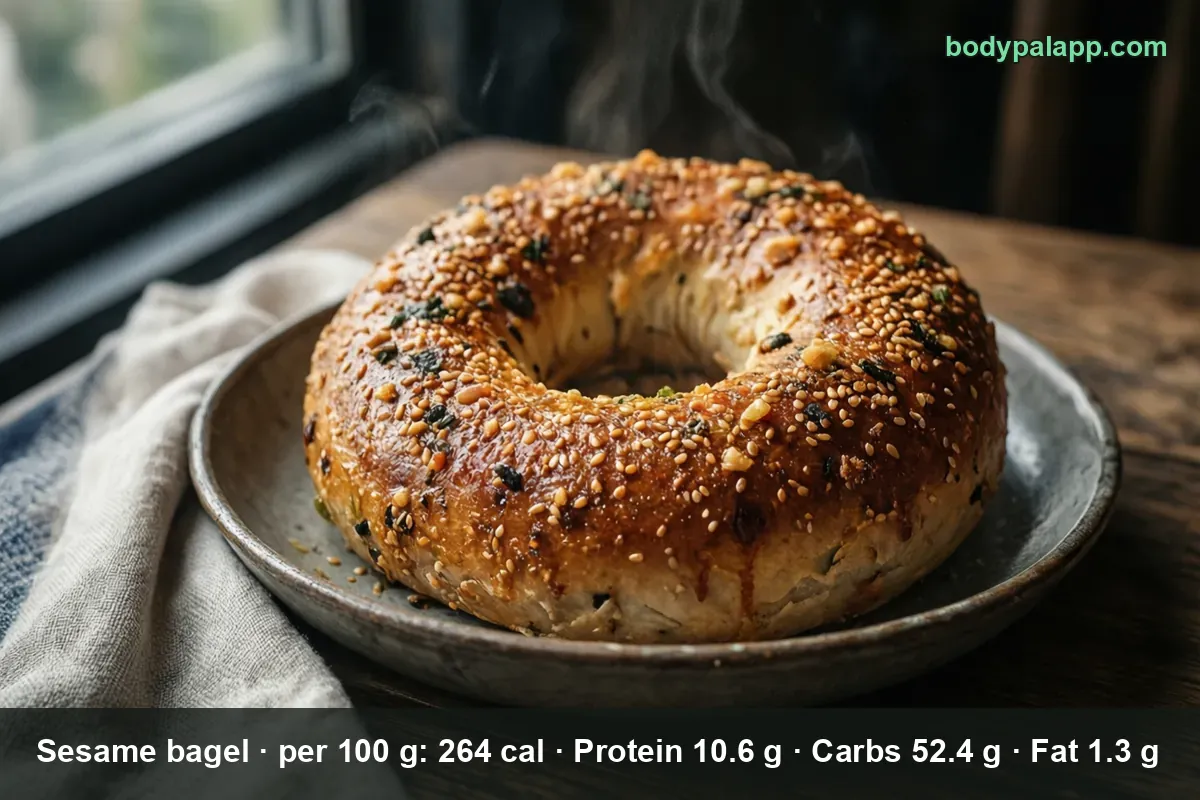
A medium sesame bagel, 3½ to 4 inches across and 105 g on the scale, is 277 calories, or 264 per 100 g. The deli-sized large one, 131 g, comes to 346. Half a medium bagel is 139. The seeds on top barely register on the scale, and that turns out to be the key to every number underneath.
On this page
- Sesame bagel quick facts
- Why USDA has no sesame bagel row
- US servings, from a mini to a deli bagel
- Toasting removes water, not calories
- The unenriched rows and the 534 mg problem
- Sodium, not fat, is the row to watch
- Half a bagel and the fiber gap
- How does a sesame bagel compare?
- Most popular sesame bagel brands
- FAQ
Sesame bagel quick facts
Every figure here comes off one record: SR Legacy 174899, "Bagels, plain, enriched, with calcium propionate (includes onion, poppy, sesame)". That is the bagel in an American bread aisle. Enriched flour is the standard, and calcium propionate is the mold inhibitor in almost every packaged US bagel, so the record and the shelf match.
The serving column is a medium bagel of 105 g, USDA's own household measure and the size a supermarket six-pack is cut to.
| Nutrient | Per 100 g | Per 1 medium bagel (105 g) | % Daily Value |
|---|---|---|---|
| Calories | 264 | 277 | — |
| Total fat | 1.32 g | 1.4 g | 2% |
| Saturated fat | 0.36 g | 0.4 g | 2% |
| Carbohydrate | 52.38 g | 55.0 g | 20% |
| Dietary fiber | 1.6 g | 1.7 g | 6% |
| Total sugars | 8.43 g | 8.9 g | — |
| Protein | 10.56 g | 11.1 g | 22% |
| Sodium | 422 mg | 443 mg | 19% |
% Daily Value is based on a 2,000-calorie diet.
Verified nutrition data
Numbers on this page come from USDA FoodData Central, the U.S. Department of Agriculture’s food composition database, and from manufacturer labels where a branded product is named. Last verified September 2026. How we verify our data →
One row a packaged label would print is missing, and that row is added sugars. The SR Legacy edition holds no added-sugars figure for any bagel line at all, so rather than guess how much of the 8.43 g of total sugars per 100 g the baker stirred in, the row stays off the table. Total sugars themselves carry no Daily Value on a US label, which is why that cell is blank rather than zero.
Three numbers sit outside the core label and come from the same record. Trans fat is 0.02 g per 100 g. Cholesterol is 0 mg, since there is no dairy or egg in a standard bagel. Potassium is 107 mg per 100 g, a rounding error against a 4,700 mg Daily Value.
Why USDA has no sesame bagel row
Search FoodData Central for a sesame bagel and you will not find one. That is not a gap in the database. USDA keeps the seeded bagels inside the plain bagel record and says so in the description itself: includes onion, poppy, sesame. A sprinkle of seeds is under one percent of the bagel's mass, and one percent of anything does not move a calorie figure that rounds to a whole number.
So the honest version reads like this. The 277 calories in your sesame bagel are the calories in a bagel. The seeds are a rounding error with a very good crunch.
There is a second choice worth explaining, because the database holds five bagel lines rather than one. Three of them cover unenriched flour, no calcium propionate, or both, and all three carry an identical set of twelve values at 275 calories per 100 g. They are not three bagels; they are one analysis split across three label combinations. The fifth line is the same bagel toasted.
We lead with 174899 for two reasons. It is the line that describes what a US store actually sells, and it is the only one that carries sugars and trans fat at all. The 264 against 275 gap is a difference of batch and flour, not a disagreement between sources, so averaging the two would produce a number that describes no bagel anywhere.
US servings, from a mini to a deli bagel
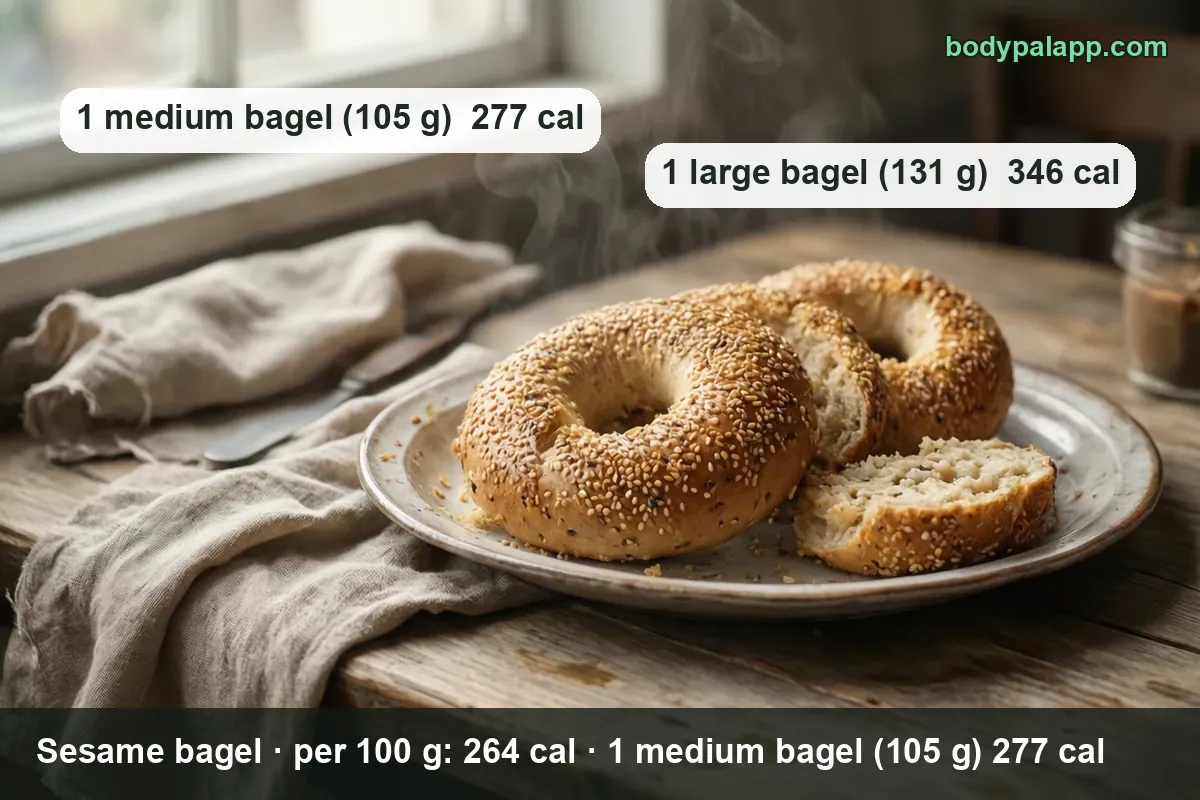
| Serving | Weight | Calories |
|---|---|---|
| Mini bagel (2½ in) | 26 g | 69 |
| Small bagel (3 in) | 69 g | 182 |
| Bagel, USDA generic | 99 g | 261 |
| Medium bagel (3½–4 in) | 105 g | 277 |
| Large bagel (4½ in) | 131 g | 346 |
| One ounce | 28.35 g | 75 |
| 100 g | 100 g | 264 |
The spread is the whole story. A mini and a large are the same dough with the same recipe, and one is five times the other: 69 calories against 346.
Nobody at the counter tells you which one you are holding. A grocery six-pack tends to sit near the medium, a bakery or deli bagel near the large, and the difference between those two habits is 69 calories a morning without a single change in what you order. Over a five-day work week that is roughly one extra bagel.
The one-ounce row is the useful anchor. If you can weigh the bagel, weigh it; the diameter guesses in inches are USDA's, and hand-shaped bagels do not respect them.
Toasting removes water, not calories
USDA keeps a toasted line for the same bagel at 287 calories per 100 g. Against 264 that reads as a 9% penalty for using the toaster, and calorie charts repeat it as though heat were an ingredient.
It is not. Toasting drives off water. What remains is denser per gram and lighter on the plate, which is why USDA's medium toasted bagel weighs 99 g instead of 105.
| Toasted serving | Weight | Calories |
|---|---|---|
| Mini (2½ in) | 24 g | 69 |
| Small (3 in) | 65 g | 187 |
| Medium (3½–4 in) | 99 g | 284 |
| Large (4½ in) | 123 g | 353 |
| One ounce | 28.35 g | 81 |
| 100 g | 100 g | 287 |
Line up the two mediums and the argument ends: 277 untoasted, 284 toasted. Seven calories, on a hand-cut bakery product where two bagels off the same tray differ by more than that.
Every other row moves the same way for the same reason. Toasted runs 11.14 g protein, 57.39 g carbohydrate, 1.8 g fiber and 457 mg sodium per 100 g, all up on the untoasted record. Nothing was created. The denominator shrank.
The unenriched rows and the 534 mg problem
The three matching lines at 275 calories per 100 g are the specialty end of the shelf: unenriched flour, no preservative, or both. They are worth their own table, because a bakery bagel with a short shelf life is a real thing people buy.
| Serving | Weight | Calories |
|---|---|---|
| Mini bagel (2½ in) | 26 g | 72 |
| Small bagel (3 in) | 69 g | 190 |
| Medium bagel (3½–4 in) | 105 g | 289 |
| Large bagel (4½ in) | 131 g | 360 |
| One ounce | 28.35 g | 78 |
| 100 g | 100 g | 275 |
Two rows a label would show are absent from that edition entirely, sugars and trans fat, so they are not printed above; the analysis simply predates them. What the edition does give changes the picture in an unexpected direction.
Fiber is better: 2.3 g per 100 g against 1.6 g on the main record. Sodium is much worse: 534 mg per 100 g against 422 mg, about a quarter more salt in the same object. Protein sits at 10.5 g and fat at 1.6 g, both within a whisker of the enriched line.
If you buy the artisan version for the shorter ingredient list, the trade is real but it runs both ways. More fiber, more sodium, twelve more calories in a medium.
Sodium, not fat, is the row to watch
A medium sesame bagel carries 443 mg of sodium, 19% of the FDA Daily Value of 2,300 mg. Carbohydrate, the nutrient bagels are famous for, is 20%. Those two figures are effectively the same size, and only one of them ever gets mentioned.
Fat, meanwhile, is 2%. The entire bagel holds 1.4 g of it, 0.4 g saturated. A food this widely treated as heavy is, on the fat row, close to empty.
The number that matters is that 443 mg is the floor, not the total. It is the bagel by itself, before cream cheese, before lox, before a slice of cheddar and a pinch of everything seasoning. The Dietary Guidelines for Americans name sodium as one of the components Americans most consistently overshoot, and a mild-tasting bread product delivering a fifth of the day's allowance before anything is spread on it is exactly how that happens unnoticed.
Half a bagel and the fiber gap
Half a medium bagel is 52.5 g and 139 calories, with 5.5 g of protein, 27.5 g of carbohydrate, 0.8 g of fiber, 0.7 g of fat and 222 mg of sodium. A mini is 26 g and 69 calories, with 2.7 g of protein, 13.6 g of carbohydrate, 0.3 g of fat and 110 mg of sodium.
Split across the two big rows, the bagel is lopsided. Protein is genuinely good at 11.1 g in a medium, 22% of the Daily Value. Fiber is genuinely poor at 1.7 g, 6% of a 28 g Daily Value, and no amount of sesame on the crust fixes that. MyPlate asks for half your grains to be whole grains; a white-flour bagel is not one of them, and the seeds do not promote it.
That shapes the practical call better than the calorie count does. Half a bagel with a protein topping keeps the protein column intact and halves everything else. A whole bare bagel spends 277 calories on 1.7 g of fiber, which is the least filling way to buy them.
How does a sesame bagel compare?
Ounce for ounce, the bagel is not unusual. It is ordinary bread, and the neighboring USDA records make the point sharply.
| Food | Per 100 g | Per 1 oz (28.35 g) | Protein | Carbs | Fat |
|---|---|---|---|---|---|
| Sesame bagel | 264 | 75 | 3.0 g | 14.9 g | 0.4 g |
| Mixed-grain hamburger or hot dog roll | 263 | 75 | 2.7 g | 12.6 g | 1.7 g |
| Multi-grain bread | 265 | 75 | 3.8 g | 12.3 g | 1.2 g |
| Potato bread | 266 | 75 | 3.5 g | 13.3 g | 0.9 g |
| Rice bran bread, toasted | 264 | 75 | 2.8 g | 13.4 g | 1.4 g |
Five different breads, one calorie count. The protein and fat columns move a little and the calories do not move at all.
Our take: a bagel is not a calorie-dense food, it is a large one. A large deli bagel weighs 131 g, roughly 4.6 ounces of bread compressed into a single object you finish without thinking, where nobody eats four and a half slices of multi-grain in one sitting. If you want the lowest-calorie bread on that list, there is no winner to pick, so pick the smaller piece instead. If you want the most protein per calorie, multi-grain bread takes it at 3.8 g an ounce. And if sodium is your number, weigh the bagel before you judge it, because the object is the problem and the recipe is not.
Most popular sesame bagel brands in the United States
Ranked by how widely each product appears among foods sold in the United States, from the BodyPal food database of over 3.3 million products. Calories are the figures printed on each Nutrition Facts label, checked against USDA FoodData Central.
| Product | Calories (per 100 g) |
|---|---|
| Seattle Bagel Bakery Sesame Bagels | 248 cal |
| Toufayan Bakeries Hearth Baked Sesame Bagels | 274 cal |
| Bell's Sesame Bagels | 283 cal |
| Pain D'Avignon Sesame Bagel | 261 cal |
| O'Doughs Sesame Bagel | 200 cal |
| Market Pantry Pre-Sliced Sesame Bagels | 247 cal |
Brand popularity: BodyPal food database. Nutrition: manufacturer labels / USDA FoodData Central.
Sesame bagel FAQs
How many calories are in a sesame bagel?
277 calories for a medium bagel of 105 g, or 264 per 100 g. A 69 g small bagel is 182, a deli-sized 131 g large one is 346, and a mini is 69. USDA files sesame inside its plain bagel record, so the seeds are already counted in that figure.
How many calories in half a sesame bagel?
139 calories. Half a medium bagel weighs 52.5 g and brings 5.5 g of protein, 27.5 g of carbohydrate, 0.8 g of fiber, 0.7 g of fat and 222 mg of sodium. Half of a large 131 g bagel is closer to 173 calories, our own scaling of the 100 g figure rather than a USDA portion.
Does toasting a bagel add calories?
No — the toasted USDA record reads 287 calories per 100 g against 264 untoasted, but toasting only drives off water. The medium toasted bagel weighs 99 g instead of 105, so the item lands at 284 calories rather than 277. Same dough, either way.
How many carbs are in a sesame bagel?
55.0 g in a medium 105 g bagel, which is 20% of the Daily Value, from 52.38 g per 100 g. Of that total, 8.9 g is sugars and 1.7 g is fiber. A mini bagel holds 13.6 g of carbohydrate and half a medium holds 27.5 g.
Is a sesame bagel healthier than a plain bagel?
The numbers are identical at 264 calories and 422 mg of sodium per 100 g. USDA has no separate sesame record: the seeds sit inside the plain bagel line, described as "includes onion, poppy, sesame", because a sprinkle is under one percent of the bagel's mass.
How much protein is in a sesame bagel?
11.1 g in a medium 105 g bagel, 22% of the Daily Value, from 10.56 g per 100 g. That is the bagel's strongest row by a distance, since fiber reaches only 1.7 g, or 6%. Half a bagel gives 5.5 g and a mini gives 2.7 g.
How much sodium is in a sesame bagel?
443 mg in a medium bagel, 19% of the 2,300 mg Daily Value, and that is before any cream cheese. Per 100 g the figure is 422 mg. The unenriched USDA bagel lines run saltier at 534 mg per 100 g, and the toasted record reads 457 mg.
How big is a standard bagel in grams?
105 g for USDA's medium bagel, 3½ to 4 inches across. The scale runs from a 26 g mini to a 131 g large at 4½ inches, with a 69 g small and a 99 g generic bagel in between. Weight, not recipe, decides how many calories you get.
Similar foods
- Bagel — 277 cal per bagel
- Bagel Thin — 150 cal per thin
- Bagel With Cream Cheese — 277 cal per medium bagel
- Sesame Seed Bagel — 277 cal per regular bagel
- Whole Grain Bread — 69 cal per slice
- Chicken Spring Roll — 170 cal per spring roll
Count it without the math
Point the camera at the bagel and BodyPal logs the calories, the carbs and the sodium in one go.


How long does it take to burn off a sesame bagel?
One medium bagel (105 g) is 277 kcal. Enter your weight and the amount you ate to see how long it takes you to burn that off:
lb
| Activity | Time to burn 277 kcal |
|---|---|
| Walking, brisk | 55 min |
| Cycling, moderate | 35 min |
| Swimming, moderate | 40 min |
| Jogging | 33 min |
| Weight training, moderate | 1 hr 2 min |
Times are for a 155 lb adult at a steady pace; change the weight to see yours. The amount is set to the portion in the text (105 g); change it to what you actually ate. BodyPal works this out from your steps automatically.
Want the bigger picture? Calculate your daily calorie needs — your maintenance figure, a target for losing or gaining, and the date you get there.