
How Many Calories Are in Cashew Nuts?
A 1 oz handful of dry roasted salted cashews, 28.35 g on a scale, carries 163 calories. Per 100 g those same nuts run 574 calories, which makes them one of the denser things you can eat straight from a bag. Cashews are fat first, and the number climbs fast once a handful turns into a cup.
On this page
- Cashew nut quick facts
- US servings from a handful to a full cup
- Raw vs roasted cashews and cashew butter
- Sodium is the row that changes
- How do cashews compare?
- Most popular cashew nuts brands
- FAQ
Cashew nut quick facts
The row on this page is SR Legacy 169421, "Nuts, cashew nuts, dry roasted, with salt added". That is the nut most Americans actually hold: a resealable bag or a canister off the snack aisle, roasted dry and salted. Raw and oil roasted cashews are real foods too, and they get their own numbers further down, but they are not what comes home from the store by default.
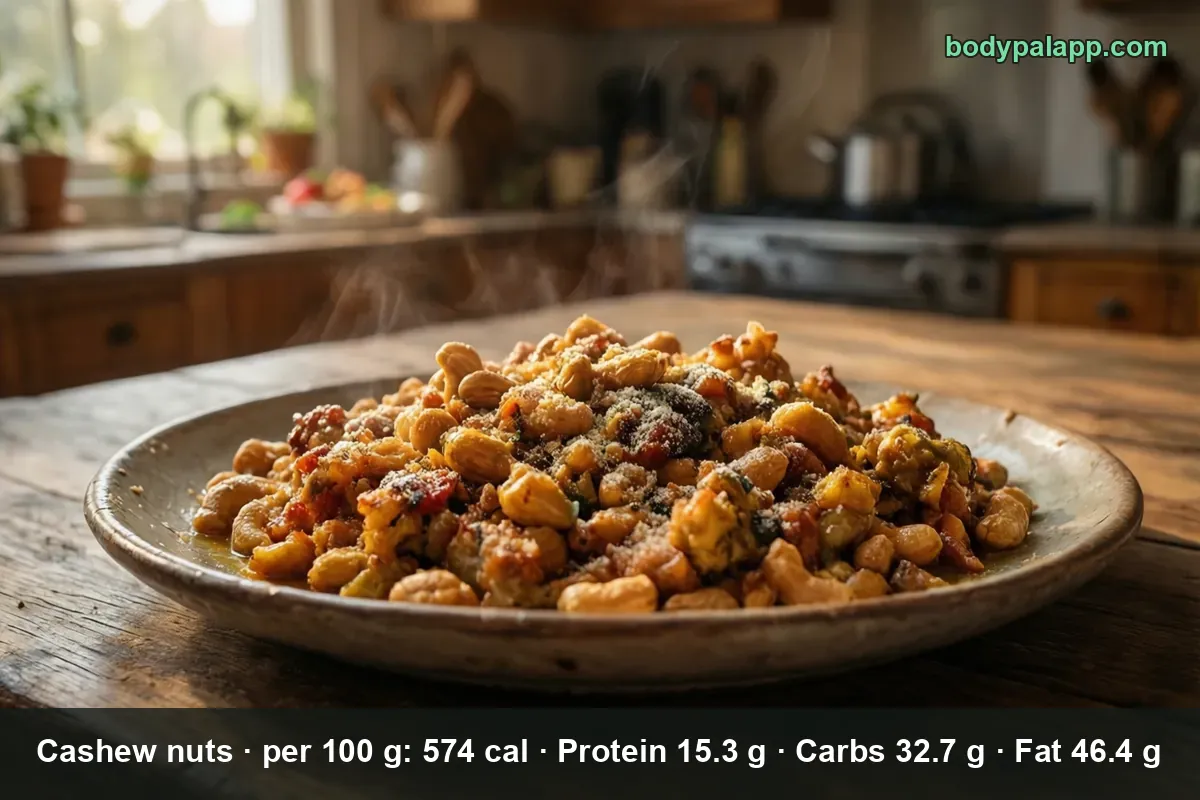
The picture at the top of this page shows cashews cooked into a dish with cheese and spices. Every number here is for the plain nuts on their own.
| Nutrient | Per 100 g | Per 1 oz (28.35 g) | % Daily Value |
|---|---|---|---|
| Calories | 574 | 163 | — |
| Total fat | 46.35 g | 13.1 g | 17% |
| Saturated fat | 9.16 g | 2.6 g | 13% |
| Carbohydrate | 32.69 g | 9.3 g | 3% |
| Dietary fiber | 3 g | 0.9 g | 3% |
| Total sugars | 5.01 g | 1.4 g | — |
| Protein | 15.31 g | 4.3 g | 9% |
| Sodium | 640 mg | 181 mg | 8% |
| Cholesterol | 0 mg | 0 mg | 0% |
| Potassium | 565 mg | 160 mg | 3% |
% Daily Value is based on a 2,000-calorie diet.
Verified nutrition data
Numbers on this page come from USDA FoodData Central, the U.S. Department of Agriculture’s food composition database, and from manufacturer labels where a branded product is named. Last verified September 2026. How we verify our data →
Two rows you would see on a bag are missing above: USDA does not publish added sugars or trans fat for this record, so we leave them out rather than guess. The 5.01 g of total sugars per 100 g are the nut's own, not anything poured on, and total sugars carry no Daily Value on the FDA label. Cholesterol is zero, as it is in every plant food, and the ounce brings 160 mg of potassium, 3% of the Daily Value.
US servings from a handful to a full cup
| Serving | Weight | Calories |
|---|---|---|
| 1 oz, a small handful | 28.35 g | 163 kcal |
| 1/4 cup, halves and whole | 34.3 g | 197 kcal |
| 1/2 cup, halves and whole | 68.5 g | 393 kcal |
| 1 cup, halves and whole | 137 g | 786 kcal |
| Per 100 g | 100 g | 574 kcal |
The ounce and the full cup are USDA household measures for this record. The quarter and half cup are our own arithmetic from the USDA 100 g figure, not USDA servings, scaled straight off the 137 g cup.
That table hides the trap most people fall into. A cup of cashews is not a big serving to look at, but it is 786 calories, nearly five ounces of nuts, and 63.5 g of fat, which is 81% of a day's fat on a 2,000-calorie diet. Bowl on the coffee table, hand going in and out, and the count is past a restaurant entree before the show ends.
The fix is boring and it works: measure the ounce once, see what it looks like in your own bowl, and eat from the bowl rather than the bag. Roughly 5.74 calories ride on every gram of these nuts, so a scale is worth more here than any piece count.
Raw vs roasted cashews and cashew butter
| Version | Per 100 g | Typical serving | Calories |
|---|---|---|---|
| Raw cashews | 553 kcal | 1 oz (28.35 g) | 157 kcal |
| Raw cashews, newer Foundation measurement | 564.664 kcal | 1 oz (28.35 g) | 160 kcal |
| Dry roasted, unsalted | 574 kcal | 1 oz (28.35 g) | 163 kcal |
| Dry roasted, salted | 574 kcal | 1 oz (28.35 g) | 163 kcal |
| Oil roasted, salted | 581 kcal | 1 oz (28.35 g) | 165 kcal |
| Oil roasted, unsalted | 580 kcal | 1 oz (28.35 g) | 164 kcal |
| Cashew butter, unsalted | 587 kcal | 2 Tbsp (32 g) | 188 kcal |
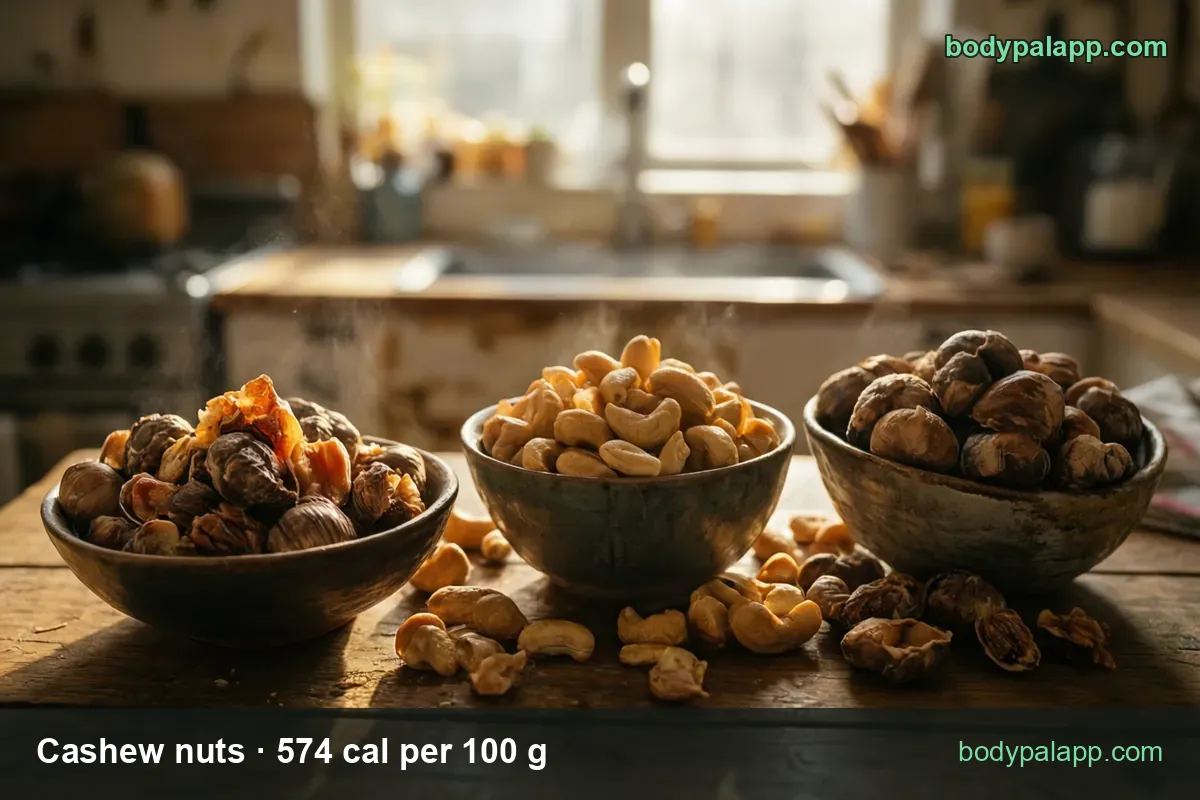
Raw cashews are the lightest of the group at 553 calories per 100 g, and roasting does not change that by much. Dry roasted comes in at 574, oil roasted at 581. Across the whole span that is eight calories on an ounce. Roasting drives off water, so the fat gets slightly more concentrated per gram; it does not pour fat into the nut the way deep frying does to a potato.
USDA holds two separate measurements of raw cashews, and they disagree by a little. The older SR Legacy record says 553 calories per 100 g, the newer Foundation record says 564.664, with more carbohydrate and more fiber. Same nut, different lab work in different years, and neither one is wrong. Nothing here is averaged between them.
Cashew butter is the outlier worth knowing. At 587 calories per 100 g it is the densest form on the table, and its serving is the problem rather than the density: two tablespoons is 32 g and 188 calories, more than a full ounce of the nuts themselves. Bagged snacks built around cashews behave differently again, because they are mostly not pure nuts. Cashew nut clusters on US shelves come in near 533 calories per 100 g with a 30 g serving at 160 calories, since the sugar and binder in a cluster dilute the fat.
Sodium is the row that changes
Put dry roasted salted next to dry roasted unsalted and something odd shows up: the calories, the fat, the protein and the carbs are identical. 574 calories, 46.35 g of fat, 15.31 g of protein per 100 g, both records. The only line that moves is sodium, and it moves a long way, from 640 mg per 100 g down to 16 mg.
On an ounce that is 181 mg against about 5 mg. The salted handful is 8% of the FDA Daily Value of 2,300 mg; the unsalted handful is a rounding error. Work through a whole cup of the salted nuts and you take on 877 mg, just over a third of a teaspoon of table salt, which is a meaningful chunk of a day for anyone the Dietary Guidelines would put on the lower end of the sodium range.
So the salt decision is free in calorie terms and expensive in sodium terms. If you are watching blood pressure or just find the salted ones impossible to stop eating, the unsalted bag costs you nothing at all on the calorie side.
The other row worth a look is protein. An ounce carries 4.3 g, 9% of the Daily Value, which is respectable for a snack but well short of what MyPlate counts as a serious protein food. Cashews are a fat food that happens to bring some protein along, and treating them as a protein source is how a 163-calorie snack turns into 500.
How do cashews compare?
| Food | Per 100 g | US serving | Calories |
|---|---|---|---|
| Cashew nuts, dry roasted salted | 574 kcal | 1 oz (28.35 g) | 163 kcal |
| Almonds | 579 kcal | 1 oz (28.35 g) | 164 kcal |
| Sunflower seed kernels, dry roasted | 582 kcal | 1 oz (28.35 g) | 165 kcal |
| Cashew butter, unsalted | 587 kcal | 1 oz (28.35 g) | 166 kcal |
Our take: cashews are the lightest thing on this table, and the margin is almost nothing. Three calories separate the top ounce from the bottom one, which means no one has ever gained or lost weight by swapping cashews for almonds. Pick on the other columns instead. Almonds carry more protein, 21.15 g per 100 g against 15.31 g, so they hold a snack together better. Cashews carry more carbohydrate and taste sweeter, which is exactly why the bag empties faster. If the goal is fewer calories at the end of the week, the portion size matters roughly a hundred times more than which nut is in the bowl.
Most popular cashew nuts brands in the United States
Ranked by how widely each product appears among foods sold in the United States, from the BodyPal food database of over 3.3 million products. Calories are the figures printed on each Nutrition Facts label, checked against USDA FoodData Central.
| Product | Calories (per 100 g) |
|---|---|
| East Bali Cashews Cashew Nuts | 571 cal |
| Good & Gather Cashew Nut Clusters | 533 cal |
| Dole Cashew Nut Clusters Snack Bites | 533 cal |
| Nuts Over Fish Cashew Nut Topping | 571 cal |
| Artisana Organics Raw Cashew Nut Butter | 562 cal |
Brand popularity: BodyPal food database. Nutrition: manufacturer labels / USDA FoodData Central.
Cashew nut FAQs
How many calories are in 1 oz of cashews?
163 calories in a 1 oz handful, 28.35 g of dry roasted salted cashews, which works out to 574 per 100 g. That ounce carries 13.1 g of fat, 4.3 g of protein and 181 mg of sodium. Raw cashews at the same weight come in slightly lower, at 157.
How many calories are in a cup of cashews?
786 calories for one cup of halves and whole cashews, 137 g on a scale. That cup carries 63.5 g of fat, 81% of the FDA Daily Value, plus 21.0 g of protein and 877 mg of sodium when the nuts are salted. Those three figures are scaled from the USDA 100 g row.
How many calories are in 10 cashews?
USDA does not publish a per-nut weight, so 10 cashews cannot be pinned to an exact number, and nut sizes vary a lot inside one bag. Use the scale instead: dry roasted cashews carry 5.74 calories per gram, straight from the 574 per 100 g figure. Weigh your ten nuts and multiply.
Are raw cashews lower in calories than roasted cashews?
Yes, but barely: 553 calories per 100 g raw against 574 dry roasted and 581 oil roasted. On an ounce that is 157 against 163 and 165, a gap of six to eight calories. Roasting drives off water rather than adding much fat, so the density barely shifts.
How much protein is in an ounce of cashews?
4.3 g of protein in a 1 oz serving, 9% of the FDA Daily Value, from 15.31 g per 100 g. Almonds beat that with 21.15 g per 100 g and dry roasted sunflower seed kernels with 19.33 g. Cashews are a fat-first food that happens to carry useful protein.
How much sodium is in salted cashews?
181 mg per ounce for dry roasted salted cashews, 8% of the FDA Daily Value, from 640 mg per 100 g. The unsalted version of the same nut is 16 mg per 100 g, about 5 mg per ounce. Calories and macros are identical, so only the salt separates the two records.
Do cashews have more calories than almonds?
No: cashews run 574 calories per 100 g and almonds 579, so an ounce is 163 against 164, one calorie apart. Almonds bring more protein, cashews more carbohydrate. At snack portions the calorie difference is far too small to be worth choosing between them.
Are cashews good for weight loss?
The portion decides it: one ounce is 163 calories and fits inside most snack budgets; one cup is 786, more than many people spend on lunch. If you are counting calories, weigh the ounce into a bowl and put the bag away, because eating straight from the bag hides the total.
Similar foods
- Cashews — 161 cal per oz
- Honey Roasted Peanuts — 161 cal per oz
- Pumpkin Seeds — 161 cal per oz
- Sunflower Seeds — 163 cal per ounce
- Watermelon Seed — 156 cal per ounce
- Almonds — 167 cal per oz
Count it without the math
Point the camera at the bowl and BodyPal counts the cashews for you, salted or not.


How long does it take to burn off Cashew nuts?
A 1 oz (28.35 g) serving is 163 kcal. Enter your weight and the amount you ate to see how long it takes you to burn that off:
lb
| Activity | Time to burn 163 kcal |
|---|---|
| Walking, brisk | 33 min |
| Cycling, moderate | 20 min |
| Swimming, moderate | 23 min |
| Jogging | 19 min |
| Weight training, moderate | 36 min |
Times are for a 155 lb adult at a steady pace; change the weight to see yours. The amount is set to the portion in the text (28.35 g); change it to what you actually ate. BodyPal works this out from your steps automatically.
This table assumes you know your daily total. If you do not, the daily calorie calculator works it out from five numbers.