Quinoa flour calories come to 110 for a 1/4 cup (28 g) and 393 per 100 g. Carbs supply 71% of those calories, but the flour also brings 4 g of protein and 2 g of fiber per 1/4 cup with almost no sodium. The real swing is how much you scoop into a recipe.
110kcal
1 quarter cup · 28 g, packaged, per label
16%protein
4 gProtein
18 gCarbs
1.5 gFat
How to burn off 110 kcal
—Walking, brisk
—Jogging
—Cycling, moderate
—Swimming
Skip the math. BodyPal counts these calories from your steps and workouts automatically.
Nutrition facts
Packaged, per label · per 28 g
Calories
110 kcal
Protein
4 g
Carbohydrate
18 g
Fat
1.5 g
Saturated fat
0 g
Cholesterol
0 mg
Sodium
8 mg
Source: USDA FoodData Central
🛡️
Verified nutrition data
Numbers on this page come from USDA FoodData Central, the U.S. Department of Agriculture’s food composition database, and from manufacturer labels where a branded product is named. Last verified September 2026. How we verify our data →
Quinoa flour: calories, protein and sodium by serving
Percent of daily value uses the FDA reference of 2,000 kcal a day.
Serving
kcal
Protein
Carbs
Fat
Sodium
% DV kcal
1/4 cup (28 g)
110
4 g
18 g
1.5 g
8 mg
6%
100 g
393
14.3 g
64.3 g
5.4 g
29 mg
20%
3 × 1/4 cup (28 g)
330
12 g
24 mg
5 × 1/4 cup (28 g)
550
20 g
41 mg
Every extra 1/4 cup adds 110 calories
A 1/4 cup of quinoa flour weighs 28 g and carries 110 calories, about 6% of the daily value for energy. That is a small amount for baking. Most recipes call for more, and the total climbs in a straight line with each scoop.
Two 1/4 cups (56 g) bring 220 calories and 8 g of protein. Three (84 g) reach 330 calories and 12 g of protein. Five scoops, or 140 g, land at 550 calories with 20 g of protein. A full 100 g sits at 393 calories, about 20% of the daily value.
Flour is easy to misjudge by volume. A cup packed down from the bag holds more than one spooned in and leveled, so the label serving of 28 g can drift. If you track closely, weigh the flour once and see how your cup compares. The per-100 g figure then lets you log any recipe amount without guessing.
Carbs supply 71% of the calories, protein holds its own
Per 100 g, quinoa flour has 64.3 g of carbs, 14.3 g of protein and 5.4 g of fat. In calorie terms that splits into 71% carbs, 16% protein and 13% fat. It is a starch-forward flour, like nearly every flour, but with a stronger protein showing than many.
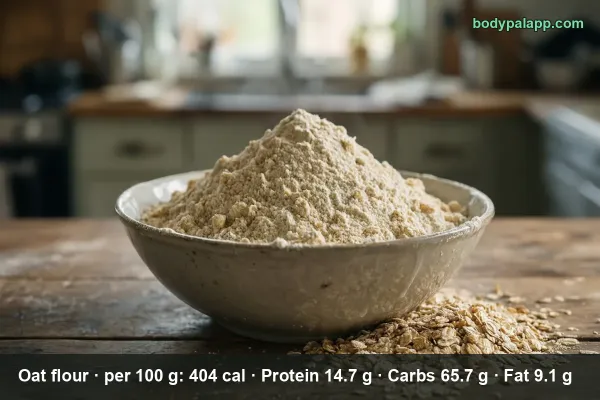
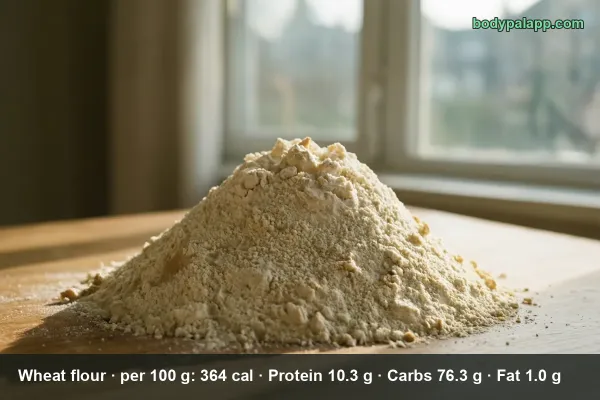
Protein is the standout. A 1/4 cup gives 4 g, which is 8% of the daily value, and 100 g gives 14.3 g, or 29%. That is well above wheat flour at 10.3 g per 100 g and close to oat flour at 14.7 g. It will not replace a protein food, but it nudges up the protein in a muffin or pancake batter.
Fiber adds to the case. There are 7.1 g per 100 g and 2 g per 1/4 cup. The label lists 0 g of sugars and 0 g of saturated fat, so the carbs come from starch and fiber rather than sugar.
Sodium, sugar and cholesterol barely register
Quinoa flour has 29 mg of sodium per 100 g and 8 mg per 1/4 cup, which rounds to 0% of the daily value. Even a full 100 g only reaches 1%. Compare that with coconut flour, which lists 200 mg of sodium per 100 g.
Cholesterol is 0 mg, sugars are 0 g and saturated fat is 0 g on this packaged label. Fat overall stays modest at 1.5 g per 1/4 cup. Few pantry staples look this clean on the lower half of the nutrition panel.
That shifts attention to everything else in the bowl. Salt, baking powder, butter and sugar will move these rows far more than the flour does. If you watch sodium or sugar, check the other ingredients in the recipe first, because the flour itself adds almost nothing to either.
Quinoa flour works best mixed into a blend
Many bakers use quinoa flour alongside other flours rather than on its own, since its earthy, slightly grassy taste can dominate. Swapping part of the wheat flour for quinoa flour barely moves calories: 393 versus 364 per 100 g. Protein rises from 10.3 g to 14.3 g in the same weight.
The trade is a little more fat, 5.4 g against 1 g per 100 g for wheat flour. That still leaves quinoa flour far leaner than coconut flour at 13.3 g of fat and a touch leaner than oat flour at 9.1 g.
On its own, flour is rarely the whole meal. Pancakes, flatbreads or muffins made with it pair well with eggs, Greek yogurt or fruit, which round out protein and add volume. Brands such as Bob's Red Mill, Inca's Gold and Namaste sell it in bags. BodyPal can log the finished dish from a photo if weighing every ingredient feels like too much.
How does quinoa flour compare?
Here is quinoa flour next to coconut, oat and wheat flour, compared per 100 g and per usual serving.
Verdict: For the fewest calories per 100 g, wheat flour wins at 364, though it trails on protein at 10.3 g. For a protein-rich swap that stays low in fat and sodium, pick quinoa flour at 14.3 g protein and 5.4 g fat over oat flour at 9.1 g fat or coconut flour at 200 mg sodium.
Most popular quinoa flour brands in the United States
Ranked by popularity in the BodyPal database
# Productkcal / 100 g
1Bob's Red Mill Whole Grain Quinoa Flour1/4 cup · 28 g393 kcal
2Inca's Gold Organic Quinoa Flour28 g375 kcal
3Namaste Raw Goods Quinoa Flour1/4 cup · 28 g393 kcal
4Livekuna Organic White Quinoa Flour1/4 cup · 28 g375 kcal
5Bob's Red Mill Organic Whole Grain Quinoa Flour1/4 cup · 28 g357 kcal
A quarter cup (28 g) of quinoa flour has about 110 calories, based on 393 calories per 100 g.
Is quinoa flour good for weight loss?
A quarter cup (28 g) has 110 calories with 4.0 g protein and 2.0 g fiber. Per 100 g it has 393 calories and 7.1 g fiber.
Quinoa flour vs oat flour: which has fewer calories?
Quinoa flour has 393 calories per 100 g and oat flour has 404, so quinoa flour is slightly lower.
How much protein is in quinoa flour?
Quinoa flour has 14.3 g protein per 100 g, or 4.0 g per quarter cup (28 g), alongside 18.0 g carbs.
What is the nutritional value of quinoa flour per 100 g?
Per 100 g, quinoa flour has 393 calories, 14.3 g protein, 64.3 g carbs, 5.4 g fat and 7.1 g fiber. The label lists 0 g sugars, 0 g saturated fat and 29 mg sodium.
What are the macros in 1/4 cup of quinoa flour?
A 1/4 cup (28 g) of quinoa flour has 18 g carbs, 4 g protein and 1.5 g fat, for 110 calories. It also gives 2 g fiber, 0 g sugars and 8 mg sodium.
Is quinoa flour higher in calories than regular flour?
Slightly. Quinoa flour has 393 calories per 100 g versus 364 for wheat flour. It also carries more protein, 14.3 g against 10.3 g, and more fat, 5.4 g against 1 g.
Where do the calories in quinoa flour come from?
About 71% of quinoa flour's calories come from carbs, 16% from protein and 13% from fat. Per 100 g that works out to 64.3 g carbs, 14.3 g protein and 5.4 g fat.
How much fiber is in quinoa flour?
Quinoa flour has 7.1 g of fiber per 100 g and 2 g per 1/4 cup (28 g). With 0 g of sugars listed, its carbs come from starch and fiber rather than sugar.